Please wait...

SBI PO 2024-25 Reasoning Test - 6
Menu grid icon
Result Result point icon
SBI PO 2024-25 Reasoning Test - 6
  • Goals icon

    /

    Score
  • Trophy icon

    -

    Rank
White alarm icon Time Taken: -
Result frame illustration
  • Question 1/10
    1 / -0.25

    Directions For Questions

    Directions: Study the following information to answer the given questions.

    Some friends sit around a circular table all facing inside. A sits 5th to the right of R, who sits 7th to the right of D. F sits 3rd to the left of U, who does not sit beside A. P sits to the immediate right of K, who sits 6th to the right of B, who sits beside R. L sits between Q and G. T, who sits immediately between O and D, sits 2nd to the right of J, who sits beside E. S sits to the immediate right of N, who sits 3rd to the left of H. 6 people sit between A and O, who sits 2nd to the left of D. Q sits beside A. I, who sits beside D, has 4 people sitting between him and M. C sits beside H, who sits beside M.

    ...view full instructions


    How many people sit around the table?

    Solutions

    Given:

    1. A sits 5th to the right of R, who sits 7th to the right of D.

    2. 6 people sit between A and O, who sits 2nd to the left of D.

    3. T, who sits immediately between O and D, sits 2nd to the right of J, who sits beside E.

    4. I, who sits beside D, has 4 people sitting between him and M.

    5. P sits to the immediate right of K, who sits 6th to the right of B, who sits beside R.

    6. C sits beside H, who sits beside M.

    7. S sits to the immediate right of N, who sits 3rd to the left of H.

    8. F sits 3rd to the left of U, who does not sit near A.

    9. Q sits beside A

    10. L sits between Q and G.

    Thus, 21 people are sitting around the table.

  • Question 2/10
    1 / -0.25

    Directions For Questions

    Directions: Study the following information to answer the given questions.

    Some friends sit around a circular table all facing inside. A sits 5th to the right of R, who sits 7th to the right of D. F sits 3rd to the left of U, who does not sit beside A. P sits to the immediate right of K, who sits 6th to the right of B, who sits beside R. L sits between Q and G. T, who sits immediately between O and D, sits 2nd to the right of J, who sits beside E. S sits to the immediate right of N, who sits 3rd to the left of H. 6 people sit between A and O, who sits 2nd to the left of D. Q sits beside A. I, who sits beside D, has 4 people sitting between him and M. C sits beside H, who sits beside M.

    ...view full instructions


    Who sits 3rd to the right of the one who sits 7th to the left of the one who sits beside L?

    Solutions

    Given:

    1. A sits 5th to the right of R, who sits 7th to the right of D.

    2. 6 people sit between A and O, who sits 2nd to the left of D.

    3. T, who sits immediately between O and D, sits 2nd to the right of J, who sits beside E.

    4. I, who sits beside D, has 4 people sitting between him and M.

    5. P sits to the immediate right of K, who sits 6th to the right of B, who sits beside R.

    6. C sits beside H, who sits beside M.

    7. S sits to the immediate right of N, who sits 3rd to the left of H.

    8. F sits 3rd to the left of U, who does not sit near A.

    9. Q sits beside A

    10. L sits between Q and G.

    G and Q sit beside L.

    In the case of G, N sits 7th to the left of G.

    In the case of Q, C sits 7th to the left of Q.

    Hence, either R or H sits 3rd to the right of the one who sits 7th to the left of the ones who sit beside L.

  • Question 3/10
    1 / -0.25

    Directions For Questions

    Directions: Study the following information to answer the given questions.

    Some friends sit around a circular table all facing inside. A sits 5th to the right of R, who sits 7th to the right of D. F sits 3rd to the left of U, who does not sit beside A. P sits to the immediate right of K, who sits 6th to the right of B, who sits beside R. L sits between Q and G. T, who sits immediately between O and D, sits 2nd to the right of J, who sits beside E. S sits to the immediate right of N, who sits 3rd to the left of H. 6 people sit between A and O, who sits 2nd to the left of D. Q sits beside A. I, who sits beside D, has 4 people sitting between him and M. C sits beside H, who sits beside M.

    ...view full instructions


    Who sits to the immediate right of the one who sits 11th to the left of N?

    Solutions

    Given:

    1. A sits 5th to the right of R, who sits 7th to the right of D.

    2. 6 people sit between A and O, who sits 2nd to the left of D.

    3. T, who sits immediately between O and D, sits 2nd to the right of J, who sits beside E.

    4. I, who sits beside D, has 4 people sitting between him and M.

    5. P sits to the immediate right of K, who sits 6th to the right of B, who sits beside R.

    6. C sits beside H, who sits beside M.

    7. S sits to the immediate right of N, who sits 3rd to the left of H.

    8. F sits 3rd to the left of U, who does not sit near A.

    9. Q sits beside A

    10. L sits between Q and G.

    A sits 11th to the left of N.

    Hence, F sits to the immediate right of A.

  • Question 4/10
    1 / -0.25

    Directions For Questions

    Directions: Study the following information to answer the given questions.

    Some friends sit around a circular table all facing inside. A sits 5th to the right of R, who sits 7th to the right of D. F sits 3rd to the left of U, who does not sit beside A. P sits to the immediate right of K, who sits 6th to the right of B, who sits beside R. L sits between Q and G. T, who sits immediately between O and D, sits 2nd to the right of J, who sits beside E. S sits to the immediate right of N, who sits 3rd to the left of H. 6 people sit between A and O, who sits 2nd to the left of D. Q sits beside A. I, who sits beside D, has 4 people sitting between him and M. C sits beside H, who sits beside M.

    ...view full instructions


    Who sits immediately between M and B?

    Solutions

    Given:

    1. A sits 5th to the right of R, who sits 7th to the right of D.

    2. 6 people sit between A and O, who sits 2nd to the left of D.

    3. T, who sits immediately between O and D, sits 2nd to the right of J, who sits beside E.

    4. I, who sits beside D, has 4 people sitting between him and M.

    5. P sits to the immediate right of K, who sits 6th to the right of B, who sits beside R.

    6. C sits beside H, who sits beside M.

    7. S sits to the immediate right of N, who sits 3rd to the left of H.

    8. F sits 3rd to the left of U, who does not sit near A.

    9. Q sits beside A

    10. L sits between Q and G.

    Hence, R sits between M and B.

  • Question 5/10
    1 / -0.25

    Directions For Questions

    Directions: Read the following instructions and answer the given questions.

    Two Luxury Buses B and Z start their journey from different cities S and U respectively to reach city A. They came across various small towns during their journey.

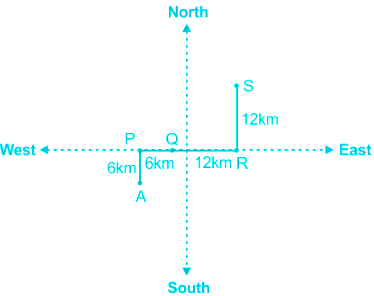
    Bus B starts moving 12 km in the south direction to reach town R then takes a right turn and moves 18 km to reach town P, then takes a left turn and moves 6 km to reach city A. Towns P, Q, and R lie in the same line, and the distance between P and Q is half of the distance between towns Q and R, city Q lies between P and R.

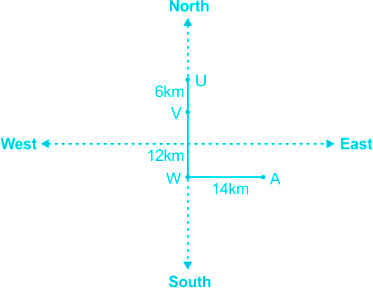
    Bus Z starts to move 18 km toward the south and reaches town W, then takes a left turn and moves 2 km more than the distance between towns Q and R to reach city A. Town V lies between U and W. The distance between V and W is double the distance between U and V.

    ...view full instructions


    What is the direction Bus Z facing when reached to city A?

    Solutions

    Given:-

    Luxury Bus B - start from City S to reach City A

    Luxury Bus Z - start from City U to reach City A

    Now,

    Journey of Bus B:

    1) Bus B starts moving 12 km in the south direction to reach town R then takes a right turn and moves 18 km to reach town P, then takes a left turn and moves 6 km to reach city A. Bus B starts moving from city S 12 km in the south direction.

    2) Towns P, Q, and R lie in the same line, and the distance between P and Q is half of the distance between towns Q and R. 

    It means PR = PQ + QR and PQ = QR/2. Also PR = 18 km. So,

    18 = QR/2 + QR

    18 = (QR + 2QR)/2

    36 = 3QR

    QR = 36/3 = 12 km.

    PQ = QR/2 = 12/2 = 6 km.
    Journey of Bus Z:

    1) Bus Z starts to move 18 km toward the south and reaches town W, then takes a left turn and moves 2 km more than the distance between towns Q and R to reach city A. Bus Z starts moving from city U 18 km in the south direction. Distance between Q ad R = 12 km. 2 km more means 12 + 2 = km is the distance between town W and city A. 

    2) Town V lies between U and W. It means UW = UV + VW

    3) The distance between V and W is double the distance between U and V. It means VW = 2(UV)

    So, UW = UV + 2(UV)

    18 = 3(UV)

    UV = 6 km

    VW = 12 km
    Combining the  journey of bus B and Z, we get,
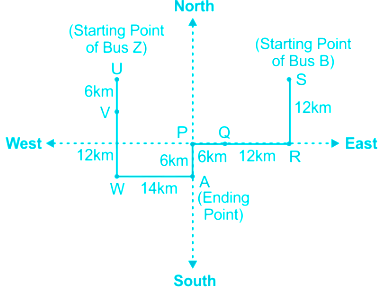
    Bus Z when reached city A was facing the East direction.

    Hence, the correct answer is East.

  • Question 6/10
    1 / -0.25

    Directions For Questions

    Directions: Read the following instructions and answer the given questions.

    Two Luxury Buses B and Z start their journey from different cities S and U respectively to reach city A. They came across various small towns during their journey.

    Bus B starts moving 12 km in the south direction to reach town R then takes a right turn and moves 18 km to reach town P, then takes a left turn and moves 6 km to reach city A. Towns P, Q, and R lie in the same line, and the distance between P and Q is half of the distance between towns Q and R, city Q lies between P and R.

    Bus Z starts to move 18 km toward the south and reaches town W, then takes a left turn and moves 2 km more than the distance between towns Q and R to reach city A. Town V lies between U and W. The distance between V and W is double the distance between U and V.

    ...view full instructions


    If Town T lies between U and S exactly midway, then what is the distance between T and the starting point of bus B?

    Solutions

    Given:-

    Luxury Bus B - start from City S to reach City A

    Luxury Bus Z - start from City U to reach City A

    Now, 

    Journey of Bus B:

    1) Bus B starts moving 12 km in the south direction to reach town R then takes a right turn and moves 18 km to reach town P, then takes a left turn and moves 6 km to reach city A. Bus B starts moving from city S 12 km in the south direction.

    2) Towns P, Q, and R lie in the same line, and the distance between P and Q is half of the distance between towns Q and R. 

    It means PR = PQ + QR and PQ = QR/2. Also PR = 18 km. So,

    18 = QR/2 + QR

    18 = (QR + 2QR)/2

    36 = 3QR

    QR = 36/3 = 12 km.

    PQ = QR/2 = 12/2 = 6 km.

    Journey of Bus Z:

    1) Bus Z starts to move 18 km toward the south and reaches town W, then takes a left turn and moves 2 km more than the distance between towns Q and R to reach city A. Bus Z starts moving from city U 18 km in the south direction. Distance between Q ad R = 12 km. 2 km more means 12 + 2 = km is the distance between town W and city A. 

    2) Town V lies between U and W. It means UW = UV + VW

    3) The distance between V and W is double the distance between U and V. It means VW = 2(UV)

    So, UW = UV + 2(UV)

    18 = 3(UV)

    UV = 6 km

    VW = 12 km

    Combining the  journey of bus B and Z, we get,

    If town T lies between U and S exactly midway, then

    Distance between T and the starting point of bus B = Distance between T and S = 16 km.

    Hence, the correct answer is 16 km.

  • Question 7/10
    1 / -0.25

    Directions For Questions

    Directions: Read the following instructions and answer the given questions.

    Two Luxury Buses B and Z start their journey from different cities S and U respectively to reach city A. They came across various small towns during their journey.

    Bus B starts moving 12 km in the south direction to reach town R then takes a right turn and moves 18 km to reach town P, then takes a left turn and moves 6 km to reach city A. Towns P, Q, and R lie in the same line, and the distance between P and Q is half of the distance between towns Q and R, city Q lies between P and R.

    Bus Z starts to move 18 km toward the south and reaches town W, then takes a left turn and moves 2 km more than the distance between towns Q and R to reach city A. Town V lies between U and W. The distance between V and W is double the distance between U and V.

    ...view full instructions


    A person wants to go to city A and starts driving north from town W after reaching point V he suddenly realizes that he is going in the wrong direction. So what will be the shortest route from the following options from town V to city A?

    Solutions

    Given:-

    Luxury Bus B - start from City S to reach City A

    Luxury Bus Z - start from City U to reach City A

    Now, 

    Journey of Bus B:

    1) Bus B starts moving 12 km in the south direction to reach town R then takes a right turn and moves 18 km to reach town P, then takes a left turn and moves 6 km to reach city A. Bus B starts moving from city S 12 km in the south direction.

    2) Towns P, Q, and R lie in the same line, and the distance between P and Q is half of the distance between towns Q and R. 

    It means PR = PQ + QR and PQ = QR/2. Also PR = 18 km. So,

    18 = QR/2 + QR

    18 = (QR + 2QR)/2

    36 = 3QR

    QR = 36/3 = 12 km.

    PQ = QR/2 = 12/2 = 6 km.

    Journey of Bus Z:

    1) Bus Z starts to move 18 km toward the south and reaches town W, then takes a left turn and moves 2 km more than the distance between towns Q and R to reach city A. Bus Z starts moving from city U 18 km in the south direction. Distance between Q ad R = 12 km. 2 km more means 12 + 2 = km is the distance between town W and city A. 

    2) Town V lies between U and W. It means UW = UV + VW

    3) The distance between V and W is double the distance between U and V. It means VW = 2(UV)

    So, UW = UV + 2(UV)

    18 = 3(UV)

    UV = 6 km

    VW = 12 km

    Combining the  journey of bus B and Z, we get,

    The shortest route from the following from town V to city A -

    1) Back to town W then go to city A from there → VW + WA = 12 + 14 = 26 km

    2) From town V he should go 14 km in the east direction and then move south to reach city A → 14 + 6 + 6 = 26 km

    3) From town V he should go north to reach point U from there, he should reach town S, then town R, then P, and then city A. → 6 + 32 + 12 + 18 + 6 = 74 km.

    Both 1) and 2) are equal and shortest routes.

    Hence, the correct answer is BBack to town W then go to city A from there.

  • Question 8/10
    1 / -0.25

    In the following question assuming the given statements to be True, find which of the conclusion among given conclusions is/are definitely true and then give your answers accordingly.

    Statements: O > F ≥ E; K < L ≤ Q; P = L; E > P; Z ≥ Q

    Conclusions:

    I. K < O

    II. F > P

    III. O ≤ Z

    Solutions

    Given statements: O > F ≥ E; K < L ≤ Q; P = L; E > P; Z ≥ Q

    On combining: Z ≥ Q ≥ L = P > K; O > F ≥ E > L = P

    Conclusions:

    I. K < O → True (O > F ≥ E > L = P and L = P > K → O > K)

    II. F > P → True (F ≥ E > L = P → F > P)

    III. O ≤ Z → False (Z ≥ Q ≥ L = P and O > F ≥ E > L = P → relation between O and Z cannot be determined.)

    Thus, both conclusions I and II are true.

  • Question 9/10
    1 / -0.25

    In the following question assuming the given statements to be True, find which of the conclusion among given conclusions is/are definitely true and then give your answers accordingly.

    Statements: R ≤ D ≤ X; K > V ≥ I; R = O ≥ K       

    Conclusions:

    I. D ≤ V

    II. X > K

    III. I < O

    Solutions

    Given statements: R ≤ D ≤ X; K > V ≥ I; R = O ≥ K      

    On combining: X ≥ D ≥ R = O ≥ K > V ≥ I

    Conclusions:

    I. D ≤ V → False (D > R = O ≥ K > V → D > V)

    II. X > K → False (X ≥ D > R = O ≥ K → X > K)

    III. I < O → True (O ≥ K > V ≥ I → O > I)

    Thus, Only III is True.

  • Question 10/10
    1 / -0.25

    In the following question assuming the given statements to be True, find which of the conclusion among given conclusions is/are definitely true and then give your answers accordingly.

    Statements: Y > Z ≤ X; W > V ≥ U; U = X       

    Conclusions:

    I. U ≥ Z

    II. Y < V

    III. W > X

    Solutions

    Given statements: Y > Z ≤ X; W > V ≥ U; U = X

    On combining: W > V ≥ U = X ≥ Z; Y > Z

    Conclusions:

    I. U ≥ Z → True (U = X ≥ Z → U ≥ Z)

    II. Y < V → False (Y > Z and V ≥ U = X ≥ Z → relation between Y and V cannot be determined.)

    III. W > X → True (W > V ≥ U = X → W > X)

    Thus, both conclusions I and III are true.

Close button icon
User Profile
-

Correct (-)

Wrong (-)

Skipped (-)


  • 1
  • 2
  • 3
  • 4
  • 5
  • 6
  • 7
  • 8
  • 9
  • 10
Mockers logo Get latest Exam Updates
& Study Material Alerts!
No, Thanks
Arrow pointer icon
Click on Allow to receive notifications
Notification bell icon ×
Open Now