Please wait...
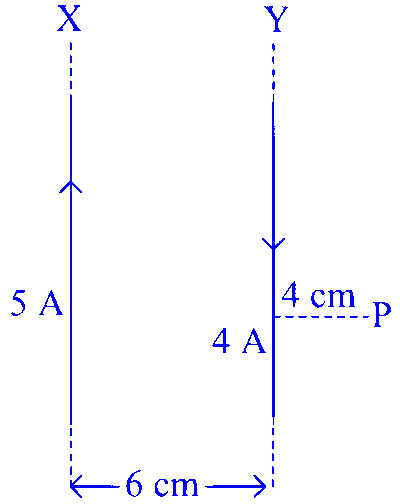
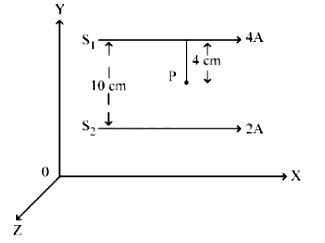
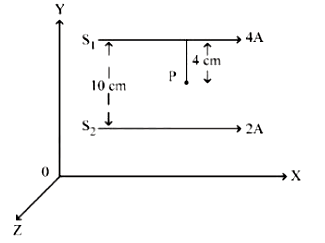
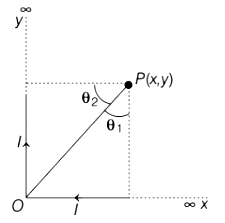
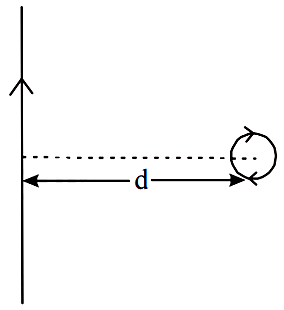
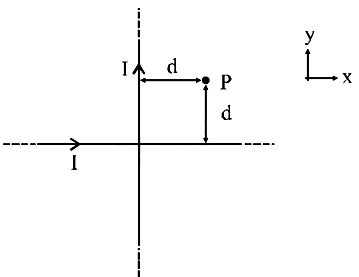
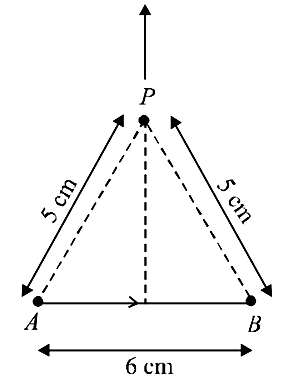
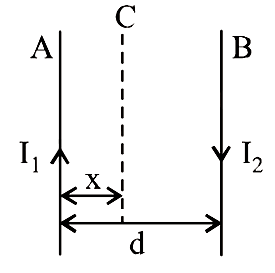
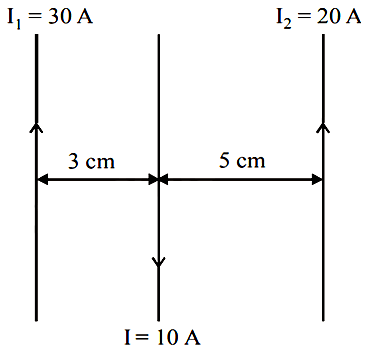
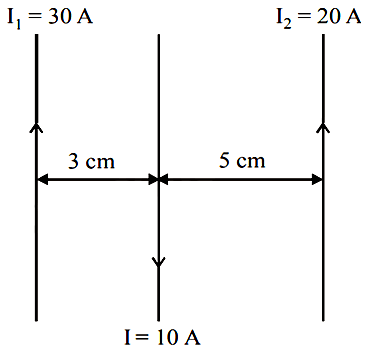
Two long parallel wires $X$ and $Y$, separated by a distance of 6 cm , carry currents of 5 A and 4A, respectively, in opposite directions as shown in the figure. Magnitude of the resultant magnetic field at point P at a distance of 4 cm from wire Y is $x \times 10^{-5} \mathrm{~T}$. The value of $x$ is _________ . Take permeability of free space as $\mu_0=4 \pi \times 10^{-7}$ SI units.
A proton is moving undeflected in a region of crossed electric and magnetic fields at a constant speed of $2 \times 10^5 \mathrm{~ms}^{-1}$. When the electric field is switched off, the proton moves along a circular path of radius 2 cm . The magnitude of electric field is $x \times 10^4 \mathrm{~N} / \mathrm{C}$. The value of $x$ is _________. Take the mass of the proton $=1.6 \times 10^{-27} \mathrm{~kg}$.
A current of 5 A exists in a square loop of side $\frac{1}{\sqrt{2}} \mathrm{~m}$. Then the magnitude of the magnetic field $B$ at the centre of the square loop will be $p \times 10^{-6} \mathrm{~T}$. where, value of p is ________ $\left[\right.$ Take $\mu_0=4 \pi \times 10^{-7} \mathrm{~T} \mathrm{~mA}^{-1}$ ].
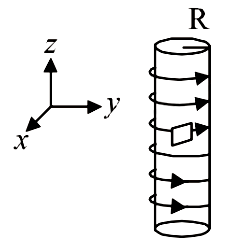
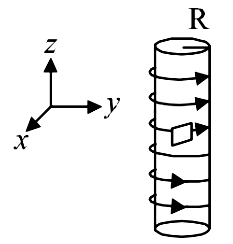
A tightly wound long solenoid carries a current of 1.5 A . An electron is executing uniform circular motion inside the solenoid with a time period of 75 ns . The number of turns per metre in the solenoid is _________.
[Take mass of electron $\mathrm{m}_{\mathrm{e}}=9 \times 10^{-31} \mathrm{~kg}$, charge of electron $\left|\mathrm{q}_{\mathrm{e}}\right|=1.6 \times 10^{-19} \mathrm{C}$,$$\left.\mu_0=4 \pi \times 10^{-7} \frac{\mathrm{~N}}{\mathrm{~A}^2}, 1 \mathrm{~ns}=10^{-9} \mathrm{~s}\right]$$
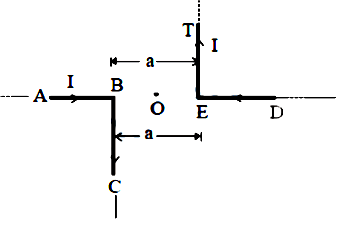
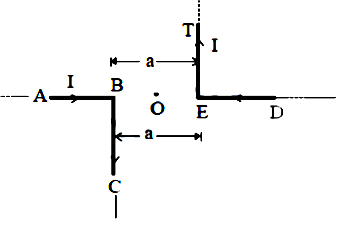
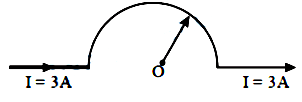
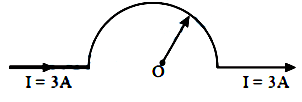
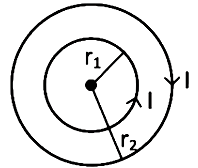
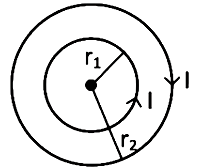
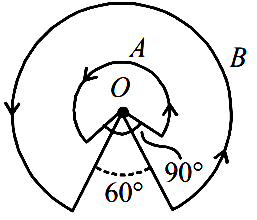
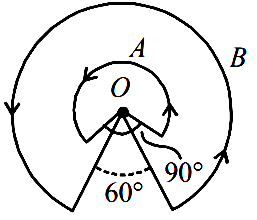
A loop ABCDA , carrying current $\mathrm{I}=12 \mathrm{~A}$, is placed in a plane, consists of two semi-circular segments of radius $R_1=6 \pi \mathrm{~m}$ and $\mathrm{R}_2=4 \pi \mathrm{~m}$. The magnitude of the resultant magnetic field at center O is $\mathrm{k} \times 10^{-7} \mathrm{~T}$. The value of k is_________.( Given $\mu_0=4 \pi \times 10^{-7} \mathrm{Tm} \mathrm{A}^{-1}$ )
If an optical medium possesses a relative permeability of $\frac{10}{\pi}$ and relative permittivity of $\frac{1}{0.0885}$, then the velocity of light is greater in vacuum than that in this medium by _________ times.
$$\left(\mu_0=4 \pi \times 10^{-7} \mathrm{H} / \mathrm{m}, \epsilon_0=8.85 \times 10^{-12} \mathrm{~F} / \mathrm{m}, \mathrm{c}=3 \times 10^8 \mathrm{~m} / \mathrm{s}\right)$$
An electron projected perpendicular to a uniform magnetic field B moves in a circle. If Bohr's quantization is applicable, then the radius of the electronic orbit in the first excited state is :
A long straight wire of a circular cross-section with radius ' a ' carries a steady current I . The current I is uniformly distributed across this cross-section. The plot of magnitude of magnetic field B with distance $r$ from the centre of the wire is given by
Given below are two statements. One is labelled as Assertion (A) and the other is labelled as Reason (R).
Assertion (A) : A electron in a certain region of uniform magnetic field is moving with constant velocity in a straight line path.
Reason (R) : The magnetic field in that region is along the direction of velocity of the electron. In the light of the above statements, choose the correct answer from the options given below :
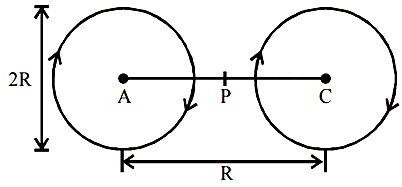
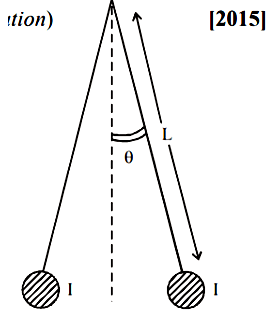
N equally spaced charges each of value q , are placed on a circle of radius R . The circle rotates about its axis with an angular velocity $\omega$ as shown in the figure. A bigger Amperian loop B encloses the whole circle where as a smaller Amperian loop A encloses a small segment. The difference between enclosed currents, $I_A-I_B$, for the given Amperian loops is
Consider a long thin conducting wire carrying a uniform current I. A particle having mass "M" and charge " $q$ " is released at a distance " $a$ " from the wire with a speed $v_0$ along the direction of current in the wire. The particle gets attracted to the wire due to magnetic force. The particle turns round when it is at distance $x$ from the wire. The value of $x$ is [ $\mu_0$ is vacuum permeability]
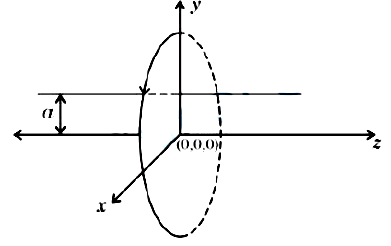
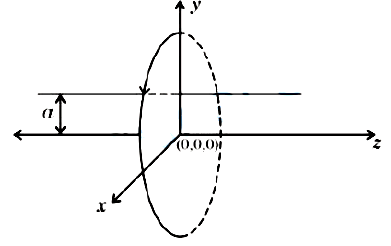
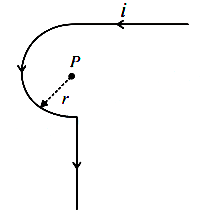
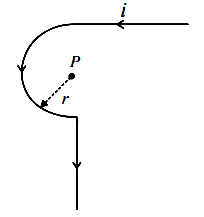
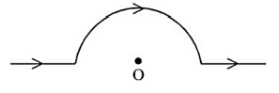
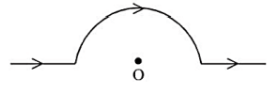
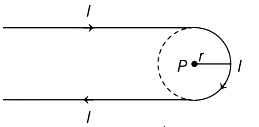
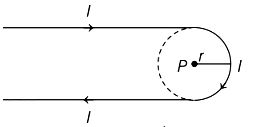
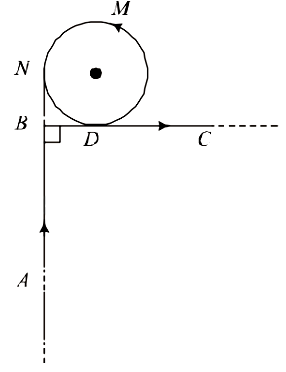
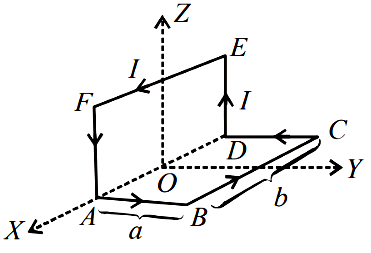
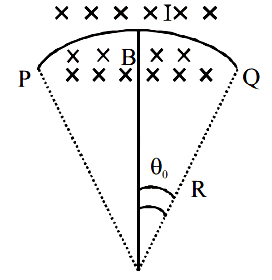
An infinite wire has a circular bend of radius a, and carrying a current I as shown in the figure. The magnitude of magnetic field at the origin O of the arc is given by:
Consider a long straight wire of a circular cross-section (radius a) carrying a steady current I. The current is uniformly distributed across this cross-section. The distances from the centre of the wire’s cross-section at which the magnetic field [inside the wire, outside the wire] is half of the maximum possible magnetic field, any where due to the wire, will be :
Let $B_1$ be the magnitude of magnetic field at center of a circular coil of radius $R$ carrying current I. Let $\mathrm{B}_2$ be the magnitude of magnetic field at an axial distance ' $x$ ' from the center. For $x: \mathrm{R}=3: 4, \frac{\mathrm{~B}_2}{\mathrm{~B}_1}$ is :
In a moving coil galvanometer, two moving coils $\mathrm{M}_1$ and $\mathrm{M}_2$ have the following particulars :
$$ \begin{aligned} & \mathrm{R}_1=5 \Omega, \mathrm{~N}_1=15, \mathrm{~A}_1=3.6 \times 10^{-3} \mathrm{~m}^2, \mathrm{~B}_1=0.25 \mathrm{~T} \\ & \mathrm{R}_2=7 \Omega, \mathrm{~N}_2=21, \mathrm{~A}_2=1.8 \times 10^{-3} \mathrm{~m}^2, \mathrm{~B}_2=0.50 \mathrm{~T} \end{aligned} $$
Assuming that torsional constant of the springs are same for both coils, what will be the ratio of voltage sensitivity of $M_1$ and $M_2$ ?
Given below are two statements: one is labelled as $\mathbf{A s s e r t i o n} \mathbf{A}$ and the other is labelled as Reason $\mathbf{R}$
Assertion A : If Oxygen ion $\left(\mathrm{O}^{-2}\right)$ and Hydrogen ion $\left(\mathrm{H}^{+}\right)$enter normal to the magnetic field with equal momentum, then the path of $\mathrm{O}^{-2}$ ion has a smaller curvature than that of $\mathrm{H}^{+}$.
Reason R : A proton with same linear momentum as an electron will form a path of smaller radius of curvature on entering a uniform magnetic field perpendicularly.
In the light of the above statements, choose the correct answer from the options given below
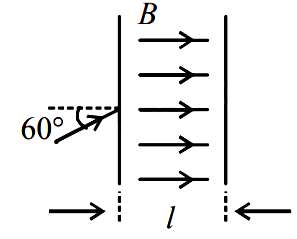
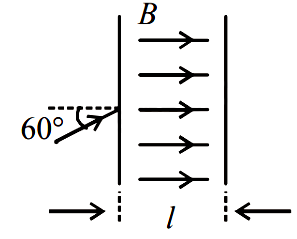
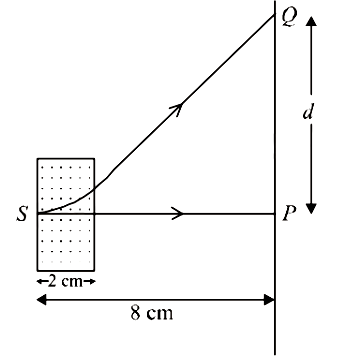
Uniform magnetic fields of different strengths $\left(B_1\right.$ and $\left.B_2\right)$, both normal to the plane of the paper exist as shown in the figure. A charged particle of mass $m$ and charge $q$, at the interface at an instant, moves into the region 2 with velocity $v$ and returns to the interface. It continues to move into region 1 and finally reaches the interface. What is the displacement of the particle during this movement along the interface?
(Consider the velocity of the particle to be normal to the magnetic field and $\mathrm{B}_2>\mathrm{B}_1$ )
A particle of charge $q$, mass $m$ and kinetic energy $E$ enters in magnetic field perpendicular to its velocity and undergoes a circular arc of radius (r). Which of the following curves represents the variation of $r$ with $E$ ?
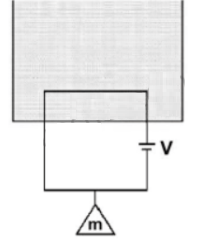
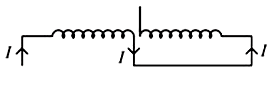
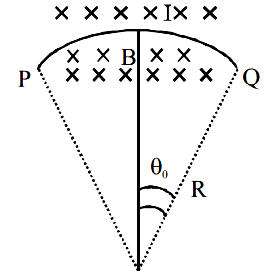
Figure shows a current carrying square loop ABCD of edge length is ‘a’ lying in a plane. If the resistance of the ABC part is r and that of ADC part is 2r, then the magnitude of the resultant magnetic field at centre of the square loop is



 ×
×
 Bank
Bank


 SSC
SSC


 Railway


 State
State


 Other
Other


 Teaching


 Insurance


 Medical


 Engineering


 Defence


 GATE
GATE


 NTA CUET

 UPSC
UPSC

 MBA Entrance


 LAW
LAW

 ReNEET UG 2026
 SSC Selection Post (Phase 14) 2026
 RRB NTPC 2026
 SSC CGL Tier-I 2026
 SSC JE 2026
 SBI PO Prelims 2026
 SSC Steno Grade C & D 2026
 SBI Clerk Prelims 2026
 IBPS PO Prelims 2026
 IBPS Clerk Prelims 2026
 SSC CPO Tier I 2026
 NDA II 2026
 CDS II 2026







 Get latest Exam Updates