Choose right statement of flows :
(1) Referred yearly or monthly
(2) Time period is not mentioned
(3) Defined at a particular point of time
(4) Over a period of time
The statement "Over a period of time" implies that the flows are measured and considered over a specific duration, indicating a temporal aspect. This could refer to various types of flows, such as financial transactions, data movement, or any other measurable quantity that occurs and is observed or recorded over a specified timeframe. The term "over a period of time" suggests a continuous or cumulative assessment of the flows, making it the most suitable option among the given choices.
The process of selling off part of equity of PSE is called :
(1) Nationalisation
(2) Disinvestment
(3) Restructuring
(4) Shutting down
The term "disinvestment" is used to describe the process of selling off or divesting a part of the government's equity or ownership in a public sector enterprise (PSE). Governments may choose to undertake disinvestment for various reasons, including raising funds, improving the efficiency of the enterprise, encouraging private sector participation, or achieving other economic and strategic objectives.
When a government engages in disinvestment, it typically involves the sale of shares of a PSE to private investors or the public. This can be done through methods such as public offerings, strategic sales, or other financial instruments. Disinvestment is a strategic economic decision that governments make to manage their portfolio of assets and optimize the functioning of the public sector.
Which is not a part of progress of china ?
(1) Great leap forward
(2) One child norm
(3) Capitalist economy
(4) Commune system
China: After the establishment of People’s Republic of China under one party rule, all critical sectors of the economy, enterprises and lands owned and operated by individuals were brought under government control. The Great Leap Forward (GLF) campaign initiated in 1958 aimed at industrialising the country on a massive scale. People were encouraged to set up industries in their backyards. In rural areas, communes were started. Under the Commune system, people collectively cultivated lands. In 1958, there were 26,000 communes covering almost all the farm population. GLF campaign met with many problems. A severe drought caused havoc in China killing about 30 million people. When Russia had conflicts with China, it withdrew its professionals who had earlier been sent to China to help in the industrialisation process. In 1965, Mao introduced the Great Proletarian Cultural Revolution (1966–76) under which students and professionals were sent to work and learn from the countryside.
One of the following function is performed by the government it if intervenes either to expand demand or to reduce it. Select the correct answer
(1) Allocation function
2) Redistribution function
(3) Stabilisation function
(4) Public provision
The government's stabilization function is associated with macroeconomic policy measures aimed at stabilizing the overall economy. Here's the reasoning:
1. Expansionary Policies: When the government intervenes to expand demand, it typically employs expansionary fiscal or monetary policies. For example, during economic downturns or recessions, the government may increase government spending, reduce taxes, or implement monetary policies to boost demand and stimulate economic activity. This helps to counteract high unemployment and sluggish economic growth.
2. Contractionary Policies: Conversely, when the government intervenes to reduce demand, it often implements contractionary fiscal or monetary policies. This might involve cutting government spending, increasing taxes, or implementing monetary measures to cool down an overheating economy. This helps to address issues such as inflation and prevent the economy from growing too quickly.
3. Stabilizing Economic Fluctuations: By adjusting demand through these policies, the government aims to stabilize economic fluctuations and maintain a balance in the economy. This is part of the stabilization function, which is crucial for promoting long-term economic growth and preventing severe economic downturns.
In summary, the government's intervention to either expand or reduce demand is associated with its stabilization function, which is aimed at maintaining overall economic stability.
China's Economic Development-Polices implemented - Arrange in order
(A) Great leap forward
(B) Nationalization of Enterprises and Land
(C) Great Proletarian Cultural Revolution
(D) Five year plan
(E) Special Economic Zone
Choose the correct answer from the options given below :
(1) (B), (C), (A), (D), (E)
(2) (B), (A), (D), (C), (E)
(3) (B), (D), (A), (C), (E)
(4) (A), (Ε), (B), (D), (C)
Here's the reasoning behind the order:
1. Great Leap Forward (A): This was an economic and social campaign initiated by the Chinese Communist Party (CCP) from 1958 to 1962. It aimed to rapidly transform China from an agrarian society into a socialist society through rapid industrialization and collectivization.
2.Special Economic Zone (E):The creation of Special Economic Zones (SEZs) began in the late 1970s as part of China's economic reforms under Deng Xiaoping. These zones were designated areas where foreign investment and business could occur with fewer restrictions, contributing significantly to China's economic growth.
3.Nationalization of Enterprises and Land (B): This refers to the period of land and enterprise nationalization that occurred after the establishment of the People's Republic of China in 1949. The state took control of various industries and redistributed land as part of the larger socialist agenda.
4. Five-Year Plan (D): China has implemented several Five-Year Plans as part of its centralized economic planning. These plans outline specific economic targets and goals for the country to achieve over a five-year period. The Five-Year Plans have been a consistent feature of China's economic development strategy.
5. Great Proletarian Cultural Revolution (C): This was a socio-political movement initiated by Mao Zedong in 1966, aiming to preserve Chinese communism by purging remnants of capitalist and traditional elements from society. It had a profound impact on Chinese society and resulted in significant economic disruption.
GDP at factor cost may be derived from using one of the following formula. Choose the corre
(1) GDP FC=GDP MP - NFIA
(2) GDP FC=GDP MP-NIT
(3) GDP FC=GDP MP - Depr
(4) GDP FC=GDP MP + NFIA
The correct formula for deriving GDP at factor cost (GDPFC) is:
(2) GDPFC = GDPMP - NIT
Here's the breakdown of the terms:
- GDPFC: GDP at factor cost
- GDPMP: Gross Domestic Product at market prices
- NIT: Net Indirect Taxes
The formula subtracts net indirect taxes from GDP at market prices to obtain GDP at factor cost.
Make a correct chronological sequence of following.
(A) Establishment of TISCO
(B) First Population census
(C) Zamindari system
(D) Opening of Suez canal
(E) Introduction of railways
Choose the correct answer from the options given below :
(1) (A), (B), (C), (D), (E)
(2) (B), (A), (C), (D), (E)
(3) (C), (D), (Ε), (A), (B)
(4) (C), (E), (D), (B), (A
Apologies for the confusion in my previous response. Here's the correct chronological sequence:
(4) (C), (E), (D), (B), (A)
1. Zamindari system (C): The zamindari system was a historical land revenue system that was present during the Mughal era and continued under British rule.
2. Introduction of railways (E):The introduction of railways in India began in the mid-19th century, with the first train running in 1853. Railways played a crucial role in transforming transportation and communication in India.
3. Opening of Suez Canal (D): The Suez Canal opened in 1869, providing a crucial maritime route connecting the Mediterranean Sea to the Red Sea. This had significant implications for global trade and transportation.
4. First Population census (B): The first population census in India took place in 1872. It was conducted during British rule and provided demographic data for policymaking and administration.
5. Establishment of TISCO (A):Tata Iron and Steel Company (TISCO) was established in 1907, marking a significant milestone in India's industrial development.
So, the correct chronological order is (C), (E), (D), (B), (A).
Borrowings in government budget shows ___ deficit
Primary
Revenue
Fiscal
Secondary
While Fiscal Deficit represents the government's total borrowing including interest payments, Primary Deficit shows the amount of borrowing excluding interest payments.Primary Deficit shows the amount of government borrowings specifically to meet the expenses by removing the interest payments.
Which is not a part of money supply ?
Reserve money
E-wallets
Saving deposit
Recurring deposit
(D) Recurring deposits
The reason for this is that while saving deposits and e-wallets are both forms of money, recurring deposits are not. A recurring deposit is a type of fixed deposit account offered by banks, where a fixed amount is deposited at regular intervals, such as monthly or quarterly. While recurring deposits can be a useful tool for saving money, they are not considered part of the money supply, as they are not immediately available for spending and do not circulate as currency. The money supply refers to the total amount of money in circulation, including cash, checking account balances, and other forms of easily accessible funds
In the production of sugar, sugarcane is
(3) Intermediate goods are unfinished goods that are used as input for further processing. For example, Sugarcane is an intermediate good in the manufacture of Sugar. Goods can be classified into various types based on different criteria. Here are some common types of goods:
1.Consumer Goods:
-Durable Goods These are goods that have a long lifespan and are used over an extended period, such as cars, appliances, and furniture.
- Non-Durable Goods: These are goods meant for immediate consumption and have a short lifespan, such as food, toiletries, and clothing.
2. Capital Goods
Industrial Goods: These are goods used in the production of other goods and services, such as machinery, tools, and equipment.
Business Goods:Goods purchased by organizations for use in their operations, including office supplies and machinery.
3. Intermediate Goods - These are goods used in the production process but are not the final product. They are consumed or transformed during the production of other goods.
4. Inferior Goods: - These are goods for which demand increases as consumer incomes fall. Examples may include generic or store-brand products.
5. Normal Goods - These are goods for which demand increases as consumer incomes rise. They include most goods and services.
Direct tax is called direct because it is collected directly from
Producer
Seller
Buyer
Income earners
The term "direct tax" is used because these taxes are levied directly on individuals or entities and the burden of the tax cannot be shifted to someone else. Here's the reasoning behind why direct taxes are called "direct" and why they are collected from income earners:
1. Imposed on Income and Wealth: Direct taxes are typically imposed on the income, profits, or wealth of individuals and businesses. Examples include income tax, corporate tax, and property tax.
2. Paid by the Taxpayer:The burden of a direct tax falls directly on the taxpayer. In the case of income tax, for example, individuals are required to pay a percentage of their income as tax. The taxpayer cannot transfer this burden to someone else.
3.Collected from Income Earners:Since direct taxes are primarily based on income, they are collected from those who earn income. This includes individuals, businesses, and other entities that generate taxable income.
4. Not Passed On to Others: Unlike indirect taxes (such as sales tax or value-added tax), where the burden can be passed on to the consumers in the form of higher prices, direct taxes cannot be shifted. They are borne by the entity on which the tax is levied.
So, the term "direct tax" emphasizes the direct relationship between the government and the individual or entity being taxed, and it reflects that the tax is collected directly from the income earners or wealth holders.
Arrange the correct sequence according to the year of Establishment/Commencement.
(A) Niti Aayog
(B) First five year plan
(C) Planning Commission
(D) Period of Plan holiday
(E) Foundation of British colonial rule in India
Choose the correct answer from the options given below :
(1) (E), (C), (B), (D), (A)
(2) (C), (B), (D), (E), (A)
(3) (E), (B), (C), (A), (D)
(4) (B), (C), (D), (E), (A)
(1) (E), (C), (B), (D), (A)
Foundation of British colonial rule in India (E): This began in the mid-18th century.
First five-year plan (B): The planning process in India officially began with the initiation of the first five-year plan in 1951.
Planning Commission (C): The Planning Commission was established in 1950 to formulate and implement five-year plans.
Niti Aayog (A): Niti Aayog replaced the Planning Commission in 2015.
Period of Plan holiday (D): The "Plan holiday" refers to a brief period in the early 1970s when the planning process was temporarily halted, and the country operated without a formal five-year plan. 1966-69
So, the correct sequence is (E), (C), (B), (D), (A).
The aim of the instruments that initiated to improve the marketing aspect is :
(1) To increase income inequalities
(2) To increase the national income
(3) Providing the food grains at a subsidised price to the poor
(4) Providing the food grains at a higher price
The reason behind providing food grains at a subsidized price to the poor, as part of instruments to improve the marketing aspect, is primarily rooted in addressing issues related to food security and poverty alleviation. Here's the reasoning:
Poverty Alleviation: Subsidized prices for essential food grains help alleviate the financial burden on low-income individuals and families. By providing these goods at lower prices, it becomes more affordable for economically disadvantaged segments of the population.
Food Security: Ensuring that all individuals have access to an adequate and nutritious diet is a fundamental aspect of food security. Subsidized food grains aim to make staple food items accessible to a broader population, particularly those who might struggle to afford them at regular market prices.
Social Welfare: Such initiatives are often part of broader social welfare programs, intending to improve the overall well-being of the population, especially the economically vulnerable groups.
Market Stability: Subsidies can also play a role in stabilizing food prices in the market. By ensuring that there is a consistent demand for essential food items, these programs contribute to market stability.
In summary, providing food grains at a subsidized price to the poor is a policy instrument designed to address issues of poverty, food security, and overall social welfare, contributing to the improvement of the marketing aspect with a focus on inclusivity and affordability.
Match List – I with List – II
| List – I | List – II |
|---|---|
| (A) Goods used in production process and are durable in character | (I) Intermediate goods |
| (B) Inputs for production | (II) Flows |
| (C) Machines in a factory | (III) Capital goods |
| (D) Annual profits | (IV) Stocks |
Choose the correct answer from the options given below:
(1) (A)–(I), (B)–(II), (C)–(III), (D)–(IV)
(2) (A)–(I), (B)–(III), (C)–(II), (D)–(IV)
(3) (A)–(I), (B)–(III), (C)–(IV), (D)–(II)
(4) (A)–(III), (B)–(I), (C)–(IV), (D)–(II)
The correct match is:
(4) (A)-(III), (B)-(I), (C)-(IV), (D)-(II)
(A) Goods used in production process and are durable in character (III) Capital goods: Capital goods are durable goods used in the production process to manufacture other goods.
(B) Inputs for production (I) Intermediate goods: Intermediate goods are inputs used in the production process but are not the final product.
(C) Machines in a factory (IV) Stocks: Machines in a factory are considered part of the capital stock or capital goods.
(D) Annual profits (II) Flows: Annual profits represent a flow of income over a period, rather than a stock of goods or assets.
So, the correct answer is (4) (A)-(III), (B)-(I), (C)-(IV), (D)-(II).
The British rule in India led to
(A) Collapse of India's world famous Handicraft industry
(B) Development of Modern industry
(C) Development of Railways
(D) Growth of education sector
Choose the correct answer from the options given below :
(1) (A), and (C) only
(2) (A), and (B) only
(3) (C), and (D) only
(4) (B), and (C) only
The correct option is:
(1) (A), and (C) only
Collapse of India's world-famous Handicraft industry (A): The British policies led to the decline of traditional handicrafts in India as they promoted the export of raw materials and the import of finished goods, affecting local industries.
The growth of railways (C) : the British rule had a detrimental effect on traditional industries, it also laid the foundation for modern industries in India, especially during the later stages of colonial rule.
(B) Development of modern industry → very limited and not for Indian benefit
(D) Growth of education sector → education was restricted and aimed at clerical needs
Arrange the correct sequence on the basis of the year of introduction :
(A) New agriculture strategy
(B) First industrial policy in India
(C) Second industrial policy in India
(D) Commission of agriculture cost and price
Choose the correct answer from the options given below :
(1) (A), (D), (B), (C)
(2) (B), (D), (A), (C)
(3) (C), (B), (D), (A)
(4) (B), (C), (A), (D)
The correct sequence on the basis of the year of introduction is:
(4) (B), (C), (A), (D)
First industrial policy in India (B): The first industrial policy was introduced in 1948.
Second industrial policy in India (C): The second industrial policy was introduced in 1956.
New agriculture strategy (A): The Green Revolution, part of the new agriculture strategy, gained momentum in the mid-1960s.
Commission of agriculture cost and price (D): The Commission was established in 1965.
So, the correct sequence is (B), (C), (A), (D).
The government budget of a hypothetical economy presents the following information:
(A) Revenue expenditure = ₹25,000 crores
(B) Capital expenditure = * 35,000 crores
(C) Capital receipt = ₹30,000 crores
(D) Revenue receipt = 20,000 crores
(E) Interest payment = ₹10,000 crores
(F) Borrowings = 20,000 crores
Which of the following is Budget Deficit ?
(1) ₹12,000 crores
(2) ₹10,000 crores
(3) ₹20,000 crores
(4) ₹ 5,000 crores
The formula for calculating the Budget Deficit is:
BudgetDeficit=TotalExpenditure−TotalRevenue
Total Expenditure (TE) is the sum of Revenue Expenditure (RE) and Capital Expenditure (CE), and Total Revenue (TR) is the sum of Revenue Receipts (RR) and Capital Receipts (CR).
TE = RE + CE
TR = RR + CR
So,Budget Deficit = TE − TR
Given the values: (A) + (B) = 25,000 + 35,000
(C) + (D) = 30,000 + 20,000
Budget Deficit = TE − TR = (A) + (B) − (C) − (D)
Substitute the values: Budget Deficit = 25,000 + 35,000 − 30,000 − 20,000 Budget Deficit = 25,000 + 35,000 − 30,000 − 20,000
BudgetDeficit = 10,000 BudgetDeficit = 10,000
Therefore, the correct answer is:(2) 10,000 Crores
The book “all enquiry into the nature and causes of the wealth of nations” written by
John maynarel keynes
Adam smith
Marshal
Pigan
The book "An Inquiry into the Nature and Causes of the Wealth of Nations" was written by Adam Smith. Published in 1776, this work is considered a foundational text in classical economics. Adam Smith, a Scottish philosopher and economist, argued for the principles of free-market capitalism and is often regarded as the father of modern economics. In this influential work, Smith discussed various economic concepts, including the division of labor, the invisible hand, and the role of self-interest in promoting overall economic well-being. His ideas had a profound impact on the development of economic thought and continue to be influential in contemporary discussions on economics and policy.
The first role of money is that it acts as a
Unit of account
Medium of exchange
Standard of deferred payment
Store of value
As explained above, the first and foremost role of money is that it acts as a medium of exchange. Barter exchanges become extremely difficult in a large economy because of the high costs people would have to incur looking for suitable persons to exchange their surpluses. 10 ÷ 2 = 5 pencils.
The main functions of money are often summarized as follows:
Medium of Exchange:
Money functions as a medium of exchange, enabling people to buy and sell goods and services without the need for a barter system. It simplifies transactions by providing a widely accepted medium that everyone is willing to use.
Unit of Account:
Money serves as a unit of account, providing a common measure for the value of goods and services. Prices are expressed in terms of the monetary unit, allowing for easy comparison and valuation.
Store of Value:
Money can act as a store of value, allowing individuals to save and store wealth for future use. Unlike perishable goods, money retains its value over time, making it a convenient way to hold and transfer wealth.
Standard of Deferred Payment:
Money serves as a standard for deferred payments, allowing individuals to make transactions where the payment is postponed to a future date. Contracts, loans, and other financial agreements are often denominated in terms of the monetary unit.
Measure of Value:
Money provides a common measure of value, facilitating economic calculations and comparisons. It allows individuals and businesses to assess the relative worth of different goods and services.
What is the general shape of demand cure?
Demand curves take the shape of a straight (linear) line or curve (nonlinear). A linear demand curve typically slopes downward as it moves to the right, demonstrating the inverse relationship between the quantity of products demanded (x-axis) and its price (on the y-axis) at a particular point in time.
__ is the rate at which RBI borrows money from the commercial banks
Bank rate
Reverse repo rate
Repo rate
Cash reserve ratio
Reverse repo rate is also a monetary policy used by the central bank (which is RBI in India) to regulate the flow of money in the market. When in need, the central bank of a country borrows money from commercial banks and pays them interest as per the reverse repo rate applicable.
Bank Rate:
The Bank Rate is the rate at which the central bank (RBI) lends money to commercial banks for long-term periods, typically beyond 90 days. It influences the interest rates that banks charge on loans and advances to their customers.
Reverse Repo Rate:
The Reverse Repo Rate is the rate at which the central bank (RBI) borrows money from commercial banks. It is a short-term borrowing arrangement where banks park their excess funds with the RBI in exchange for earning interest. This rate helps the RBI control the money supply in the economy.
Repo Rate:
The Repo Rate is the rate at which the central bank (RBI) lends money to commercial banks for a short-term, usually overnight. It is a tool used by the RBI to control inflation and money supply in the economy. An increase in the repo rate generally signals a tightening of monetary policy.
Cash Reserve Ratio (CRR):
The Cash Reserve Ratio is the percentage of a bank's total deposits that it must maintain as reserves with the central bank (RBI). It is a monetary policy tool that influences the amount of money banks can lend. An increase in the CRR reduces the amount of funds that banks can use for lending and vice versa.
A student of economics has recorded following transactions under revenue receipts, Identify the incorrect item recorded by her, if any:
(1) Duties levied on goods produced within country
(2) Value of goods produced by government undertakings
(3) Dividend received on investments made by govemment
(4) Cash grants in aid received from foreign countries
The incorrect item recorded is:
(2) Value of goods produced by government undertakings
Revenue receipts typically include items that represent income earned by the government without corresponding liabilities. The value of goods produced by government undertakings is considered a part of the government's production and falls under the category of revenue from the sale of goods and services. It is not a revenue receipt in the traditional sense because it involves a sale transaction rather than an inflow of funds without a corresponding obligation.
The other items listed:
So, the incorrect item is (2) Value of goods produced by government undertakings.
In India, Fiscal Responsibility and Budget Management Act, (FRBMA) was enacted in the year
(1) 2000
(2) 2003
(3) 2009
(4) 2005
The FRBM Act was passed in the year 2003. It is an act of the parliament that set targets for the Government of India to establish financial discipline, improve the management of public funds, strengthen fiscal prudence, and reduce its fiscal deficits. The FRBM Act was brought into effect on July 5, 2004.
Match List – I with List – II
| List – I | List – II |
|---|---|
| (A) Institution that accept public deposits | (I) Issuance of currency notes |
| (B) The Central Bank of India | (II) Acceptance of deposit from public |
| (C) Function of a Central bank | (III) Reserve Bank of India |
| (D) Function of Commercial bank | (IV) Commercial bank |
Options
(1) (A)–(IV), (B)–(I), (C)–(II), (D)–(III)
(2) (A)–(IV), (B)–(III), (C)–(I), (D)–(II)
(3) (A)–(II), (B)–(III), (C)–(IV), (D)–(I)
(4) (A)–(I), (B)–(III), (C)–(II), (D)–(IV)
The correct match is:
(2) (A)-(IV), (B)-(III), (C)-(I), (D)-(II)
(A) Institution that accepts public deposits (IV): This function is typically associated with Commercial banks, which accept deposits from the public.
(B) The central Bank of India (III): The Reserve Bank of India (RBI) is the central bank of India.
(C) Issuance of currency notes (I): This function is associated with the Reserve Bank of India (RBI) as the central bank, which has the authority to issue currency notes.
(D) Function of Commercial bank (II): Commercial banks perform the function of accepting deposits from the public, among other functions.
So, the correct answer is (2) (A)-(IV), (B)-(III), (C)-(I), (D)-(II).
Nation is a lender to other countries means
Surplus current account
Deficit current account
Trade surplus
Trade deficit
Surplus Current Account:
Lending to Other Countries:
In summary, when a nation has a surplus current account, it signifies that it is earning more from its international transactions than it is spending. This surplus allows the country to become a lender to other nations by investing or lending its excess funds.
Match List – I with List – II
| List – I | List – II |
|---|---|
| (A) Export of goods and services | (I) Excess of export of goods over import of goods |
| (B) Trade surplus | (II) An element of invisible item |
| (C) Current transfers to rest of the world | (III) Recorded in credit side of the current account BOP |
| (D) Portfolio investment | (IV) Foreign institutional investment |
Options
(1) (A)–(I), (B)–(II), (C)–(IV), (D)–(III)
(2) (A)–(III), (B)–(II), (C)–(I), (D)–(IV)
(3) (A)–(I), (B)–(II), (C)–(III), (D)–(IV)
(4) (A)–(III), (B)–(I), (C)–(II), (D)–(IV)
Correct answer: Option (4)
(A) Export of goods and services
→ Recorded on the credit side of current account of BOP
→ (III)
(B) Trade surplus
→ Excess of exports over imports of goods
→ (I)
(C) Current transfers to rest of the world
→ Part of invisible items
→ (II)
(D) Portfolio investment
→ Foreign Institutional Investment (FII)
→ (IV)
Correct matching: (A)–(III), (B)–(I), (C)–(II), (D)–(IV)
The following are features of flexible exchange rate system select the correct option.
(A) Give more flexibility to government.
(B) Restricts countries in conducting monetary policies.
(C) Government intervenes to comes gaps in BOP.
(D) Automatically takes care of surplus and deficit in BOP.
(E) Speculator attack on currency.
Choose the correct answer from the options given below :
(1) (A) and (B) only
(2) (D) only
(3) (C) and (D) only
(4) (D) and (F) only
(2) (D) only
(A) Gives more flexibility to government
→ False. Monetary policy is more independent.
(B) Restricts countries in conducting monetary policies
→ False. That happens under a fixed exchange rate system.
(C) Government intervenes to cover gaps in BOP
→ False. In flexible rates, market forces adjust BOP.
(D) Automatically takes care of surplus and deficit in BOP
→ True. Exchange rate adjusts automatically.
(E) Speculator attack on currency
→ More common in fixed exchange rate systems.
Correct statements: (D)
Identify the correct statements from the following:
(A) When central bank buys securities without any promise to sell them later is called injecting
(B) Open market operations in buying and selling of securities by the commercial bank
(C) Open market operation leads to a change in bank rate
(D) When central bank sells securities without any promise to buy them later is called injecting
(E) RBI influences money supply through open market operations
Choose the correct answer from the options given below :
(1) (A) and (E) only
(2) (A) and (D) only
(3) (E) and (D) only
(4) (B) and (C) only
(1) (A) and (E) only
(A) When the central bank buys securities outright (no promise to sell later), it injects liquidity → Correct
(B) Open market operations are done by the central bank, not commercial banks → Incorrect
(C) Open market operations do not change the bank rate → Incorrect
(D) Selling securities outright absorbs liquidity, it does not inject → Incorrect
(E) RBI influences money supply through open market operations → Correct
Correct statements: (A) and (E)
Which of the following is not true for capital receipts ?
(1) They are regular and recurring in nature
(2) They either create any liability or reduce any asset of government
(3) E.g Loans and Borrowings
(4)They relate to future obligation to return or disinvestment of assets
(1) They are regular and recurring in nature
Explanation:
(1) They are regular and recurring in nature: This is not true. Capital receipts are typically irregular and non-recurring. They represent transactions that lead to a change in the liability or net worth of the government.
(2) They create a future obligation to return or disinvestment of assets: This is true. Capital receipts often involve borrowing or disinvestment of assets, and they create an obligation for the government to repay loans or return the value of disinvested assets in the future.
(3) E.g., Loans and Borrowings: This is true. Loans and borrowings are examples of capital receipts. They do not represent regular and recurring transactions.
(4) They relate to the future obligation to return or disinvestment of assets: This is true. Capital receipts are associated with future obligations or changes in the government's assets.
Therefore, the statement that is not true is option (1)
Functions of central bank are:
(A) SLR
(B) CRR
(C) Open market operations
(D) Banker's Bank
(E) Issue of currency
Choose the correct answer from the options given below :
(1) (D) and (E) only
(2) (A) and (C) only
(3) (C) and (D) only
(4) (A) and (E) only
The functions of the central bank are:
(D) Banker's Bank: The central bank acts as a banker to other banks, providing various banking services such as holding their deposits, providing loans, and clearing their transactions.
(E) Issue of currency: The central bank has the sole authority to issue currency in the country.
Options (1), (2), and (3) do not correctly represent the functions of the central bank:
(1) (D) and (E) only: This is correct.
(2) (A) and (C) only: SLR (Statutory Liquidity Ratio) and Open Market Operations are tools used by the central bank to regulate the money supply, but they are not direct functions of the central bank.
(3) (C) and (D) only: Open Market Operations and Banker's Bank are functions, but SLR is a regulatory requirement, not a direct function.
(4) (A) and (E) only: SLR is a regulatory requirement, and CRR (Cash Reserve Ratio) is not mentioned, which is another important regulatory tool used by central banks.
Therefore, the correct answer is (1) (D) and (E) only.
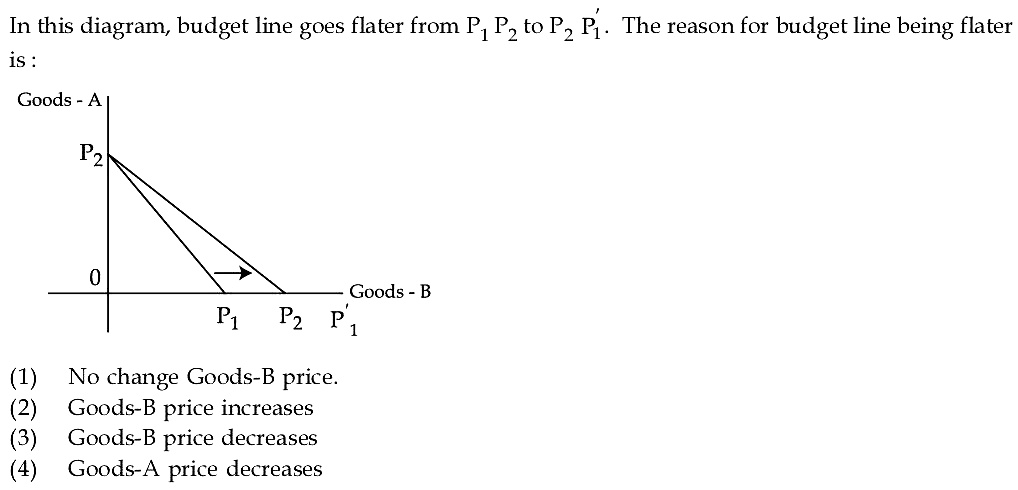
The information provided is a bit unclear without a visual representation of the diagram. However, based on the description "budget line goes flatter from P₁ P₂ to P₂ P₁," it implies a change in the relative prices of goods A and B along the budget line.
A flatter budget line typically indicates a decrease in the relative price of the good on the horizontal axis (Goods A) compared to the good on the vertical axis (Goods B). Therefore, the correct reason for the budget line being flatter is:
(3) Goods-B price decreases
This means that the price of Goods B has decreased relative to the price of Goods A, leading to a flatter budget line.
Identify the correct statements from the following:
(A) Deforestation means planting of more and more trees
(B) Deforestation leads to biodiversity loss
(C) Deforestation contributes in the GDP of the country
(D) Deforestation leads to noise pollution
(E) Environment degradation is induced by poverty in India
Choose the correct answer from the options given below :
(1) (A) and (B) only
(2) (D) and (E) only
(3) (B) and (E) only
(4) (C) and (E) only
The correct statements are:
(3) (B) and (E) only
Explanation:
(B) Deforestation leads to biodiversity loss: This is true. Deforestation involves the removal or clearing of forests, leading to the loss of habitat for numerous species and a decline in biodiversity.
(E) Environment degradation is induced by poverty in India: This is generally true. Poverty can contribute to environmental degradation as people may resort to unsustainable practices for their livelihoods.
The other statements are not correct:
(A) Deforestation means planting more and more trees: This is incorrect. Deforestation refers to the removal or clearing of forests, not planting more trees.
(C) Deforestation contributes to the GDP of the country: While deforestation may contribute to short-term economic gains, it often leads to long-term environmental and economic problems, such as loss of biodiversity and ecosystem services. Therefore, the statement is not entirely correct.
(D) Deforestation leads to noise pollution: This is not mentioned in the correct statements.
Therefore, the correct answer is (3) (B) and (E) only.
Which of the following definition is correct answer of the production possibility set of the economy ?
(1) The collection of all possible combination of the goods and services that can not be produced a fixed amount
(2) The collection of all possible combinations of goods and services that can be produced from a given amount of resources and a given stock of technological knowledge
(3) Tmbination of all goods and its resources creates the production possibility curve
The correct definition for the production possibility set or production possibility curve of the economy is likely to be:
(2) The collection of all possible combinations of goods and services that can be produced from resources and a given stock of technological knowledge
This definition captures the essence of the production possibility set, which represents the various combinations of goods and services that an economy can produce given its available resources and technological knowledge.
The difference between national income and domestic income is answer from the following. Choose the correct answer
(1) Net indirect taxes
(2) Net factor income from abroad
(3) Consumption of fixed capital
(4) Intermediate goods
The difference between national income and domestic income is typically represented by:
(2) Net factor income from abroad
Net factor income from abroad takes into account the income earned by domestic factors of production (labor and capital) from foreign sources minus the income earned by foreign factors of production within the domestic economy. This includes wages, profits, and other factor incomes that flow into or out of the country.
Net Indirect Taxes:
Consumption of Fixed Capital:
Intermediate Goods:
In summary, the relationship between national income and domestic income involves adjustments for net indirect taxes, consumption of fixed capital, and the exclusion of intermediate goods. The key difference is often related to the income earned from abroad, which is captured in the term "Net Factor Income from Abroad" in option (2)
The first IPR in independent India was introduced in
1948
1984
1958
2000
The first Industrial Policy in India was announced post-independence in 1948. It was presented by Dr. Shyama Prasad Mukherjee.
Among the following which is not included in capital account
Among the options given, the item that is not typically included in the Capital Account Balance is:
(1) Gifts and Donations
Explanation:
Flow of Banking Capital (Option 2): This includes movements of capital related to banks, such as foreign investments by banks or borrowing from foreign banks, and is a component of the capital account.
Flow of Gold (Option 3): Movements of gold across borders are included in the capital account.
Loans (Option 4): Loans between countries, whether they are given or received, are part of the capital account.
Gifts and Donations (Option 1): While gifts and donations involve the transfer of economic value, they are typically categorized separately and are not considered a standard component of the capital account. They may be recorded in the current account or under transfers.
Therefore, the correct answer is (1) Gifts and Donations.
Match List – I with List – II
| List – I | List – II |
|---|---|
| (A) Balance of Trade | (I) International transaction related to financial assets |
| (B) Balance of payment | (II) Export and import of services |
| (C) Net invisibles | (III) Goods, Service and Transaction in assets |
| (D) Balance on capital accounts | (IV) Export and import of goods |
Options
(1) (A)–(I), (B)–(III), (C)–(II), (D)–(IV)
(2) (A)–(IV), (B)–(III), (C)–(II), (D)–(I)
(3) (A)–(II), (B)–(III), (C)–(IV), (D)–(I)
(4) (A)–(I), (B)–(IV), (C)–(II), (D)–(III)
(2) (A)–(IV), (B)–(III), (C)–(II), (D)–(I)
(A) Balance of Trade
→ Refers to export and import of goods
→ (IV)
(B) Balance of Payment
→ Includes goods, services and transactions in assets
→ (III)
(C) Net invisibles
→ Covers export and import of services
→ (II)
(D) Balance on capital accounts
→ Deals with international transactions related to financial assets
→ (I)
Correct matching:(A)–(IV), (B)–(III), (C)–(II), (D)–(I)
What is the other name of central problem of economy - for whom to produce?
Problem of distribution
Problem of allocation of resources
Problem of quantities of production
Problem of choice of techniques
The reason "For whom to produce?" is referred to as the "Problem of distribution" is rooted in the fundamental question of how the output or wealth generated by an economy is allocated among the individuals or groups within that society. Let's delve into the reason:
(1) Problem of Distribution:
In a broader sense, the "Problem of distribution" is about determining the principles and mechanisms through which the benefits and burdens of economic activities are shared among people. This encompasses issues of income inequality, social justice, and the overall well-being of the population.
So, when the question is framed as "For whom to produce?" it essentially translates to addressing the distributional aspects of economic output, making "Problem of distribution" an apt alternative name for this facet of the central economic problem.
Regulation of market aim to create orderly and transparent marketing conditions. Name the group that has been benefited from this
Consumer
Middleman
Consumer and farmer
Agents and trader
The group that has been benefited from the regulation of markets, aiming to create orderly and transparent marketing conditions, is:
(3) Consumers And Farmer
Explanation:
Regulation of markets is primarily implemented to protect the interests of consumers by ensuring fair practices, transparent information, and a competitive environment.
While other groups, such as intermediaries (like middlemen, agents, and traders), may also be influenced by market regulations, the overarching goal is often to safeguard consumers from unfair practices, promote transparency, and create a market that serves their interests.
Therefore, the correct answer is (3) Consumers And Farmer
When total utility remains constant the value of marginal utility is
Maximum
Zero
Negative
Minimum
Marginal Utility is derived from the consumption of an extra unit of item. When total utility is maximum, marginal utility is zero. When total utility is decreasing, marginal utility is negative. When total utility is increasing, marginal utility is positive.
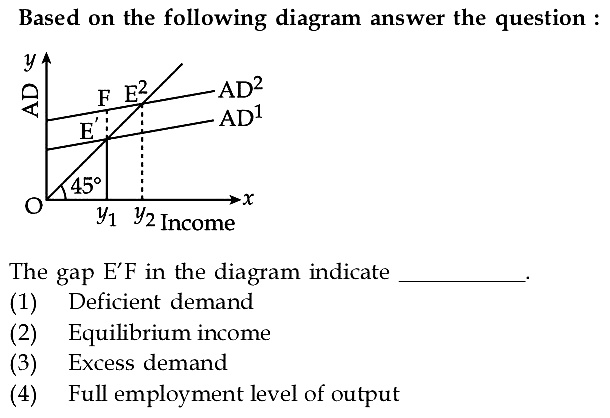
In a standard AD-AS (Aggregate Demand-Aggregate Supply) diagram:
Equilibrium Output (Income): This occurs at the intersection of the Aggregate Demand (AD) and Aggregate Supply (AS) curves. The level of output where AD equals AS is the equilibrium level of income.
Deficient Demand: If the equilibrium level of output is below the full employment level, it may indicate deficient demand, which means the economy is not producing at its full potential.
Excess Demand: If the equilibrium level of output is above the full employment level, it may indicate excess demand, suggesting that the economy is operating beyond its full capacity.
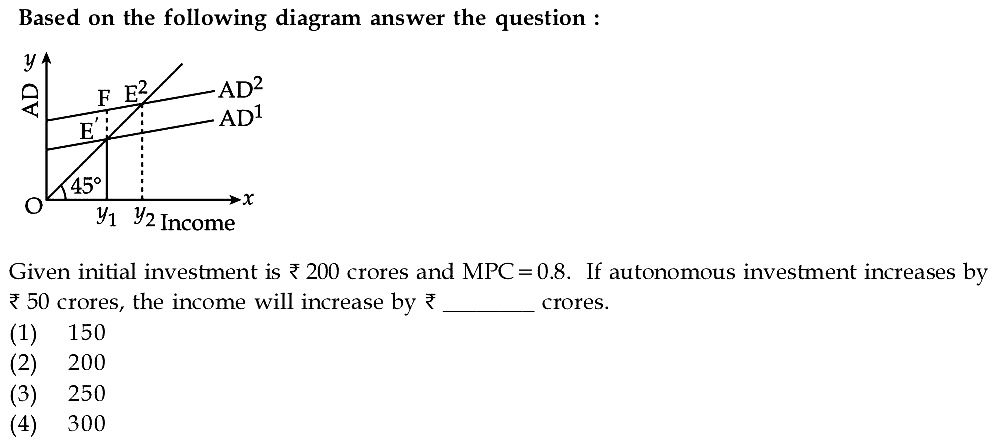
Given:
Initial investment (I) = ₹200 crores
MPC = 0.8 (Marginal Propensity to Consume)
Increase in autonomous investment = ₹50 crores
The multiplier (k) can be calculated using the formula:
k= 1/1-mpc
k=1/1-0.8=5
change in income= k*change in investment
change in income = 5*50=250
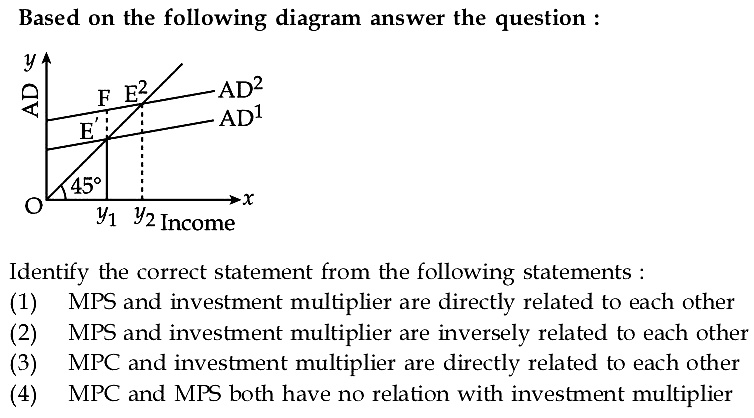
The correct statement is:
(2) MPS and investment multiplier are inversely related to each other.
Explanation:
The Marginal Propensity to Save (MPS) is the fraction of additional income that a household saves, and it is related to the Marginal Propensity to Consume (MPC) through the equation:1MPS+MPC=1.
The investment multiplier is inversely related to the MPS. The multiplier (k) is calculated as k=1−MPS, so as MPS increases, the multiplier decreases, and vice versa.
Therefore, option (2) is the correct statement.
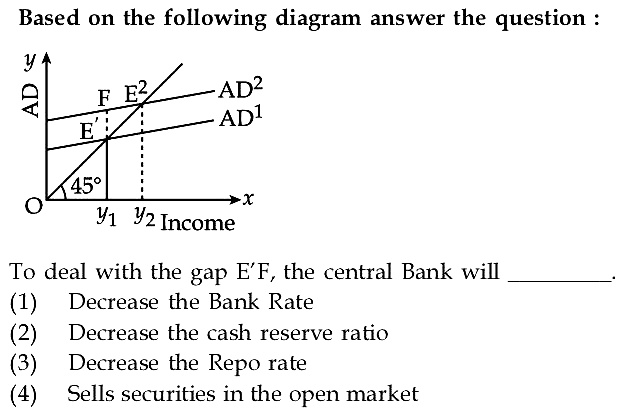
The correct action for the central bank to deal with the gap E'F is to:
(4) Sell securities in the open market.
Explanation:
Selling securities in the open market is a contractionary monetary policy tool. When the central bank sells securities, it reduces the money supply in the economy, leading to higher interest rates.
Higher interest rates can encourage saving and reduce borrowing and spending. This, in turn, can help control inflationary pressures and bring the economy closer to full employment.
Therefore, option (4) is the appropriate action for the central bank to deal with the gap E'F.
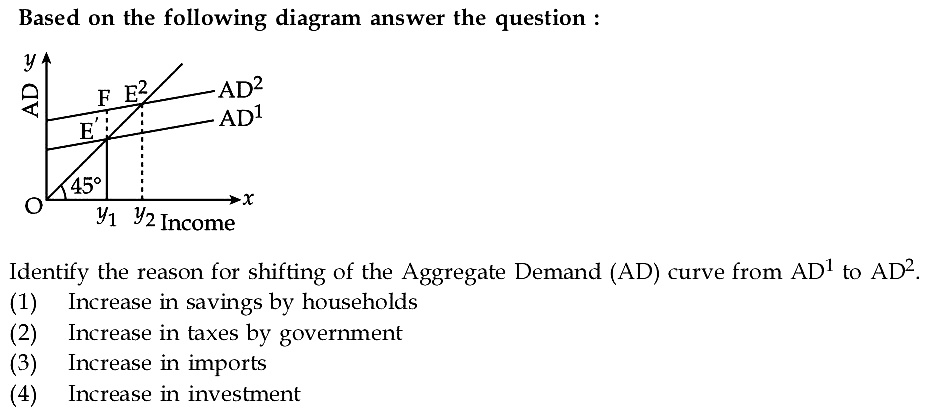
The shift of the Aggregate Demand (AD) curve from AD¹ to AD² can be explained by different factors influencing the components of aggregate demand. Let's consider each option:
(1) Increase in savings by households:
(2) Increase in taxes by government:
(3) Increase in imports:
(4) Increase in investment:
Given the options, the most likely reason for the shift from AD¹ to AD² is:
(4) Increase in investment.
An increase in investment is a common factor that can lead to an expansion of economic activity, causing the AD curve to shift to the right.
Poverty has many faces, which have been changing from place to place and across time and has been described in many ways. In pre-independent India, Dadabhai Naoroji was first to discuss the concept of poverty line. In post-independent India, there have been several attempts to work out a mechanism to identify the number of poor in the country. The official data on poverty is made to the public by the planning commission. It is estimated on the basis of consumption expenditure data collected by the National Sample Survey organisation. Most poverty alleviation programmes implemented are based on the perspective of the five year plans. The government has a variety of programmes to generate wage employment for the poor unskilled people living in rural area.
Which of the following is correct answer to discuss the concept of a poverty line in pre-independent India ?
(1) Minimum expenditure cost
(2) Jail cost living
(3) Calculate expenditure on base price
(4) Adult expenditure cost
The correct answer to discuss the concept of a poverty line in pre-independent India is:
(4) Adult expenditure cost
Dadabhai Naoroji, in pre-independent India, was one of the first to discuss the concept of the poverty line. The idea was related to estimating the expenditure needed for an adult individual to meet the basic necessities of life. Therefore, "Adult expenditure cost" is the correct option.
Poverty has many faces, which have been changing from place to place and across time and has been described in many ways. In pre-independent India, Dadabhai Naoroji was first to discuss the concept of poverty line. In post-independent India, there have been several attempts to work out a mechanism to identify the number of poor in the country. The official data on poverty is made to the public by the planning commission. It is estimated on the basis of consumption expenditure data collected by the National Sample Survey organisation. Most poverty alleviation programmes implemented are based on the perspective of the five year plans. The government has a variety of programmes to generate wage employment for the poor unskilled people living in rural area
When did the "Task force on projections of minimum needs and effective consumption demand form to identify the number of poor in our country?
(1) 1962
(2) 1976
(3) 1979
(4) 1989
The "Task force on projections of minimum needs and effective consumption demand" was formed in 1979 to address issues related to identifying the number of poor in the country. The task force aimed to project the minimum needs and effective consumption demand, providing insights into poverty estimation and alleviation strategies.
Poverty has many faces, which have been changing from place to place and across time and has been described in many ways. In pre-independent India, Dadabhai Naoroji was first to discuss the concept of poverty line. In post-independent India, there have been several attempts to work out a mechanism to identify the number of poor in the country. The official data on poverty is made to the public by the planning commission. It is estimated on the basis of consumption expenditure data collected by the National Sample Survey organisation. Most poverty alleviation programmes implemented are based on the perspective of the five year plans. The government has a variety of programmes to generate wage employment for the poor unskilled people living in rural area
From 1973 to 2012 the poverty levels in some states were above the national poverty level. Choose the correct answer from the options:
(1) Odisha, Bihar, Uttar pradesh and Assam
(2) Odisha, Madhya pradesh, Bihar and Uttar pradesh
(3) Bihar, Odisha, Assam and West Bengal
(4) Bihar, Assam, Uttar pradesh and West Bengal
Poverty levels for the years 1973 to 2012 for the states mentioned. However, based on general knowledge about the socio-economic conditions in India during that period, Option (2) seems more plausible:
(2) Odisha, Madhya Pradesh, Bihar, and Uttar Pradesh
These states have historically faced challenges related to poverty, and during the specified time frame, they might have experienced poverty levels above the national average. For accurate and detailed information, it's recommended to refer to official reports and statistical data provided by government agencies or reliable research institutions.
Poverty has many faces, which have been changing from place to place and across time and has been described in many ways. In pre-independent India, Dadabhai Naoroji was first to discuss the concept of poverty line. In post-independent India, there have been several attempts to work out a mechanism to identify the number of poor in the country. The official data on poverty is made to the public by the planning commission. It is estimated on the basis of consumption expenditure data collected by the National Sample Survey organisation. Most poverty alleviation programmes implemented are based on the perspective of the five year plans. The government has a variety of programmes to generate wage employment for the poor unskilled people living in rural area.
Which of the following programme provides partial financial assistance to SHGs for self-employment activities?
(1) Swarnjayanti Gram Swarozgar Yojana
(2) Prime minister's Rozgar Yojana
(3) Self-employment programmes are Rural employment generation programme
(4) National rural development mission
he correct answer is:
swarna Gram Swarozgar Yojana (SGSY):Explanation:
swarna Gram Swarozgar Yojana (SGSY):
SGSY was a self-employment program aimed at providing sustainable income to rural families living below the poverty line.
It focused on the establishment of micro-enterprises in the rural sector.
The program has since been restructured and merged into the National Rural Livelihood Mission (NRLM).
Prime Minister's Rozgar Yojana (PMRY):
PMRY was a scheme that aimed at providing self-employment opportunities to educated unemployed youth in the urban and rural areas.
It provided financial assistance for starting small businesses and industries.
Self-Employment Programmes under Rural Employment Generation Programme (REGP):
The Rural Employment Generation Programme (REGP) includes various self-employment programs that provide financial assistance to individuals, including Self-Help Groups (SHGs), for starting micro-enterprises.
This program is often a part of broader initiatives to generate employment and income in rural areas.
National Rural Development Mission:
The National Rural Development Mission (NRDM) may refer to various initiatives aimed at overall rural development, including infrastructure, education, health, and livelihoods.
Poverty has many faces, which have been changing from place to place and across time and has been described in many ways. In pre-independent India, Dadabhai Naoroji was first to discuss the concept of poverty line. In post-independent India, there have been several attempts to work out a mechanism to identify the number of poor in the country. The official data on poverty is made to the public by the planning commission. It is estimated on the basis of consumption expenditure data collected by the National Sample Survey organisation. Most poverty alleviation programmes implemented are bas based on the perspective of the five year plans. The government has a variety of programmes to generate wage employment for the poor unskilled people living in rural area.
How many rural workers got employment opportunities under Mahatma Gandhi National Rural Employment Guarantee Act in 2013-2014 ?
(1) About seven crore
(2) About five crore
(3) About 7.5 crore
(4) About six crore
The government has a variety of programmes to generate wage employment for the poor unskilled people living in rural areas. In August 2005, the Parliament passed a new Act to provide guaranteed wage employment to every rural household whose adult volunteer is to do unskilled manual work for a minimum of 100 days in a year. This Act is known as Mahatma Gandhi National Rural Employment Guarantee Act. Under this Act all those among the poor who are ready to work at the minimum wage can report for work in areas where this programme is implemented. In 2013-14, nearly five crore households got employment opportunities under this law.



 ×
×
 Bank
Bank


 SSC
SSC


 Railway


 State
State


 Other
Other


 Teaching


 Insurance


 Medical


 Engineering


 Defence


 GATE
GATE


 NTA CUET

 UPSC
UPSC

 MBA Entrance


 LAW
LAW

 ReNEET UG 2026
 CUET UG 2026
 UP Police Constable 2026
 SSC Selection Post (Phase 14) 2026
 SSC GD 2025-26
 RRB NTPC 2026
 SSC CGL Tier-I 2026
 SSC JE 2026
 UPSC (CSE) 2026
 SBI PO Prelims 2026
 SSC Steno Grade C & D 2026
 SBI Clerk Prelims 2026
 IBPS PO Prelims 2026
 IBPS Clerk Prelims 2026
 SSC CPO Tier I 2026


 Get latest Exam Updates