Please wait...
Considering only the principal values of the inverse trigonometric functions, the value of
is
Consider the equation
∫1e(logex)1/2x(a−(logex)3/2)2dx=1,a∈(−∞,0)∪(1,∞)
Which of the following statements is/are TRUE?
Let a1,a2,a3,… be an arithmetic progression with a1=7 and common difference 8. Let T1,T2,T3,… be such that T1=3 and Tn+1−Tn=an for n≥1. Then, which of the following is/are TRUE ?
Consider the parabola y2=4x. Let S be the focus of the parabola. A pair of tangents drawn to the parabola from the point P=(−2,1) meet the parabola at P1 and P2. Let Q1 and Q2 be points on the lines SP1 and SP2 respectively such that PQ1 is perpendicular to SP1 and PQ2 is perpendicular to SP2. Then, which of the following is/are TRUE?
Let |M| denote the determinant of a square matrix M. Let g:[0,π2]→R be the function defined by
g(θ)=f(θ)−1+f(π2−θ)−1
where
f(θ)=12|1sinθ1−sinθ1sinθ−1−sinθ1|+|sinπcos(θ+π4)tan(θ−π4)sin(θ−π4)−cosπ2loge(4π)cot(θ+π4)loge(π4)tanπ|.
Let p(x) be a quadratic polynomial whose roots are the maximum and minimum values of the function g(θ), and p(2)=2−2. Then, which of the following is/are TRUE ?
Consider the following lists:
Two players, P1 and P2, play a game against each other. In every round of the game, each player rolls a fair die once, where the six faces of the die have six distinct numbers. Let x and y denote the readings on the die rolled by P1 and P2, respectively. If x>y, then P1 scores 5 points and P2 scores 0 point. If x=y, then each player scores 2 points. If x<y, then P1 scores 0 point and P2 scores 5 points. Let Xi and Yi be the total scores of P1 and P2, respectively, after playing the ith round.
Let p,q,r be nonzero real numbers that are, respectively, the 10th ,100th and 1000th terms of a harmonic progression. Consider the system of linear equations
x+y+z=110x+100y+1000z=0qrx+pry+pqz=0
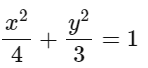
Consider the ellipse
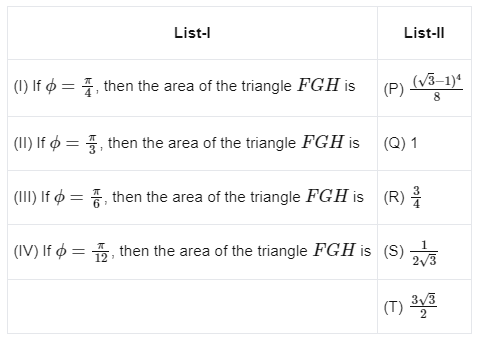
Let 𝐻(𝛼, 0), 0 < 𝛼 < 2, be a point. A straight line drawn through 𝐻 parallel to the 𝑦-axis crosses the ellipse and its auxiliary circle at points 𝐸 and 𝐹 respectively, in the first quadrant. The tangent to the ellipse at the point 𝐸 intersects the positive 𝑥-axis at a point 𝐺. Suppose the straight line joining 𝐹 and the origin makes an angle 𝜙 with the positive 𝑥-axis.
2 molofHg(g) is combusted in a fixed volume bomb calorimeter with excess of O2 at 298 K and 1 atm into HgO(s). During the reaction, temperature increases from 298.0 K to 312.8 K. If heat capacity of the bomb calorimeter and enthalpy of formation of Hg(g) are 20.00 kJ K−1 and 61.32 kJ mol−1 at 298 K, respectively, the calculated standard molar enthalpy of formation of HgO(s) at 298 K is XkJmol−1. The value of |X| is _________ .
[Given: Gas constant R=8.3 J K-1 mol-1 ]
The reduction potential (E0, in V) of MnO4−(aq)/Mn(s) is __________.
[Given: E(MnO4−(aq)/MnO2( s))0=1.68 V;E(MnO2( s)/Mn2+(aq))0=1.21 V;E(Mn2+(aq)/Mn(s))0=−1.03 V ]
A solution is prepared by mixing 0.01 mol each of H2CO3,NaHCO3,Na2CO3, and NaOH in 100 mL of water. pH of the resulting solution is _________.
[Given: p Ka1 and p Ka2 of H2CO3 are 6.37 and 10.32, respectively; log2=0.30 ]
The treatment of an aqueous solution of 3.74 g of Cu(NO3)2 with excess KI results in a brown solution along with the formation of a precipitate. Passing H2 S through this brown solution gives another precipitate X. The amount of X (in g ) is ___________.
[Given: Atomic mass of H=1, N=14,O=16, S=32, K=39,Cu=63,I=127 ]
Dissolving 1.24 g of white phosphorous in boiling NaOH solution in an inert atmosphere gives a gas Q. The amount of CuSO4 (in g) required to completely consume the gas Q is _________.
[Given: Atomic mass of H=1,O=16,Na=23,P=31, S=32,Cu=63 ]
Consider the following reaction.
On estimation of bromine in 1.00 g of R using Carius method, the amount of AgBr formed (in g ) is ___________.
[Given: Atomic mass of H=1,C=12,O=16,P=31,Br=80,Ag=108]
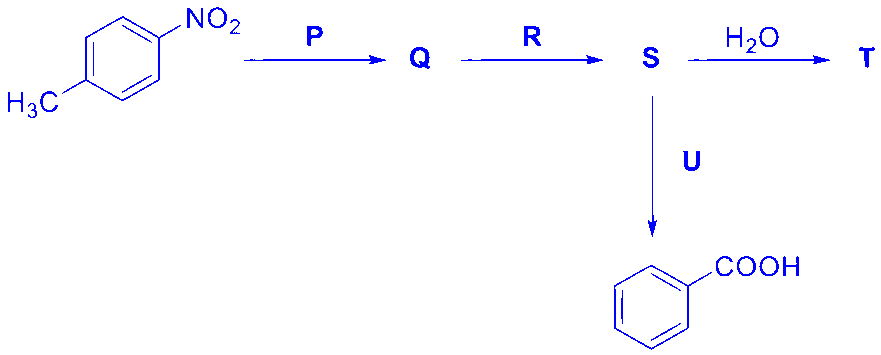
The weight percentage of hydrogen in Q, formed in the following reaction sequence, is ________.
[Given: Atomic mass of H=1,C=12, N=14,O=16, S=32,Cl=35 ]
If the reaction sequence given below is carried out with 15 moles of acetylene, the amount of the product D formed (in g ) is ___________ .
The yields of A,B,C and D are given in parentheses.
[Given: Atomic mass of H=1,C=12,O=16,Cl=35 ]
Considering the reaction sequence given below, the correct statement(s) is(are)
Considering the following reaction sequence,
the correct option(s) is(are)
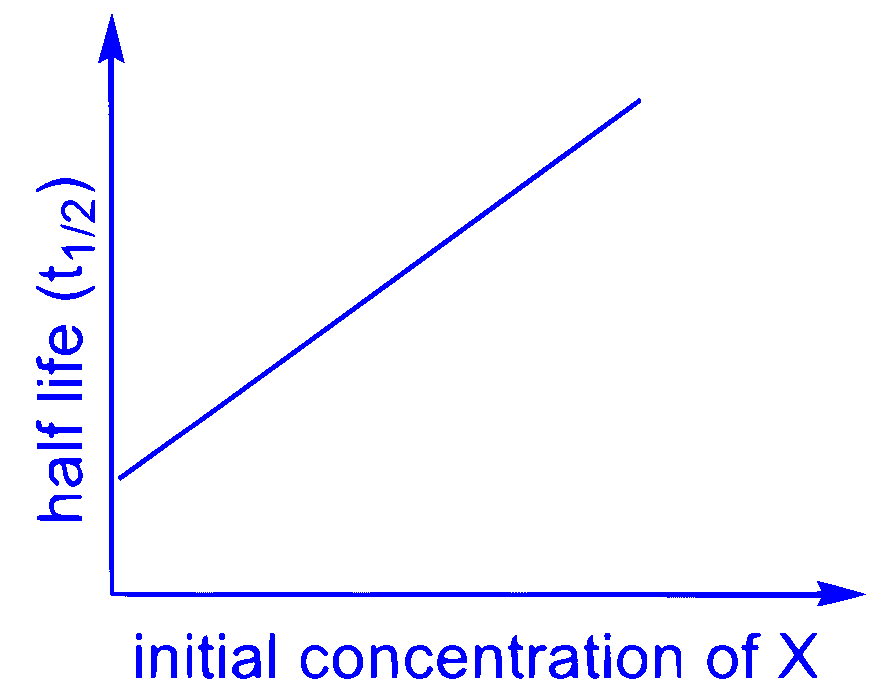
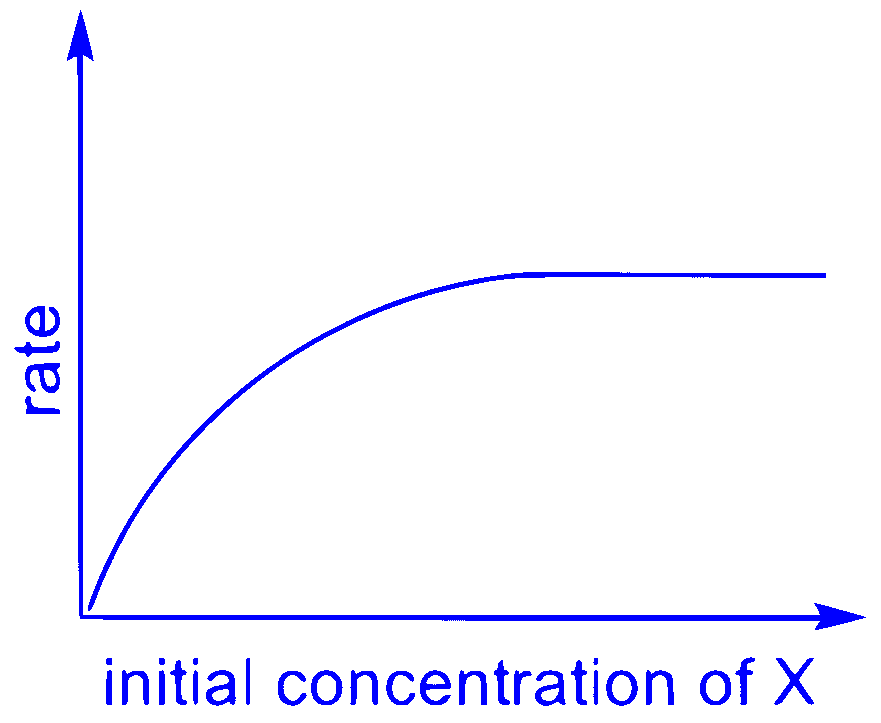
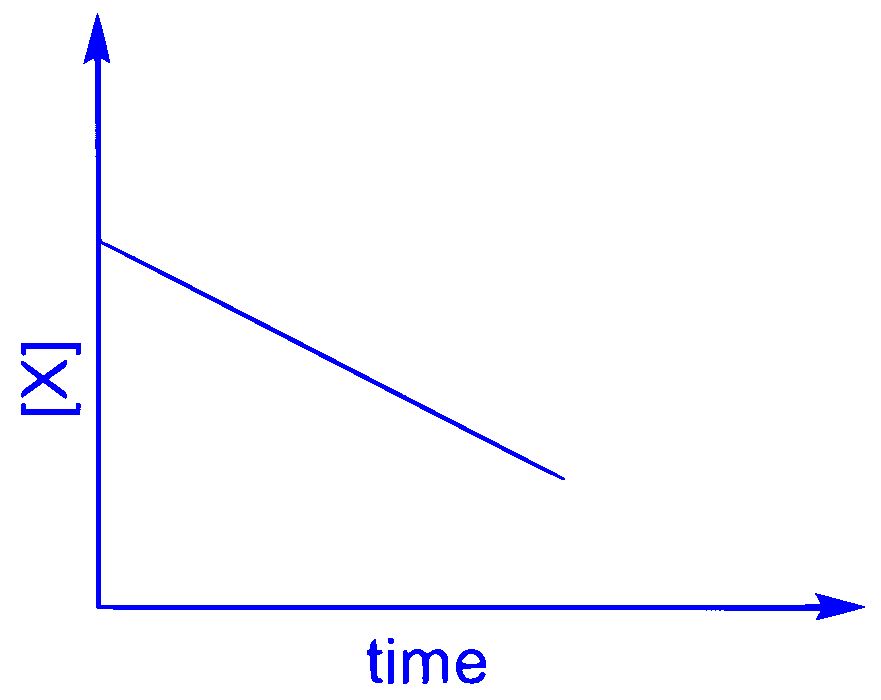
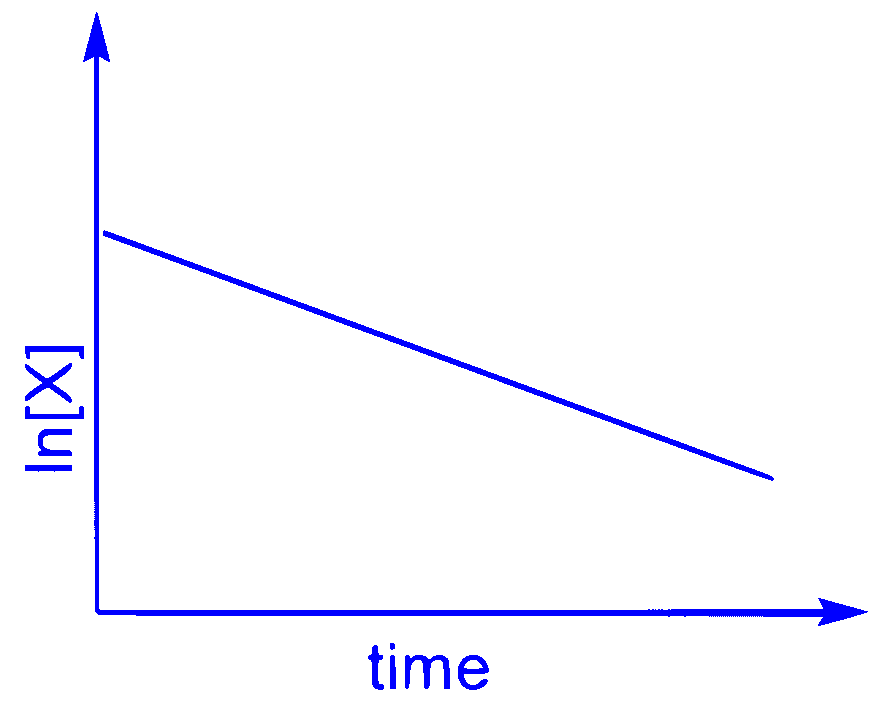
Match the rate expressions in LIST-I for the decomposition of X with the corresponding profiles provided in LIST-II. Xs and k are constants having appropriate units.
LIST-I contains compounds and LIST-II contains reactions
Match each compound in LIST-I with its formation reaction(s) in LIST-II, and choose the correct option
LIST-I contains metal species and LIST-II contains their properties.
[Given: Atomic number of Cr=24,Ru=44,Fe=26 ]
Match each metal species in LIST-I with their properties in LIST-II, and choose the correct option
Match the compounds in LIST-I with the observations in LIST-II, and choose the correct option.
Two spherical stars A and B have densities ρA and ρB, respectively. A and B have the same radius, and their masses MA and MB are related by MB=2MA. Due to an interaction process, star A loses some of its mass, so that its radius is halved, while its spherical shape is retained, and its density remains ρA. The entire mass lost by A is deposited as a thick spherical shell on B with the density of the shell being ρA. If vA and vB are the escape velocities from A and B after the interaction process, the ratio vBvA=10n151/3. The value of n is __________ .
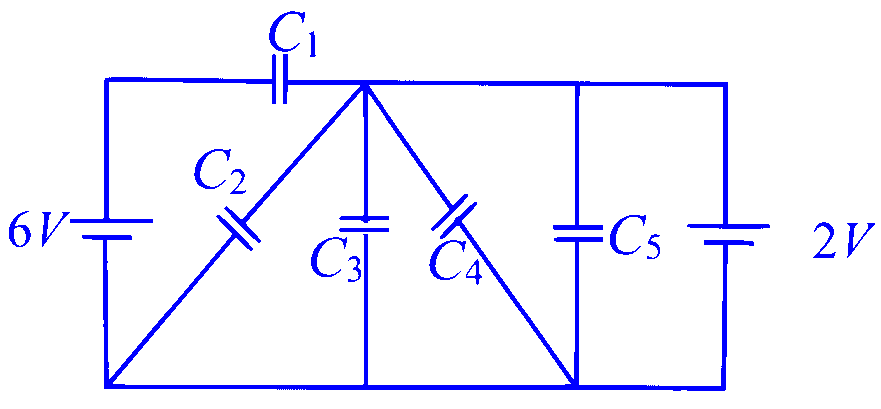
In the following circuit C1=12μF,C2=C3=4μF and C4=C5=2μF. The charge stored in C3 is ____________ μC.
A rod of length 2 cm makes an angle 2π3rad with the principal axis of a thin convex lens. The lens has a focal length of 10 cm and is placed at a distance of 403 cm from the object as shown in the figure. The height of the image is 30313 cm and the angle made by it with respect to the principal axis is α rad. The value of α is πnrad, where n is __________ .
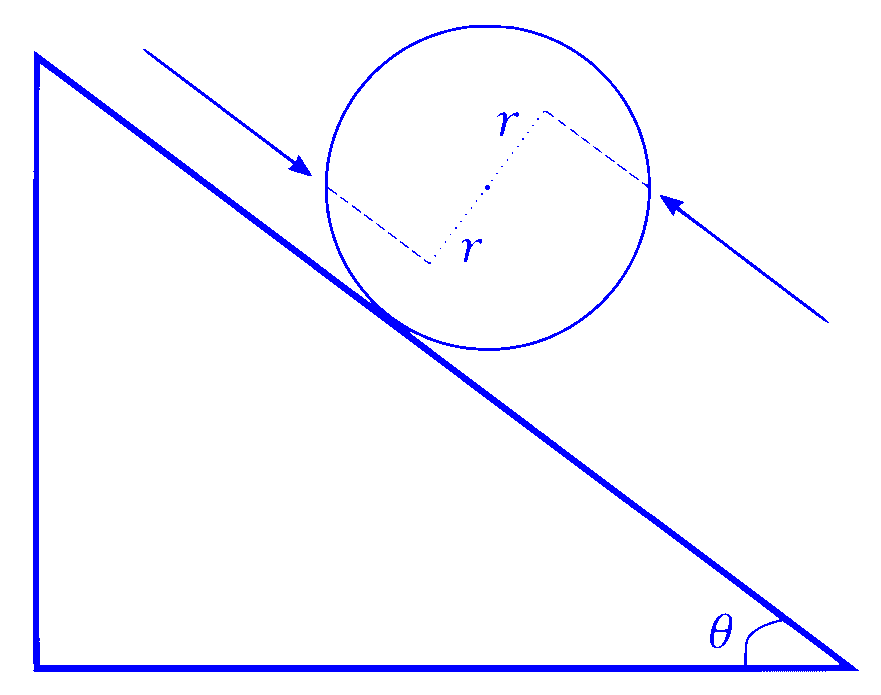
A solid sphere of mass 1 kg and radius 1 m rolls without slipping on a fixed inclined plane with an angle of inclination θ=30∘ from the horizontal. Two forces of magnitude 1 N each, parallel to the incline, act on the sphere, both at distance r=0.5 m from the center of the sphere, as shown in the figure. The acceleration of the sphere down the plane is _________ ms−2.( Take g=10ms−2)
A medium having dielectric constant K>1 fills the space between the plates of a parallel plate capacitor. The plates have large area, and the distance between them is d. The capacitor is connected to a battery of voltage V, as shown in Figure (a). Now, both the plates are moved by a distance of d2 from their original positions, as shown in Figure (b).
In the process of going from the configuration depicted in Figure (a) to that in Figure (b), which of the following statement(s) is(are) correct?
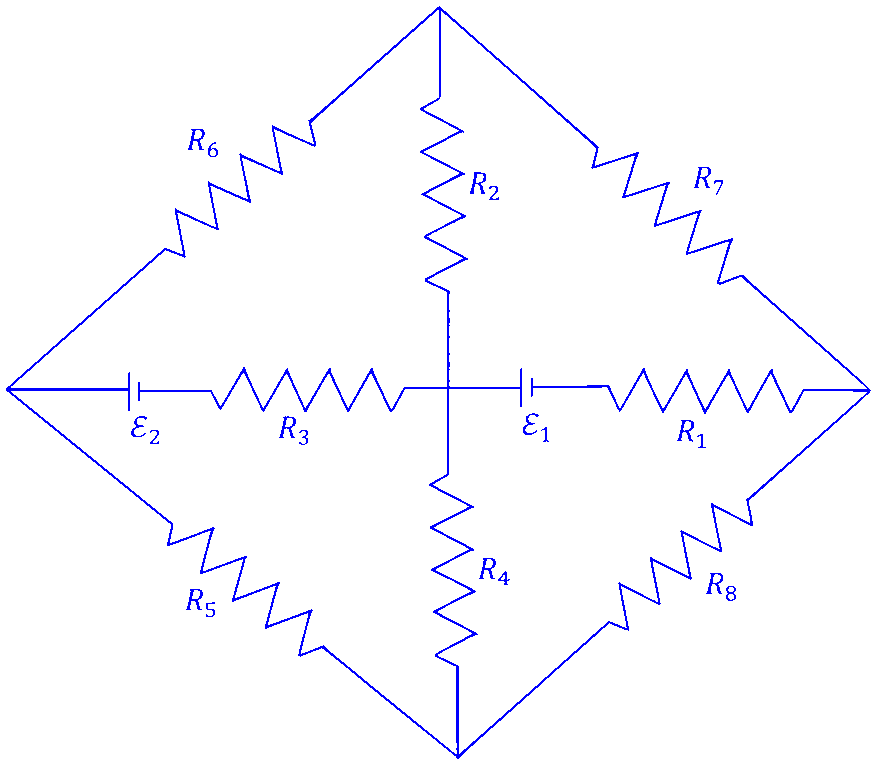
The figure shows a circuit having eight resistances of 1Ω each, labelled R1 to R8, and two ideal batteries with voltages ε1=12 V and ε2=6 V.
Which of the following statement(s) is(are) correct?
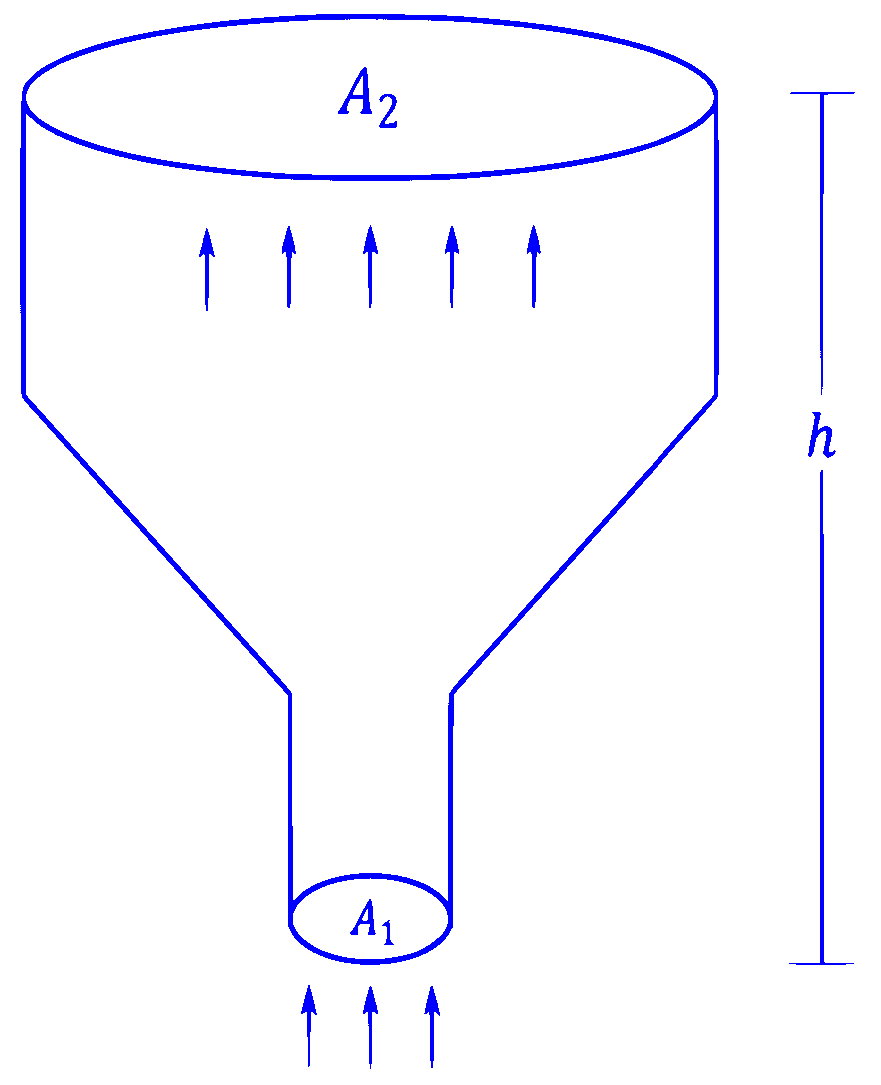
An ideal gas of density ρ=0.2 kg m−3 enters a chimney of height h at the rate of α= 0.8 kg s−1 from its lower end, and escapes through the upper end as shown in the figure. The cross-sectional area of the lower end is A1=0.1 m2 and the upper end is A2=0.4 m2. The pressure and the temperature of the gas at the lower end are 600 Pa and 300 K, respectively, while its temperature at the upper end is 150 K. The chimney is heat insulated so that the gas undergoes adiabatic expansion. Take g=10 m s−2 and the ratio of specific heats of the gas γ=2. Ignore atmospheric pressure.
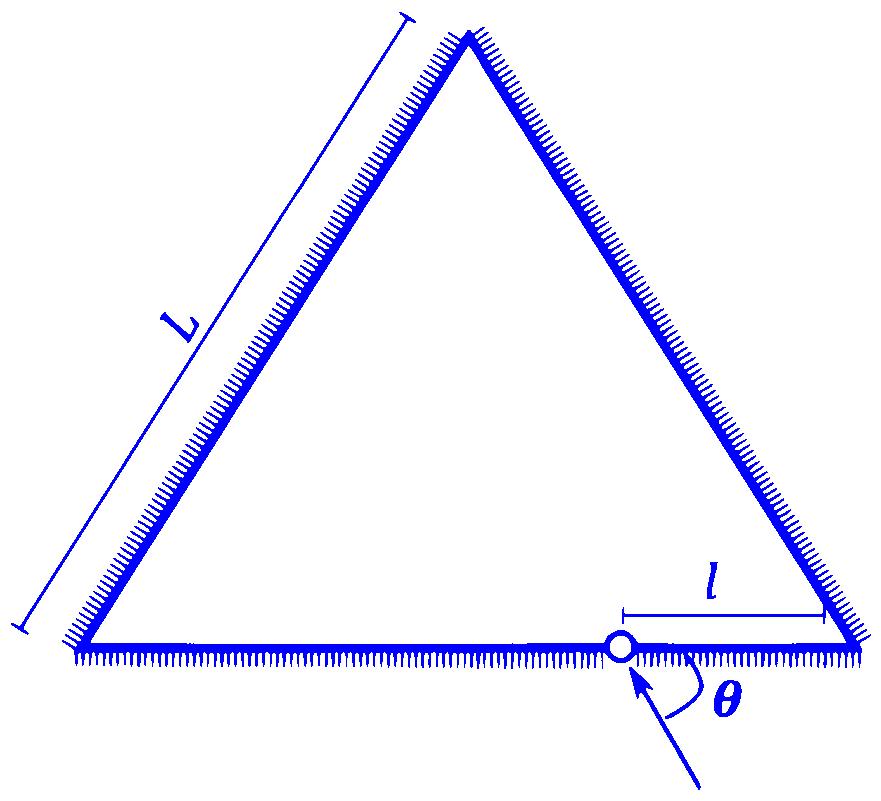
Three plane mirrors form an equilateral triangle with each side of length L. There is a small hole at a distance l>0 from one of the corners as shown in the figure. A ray of light is passed through the hole at an angle θ and can only come out through the same hole. The cross section of the mirror configuration and the ray of light lie on the same plane.
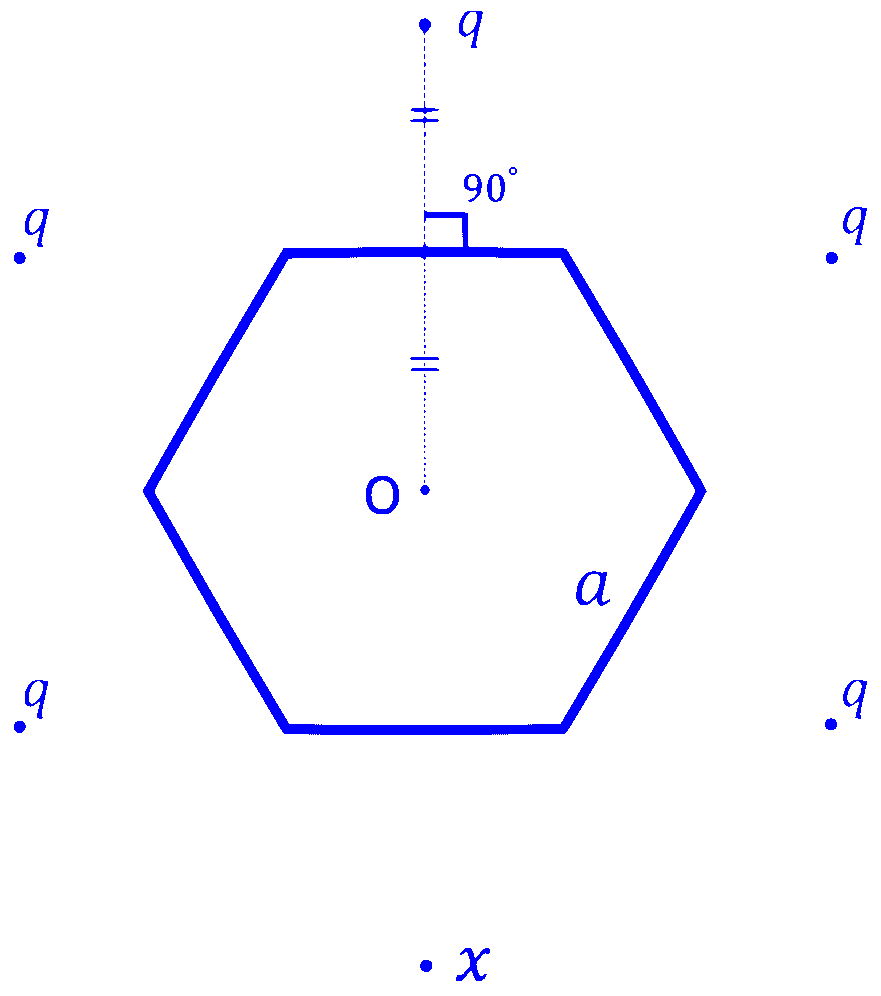
Six charges are placed around a regular hexagon of side length a as shown in the figure. Five of them have charge q, and the remaining one has charge x. The perpendicular from each charge to the nearest hexagon side passes through the center 0 of the hexagon and is bisected by the side.
Which of the following statement(s) is(are) correct in SI units?
The binding energy of nucleons in a nucleus can be affected by the pairwise Coulomb repulsion. Assume that all nucleons are uniformly distributed inside the nucleus. Let the binding energy of a proton be Ebp and the binding energy of a neutron be Ebn in the nucleus.
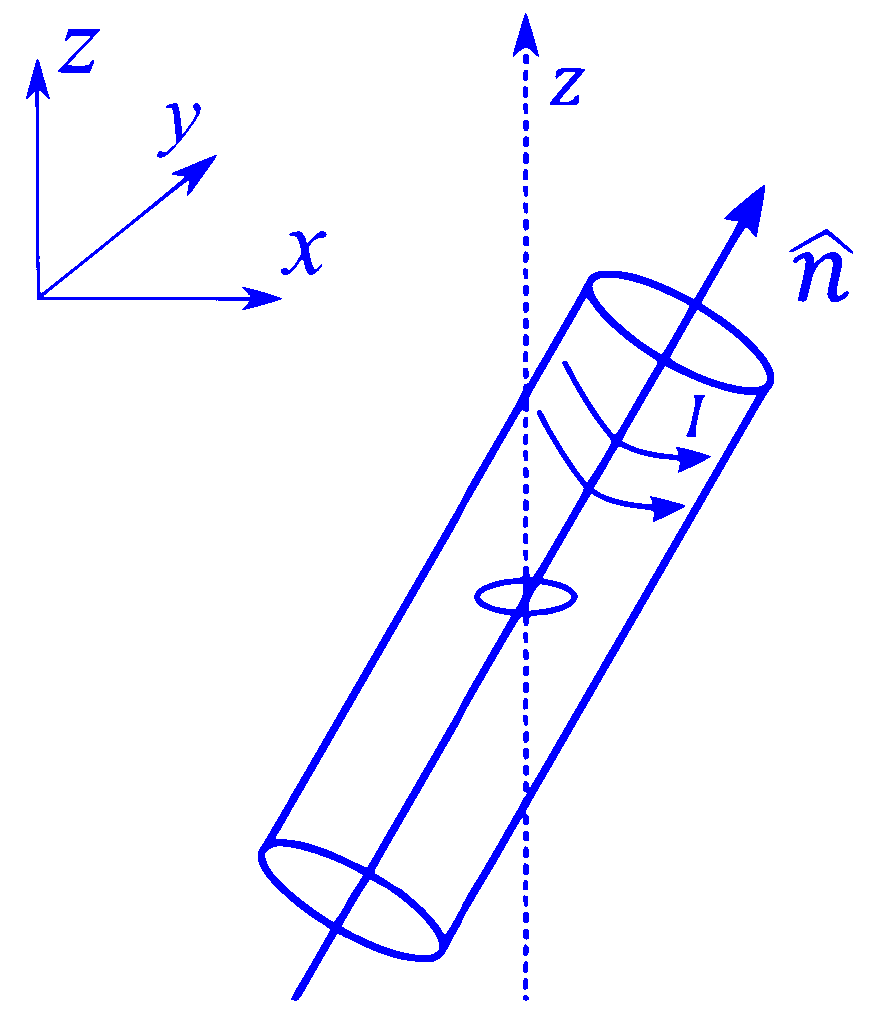
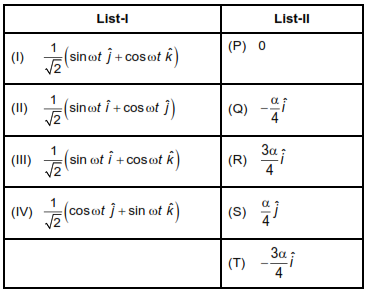
A small circular loop of area A and resistance R is fixed on a horizontal xy-plane with the center of the loop always on the axis n^ of a long solenoid. The solenoid has m turns per unit length and carries current I counterclockwise as shown in the figure. The magnetic field due to the solenoid is in n^ direction. List-I gives time dependences of n^ in terms of a constant angular frequency ω. List-II gives the torques experienced by the circular loop at time t=π6ω. Let α=A2μ02m2I2ω2R.
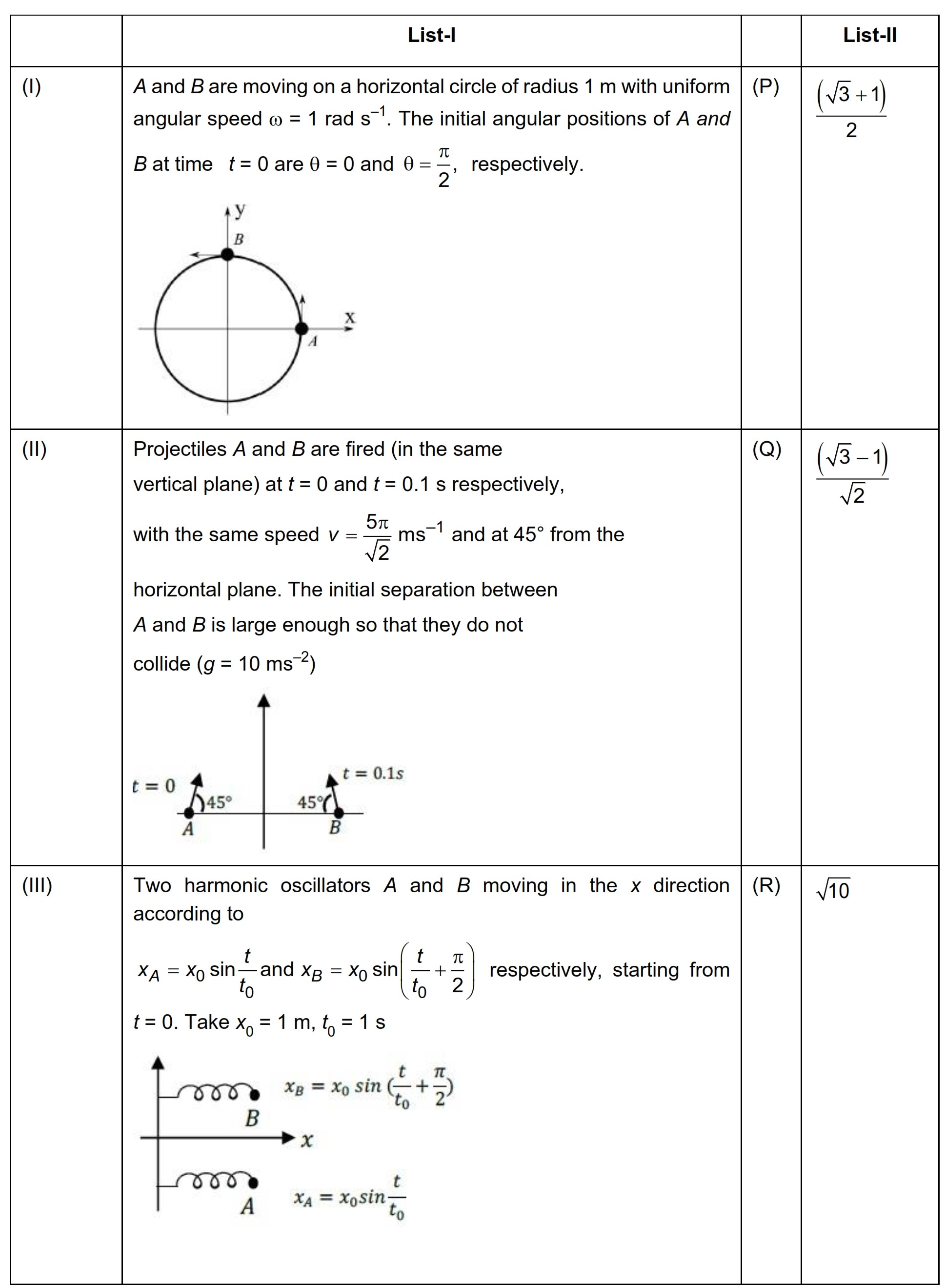
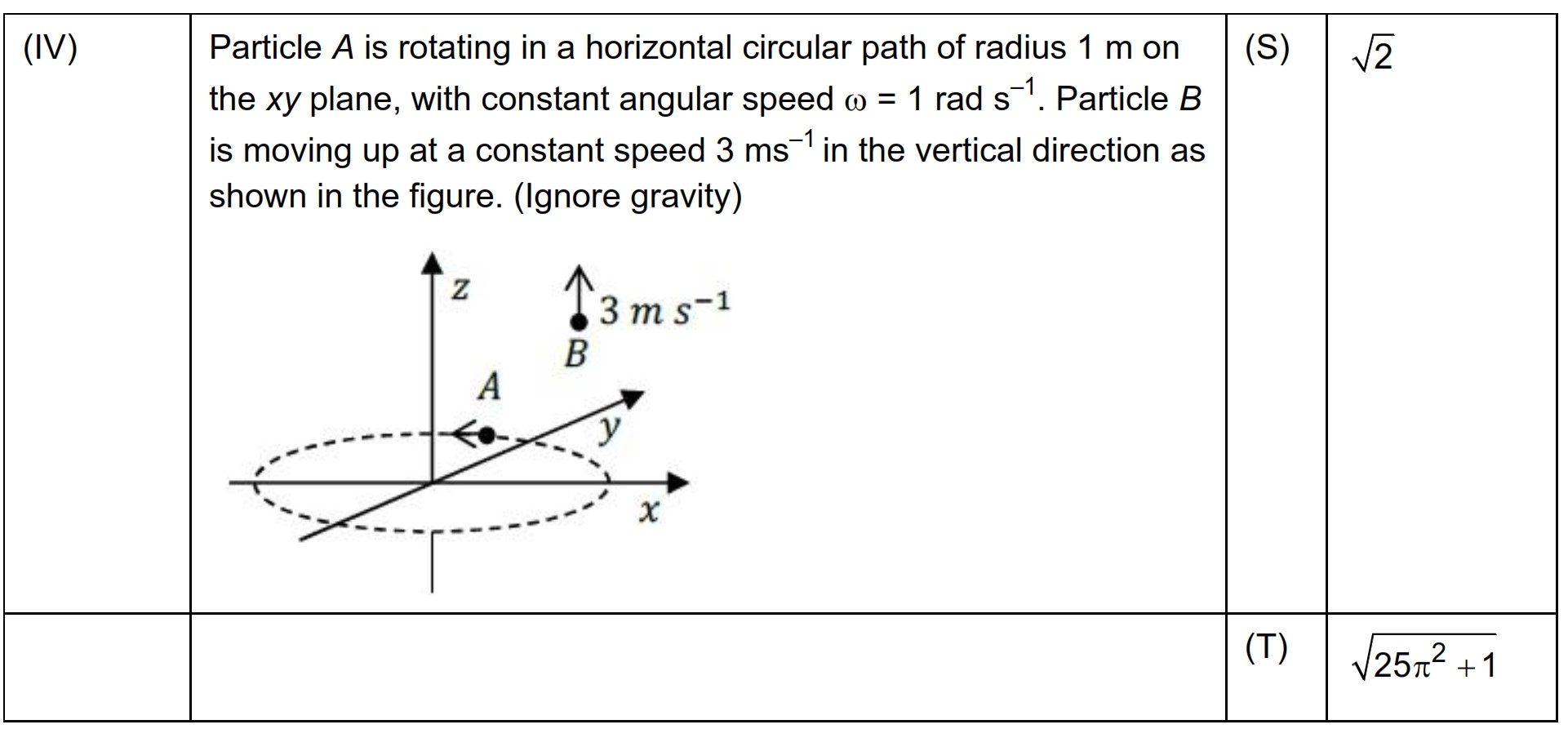
List I describes four systems, each with two particles A and B in relative motion as shown in figures. List II gives possible magnitudes of their relative velocities (in ms−1 ) at time t=π3s.
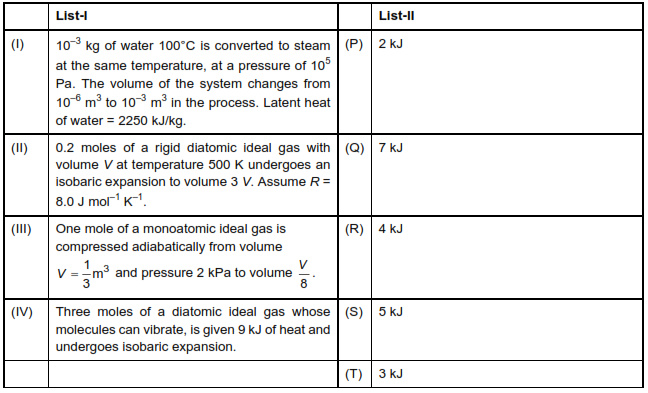
List I describes thermodynamic processes in four different systems. List II gives the magnitudes (either exactly or as a close approximation) of possible changes in the internal energy of the system due to the process.
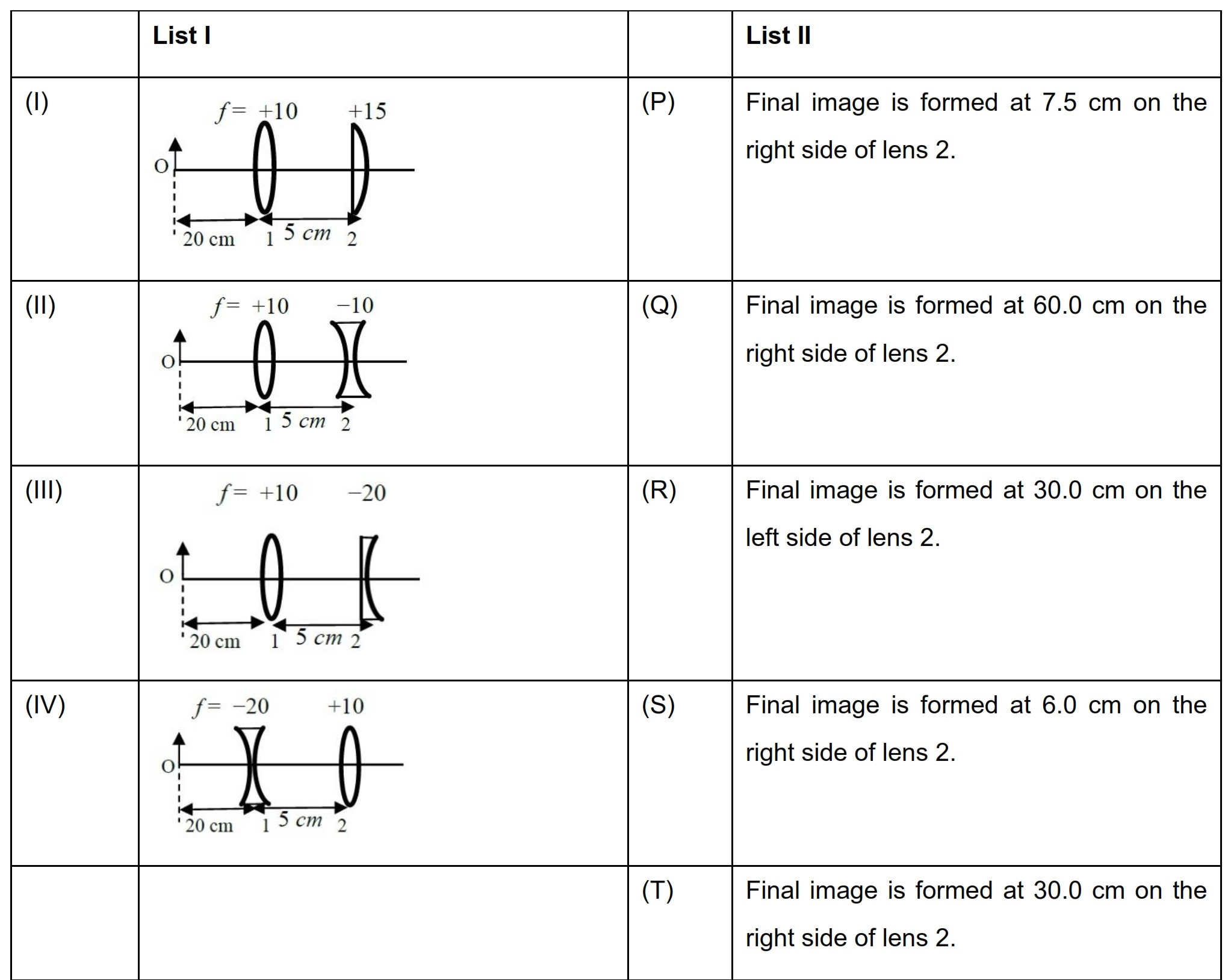
List I contains four combinations of two lenses (1 and 2) whose focal lengths (in cm ) are indicated in the figures. In all cases, the object is placed 20 cm from the first lens on the left, and the distance between the two lenses is 5 cm. List II contains the positions of the final images.
Which one of the following options is correct?


 Bank
Bank


 SSC
SSC


 Railway


 State
State


 Other
Other


 Teaching


 Insurance


 Medical


 Engineering


 Defence


 GATE
GATE


 NTA CUET

 UPSC
UPSC

 MBA Entrance


 LAW
LAW

 ReNEET UG 2026
 CUET UG 2026
 UP Police Constable 2026
 SSC Selection Post (Phase 14) 2026
 SSC GD 2025-26
 RRB NTPC 2026
 SSC CGL Tier-I 2026
 SSC JE 2026
 UPSC (CSE) 2026
 SBI PO Prelims 2026
 SSC Steno Grade C & D 2026
 SBI Clerk Prelims 2026
 IBPS PO Prelims 2026
 IBPS Clerk Prelims 2026
 SSC CPO Tier I 2026











 Get latest Exam Updates