Please wait...

Solution
Hindi language icon English language icon
Q.13 Correct
Q.13 In-correct
Q.13 Unattempt
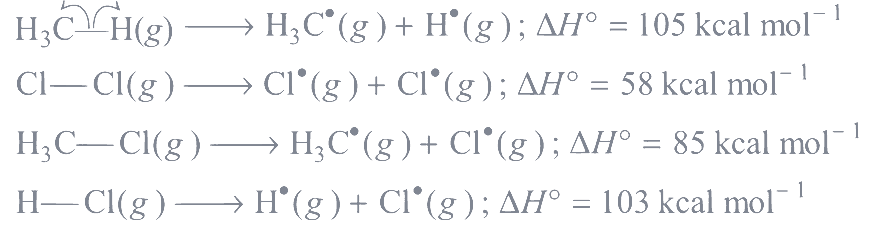
The amount of energy required to break a bond is same as the amount of energy released when the same bond is formed. In gaseous state, the energy required for homolytic cleavage of a bond is called Bond Dissociation Energy (BDE) or Bond Strength. BDE is affected by s-character of the bond and the stability of the radicals formed. Shorter bonds are typically stronger bonds. BDEs for some bonds are given below :
Correct match of the C-H bonds (shown in bold) in Column J with their BDE in Column K is

Column J
Molecule
Column K
BDE (kcal mol1)
(P) H-CH(CH3)2 (i) 132
(Q) H-CH2Ph (ii) 110
(R) H-CH=CH2 (iii) 95
(S) H-C CH (iv) 88
The amount of energy required to break a bond is same as the amount of energy released when the same bond is formed. In gaseous state, the energy required for homolytic cleavage of a bond is called Bond Dissociation Energy (BDE) or Bond Strength. BDE is affected by s-character of the bond and the stability of the radicals formed. Shorter bonds are typically stronger bonds. BDEs for some bonds are given below :
Correct match of the C-H bonds (shown in bold) in Column J with their BDE in Column K is

Column J
Molecule
Column K
BDE (kcal mol1)
(P) H-CH(CH3)2 (i) 132
(Q) H-CH2Ph (ii) 110
(R) H-CH=CH2 (iii) 95
(S) H-C CH (iv) 88
Q.7 Correct
Q.7 In-correct
Q.7 Unattempt
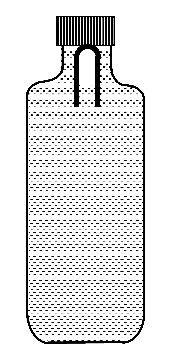
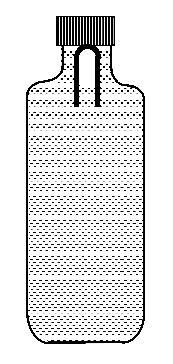
A soft plastic bottle, filled with water of density 1 gm/cc, carries an inverted glass test-tube with some air (ideal gas) trapped as shown in the figure. The test-tube has a mass of 5 gm, and it is made of a thick glass of density 2.5 gm/cc. Initially the bottle is sealed at atmosphere pressure p0 = 105 Pa so that the volume of the trapped air is v0 = 3.3 cc. When the bottle is squeezed from outside at constant temperature, the pressure inside rises and the volume of the trapped air reduces. It is found that the test tube begins to sink at pressure p0 + Δp without changing its orientation. At this pressure, the volume of the trapped air is v0 Δv. Let Δv = X cc and Δp = Y × 103 Pa.


The value of X is _______________.
A soft plastic bottle, filled with water of density 1 gm/cc, carries an inverted glass test-tube with some air (ideal gas) trapped as shown in the figure. The test-tube has a mass of 5 gm, and it is made of a thick glass of density 2.5 gm/cc. Initially the bottle is sealed at atmosphere pressure p0 = 105 Pa so that the volume of the trapped air is v0 = 3.3 cc. When the bottle is squeezed from outside at constant temperature, the pressure inside rises and the volume of the trapped air reduces. It is found that the test tube begins to sink at pressure p0 + Δp without changing its orientation. At this pressure, the volume of the trapped air is v0 Δv. Let Δv = X cc and Δp = Y × 103 Pa.


The value of X is _______________.
Q.8 Correct
Q.8 In-correct
Q.8 Unattempt
A soft plastic bottle, filled with water of density 1 gm/cc, carries an inverted glass test-tube with some air (ideal gas) trapped as shown in the figure. The test-tube has a mass of 5 gm, and it is made of a thick glass of density 2.5 gm/cc. Initially the bottle is sealed at atmosphere pressure p0 = 105 Pa so that the volume of the trapped air is v0 = 3.3 cc. When the bottle is squeezed from outside at constant temperature, the pressure inside rises and the volume of the trapped air reduces. It is found that the test tube begins to sink at pressure p0 + Δp without changing its orientation. At this pressure, the volume of the trapped air is v0 Δv. Let Δv = X cc and Δp = Y × 103 Pa.


The value of Y is _______________.
A soft plastic bottle, filled with water of density 1 gm/cc, carries an inverted glass test-tube with some air (ideal gas) trapped as shown in the figure. The test-tube has a mass of 5 gm, and it is made of a thick glass of density 2.5 gm/cc. Initially the bottle is sealed at atmosphere pressure p0 = 105 Pa so that the volume of the trapped air is v0 = 3.3 cc. When the bottle is squeezed from outside at constant temperature, the pressure inside rises and the volume of the trapped air reduces. It is found that the test tube begins to sink at pressure p0 + Δp without changing its orientation. At this pressure, the volume of the trapped air is v0 Δv. Let Δv = X cc and Δp = Y × 103 Pa.


The value of Y is _______________.
Q.13 Correct
Q.13 In-correct
Q.13 Unattempt
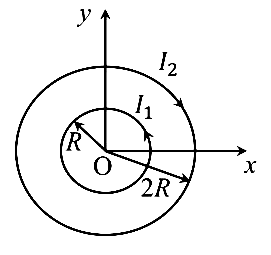
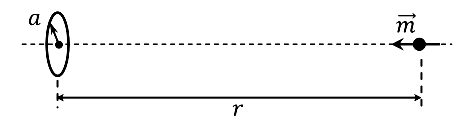
A special metal S conducts electricity without any resistance. A closed wire loop, made of S, does not allow any change in flux through itself by inducing a suitable current to generate a compensating flux. The induced current in the loop cannot decay due to its zero resistance. This current gives rise to a magnetic moment which in turn repels the source of magnetic field or flux. Consider such a loop, of radius a, with its center at the origin. A magnetic dipole of moment m is brought along the axis of this loop from infinity to a point at distance r (>> a) from the center of the loop with its north pole always facing the loop, as shown in the figure below.

The magnitude of magnetic field of a dipole m, at a point on its axis at distance r, is μ02πmr3, where μ0 is the permeability of free space. The magnitude of the force between two magnetic dipoles with moments, m1 and m2, separated by a distance r on the common axis, with their north poles facing each other, is km1m2r4, where k is a constant of appropriate dimensions. The direction of this force is along the line joining the two dipoles.
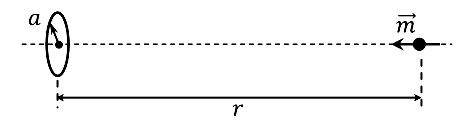
When the dipole m is placed at a distance r from the center of the loop (as shown in the figure), the current induced in the loop will be proportional to
A special metal S conducts electricity without any resistance. A closed wire loop, made of S, does not allow any change in flux through itself by inducing a suitable current to generate a compensating flux. The induced current in the loop cannot decay due to its zero resistance. This current gives rise to a magnetic moment which in turn repels the source of magnetic field or flux. Consider such a loop, of radius a, with its center at the origin. A magnetic dipole of moment m is brought along the axis of this loop from infinity to a point at distance r (>> a) from the center of the loop with its north pole always facing the loop, as shown in the figure below.

The magnitude of magnetic field of a dipole m, at a point on its axis at distance r, is μ02πmr3, where μ0 is the permeability of free space. The magnitude of the force between two magnetic dipoles with moments, m1 and m2, separated by a distance r on the common axis, with their north poles facing each other, is km1m2r4, where k is a constant of appropriate dimensions. The direction of this force is along the line joining the two dipoles.

When the dipole m is placed at a distance r from the center of the loop (as shown in the figure), the current induced in the loop will be proportional to
Q.14 Correct
Q.14 In-correct
Q.14 Unattempt
A special metal S conducts electricity without any resistance. A closed wire loop, made of S, does not allow any change in flux through itself by inducing a suitable current to generate a compensating flux. The induced current in the loop cannot decay due to its zero resistance. This current gives rise to a magnetic moment which in turn repels the source of magnetic field or flux. Consider such a loop, of radius a, with its center at the origin. A magnetic dipole of moment m is brought along the axis of this loop from infinity to a point at distance r (>> a) from the center of the loop with its north pole always facing the loop, as shown in the figure below.

The magnitude of magnetic field of a dipole m, at a point on its axis at distance r, is μ02πmr3, where μ0 is the permeability of free space. The magnitude of the force between two magnetic dipoles with moments, m1 and m2, separated by a distance r on the common axis, with their north poles facing each other, is km1m2r4, where k is a constant of appropriate dimensions. The direction of this force is along the line joining the two dipoles.

The work done in bringing the dipole from infinity to a distance r from the center of the loop by the given process is proportional to
A special metal S conducts electricity without any resistance. A closed wire loop, made of S, does not allow any change in flux through itself by inducing a suitable current to generate a compensating flux. The induced current in the loop cannot decay due to its zero resistance. This current gives rise to a magnetic moment which in turn repels the source of magnetic field or flux. Consider such a loop, of radius a, with its center at the origin. A magnetic dipole of moment m is brought along the axis of this loop from infinity to a point at distance r (>> a) from the center of the loop with its north pole always facing the loop, as shown in the figure below.

The magnitude of magnetic field of a dipole m, at a point on its axis at distance r, is μ02πmr3, where μ0 is the permeability of free space. The magnitude of the force between two magnetic dipoles with moments, m1 and m2, separated by a distance r on the common axis, with their north poles facing each other, is km1m2r4, where k is a constant of appropriate dimensions. The direction of this force is along the line joining the two dipoles.

The work done in bringing the dipole from infinity to a distance r from the center of the loop by the given process is proportional to
Q.15 Correct
Q.15 In-correct
Q.15 Unattempt
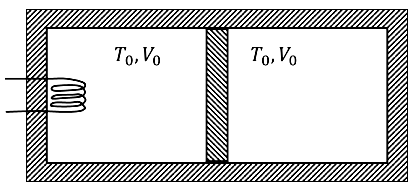
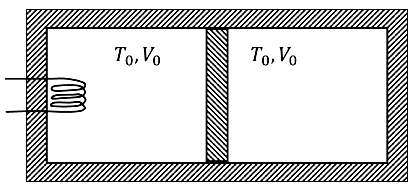
A thermally insulating cylinder has a thermally insulating and frictionless movable partition in the middle, as shown in the figure below. On each side of the partition, there is one mole of an ideal gas, with specific heat at constant volume, CV = 2R. Here, R is the gas constant. Initially, each side has a volume V0 and temperature T0. The left side has an electric heater, which is turned on at very low power to transfer heat Q to the gas on the left side. As a result the partition moves slowly towards the right reducing the right side volume to V0/2. Consequently, the gas temperatures on the left and the right sides become TL and TR, respectively. Ignore the changes in the temperatures of the cylinder, heater and the partition.

The value of TRT0 is
A thermally insulating cylinder has a thermally insulating and frictionless movable partition in the middle, as shown in the figure below. On each side of the partition, there is one mole of an ideal gas, with specific heat at constant volume, CV = 2R. Here, R is the gas constant. Initially, each side has a volume V0 and temperature T0. The left side has an electric heater, which is turned on at very low power to transfer heat Q to the gas on the left side. As a result the partition moves slowly towards the right reducing the right side volume to V0/2. Consequently, the gas temperatures on the left and the right sides become TL and TR, respectively. Ignore the changes in the temperatures of the cylinder, heater and the partition.

The value of TRT0 is
Q.16 Correct
Q.16 In-correct
Q.16 Unattempt
A thermally insulating cylinder has a thermally insulating and frictionless movable partition in the middle, as shown in the figure below. On each side of the partition, there is one mole of an ideal gas, with specific heat at constant volume, CV = 2R. Here, R is the gas constant. Initially, each side has a volume V0 and temperature T0. The left side has an electric heater, which is turned on at very low power to transfer heat Q to the gas on the left side. As a result the partition moves slowly towards the right reducing the right side volume to V0/2. Consequently, the gas temperatures on the left and the right sides become TL and TR, respectively. Ignore the changes in the temperatures of the cylinder, heater and the partition.

The value of QRT0 is
A thermally insulating cylinder has a thermally insulating and frictionless movable partition in the middle, as shown in the figure below. On each side of the partition, there is one mole of an ideal gas, with specific heat at constant volume, CV = 2R. Here, R is the gas constant. Initially, each side has a volume V0 and temperature T0. The left side has an electric heater, which is turned on at very low power to transfer heat Q to the gas on the left side. As a result the partition moves slowly towards the right reducing the right side volume to V0/2. Consequently, the gas temperatures on the left and the right sides become TL and TR, respectively. Ignore the changes in the temperatures of the cylinder, heater and the partition.

The value of QRT0 is
Mockers logo Get latest Exam Updates
& Study Material Alerts!
No, Thanks
Arrow pointer icon
Click on Allow to receive notifications
Notification bell icon ×
Open Now