Please wait...

Solution
Hindi language icon English language icon
Q.16 Correct
Q.16 In-correct
Q.16 Unattempt
In a high school, a committee has to be formed from a group of 6 boys M1, M2, M3, M4, M5, M6 and 5 girls G1, G2, G3, G4, G5.

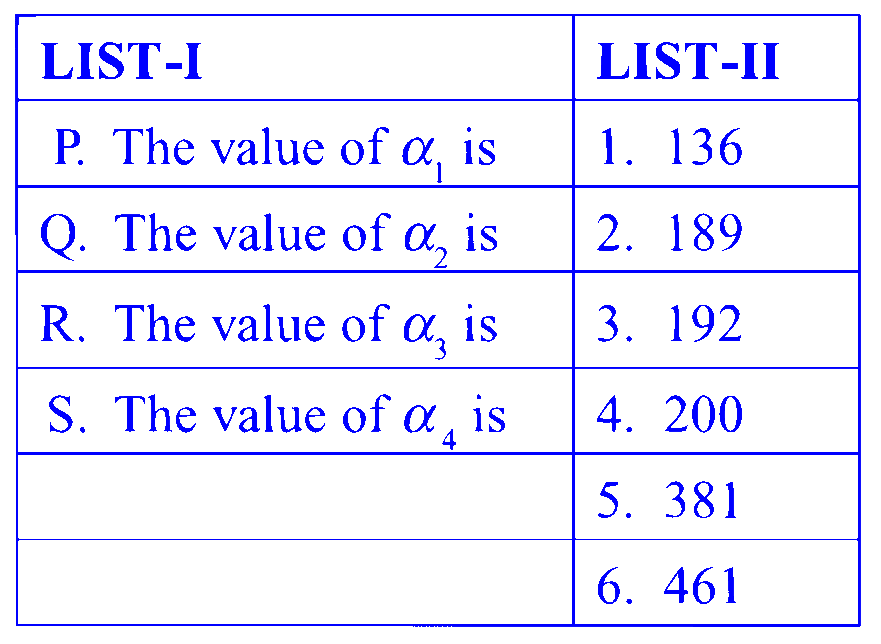
(i) Let α1 be the total number of ways in which the committee can be formed such that the committee has 5 members, having exactly 3 boys and 2 girls.

(ii) Let α2 be the total number of ways in which the committee can be formed such that the committee has at least 2 members, and having an equal number of boys and girls.

i) Let α3 be the total number of ways in which the committee can be formed such that the committee has 5 members, at least 2 of them being girls.

(iv) Let α4 be the total number of ways in which the committee can be formed such that the committee has 4 members, having at least 2 girls such that both M1 and G1 are NOT in the committee together.


The correct option is
In a high school, a committee has to be formed from a group of 6 boys M1, M2, M3, M4, M5, M6 and 5 girls G1, G2, G3, G4, G5.

(i) Let α1 be the total number of ways in which the committee can be formed such that the committee has 5 members, having exactly 3 boys and 2 girls.

(ii) Let α2 be the total number of ways in which the committee can be formed such that the committee has at least 2 members, and having an equal number of boys and girls.

i) Let α3 be the total number of ways in which the committee can be formed such that the committee has 5 members, at least 2 of them being girls.

(iv) Let α4 be the total number of ways in which the committee can be formed such that the committee has 4 members, having at least 2 girls such that both M1 and G1 are NOT in the committee together.


The correct option is
Q.18 Correct
Q.18 In-correct
Q.18 Unattempt
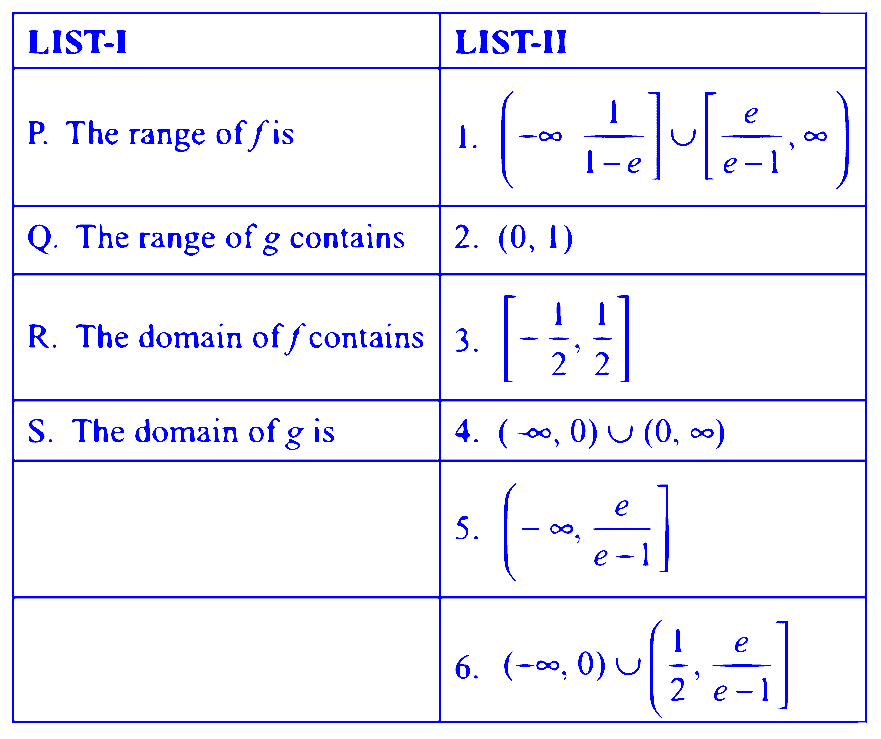
Let f1:RR,f2:(π2,π2)R,f3:(1,eπ/22)R and f4:RR be functions defined by

(i) f1(x)=sin(1ex2),

(ii) f2(x)={|sinx|tan1xifx0,where1ifx=0

the inverse trigonometric function tan1x assumes values in (π2,π2),

(iii) f3(x)=[sin(loge(x+2))], where for tR,[t] denotes the greatest integer less than or equal to t,

(iv)
Q.12 Correct
Q.12 In-correct
Q.12 Unattempt
Match each set of hybrid orbitals from LIST - A with complex(es) given in LIST - B

  List - A     List - B
P. dsp2   1. [FeF6]4-
Q. sp3   2. [Ti(H2O)3Cl3]
R. sp3d2   3. [Cr(NH3)6]3+
S. d2sp3   4. [FeCl4]2-
      5. Ni(CO)4
      6. [Ni(CN)4]2-


The correct option is
Match each set of hybrid orbitals from LIST - A with complex(es) given in LIST - B

  List - A     List - B
P. dsp2   1. [FeF6]4-
Q. sp3   2. [Ti(H2O)3Cl3]
R. sp3d2   3. [Cr(NH3)6]3+
S. d2sp3   4. [FeCl4]2-
      5. Ni(CO)4
      6. [Ni(CN)4]2-


The correct option is
Q.15 Correct
Q.15 In-correct
Q.15 Unattempt
Dilution processes of different aqueous solutions, with water, are given in LIST - I. The effects of dilution of the solutions on [H+] are given in LIST - II

(Note: Degree of dissociation (a) of weak acid and weak base is <<1; degree of hydrolysis of salt <<1; [H+] represents the concentration of H+ ions)

  LIST-I   LIST-II
P. (10 mL of 0.1 M NaOH + 20 mL of
0.1 M acetic acid) diluted to 60 mL
1. the value of [H+] does not change
on dilution
Q. (20 mL of 0.1 M NaOH + 20 mL of
0.1 M acetic acid) diluted to 80 mL
2. the value of [H+] changes to half
of its initial value on dilution
R. (20 mL of 0.1 M HCL + 20 mL of
0.1 M ammonia solution) diluted to
80 mL
3. the value of [H+] changes to two
times of its initial value on dilution
S. 10 mL saturated solution of Ni(OH)2
in equilibrium with excess solid
Ni(OH)2 is diluted to 20 mL (solid
Ni(OH)2 is still present after dilution).
4. the value of [H+] changes to 1/root2
times of its initial value on dilution
    5. the value of [H+] changes to root2
times of its initial value on dilution


Match each process given in LIST-I with one or more effect(s) in LIST-II. The correct option is
Dilution processes of different aqueous solutions, with water, are given in LIST - I. The effects of dilution of the solutions on [H+] are given in LIST - II

(Note: Degree of dissociation (a) of weak acid and weak base is <<1; degree of hydrolysis of salt <<1; [H+] represents the concentration of H+ ions)

  LIST-I   LIST-II
P. (10 mL of 0.1 M NaOH + 20 mL of
0.1 M acetic acid) diluted to 60 mL
1. the value of [H+] does not change
on dilution
Q. (20 mL of 0.1 M NaOH + 20 mL of
0.1 M acetic acid) diluted to 80 mL
2. the value of [H+] changes to half
of its initial value on dilution
R. (20 mL of 0.1 M HCL + 20 mL of
0.1 M ammonia solution) diluted to
80 mL
3. the value of [H+] changes to two
times of its initial value on dilution
S. 10 mL saturated solution of Ni(OH)2
in equilibrium with excess solid
Ni(OH)2 is diluted to 20 mL (solid
Ni(OH)2 is still present after dilution).
4. the value of [H+] changes to 1/root2
times of its initial value on dilution
    5. the value of [H+] changes to root2
times of its initial value on dilution


Match each process given in LIST-I with one or more effect(s) in LIST-II. The correct option is
Q.15 Correct
Q.15 In-correct
Q.15 Unattempt
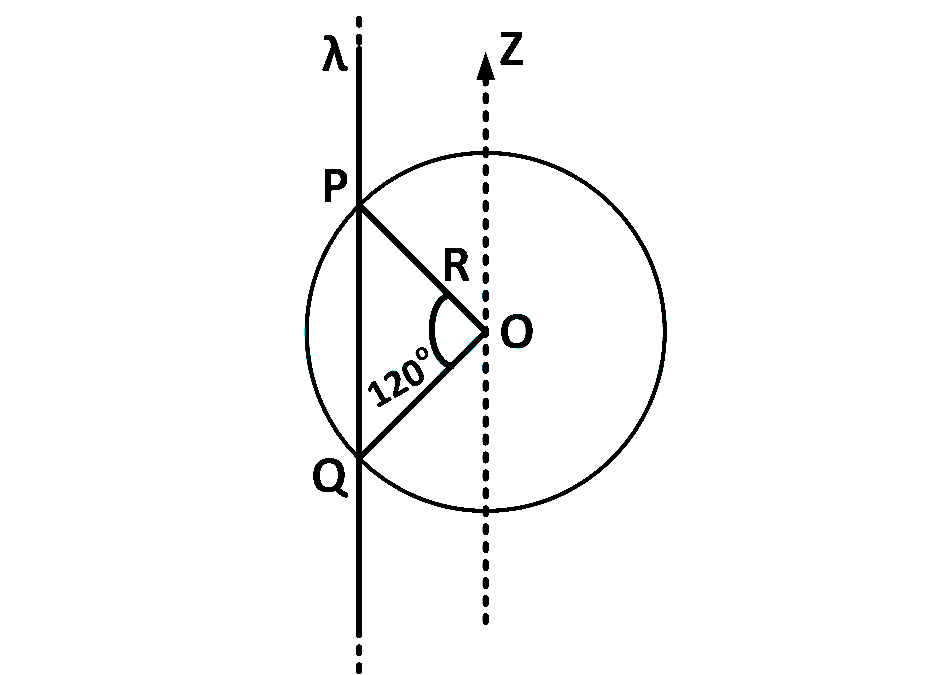
The electric field E is measured at a point P(0,0,d) generated due to various charge distributions and the dependence of E on d is found to be different for different charge distributions. List-I contains different relations between E and d. List-II describes different electric charge distributions, along with their locations. Match the functions in List-I with the related charge distributions in List-II.

LIST - I LIST - II
P. E is independent of d 1. A point charge Q at the origin
Q. E1/d 2. A small dipole with point charges
Q at (0,0,l) and Q at
(0,0,l). Take 2l<<d
R. E1/d2 3. An infinite line charge coincident
with the x-axis, with uniform linear charge density λ
S. E1/d3 4. Two infinite wires carrying
uniform linear charge density
parallel to the x-axis. The one
along (y=0,z=l) has
a charge density +λ and the one
along (y=0,z=l) has a
charge density Take
    5. Infinite plane charge coincident
with the xy-plane with uniform surface charge density
The electric field E is measured at a point P(0,0,d) generated due to various charge distributions and the dependence of E on d is found to be different for different charge distributions. List-I contains different relations between E and d. List-II describes different electric charge distributions, along with their locations. Match the functions in List-I with the related charge distributions in List-II.

LIST - I LIST - II
P. E is independent of d 1. A point charge Q at the origin
Q. E1/d 2. A small dipole with point charges
Q at (0,0,l) and Q at
(0,0,l). Take 2l<<d
R. E1/d2 3. An infinite line charge coincident
with the x-axis, with uniform linear charge density λ
S. E1/d3 4. Two infinite wires carrying
uniform linear charge density
parallel to the x-axis. The one
along (y=0,z=l) has
a charge density +λ and the one
along (y=0,z=l) has a
charge density Take
    5. Infinite plane charge coincident
with the xy-plane with uniform surface charge density
Q.16 Correct
Q.16 In-correct
Q.16 Unattempt
A planet of mass M, has two natural satellites with masses m1 and m2. The radii of their circular orbits are R1 and R2 respectively, Ignore the gravitational force between the satellites. Define v1,L1,K1 and T1 to be , respectively, the orbital speed, angular momentum, kinetic energy and time period of revolution of satellite 1; and v2,L2,K2, and T2 to be the corresponding quantities of satellite 2. Given m1/m2=2 and R1/R2=1/4, match the ratios in List-I to the numbers in List-II.

LIST - I LIST - II
P. v1/v2 1. 1/8
Q. L1/L2 2. 1
R. K1/K2 3. 2
S. T1/T2 4. 8
A planet of mass M, has two natural satellites with masses m1 and m2. The radii of their circular orbits are R1 and R2 respectively, Ignore the gravitational force between the satellites. Define v1,L1,K1 and T1 to be , respectively, the orbital speed, angular momentum, kinetic energy and time period of revolution of satellite 1; and v2,L2,K2, and T2 to be the corresponding quantities of satellite 2. Given m1/m2=2 and R1/R2=1/4, match the ratios in List-I to the numbers in List-II.

LIST - I LIST - II
P. v1/v2 1. 1/8
Q. L1/L2 2. 1
R. K1/K2 3. 2
S. T1/T2 4. 8
Q.17 Correct
Q.17 In-correct
Q.17 Unattempt
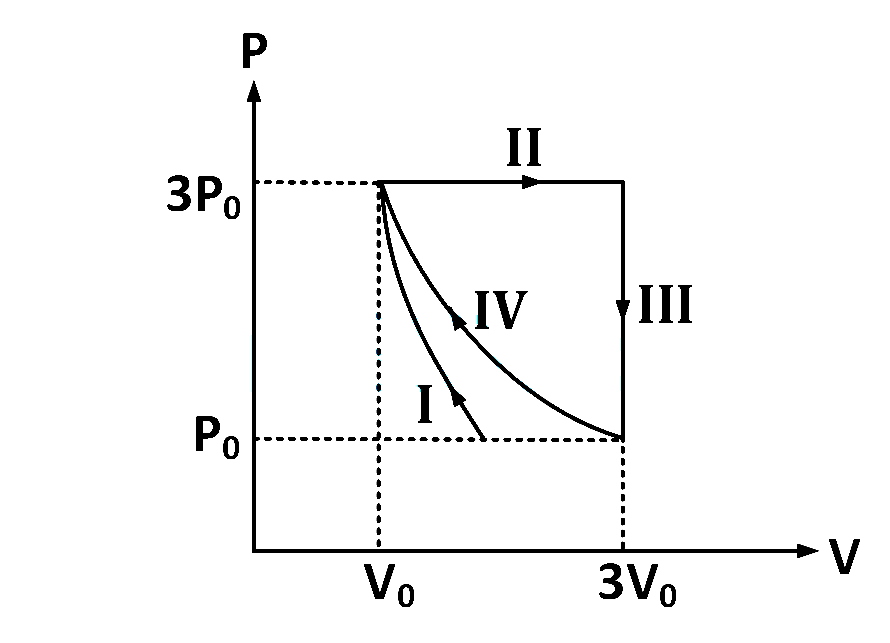
One mole of a monatomic ideal gas undergoes four thermodynamic processes as shown schematically in the PV-diagram below. Among these four processes, one is isobaric, one is isochoric, one is isothermal and one is adiabatic. Match the processes mentioned in List-I with the corresponding statements in List-II.


LIST - I LIST - II
P. In process I 1. Work done by the gas is zero
Q. In process II 2. Temperature of the gas remains
unchanged
R. In process III 3. No heat is exchanged between
the gas and its surroundings
S. In process IV 4. Work done by the gas is 6P0V0
One mole of a monatomic ideal gas undergoes four thermodynamic processes as shown schematically in the PV-diagram below. Among these four processes, one is isobaric, one is isochoric, one is isothermal and one is adiabatic. Match the processes mentioned in List-I with the corresponding statements in List-II.


LIST - I LIST - II
P. In process I 1. Work done by the gas is zero
Q. In process II 2. Temperature of the gas remains
unchanged
R. In process III 3. No heat is exchanged between
the gas and its surroundings
S. In process IV 4. Work done by the gas is 6P0V0
Q.18 Correct
Q.18 In-correct
Q.18 Unattempt
In the List-I below, four different paths of a particle are given as functions of time. In these functions, α and β are positive constants of appropriate dimensions and αβ In each case, the force acting on the particle is either zero or conservative. In List-II, five physical quantities of the particle are mentioned p is the linear momentum, L is the angular momentum about the origin, K is the kinetic energy, U is the potential energy and E is the total energy. Match each path in List-I with those quantities in List-II, which are conserved for that path.

LIST - I LIST - II
P. r(t)=α ti^+βtj^ 1. p
Q. r(t)=αcosωti^+βsinωtj^ 2. L
R. r(t)=α(cosωti^+sinωtj^) 3. K
S. r(t)=αti^+β2t2j^ 4. U
 
In the List-I below, four different paths of a particle are given as functions of time. In these functions, α and β are positive constants of appropriate dimensions and αβ In each case, the force acting on the particle is either zero or conservative. In List-II, five physical quantities of the particle are mentioned p is the linear momentum, L is the angular momentum about the origin, K is the kinetic energy, U is the potential energy and E is the total energy. Match each path in List-I with those quantities in List-II, which are conserved for that path.

LIST - I LIST - II
P. r(t)=α ti^+βtj^ 1. p
Q. r(t)=αcosωti^+βsinωtj^ 2. L
R. r(t)=α(cosωti^+sinωtj^) 3. K
S. r(t)=αti^+β2t2j^ 4. U
 
Mockers logo Get latest Exam Updates
& Study Material Alerts!
No, Thanks
Arrow pointer icon
Click on Allow to receive notifications
Notification bell icon ×
Open Now