Please wait...
A tube of length 1 m is filled completely with an ideal liquid of mass 2 M , and closed at both ends. The tube is rotated uniformly in horizontal plane about one of its ends. If the force exerted by the liquid at the other end is F then angular velocity of the tube is $\sqrt{\frac{\mathrm{F}}{\alpha \mathrm{M}}}$ in SI unit. The value of $\alpha$ is _________.
A string of length $L$ is fixed at one end and carries a mass of $M$ at the other end. The mass makes $\left(\frac{3}{\pi}\right)$ rotations per second about the vertical axis passing through end of the string as shown. The tension in the string is __________ ML.
A particle of charge $1.6 \mu \mathrm{C}$ and mass $16 \mu \mathrm{~g}$ is present in a strong magnetic field of 6.28 T . The particle is then fired perpendicular to magnetic field. The time required for the particle to return to original location for the first time is _________ s. $(\pi=3.14)$
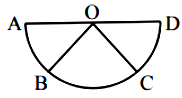
A bob of mass $m$ is suspended at a point $O$ by a light string of length $l$ and left to perform vertical motion (circular) as shown in figure. Initially, by applying horizontal velocity $v_0$ at the point ' A ', the string becomes slack when, the bob reaches at the point ' $D$ '. The ratio of the kinetic energy of the bob at the points B and C is _________.
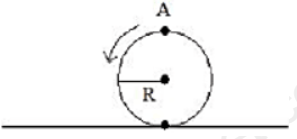
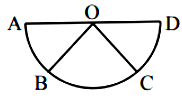
A body of mass 100 g is moving in circular path of radius 2 m on vertical plane as shown in figure. The velocity of the body at point $A$ is $10 \mathrm{~m} / \mathrm{s}$. The ratio of its kinetic energies at point B and C is :
(Take acceleration due to gravity as $10 \mathrm{~m} / \mathrm{s}^2$)
A car of mass ' $m$ ' moves on a banked road having radius ' $r$ ' and banking angle $\theta$. To avoid slipping from banked road, the maximum permissible speed of the car is $v_0$. The coefficient of friction $\mu$ between the wheels of the car and the banked road is
A body of mass ‘m’ connected to a massless and unstretchable string goes in vertical circle of radius ‘R’ under gravity g. The other end of the string is fixed at the center of circle. If velocity at top of circular path is $n\sqrt{ g R}$ , where, n ≥ 1, then ratio of kinetic energy of the body at bottom to that at top of the circle is :
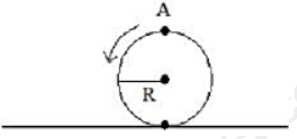
A wheel is rolling on a plane surface. The speed of a particle on the highest point of the rim is $8 \mathrm{~m} / \mathrm{s}$. The speed of the particle on the rim of the wheel at the same level as the centre of wheel, will be :
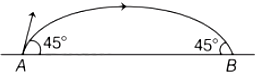
A particle is projected at an angle of $30^{\circ}$ from horizontal at a speed of $60 \mathrm{~m} / \mathrm{s}$. The height traversed by the particle in the first second is $\mathrm{h}_0$ and height traversed in the last second, before it reaches the maximum height, is $h_1$. The ratio $h_0: h_1$ is __________.
[Take, $\mathrm{g}=10 \mathrm{~m} / \mathrm{s}^2$ ]
The maximum speed of a boat in still water is 27 km/h. Now this boat is moving downstream in a river flowing at 9 km/h. A man in the boat throws a ball vertically upwards with speed of 10 m/s. Range of the ball as observed by an observer at rest on the bank is __________ cm. (Take $g=10$ m/s2)
A ball of mass 100 g is projected with velocity $20 \mathrm{~m} / \mathrm{s}$ at $60^{\circ}$ with horizontal. The decrease in kinetic energy of the ball during the motion from point of projection to highest point is
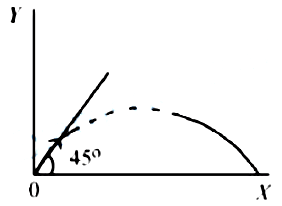
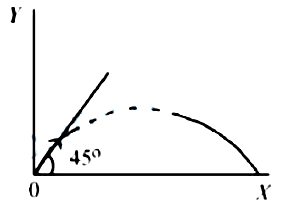
An object of mass ' m ' is projected from origin in a vertical xy plane at an angle $45^{\circ}$ with the $\mathrm{x}-$ axis with an initial velocity $\mathrm{v}_0$. The magnitude and direction of the angular momentum of the object with respect to origin, when it reaches at the maximum height, will be [ g is acceleration due to gravity]
The position vector of a moving body at any instant of time is given as $\overrightarrow{\mathrm{r}}=\left(5 \mathrm{t}^2 \hat{i}-5 \mathrm{t} \hat{j}\right) \mathrm{m}$. The magnitude and direction of velocity at $t=2 s$ is,
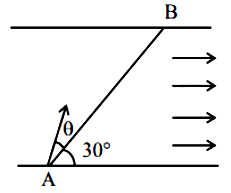
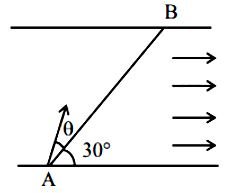
A river is flowing from west to east direction with speed of $9 \mathrm{~km} \mathrm{~h}^{-1}$. If a boat capable of moving at a maximum speed of $27 \mathrm{~km} \mathrm{~h}^{-1}$ in still water, crosses the river in half a minute, while moving with maximum speed at an angle of $150^{\circ}$ to direction of river flow, then the width of the river is :
The angle of projection of a particle is measured from the vertical axis as $\phi$ and the maximum height reached by the particle is $\mathrm{h}_{\mathrm{m}}$. Here $\mathrm{h}_{\mathrm{m}}$ as function of $\phi$ can be presented as
A particle is projected with velocity $u$ so that its horizontal range is three times the maximum height attained by it. The horizontal range of the projectile is given as $\frac{n u^2}{25 g}$, where value of $n$ is: (Given, ' $g$ ' is the acceleration due to gravity.)
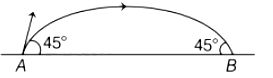
Two projectiles are fired from ground with same initial speeds from same point at angles $\left(45^{\circ}+\right.$ $\alpha)$ and $\left(45^{\circ}-\alpha\right)$ with horizontal direction. The ratio of their times of flights is
A helicopter flying horizontally with a speed of 360 km/h at an altitude of 2 km, drops an object at an instant. The object hits the ground at a point O, 20 s after it is dropped. Displacement of 'O' from the position of helicopter where the object was released is :
(use acceleration due to gravity g = 10 m/s2 and neglect air resistance)
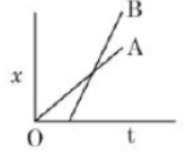
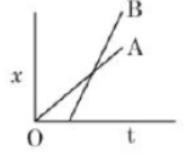
Two cars P and Q are moving on a road in the same direction. Acceleration of car P increases linearly with time whereas car Q moves with a constant acceleration. Both cars cross each other at time t = 0, for the first time. The maximum possible number of crossing(s) (including the crossing at t = 0) is ________.
A person travelling on a straight line moves with a uniform velocity $v_1$ for a distance $x$ and with a uniform velocity $v_2$ for the next $\frac{3}{2} x$ distance. The average velocity in this motion is $\frac{50}{7} \mathrm{~m} / \mathrm{s}$. If $v_1$ is $5 \mathrm{~m} / \mathrm{s}$ then $v_2=$ __________ $\mathrm{m} / \mathrm{s}$.
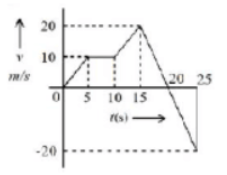
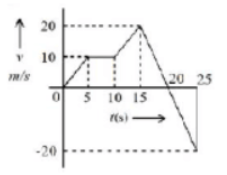
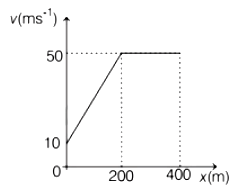
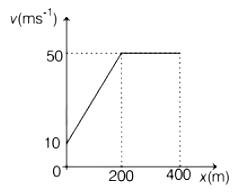
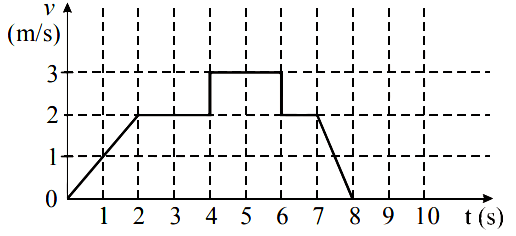
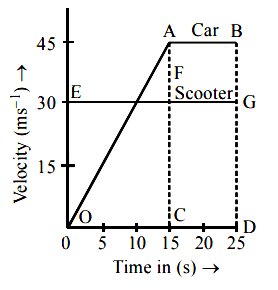
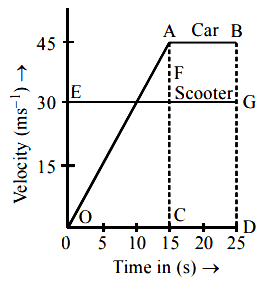
The motion of an airplane is represented by velocity-time graph as shown below. The distance covered by airplane in the first 30.5 second is ̱_______ km .
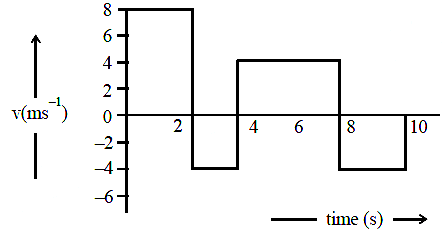
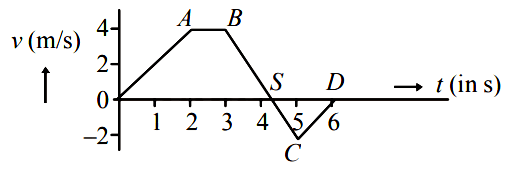
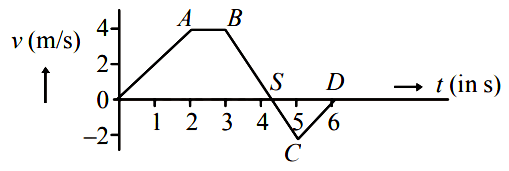
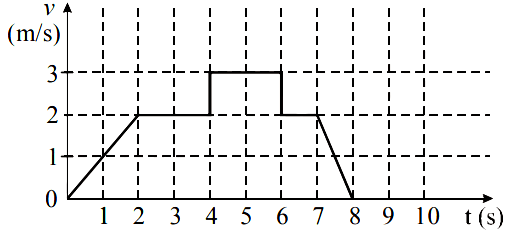
The velocity-time graph of an object moving along a straight line is shown in the figure. What is the distance covered by the object between $t = 0$ to $t = 4s$?
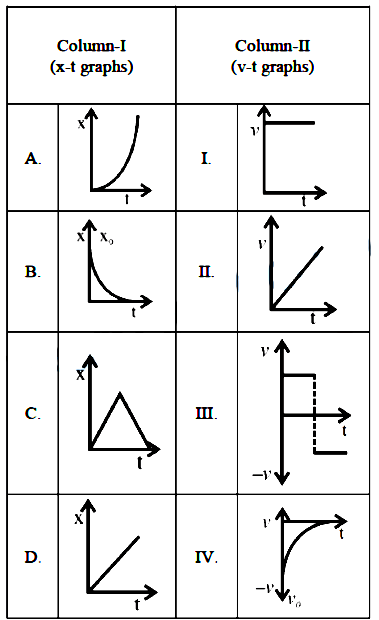
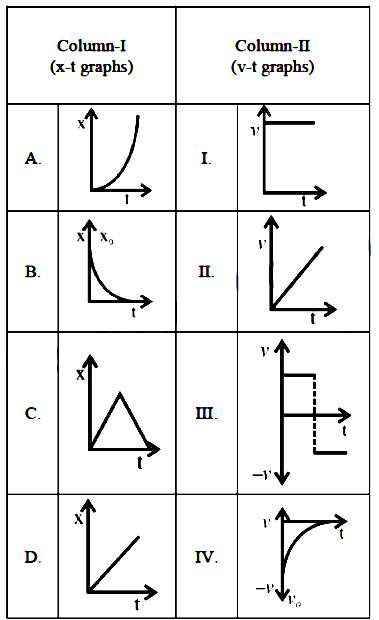
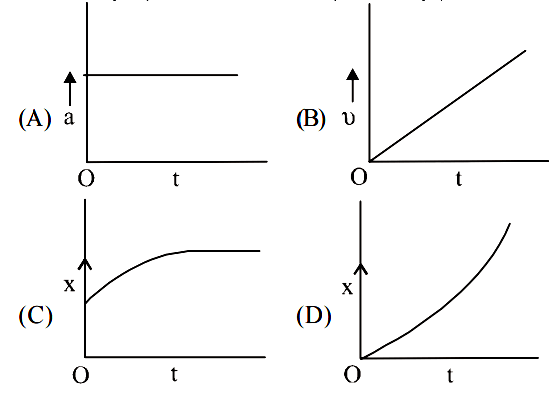
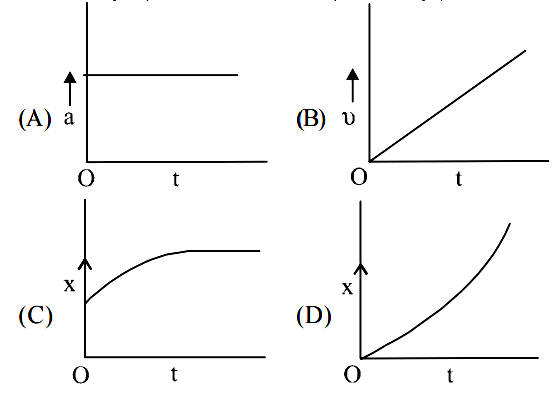
$$ \text {Which of the following curves possibly represent one-dimensional motion of a particle? } $$
Choose the correct answer from the options given below :
A particle moves along the $x$-axis and has its displacement $x$ varying with time t according to the equation:
$$ x=\mathrm{c}_0\left(\mathrm{t}^2-2\right)+\mathrm{c}(\mathrm{t}-2)^2 $$
where $\mathrm{c}_0$ and c are constants of appropriate dimensions.
Then, which of the following statements is correct?
The displacement x versus time graph is shown below.
(A) The average velocity during 0 to 3 s is $10 \mathrm{~m} / \mathrm{s}$
(B) The average velocity during 3 to 5 s is $0 \mathrm{~m} / \mathrm{s}$
(C) The instantaneous velocity at $\mathrm{t}=2 \mathrm{~s}$ is $5 \mathrm{~m} / \mathrm{s}$
(D) The average velocity during 5 to 7 s and instantaneous velocity at $\mathrm{t}=6.5 \mathrm{~s}$ are equal
(E) The average velocity from $t=0$ to $t=9 \mathrm{~s}$ is zero
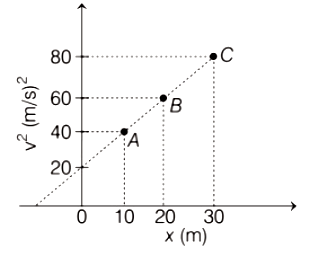
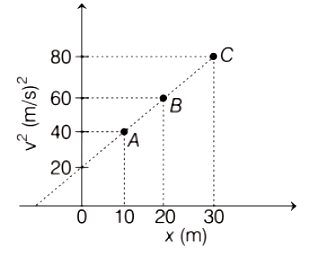
A bullet is fired into a fixed target looses one third of its velocity after travelling 4cm. It penetrates further D × 10−3m before coming to rest. The value of D is :
[27-Jan-2024 Shift 2]
A body falling under gravity covers two points A and B separated by 80m in 2 s. The distance of upper point A from the starting point is____ m (. use g = 10ms−2)
A body starts moving from rest with constant acceleration covers displacement S1 in first ( p − 1 ) seconds and S2 in first p seconds. The displacement S1 + S2 will be made in time :
[29-Jan-2024 Shift 1]
A particle is moving in a straight line. The variation of position ' x ' as a function of time ' t ' is given as
x = (t3 − 6t2 + 20t + 15)m. The velocity of the body when its acceleration becomes zero is :
[29-Jan-2024 Shift 2]
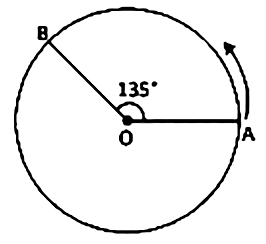
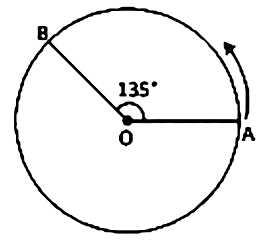
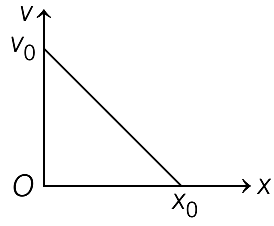
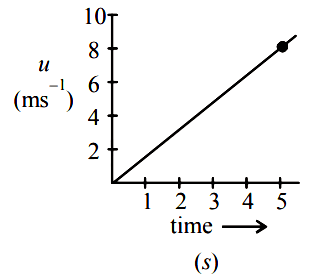
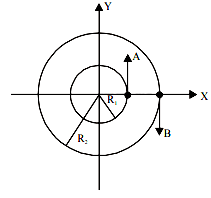
A particle is moving in a circle of radius 50cm in such a way that at any instant the normal and tangential components of its acceleration are equal. If its speed at t = 0 is 4m∕ s, the time taken to complete the first revolution will be where α =
The displacement and the increase in the velocity of a moving particle in the time interval of t to (t + 1) s are 125m and 50m∕ s, respectively. The distance travelled by the particle in (t + 2)th s is ____m.
[30-Jan-2024 Shift 1]
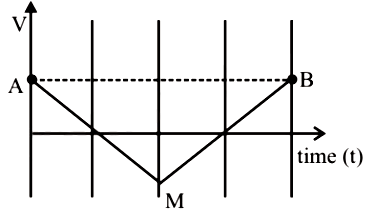
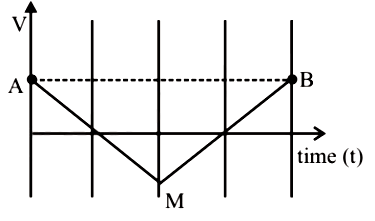
A small steel ball is dropped into a long cylinder containing glycerine. Which one of the following is the correct representation of the velocity time graph for the transit of the ball?
[31-Jan-2024 Shift 1]
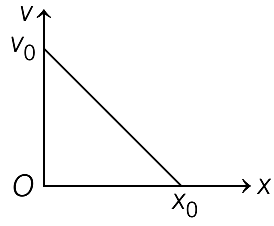
The relation between time ' t ' and distance ' x ' is t = αx2 + βx, where α and β are constants. The relation between acceleration (a) and velocity (v) is:
If the radius of curvature of the path of two particles of same mass are in the ratio 3:4, then in order to have constant centripetal force, their velocities will be in the ratio of:
A ball rolls off the top of a stairway with horizontal velocity u. The steps are 0.1m high and 0.1m wide. The minimum velocity u with which that ball just hits the step 5 of the stairway will be √xms−1 where x = ________ [use g = 10m∕ s2].
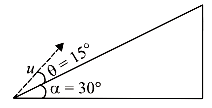
A particle of mass m projected with a velocity ' u ' making an angle of 30∘ with the horizontal. The magnitude of angular momentum of the projectile about the point of projection when the particle is at its maximum height h is :
Projectiles A and B are thrown at angles of 45∘ and 60∘ with vertical respectively from top of a 400m high tower. If their ranges and times of flight are same, the ratio of their speeds of projection vA : vB is :
[30-Jan-2024 Shift 2]
A body starts falling freely from height H hits an inclined plane in its path at height h. As a result of this perfectly elastic impact, the direction of the velocity of the body becomes horizontal. The value of H/h for which the body will take the maximum time to reach the ground is_____
A particle is moving in one dimension (along x axis) under the action of a variable force. It's initial position was 16m right of origin. The variation of its position (x) with time (t) is given as x = −3t3 + 18t2 + 16t, where x is in m and t is in s. The velocity of the particle when its acceleration becomes zero is_______ m∕ s.
[1-Feb-2024 Shift 1]
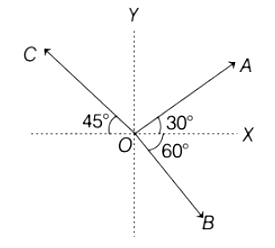
Train A is moving along two parallel rail tracks towards north with speed 72km∕h and train B is moving towards south with speed 108km∕h. Velocity of train B with respect to A and velocity of ground with respect to B are (in ms−1) :
[1-Feb-2024 Shift 2]
A particle initially at rest starts moving from reference point. x = 0 along x-axis, with velocity v that varies as v = 4√xm∕ s. The acceleration of the particle is____ ms−2.
A particle moving in a circle of radius R with uniform speed takes time T to complete one revolution. If this particle is projected with the same speed at an angle θ to the horizontal, the maximum height attained by it is equal to 4R. The angle of projection θ is then given by :



 ×
×
 Bank
Bank


 SSC
SSC


 Railway


 State
State


 Other
Other


 Teaching


 Insurance


 Medical


 Engineering


 Defence


 GATE
GATE


 NTA CUET

 UPSC
UPSC

 MBA Entrance


 LAW
LAW

 ReNEET UG 2026
 SSC Selection Post (Phase 14) 2026
 RRB NTPC 2026
 SSC CGL Tier-I 2026
 SSC JE 2026
 SBI PO Prelims 2026
 SSC Steno Grade C & D 2026
 SBI Clerk Prelims 2026
 IBPS PO Prelims 2026
 IBPS Clerk Prelims 2026
 SSC CPO Tier I 2026
 NDA II 2026
 CDS II 2026












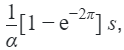 where α =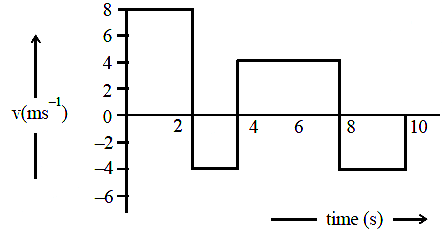


 Get latest Exam Updates