Please wait...
A balloon and its content having mass M is moving up with an acceleration ‘a’. The mass that must be released from the content so that the balloon starts moving up with an acceleration ‘3a’ will be
(Take ‘g’ as acceleration due to gravity)
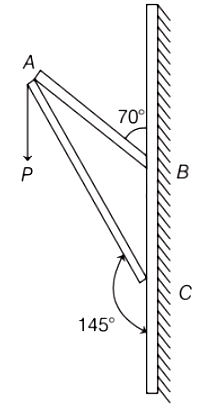
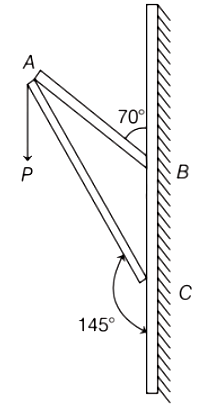
A body of mass 1 kg is suspended with the help of two strings making angles as shown in figure. Magnitudes of tensions $\mathrm{T}_1$ and $\mathrm{T}_2$, respectively, are (in N ) :
(Take acceleration due to gravity $10 \mathrm{~m} / \mathrm{s}^2$ )
A block of mass 1 kg , moving along $x$ with speed $v_i=10 \mathrm{~m} / \mathrm{s}$ enters a rough region ranging from $x=0.1 \mathrm{~m}$ to $x=1.9 \mathrm{~m}$. The retarding force acting on the block in this range is $\mathrm{F}_{\mathrm{r}}=-\mathrm{kr} \mathrm{N}$, with k $=10 \mathrm{~N} / \mathrm{m}$. Then the final speed of the block as it crosses rough region is.
A body of mass $m$ is suspended by two strings making angles $\theta_1$ and $\theta_2$ with the horizontal ceiling with tensions $T_1$ and $T_2$ simultaneously. $T_1$ and $T_2$ are related by $T_1=\sqrt{3} T_2$, the angles $\theta_1$ and $\theta_2$ are
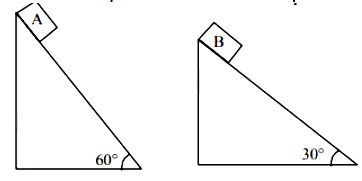
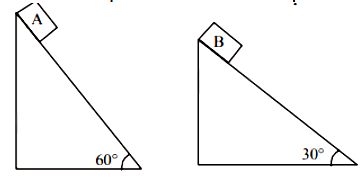
A cubic block of mass $m$ is sliding down on an inclined plane at $60^{\circ}$ with an acceleration of $\frac{g}{2}$, the value of coefficient of kinetic friction is
An object with mass 500 g moves along x-axis with speed $v = 4\sqrt{x}$ m/s. The force acting on the object is :
A body of mass 2 kg moving with velocity of $ \vec{v}_{in} = 3 \hat{i} + 4 \hat{j} \text{ ms}^{-1} $ enters into a constant force field of 6N directed along positive z-axis. If the body remains in the field for a period of $ \frac{5}{3} $ seconds, then velocity of the body when it emerges from force field is.
A body of mass 1000kg is moving horizontally with a velocity 6m∕ s. If 200kg extra mass is added, the final velocity (in m∕ s ) is:
[27-Jan-2024 Shift 1]
A train is moving with a speed of 12m∕ s on rails which are 1.5m apart. To negotiate a curve radius 400m, the height by which the outer rail should be raised with respect to the inner rail is (Given, g = 10m∕ s2):
A heavy iron bar of weight 12kg is having its one end on the ground and the other on the shoulder of a man. The rod makes an angle 60∘ with the horizontal, the weight experienced by the man is :
[27-Jan-2024 Shift 2]
Given below are two statements :
Statement (I) : The limiting force of static friction depends on the area of contact and independent of materials. Statement (II) : The limiting force of kinetic friction is independent of the area of contact and depends on materials. In the light of the above statements, choose the most appropriate answer from the options given below :
A stone of mass 900g is tied to a string and moved in a vertical circle of radius 1m making 10rpm. The tension in the string, when the stone is at the lowest point is (if π2 = 9.8 and g = 9.8m∕ s2)
[29-Jan-2024 Shift 2]
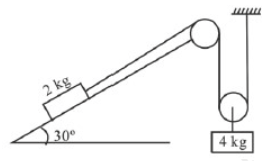
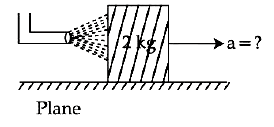
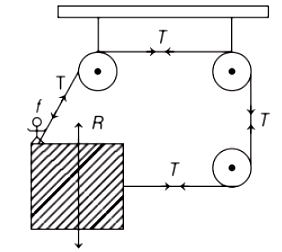
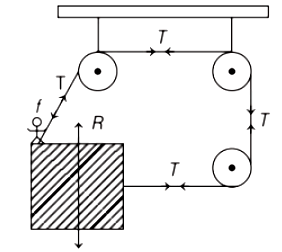
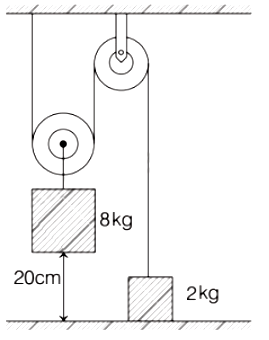
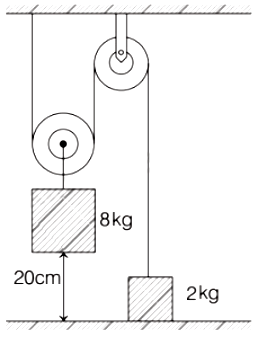
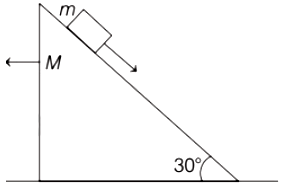
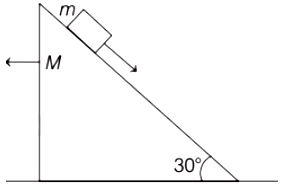
All surfaces shown in figure are assumed to be frictionless and the pulleys and the string are light. The acceleration of the block of mass 2kg is :
[30-Jan-2024 Shift 1]
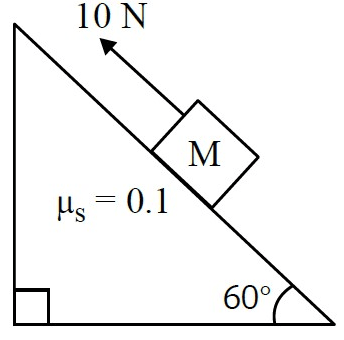
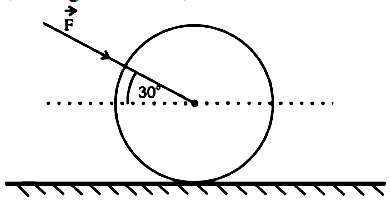
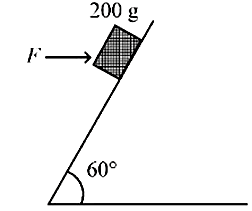
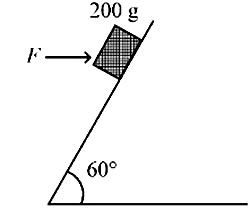
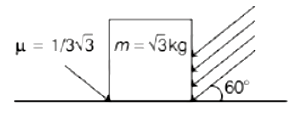
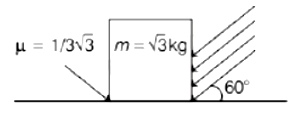
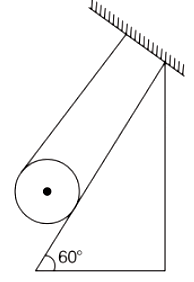
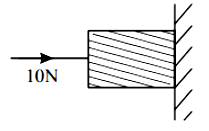
A block of mass 1kg is pushed up a surface inclined to horizontal at an angle of 60∘ by a force of 10N parallel to the inclined surface as shown in figure. When the block is pushed up by 10m along inclined surface, the work done against frictional force is : [g = 10m∕ s2]
[30-Jan-2024 Shift 2]
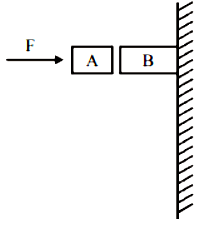
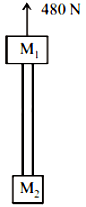
Three blocks A, B and C are pulled on a horizontal smooth surface by a force of 80N as shown in figure
The tensions T1 and T2 in the string are respectively:
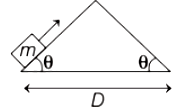
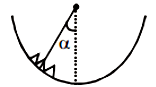
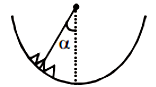
A block of mass m is placed on a surface having vertical cross section given by y = x2∕4. If coefficient of friction is 0.5 , the maximum height above the ground at which block can be placed without slipping is:
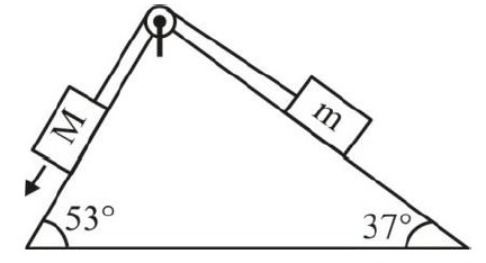
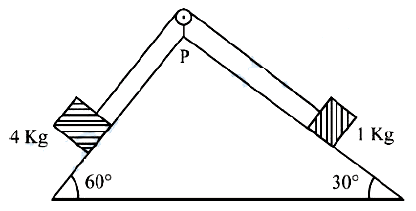
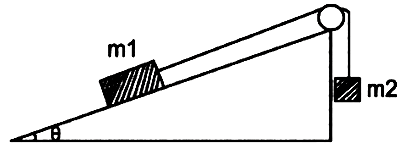
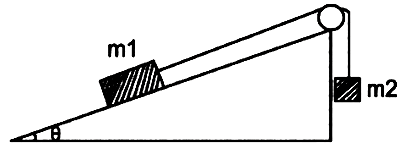
In the given arrangement of a doubly inclined plane two blocks of masses M and m are placed. The blocks are connected by a light string passing over an ideal pulley as shown. The coefficient of friction between the surface of the plane and the blocks is 0.25 . The value of m, for which M = 10 kg will move down with an acceleration of 2m∕s2, is : (. take g=10m∕s2 and tan37∘ = 3∕4)
[31-Jan-2024 Shift 1]
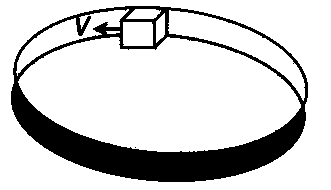
A coin is placed on a disc. The coefficient of friction between the coin and the disc is µ. If the distance of the coin from the center of the disc is r, the maximum angular velocity which can be given to the disc, so that the coin does not slip away, is :
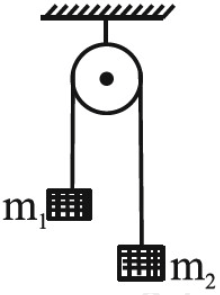
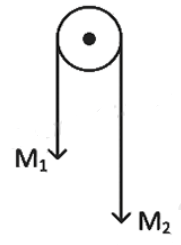
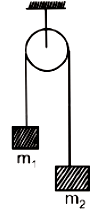
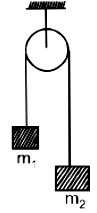
A light string passing over a smooth light fixed pulley connects two blocks of masses m1 and m2. If the acceleration of the system is g∕8, then the ratio of masses is
[31-Jan-2024 Shift 2]
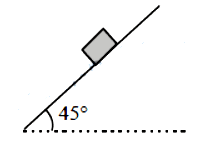
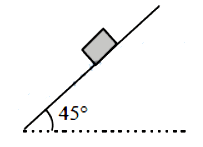
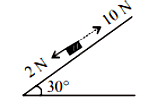
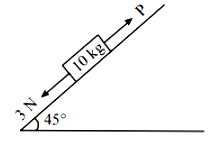
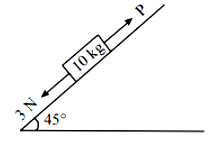
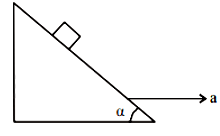
A block of mass 5kg is placed on a rough inclined surface as shown in the figure.
If is the force required to just move the block up the inclined plane and is the force required to just prevent the block from sliding down, then the value of is : [Use g=10m∕ s2]
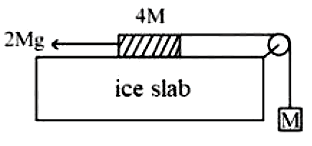
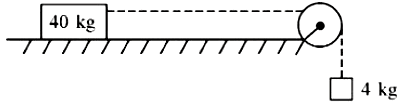
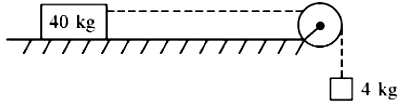
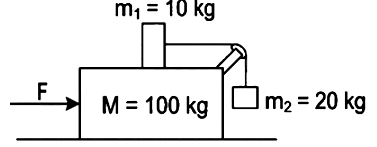
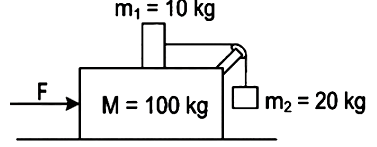
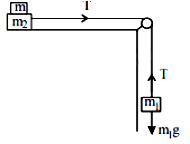
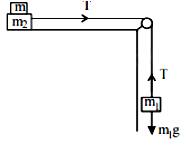
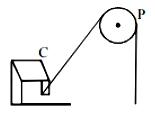
Consider a block and trolley system as shown in figure. If the coefficient of kinetic friction between the trolley and the surface is 0.04 , the acceleration of the system in ms−2 is :
(Consider that the string is massless and unstretchable and the pulley is also massless and frictionless) :
[1-Feb-2024 Shift 1]
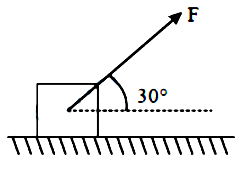
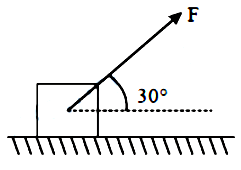
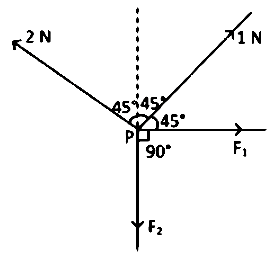
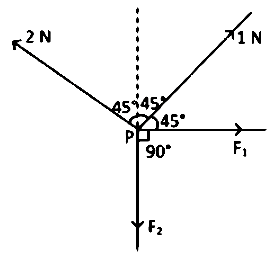
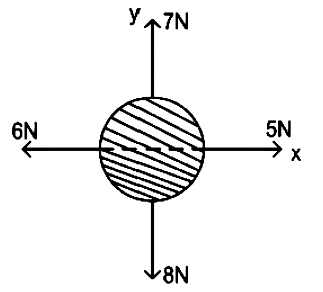
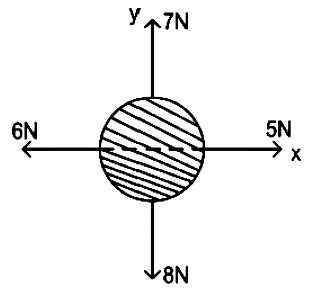
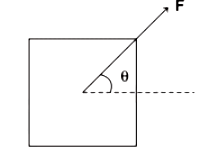
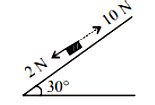
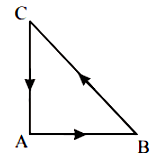
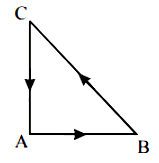
A body of mass 4 kg experiences two forces The acceleration acting on the body is :
[1-Feb-2024 Shift 2]
A cricket player catches a ball of mass 120g moving with 25m∕ s speed. If the catching process is completed in 0.1 s then the magnitude of force exerted by the ball on the hand of player will be (in SI unit):



 ×
×
 Bank
Bank


 SSC
SSC


 Railway


 State
State


 Other
Other


 Teaching


 Insurance


 Medical


 Engineering


 Defence


 GATE
GATE


 NTA CUET

 UPSC
UPSC

 MBA Entrance


 LAW
LAW

 ReNEET UG 2026
 SSC Selection Post (Phase 14) 2026
 RRB NTPC 2026
 SSC CGL Tier-I 2026
 SSC JE 2026
 SBI PO Prelims 2026
 SSC Steno Grade C & D 2026
 SBI Clerk Prelims 2026
 IBPS PO Prelims 2026
 IBPS Clerk Prelims 2026
 SSC CPO Tier I 2026
 NDA II 2026
 CDS II 2026


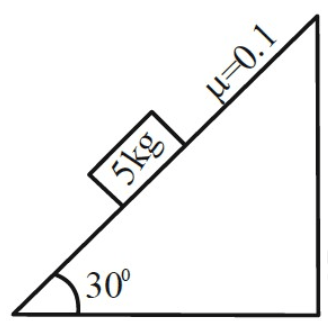
 is the force required to just move the block up the inclined plane and
  is the force required to just prevent the block from sliding down, then the value of
 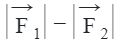 is : [Use g=10m∕ s2]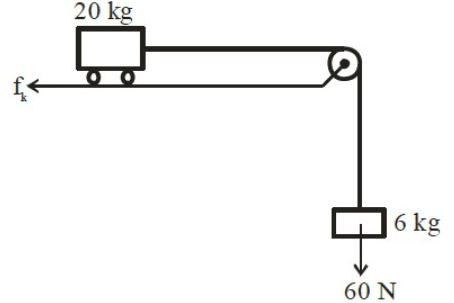
 The acceleration acting on the body is :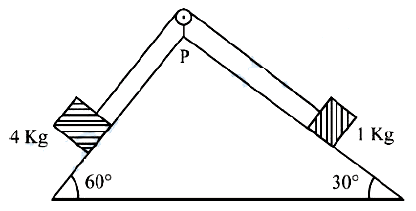




 Get latest Exam Updates