Please wait...
A force $\mathrm{f}=\mathrm{x}^2 \mathrm{y} \hat{\mathrm{i}}+\mathrm{y}^2 \hat{\mathrm{j}}$ acts on a particle in a plane $\mathrm{x}+\mathrm{y}=10$. The work done by this force during a displacement from $(0,0)$ to $(4 \mathrm{~m}, 2 \mathrm{~m})$ is _________ Joule (round off to the nearest integer)
In a hydraulic lift, the surface area of the input piston is 6 cm2 and that of the output piston is 1500 cm2. If 100 N force is applied to the input piston to raise the output piston by 20 cm, then the work done is _______ kJ.
A force $\overrightarrow{\mathrm{F}}=2 \hat{i}+\mathrm{b} \hat{j}+\hat{k}$ is applied on a particle and it undergoes a displacement $\hat{i}-2 \hat{j}-\hat{k}$ What will be the value of $b$, if work done on the particle is zero.
A ball having kinetic energy KE, is projected at an angle of $60^{\circ}$ from the horizontal. What will be the kinetic energy of ball at the highest point of its flight?
A force $\mathrm{F}=\alpha+\beta \mathrm{x}^2$ acts on an object in the x -direction. The work done by the force is 5 J when the object is displaced by 1 m . If the constant $\alpha=1 \mathrm{~N}$ then $\beta$ will be
Given below are two statements: one is labelled as Assertion A and the other is labelled as Reason $\mathbf{R}$
Assertion A: In a central force field, the work done is independent of the path chosen.
Reason R: Every force encountered in mechanics does not have an associated potential energy.
In the light of the above statements, choose the most appropriate answer from the options given below
A bead of mass ' $m$ ' slides without friction on the wall of a vertical circular hoop of radius ' $R$ ' as shown in figure. The bead moves under the combined action of gravity and a massless spring (k) attached to the bottom of the hoop. The equilibrium length of the spring is ' $R$ '. If the bead is released from top of the hoop with (negligible) zero initial speed, velocity of bead, when the length of spring becomes ' $R$ ', would be (spring constant is ' $k$ ', $g$ is accleration due to gravity)
A sand dropper drops sand of mass m(t) on a conveyer belt at a rate proportional to the square root of speed (v) of the belt, i.e., $\frac{dm}{dt} \propto \sqrt{v}$. If P is the power delivered to run the belt at constant speed then which of the following relationship is true?
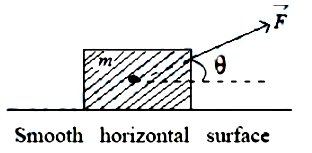
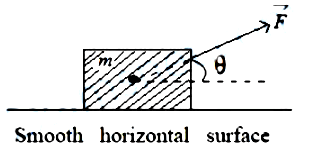
A block of mass 25 kg is pulled along a horizontal surface by a force at an angle $45^{\circ}$ with the horizontal. The friction coefficient between the block and the surface is 0.25 . The block travels at a uniform velocity. The work done by the applied force during a displacement of 5 m of the block is :
An object of mass 1000 g experiences a time dependent force $\vec{F}=\left(2 t \hat{i}+3 t^2 \hat{j}\right) N$. The power generated by the force at time $t$ is:
Which one of the following forces cannot be expressed in terms of potential energy?



 ×
×
 Bank
Bank


 SSC
SSC


 Railway


 State
State


 Other
Other


 Teaching


 Insurance


 Medical


 Engineering


 Defence


 GATE
GATE


 NTA CUET

 UPSC
UPSC

 MBA Entrance


 LAW
LAW

 ReNEET UG 2026
 SSC Selection Post (Phase 14) 2026
 RRB NTPC 2026
 SSC CGL Tier-I 2026
 SSC JE 2026
 SBI PO Prelims 2026
 SSC Steno Grade C & D 2026
 SBI Clerk Prelims 2026
 IBPS PO Prelims 2026
 IBPS Clerk Prelims 2026
 SSC CPO Tier I 2026
 NDA II 2026
 CDS II 2026







 Get latest Exam Updates