Please wait...
The position vectors of two 1 kg particles, (A) and (B), are given by$$\overrightarrow{\mathrm{r}}_{\mathrm{A}}=\left(\alpha_1 \mathrm{t}^2 \hat{i}+\alpha_2 \mathrm{t} \hat{j}+\alpha_3 \mathrm{t} \hat{k}\right) \mathrm{m} \text { and } \overrightarrow{\mathrm{r}}_{\mathrm{B}}=\left(\beta_1 \hat{\mathrm{t}} \hat{i}+\beta_2 \mathrm{t}^2 \hat{j}+\beta_3 \mathrm{t} \hat{k}\right) \mathrm{m} \text {, respectively; }$$$\left(\alpha_1=1 \mathrm{~m} / \mathrm{s}^2, \alpha_2=3 \mathrm{n} \mathrm{m} / \mathrm{s}, \alpha_3=2 \mathrm{~m} / \mathrm{s}, \beta_1=2 \mathrm{~m} / \mathrm{s}, \beta_2=-1 \mathrm{~m} / \mathrm{s}^2, \beta_3=4 \mathrm{pm} / \mathrm{s}\right)$, where t is time, n and $p$ are constants. At $t=1 \mathrm{~s},\left|\overrightarrow{V_A}\right|=\left|\overrightarrow{V_B}\right|$ and velocities $\vec{V}_A$ and $\vec{V}_B$ of the particles are orthogonal to each other. At $t=1 \mathrm{~s}$, the magnitude of angular momentum of particle (A) with respect to the position of particle (B) is $\sqrt{\mathrm{L}} \mathrm{kgm}^2 \mathrm{~s}^{-1}$. The value of L is _________.
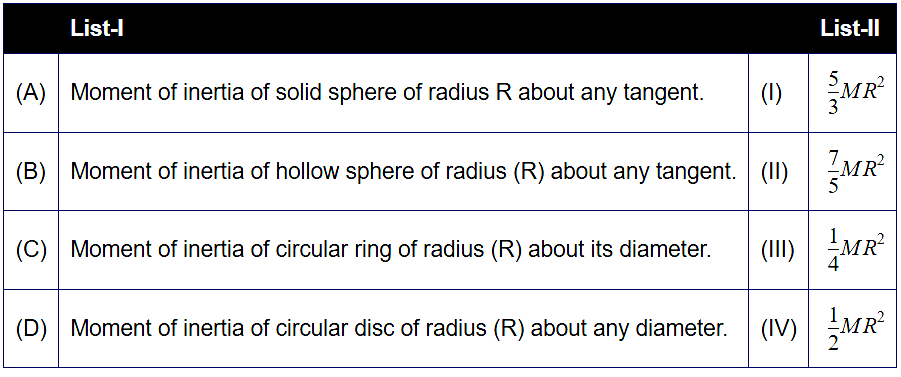
The moment of inertia of a solid disc rotating along its diameter is 2.5 times higher than the moment of inertia of a ring rotating in similar way. The moment of inertia of a solid sphere which has same radius as the disc and rotating in similar way, is $n$ times higher than the moment of inertia of the given ring. Here, $\mathrm{n}=$ ________ Consider all the bodies have equal masses.
Two iron solid discs of negligible thickness have radii $R_1$ and $R_2$ and moment of intertia $I_1$ and $I_2$, respectively. For $R_2=2 R_1$, the ratio of $I_1$ and $I_2$ would be $1 / x$, where $\mathrm{x}=$ _______ .
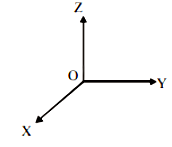
The coordinates of a particle with respect to origin in a given reference frame is (1, 1, 1) meters. If a force of $\vec{F} = \hat{i} - \hat{j} + \hat{k}$ acts on the particle, then the magnitude of torque (with respect to origin) in z-direction is __________.
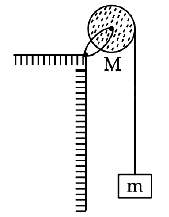
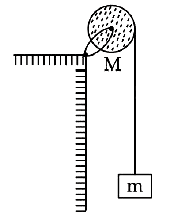
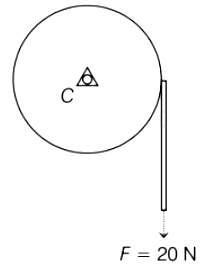
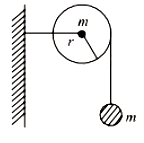
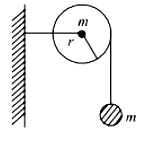
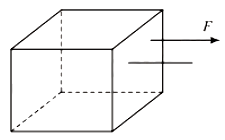
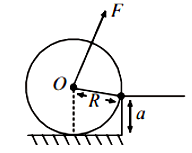
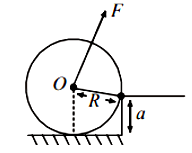
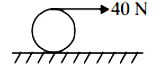
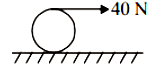
A wheel of radius 0.2 m rotates freely about its center when a string that is wrapped over its rim is pulled by force of 10 N as shown in figure. The established torque produces an angular acceleration of $2 \mathrm{rad} / \mathrm{s}^2$. Moment of intertia of the wheel is___________ $\mathrm{kg} \mathrm{}\,\, \mathrm{m}^2$. (Acceleration due to gravity $=10 \mathrm{~m} / \mathrm{s}^2$ )
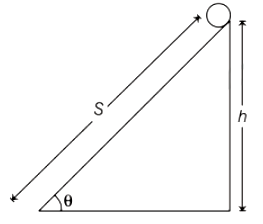
A circular ring and a solid sphere having same radius roll down on an inclined plane from rest without slipping. The ratio of their velocities when reached at the bottom of the plane is $\sqrt{\frac{x}{5}}$ where $x=$ ________.
A solid sphere with uniform density and radius $R$ is rotating initially with constant angular velocity $\left(\omega_1\right)$ about its diameter. After some time during the rotation its starts loosing mass at a uniform rate, with no change in its shape. The angular velocity of the sphere when its radius become $\mathrm{R} / 2$ is $x \omega_1$. The value of $x$ is _________.
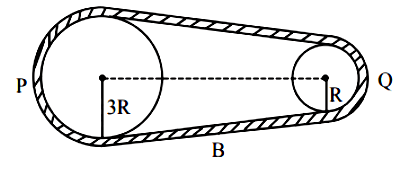
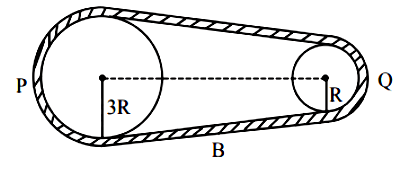
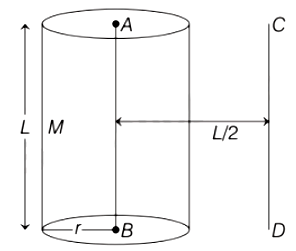
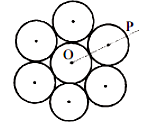
$\mathrm{A}, \mathrm{B}$ and C are disc, solid sphere and spherical shell respectively with same radii and masses. These masses are placed as shown in figure.
The moment of inertia of the given system about PQ axis is $\frac{x}{15} \mathrm{I}$, where I is the moment of inertia of the disc about its diameter. The value of $x$ is ____________.
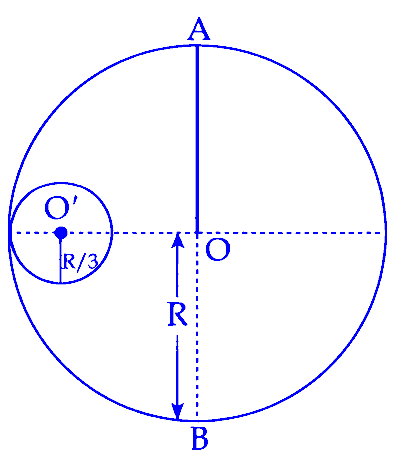
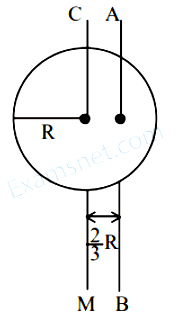
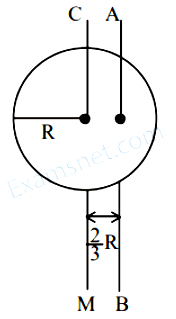
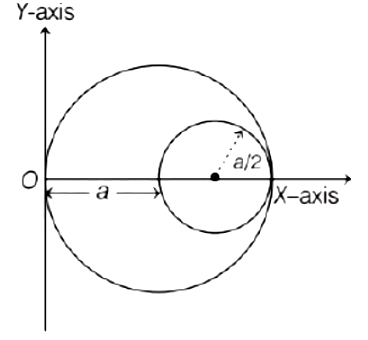
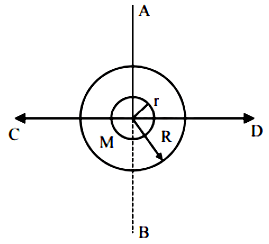
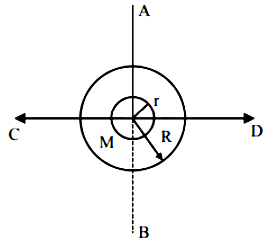
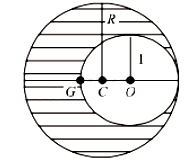
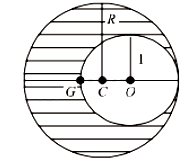
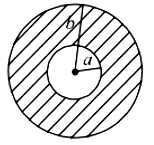
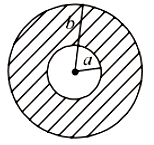
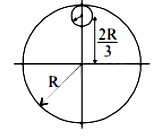
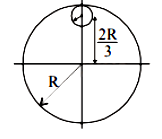
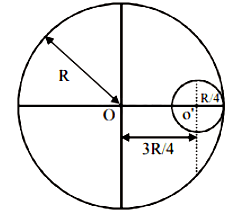
A uniform circular disc of radius ' $\mathrm{R}^{\prime}$ and mass ' $\mathrm{M}^{\prime}$ is rotating about an axis perpendicular to its plane and passing through its centre. A small circular part of radius $R / 2$ is removed from the original disc as shown in the figure. Find the moment of inertia of the remaining part of the original disc about the axis as given above.
The torque due to the force $(2 \hat{i}+\hat{j}+2 \hat{k})$ about the origin, acting on a particle whose position vector is $(\hat{i}+\hat{j}+\hat{k})$, would be
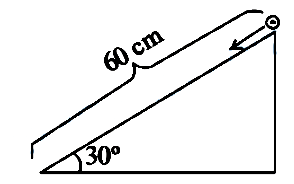
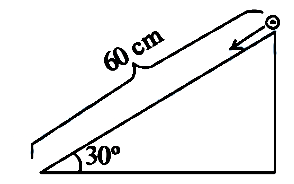
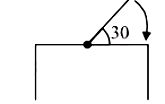
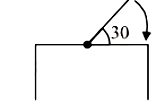
A solid sphere of mass ' $m$ ' and radius ' $r$ ' is allowed to roll without slipping from the highest point of an inclined plane of length ' $L$ ' and makes an angle $30^{\circ}$ with the horizontal. The speed of the particle at the bottom of the plane is $v_1$. If the angle of inclination is increased to $45^{\circ}$ while keeping $L$ constant. Then the new speed of the sphere at the bottom of the plane is $v_2$. The ratio $v_1^2: v_2^2$ is
A circular disk of radius R meter and mass M kg is rotating around the axis perpendicular to the disk. An external torque is applied to the disk such that $\theta(t)=5 t^2-8 t$, where $\theta(t)$ is the angular position of the rotating disc as a function of time $t$.How much power is delivered by the applied torque, when $t=2 \mathrm{~s}$ ?
A uniform solid cylinder of mass ' m ' and radius ' r ' rolls along an inclined rough plane of inclination $45^{\circ}$. If it starts to roll from rest from the top of the plane then the linear acceleration of the cylinder's axis will be
A solid sphere is rolling without slipping on a horizontal plane. The ratio of the linear kinetic energy of the centre of mass of the sphere and rotational kinetic energy is :
A solid sphere and a hollow sphere of the same mass and of same radius are rolled on an inclined plane. Let the time taken to reach the bottom by the solid sphere and the hollow sphere be $t_1$ and $t_2$, respectively, then
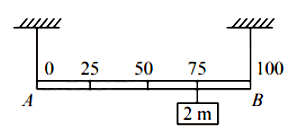
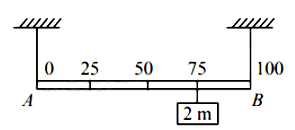
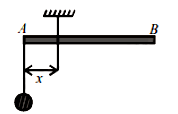
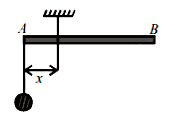
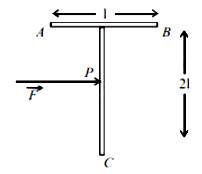
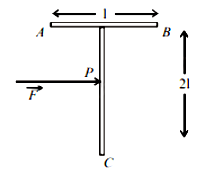
A uniform rod of mass 250 g having length 100 cm is balanced on a sharp edge at 40 cm mark. A mass of 400 g is suspended at 10 cm mark. To maintain the balance of the rod, the mass to be suspended at 90 cm mark, is
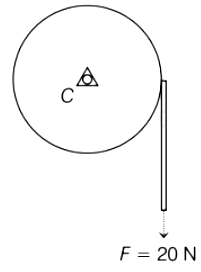
A cord of negligible mass is wound around the rim of a wheel supported by spokes with negligible mass. The mass of wheel is 10 kg and radius is 10 cm and it can freely rotate without any friction. Initially the wheel is at rest. If a steady pull of 20 N is applied on the cord, the angular velocity of the wheel, after the cord is unwound by 1 m , would be:
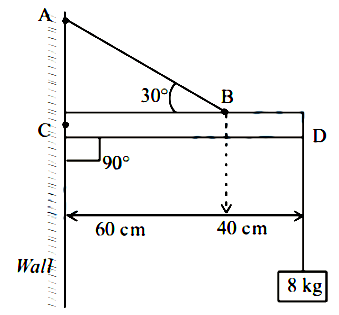
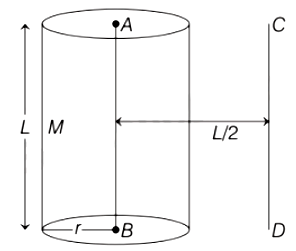
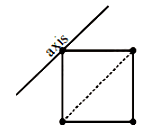
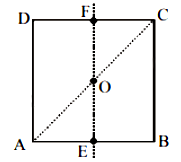
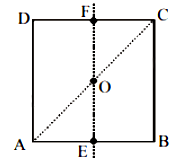
A square Lamina OABC of length 10 cm is pivoted at ' $\mathrm{O}^{\prime}$. Forces act at Lamina as shown in figure. If Lamina remains stationary, then the magnitude of F is :
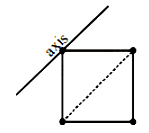
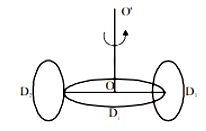
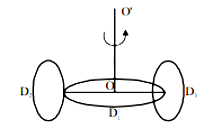
Moment of inertia of a rod of mass ' M ' and length ' L ' about an axis passing through its center and normal to its length is ' $\alpha$ '. Now the rod is cut into two equal parts and these parts are joined symmetrically to form a cross shape. Moment of inertia of cross about an axis passing through its center and normal to plane containing cross is :
A force of 49 N acts tangentially at the highest point of a sphere (solid) of mass 20 kg , kept on a rough horizontal plane. If the sphere rolls without slipping, then the acceleration of the center of the sphere is
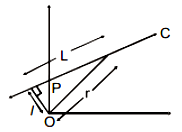
If $\vec{L}$ and $\vec{P}$ represent the angular momentum and linear momentum respectively of a particle of mass ' $m$ ' having position vector as $\vec{r}=a(\hat{i} \cos \omega t+\hat{j} \sin \omega t)$. The direction of force is
Which of the following are correct expression for torque acting on a body?
A. $\vec{\tau}=\vec{r} \times \vec{L}$
B. $\vec{\tau}=\frac{d}{d t}(\vec{r} \times \vec{p})$
C. $\vec{\tau}=\vec{r} \times \frac{d \vec{p}}{d t}$
D. $\vec{\tau}=I \vec{\alpha}$
E. $\vec{\tau}=\vec{r} \times \vec{F}$
( $\vec{r}=$ position vector; $\vec{p}=$ linear momentum; $\vec{L}=$ angular momentum; $\vec{\alpha}=$ angular acceleration; $I=$ moment of inertia; $\vec{F}=$ force; $t=$ time)
Choose the correct answer from the options given below:
A rod of linear mass density 'λ' and length 'L' is bent to form a ring of radius 'R'. Moment of inertia of ring about any of its diameter is.
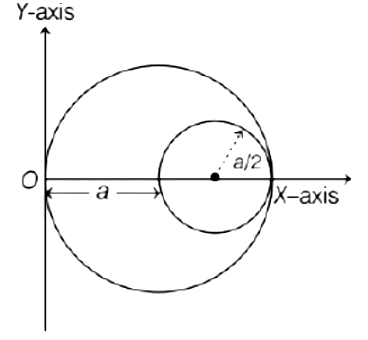
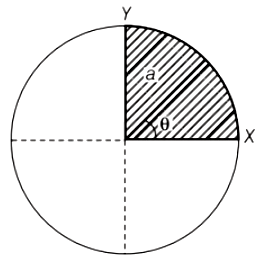
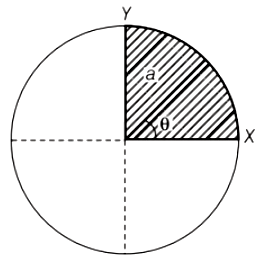
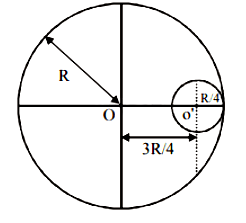
Consider a circular disc of radius 20 cm with centre located at the origin. A circular hole of radius 5 cm is cut from this disc in such a way that the edge of the hole touches the edge of the disc. The distance of centre of mass of residual or remaining disc from the origin will be
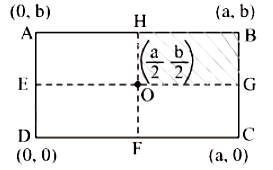
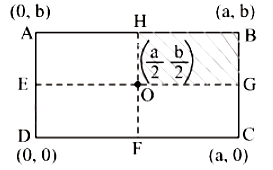
The center of mass of a thin rectangular plate (fig - x ) with sides of length $a$ and $b$, whose mass per unit area $(\sigma)$ varies as $\sigma=\frac{\sigma_0 x}{a b}$ (where $\sigma_0$ is a constant), would be __________.
As shown below, bob A of a pendulum having massless string of length 'R' is released from 60° to the vertical. It hits another bob B of half the mass that is at rest on a frictionless table in the center. Assuming elastic collision, the magnitude of the velocity of bob A after the collision will be (take g as acceleration due to gravity.)
Given below are two statements. One is labelled as Assertion (A) and the other is labelled as Reason (R).
Assertion (A): Three identical spheres of same mass undergo one dimensional motion as shown in figure with initial velocities $v_{\mathrm{A}}=5 \mathrm{~m} / \mathrm{s}, v_{\mathrm{B}}=2 \mathrm{~m} / \mathrm{s}, v_{\mathrm{C}}=4 \mathrm{~m} / \mathrm{s}$. If we wait sufficiently long for elastic collision to happen, then $v_{\mathrm{A}}=4 \mathrm{~m} / \mathrm{s}, v_{\mathrm{B}}=2 \mathrm{~m} / \mathrm{s}$, $v_{\mathrm{C}}=5 \mathrm{~m} / \mathrm{s}$ will be the final velocities.
Reason (R): In an elastic collision between identical masses, two objects exchange their velocities.
In the light of the above statements, choose the correct answer from the options given below:
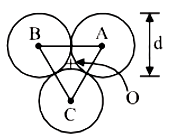
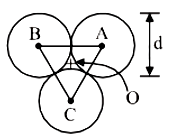
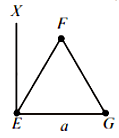
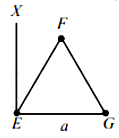
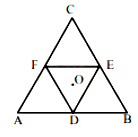
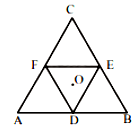
Three equal masses $m$ are kept at vertices $(A, B, C)$ of an equilateral triangle of side a in free space. At $t=0$, they are given an initial velocity $\overrightarrow{V_A}=V_0 \overrightarrow{A C}, \overrightarrow{V_B}=V_0 \overrightarrow{B A}$ and $\overrightarrow{V_C}=V_0 \overrightarrow{C B}$. Here, $\overrightarrow{A C}, \overrightarrow{C B}$ and $\overrightarrow{B A}$ are unit vectors along the edges of the triangle. If the three masses interact gravitationally, then the magnitude of the net angular momentum of the system at the point of collision is :
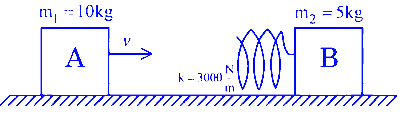
Consider two blocks A and B of masses $m_1=10 \mathrm{~kg}$ and $\mathrm{m}_2=5 \mathrm{~kg}$ that are placed on a frictionless table. The block A moves with a constant speed $v=3 \mathrm{~m} / \mathrm{s}$ towards the block B kept at rest. A spring with spring constant $\mathrm{k}=3000 \mathrm{~N} / \mathrm{m}$ is attached with the block B as shown in the figure. After the collision, suppose that the blocks A and B, along with the spring in constant compression state, move together, then the compression in the spring is, (Neglect the mass of the spring)
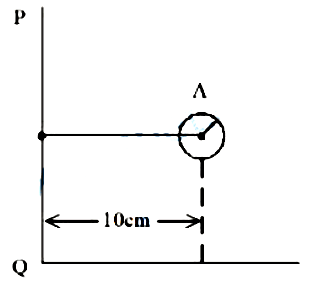
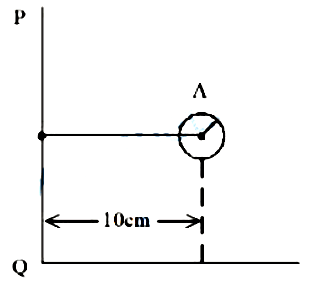
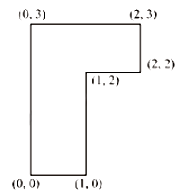
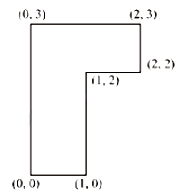
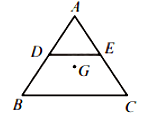
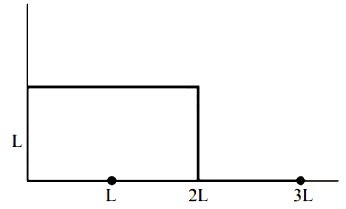
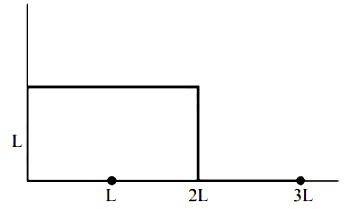
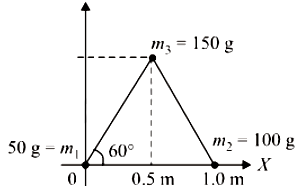
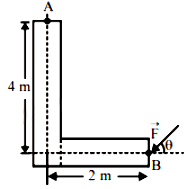
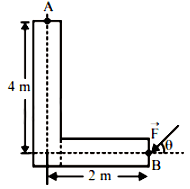
A rod of length 5 L is bent right angle keeping one side length as 2 L .
The position of the centre of mass of the system :
(Consider $\mathrm{L}=10 \mathrm{~cm}$)
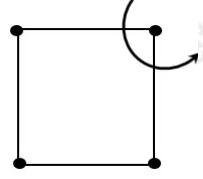
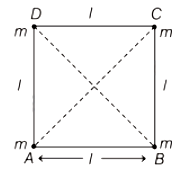
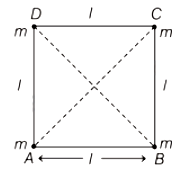
Four particles each of mass 1kg are placed at four corners of a square of side 2m. Moment of inertia of system about an axis perpendicular to its plane and passing through one of its vertex is____ kgm2.
[27-Jan-2024 Shift 1]
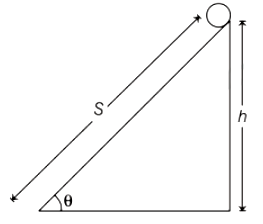
A ring and a solid sphere roll down the same inclined plane without slipping. They start from rest. The radii of both bodies are identical and the ratio of their kinetic energies is 7/x where x is
[27-Jan-2024 Shift 2]
A body of mass 5kg moving with a uniform speed 3√2ms−1 in X − Y plane along the line y = x + 4. The angular momentum of the particle about the origin will be ____kgm2 s−1.
[29-Jan-2024 Shift 2]
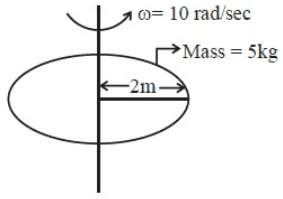
Consider a Disc of mass 5kg, radius 2m, rotating with angular velocity of 10rad∕ s about an axis perpendicular to the plane of rotation. An identical disc is kept gently over the rotating disc along the same axis. The energy dissipated so that both the discs continue to rotate together without slipping is______ J.
[30-Jan-2024 Shift 1]
Two discs of moment of inertia I1 = 4kgm2 and I2 = 2kgm2 about their central axes & normal to their planes, rotating with angular speeds 10rad∕ s & 4rad∕ s respectively are brought into contact face to face with their axe of rotation coincident. The loss in kinetic energy of the system in the process is ______J.
[30-Jan-2024 Shift 2]
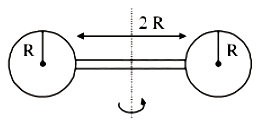
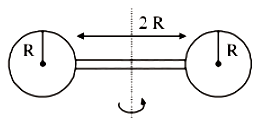
Two identical spheres each of mass 2kg and radius 50cm are fixed at the ends of a light rod so that the separation between the centers is 150cm. Then, moment of inertia of the system about an axis perpendicular to the rod and passing through its middle point is x/20 kg m2, where the value of x is___
[31-Jan-2024 Shift 2]
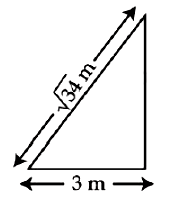
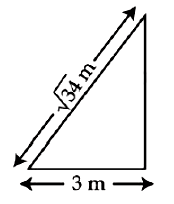
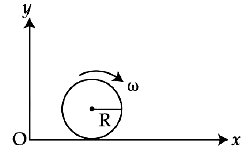
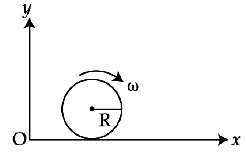
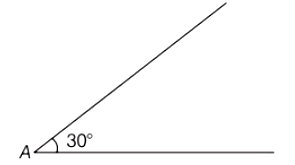
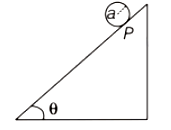
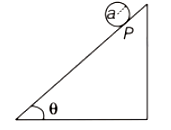
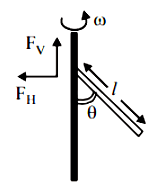
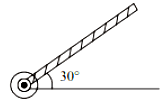
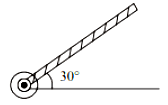
A cylinder is rolling down on an inclined plane of inclination 60∘. It's acceleration during rolling down will be where x =______ (use g = 10m∕ s2).
[29-Jan-2024 Shift 1]
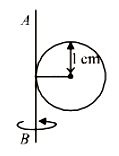
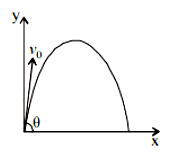
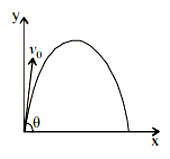
A body of mass ' m ' is projected with a speed ' u ' making an angle of 45∘ with the ground. The angular momentum of the body about the point of projection, at the highest point is expressed as The value of ' X ' is______
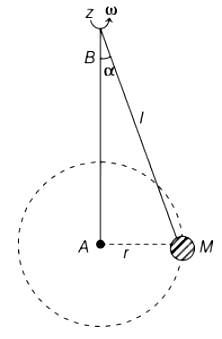
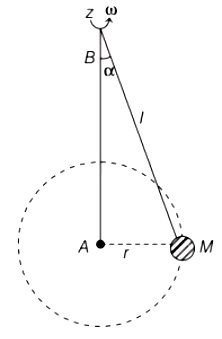
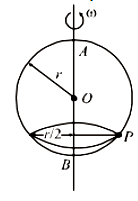
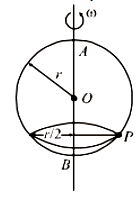
A ball of mass 0.5kg is attached to a string of length 50cm. The ball is rotated on a horizontal circular path about its vertical axis. The maximum tension that the string can bear is 400N. The maximum possible value of angular velocity of the ball in rad∕ s is,:
[1-Feb-2024 Shift 1]
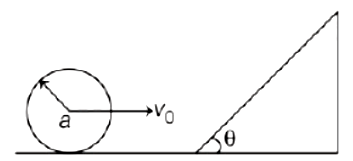
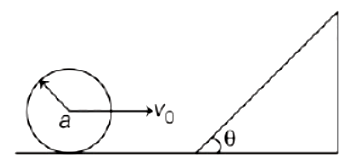
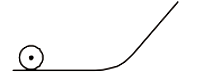
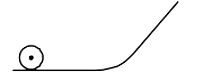
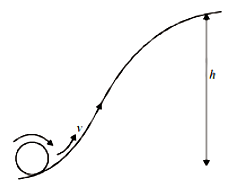
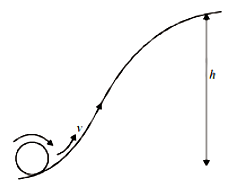
A disc of radius R and mass M is rolling horizontally without slipping with speed v. It then moves up an inclined smooth surface as shown in figure. The maximum height that the disc can go up the incline is :
[1-Feb-2024 Shift 2]



 ×
×
 Bank
Bank


 SSC
SSC


 Railway


 State
State


 Other
Other


 Teaching


 Insurance


 Medical


 Engineering


 Defence


 GATE
GATE


 NTA CUET

 UPSC
UPSC

 MBA Entrance


 LAW
LAW

 ReNEET UG 2026
 SSC Selection Post (Phase 14) 2026
 RRB NTPC 2026
 SSC CGL Tier-I 2026
 SSC JE 2026
 SBI PO Prelims 2026
 SSC Steno Grade C & D 2026
 SBI Clerk Prelims 2026
 IBPS PO Prelims 2026
 IBPS Clerk Prelims 2026
 SSC CPO Tier I 2026
 NDA II 2026
 CDS II 2026








 Three identical spheres of same mass undergo one dimensional motion as shown in figure with initial velocities $v_{\mathrm{A}}=5 \mathrm{~m} / \mathrm{s}, v_{\mathrm{B}}=2 \mathrm{~m} / \mathrm{s}, v_{\mathrm{C}}=4 \mathrm{~m} / \mathrm{s}$. If we wait sufficiently long for elastic collision to happen, then $v_{\mathrm{A}}=4 \mathrm{~m} / \mathrm{s}, v_{\mathrm{B}}=2 \mathrm{~m} / \mathrm{s}$, $v_{\mathrm{C}}=5 \mathrm{~m} / \mathrm{s}$ will be the final velocities.

 where x =______ (use g = 10m∕ s2).
 The value of ' X ' is______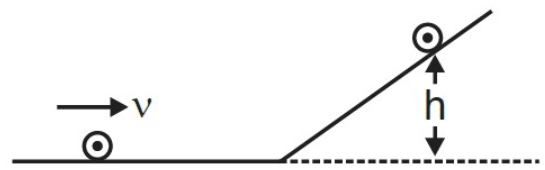




 Get latest Exam Updates