Please wait...
Two soap bubbles of radius 2 cm and 4 cm , respectively, are in contact with each other. The radius of curvature of the common surface, in cm , is _________.
An air bubble of radius 1.0 mm is observed at a depth 20 cm below the free surface of a liquid having surface tension $0.095 \mathrm{~J} / \mathrm{m}^2$ and density $10^3 \mathrm{~kg} / \mathrm{m}^3$. The difference between pressure inside the bubble and atmospheric pressure is __________ $\mathrm{N} / \mathrm{m}^2$. (Take $\mathrm{g}=10 \mathrm{~m} / \mathrm{s}^2$ )
The increase in pressure required to decrease the volume of a water sample by $0.2 \%$ is $\mathrm{P} \times 10^5 \mathrm{Nm}^{-2}$. Bulk modulus of water is $2.15 \times 10^9 \mathrm{Nm}^{-2}$. The value of P is _________ .
In a measurement, it is asked to find modulus of elasticity per unit torque applied on the system. The measured quantity has dimension of $\left[M^a L^b T^c\right]$. If $b=3$, the value of $c$ is _________.
The volume contraction of a solid copper cube of edge length 10 cm , when subjected to a hydraulic pressure of $7 \times 10^{6} ~\mathrm{Pa}$, would be __________ $\mathrm{mm}{ }^3$.
(Given bulk modulus of copper $=1.4 \times 10^{11} \mathrm{~N} \mathrm{~m}^{-2}$ )
A vessel with square cross-section and height of 6 m is vertically partitioned. A small window of $100 \mathrm{~cm}^2$ with hinged door is fitted at a depth of 3 m in the partition wall. One part of the vessel is filled completely with water and the other side is filled with the liquid having density $1.5 \times 10^3 \mathrm{~kg} / \mathrm{m}^3$. What force one needs to apply on the hinged door so that it does not get opened ?
$$\text { (Acceleration due to gravity }=10 \mathrm{~m} / \mathrm{s}^2 \text { ) }$$
A steel wire of length 2 m and Young's modulus $2.0 \times 10^{11} \mathrm{~N} \mathrm{~m}^{-2}$ is stretched by a force. If Poisson ratio and transverse strain for the wire are 0.2 and $10^{-3}$ respectively, then the elastic potential energy density of the wire is __________ $\times 10^5$ (in SI units).
The excess pressure inside a soap bubble A in air is half the excess pressure inside another soap bubble B in air. If the volume of the bubble A is $n$ times the volume of the bubble $B$, then, the value of $n$ is__________.
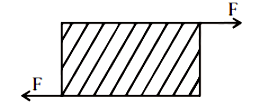
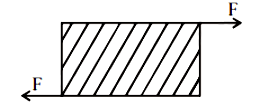
Two slabs with square cross section of different materials $(1,2)$ with equal sides $(l)$ and thickness $d_1$ and $d_2$ such that $d_2=2 d_1$ and $l>d_2$. Considering lower edges of these slabs are fixed to the floor, we apply equal shearing force on the narrow faces. The angle of deformation is $\theta_2=2 \theta_1$. If the shear moduli of material 1 is $4 \times 10^9 \mathrm{~N} / \mathrm{m}^2$, then shear moduli of material 2 is $x \times 10^9 \mathrm{~N} / \mathrm{m}^2$, where value of $x$ is ________.
A cube having a side of 10 cm with unknown mass and 200 gm mass were hung at two ends of a uniform rigid rod of 27 cm long. The rod along with masses was placed on a wedge keeping the distance between wedge point and 200 gm weight as 25 cm. Initially the masses were not at balance. A beaker is placed beneath the unknown mass and water is added slowly to it. At given point the masses were in balance and half volume of the unknown mass was inside the water. (Take the density of unknown mass is more than that of the water, the mass did not absorb water and water density is 1 gm/cm3.) The unknown mass is _____ kg.
A sample of a liquid is kept at 1 atm. It is compressed to 5 atm which leads to a change of volume of 0.8 cm3. If the bulk modulus of the liquid is 2 GPa, the initial volume of the liquid was _______ litre.
(Take 1 atm = 105 Pa)
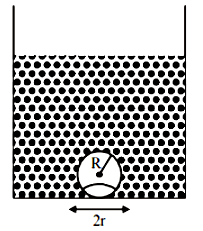
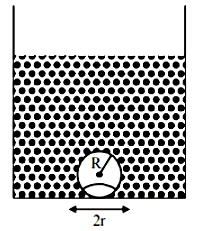
A small rigid spherical ball of mass M is dropped in a long vertical tube containing glycerine. The velocity of the ball becomes constant after some time. If the density of glycerine is half of the density of the ball, then the viscous force acting on the ball will be (consider g as acceleration due to gravity)
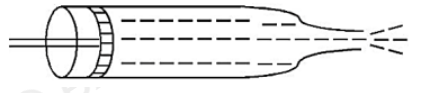
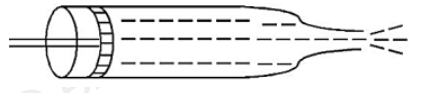
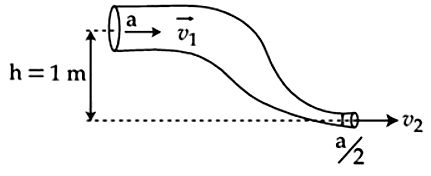
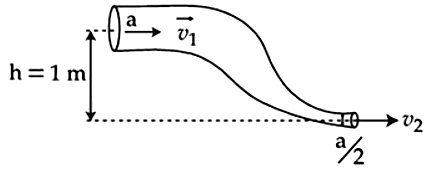
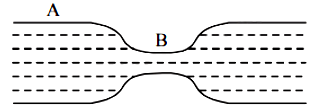
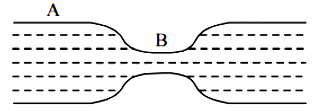
A tube of length $L$ is shown in the figure. The radius of cross section at the point $(1)$ is 2 cm and at the point (2) is 1 cm , respectively. If the velocity of water entering at point (1) is $2 \mathrm{~m} / \mathrm{s}$, then velocity of water leaving the point (2) will be
Given below are two statements:
Statement I: The hot water flows faster than cold water
Statement II: Soap water has higher surface tension as compared to fresh water.In the light above statements, choose the correct answer from the options given below
Water flows in a horizontal pipe whose one end is closed with a valve. The reading of the pressure gauge attached to the pipe is $P_1$. The reading of the pressure gauge falls to $P_2$ when the valve is opened. The speed of water flowing in the pipe is proportional to
A massless spring gets elongated by amount $x_1$ under a tension of 5 N . Its elongation is $x_2$ under the tension of 7 N . For the elongation of $\left(5 x_1-2 x_2\right)$, the tension in the spring will be,
The amount of work done to break a big water drop of radius ' $R$ ' into 27 small drops of equal radius is 10 J . The work done required to break the same big drop into 64 small drops of equal radius will be
Consider following statements:
A. Surface tension arises due to extra energy of the molecules at the interior as compared to the molecules at the surface, of a liquid.
B. As the temperature of liquid rises, the coefficient of viscosity increases.
C. As the temperature of gas increases, the coefficient of viscosity increases
D. The onset of turbulence is determined by Reynold's number.
E. In a steady flow two stream lines never intersect.
Choose the correct answer from the options given below:
In the experiment for measurement of viscosity ' $\eta$ ' of given liquid with a ball having radius $R$, consider following statements.
A. Graph between terminal velocity V and R will be a parabola.
B. The terminal velocities of different diameter balls are constant for a given liquid.
C. Measurement of terminal velocity is dependent on the temperature.
D. This experiment can be utilized to assess the density of a given liquid.
E. If balls are dropped with some initial speed, the value of $\eta$ will change.
A 400 g solid cube having an edge of length 10 cm floats in water. How much volume of the cube is outside the water?
(Given: density of water = 1000 kg m-3)
The fractional compression $\left( \frac{\Delta V}{V} \right)$ of water at the depth of 2.5 km below the sea level is __________ %. Given, the Bulk modulus of water = $2 \times 10^9$ N m$^{-2}$, density of water = $10^3$ kg m$^{-3}$, acceleration due to gravity $g = 10$ m s$^{-2}$.
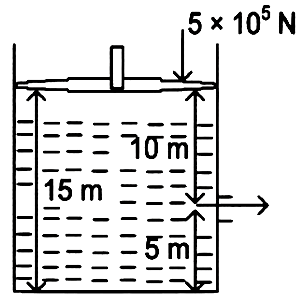
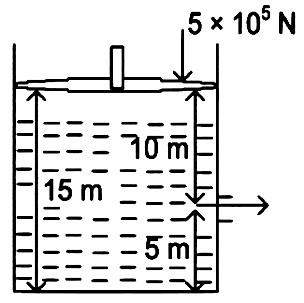
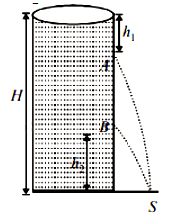
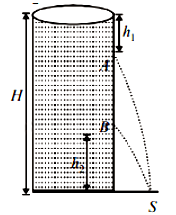
Consider a completely full cylindrical water tank of height 1.6 m and of cross-sectional area $0.5 \mathrm{~m}^2$. It has a small hole in its side at a height 90 cm from the bottom. Assume, the crosssectional area of the hole to be negligibly small as compared to that of the water tank. If a load 50 kg is applied at the top surface of the water in the tank then the velocity of the water coming out at the instant when the hole is opened is:
$$ \left(\mathrm{g}=10 \mathrm{~m} / \mathrm{s}^2\right) $$
A solid steel ball of diameter 3.6 mm acquired terminal velocity $2.45 \times 10^{-2} \mathrm{~m} / \mathrm{s}$ while falling under gravity through an oil of density $925 \mathrm{~kg} \mathrm{~m}^{-3}$. Take density of steel as $7825 \mathrm{~kg} \mathrm{~m}^{-3}$ and g as $9.8 \mathrm{~m} / \mathrm{s}^2$. The viscosity of the oil in SI unit is
Two liquids $A$ and $B$ have $\theta_A$ and $\theta_B$ as contact angles in a capillary tube. If $K=\cos \theta_A / \cos \theta_B$, then identify the correct statement:
A cylindrical rod of length 1 m and radius 4 cm is mounted vertically. It is subjected to a shear force of $10^5 \mathrm{~N}$ at the top. Considering infinitesimally small displacement in the upper edge, the angular displacement $\theta$ of the rod axis from its original position would be : (shear moduli, $G=10^{10} \mathrm{~N} / \mathrm{m}^2$ )
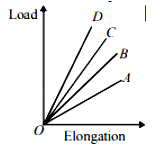
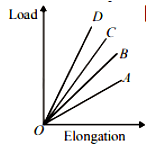
Two wires A and B are made of same material having ratio of lengths $\frac{L_A}{L_B}=\frac{1}{3}$ and their diameters ratio $\frac{d_A}{d_B}=2$. If both the wires are stretched using same force, what would be the ratio of their respective elongations?
A capillary tube of radius 0.1 mm is partly dipped in water (surface tension 70 dyn/cm and glass water contact angle ≈ 0°) with 30° inclined with the vertical. The length of water risen in the capillary is _______ cm. (Take $g = 9.8 \text{ m/s}^2$)
A 3 m long wire of radius 3 mm shows an extension of 0.1 mm when loaded vertically by a mass of 50 kg in an experiment to determine Young's modulus. The value of Young's modulus of the wire as per this experiment is $P \times 10^{11} \, \text{Nm}^{-2}$, where the value of $P$ is: (Take $g = 3\pi \, \text{m/s}^2$)



 ×
×
 Bank
Bank


 SSC
SSC


 Railway


 State
State


 Other
Other


 Teaching


 Insurance


 Medical


 Engineering


 Defence


 GATE
GATE


 NTA CUET

 UPSC
UPSC

 MBA Entrance


 LAW
LAW

 ReNEET UG 2026
 SSC Selection Post (Phase 14) 2026
 RRB NTPC 2026
 SSC CGL Tier-I 2026
 SSC JE 2026
 SBI PO Prelims 2026
 SSC Steno Grade C & D 2026
 SBI Clerk Prelims 2026
 IBPS PO Prelims 2026
 IBPS Clerk Prelims 2026
 SSC CPO Tier I 2026
 NDA II 2026
 CDS II 2026



 Get latest Exam Updates