Please wait...

Solution
Hindi language icon English language icon
Q.13 Correct
Q.13 In-correct
Q.13 Unattempt
Given below are two statements :
Statements I : The temperature of a gas is 73C. When the gas is heated to 527C, the root mean square speed of the molecules is doubled.
Statement II : The product of pressure and volume of an ideal gas will be equal to translational kinetic energy of the molecules.
In the light of the above statements, choose the correct answer from the options given below :
[24-Jan-2023 Shift 1]
Given below are two statements :
Statements I : The temperature of a gas is 73C. When the gas is heated to 527C, the root mean square speed of the molecules is doubled.
Statement II : The product of pressure and volume of an ideal gas will be equal to translational kinetic energy of the molecules.
In the light of the above statements, choose the correct answer from the options given below :
[24-Jan-2023 Shift 1]
Q.14 Correct
Q.14 In-correct
Q.14 Unattempt
The root mean square velocity of molecules of gas is
[25-Jan-2023 Shift 1]
The root mean square velocity of molecules of gas is
[25-Jan-2023 Shift 1]
Q.15 Correct
Q.15 In-correct
Q.15 Unattempt
At 300K, the rms speed of oxygen molecules is
α+5
α
times to that of its average speed in the gas. Then, the value of α will be (used π=
22
7
)
[29-Jan-2023 Shift 2]
At 300K, the rms speed of oxygen molecules is
α+5
α
times to that of its average speed in the gas. Then, the value of α will be (used π=
22
7
)
[29-Jan-2023 Shift 2]
Q.16 Correct
Q.16 In-correct
Q.16 Unattempt
The pressure (P) and temperature (T) relationship of an ideal gas obeys the equation PT2= constant. The volume expansion coefficient of the gas will be:
[30-Jan-2023 Shift 1]
The pressure (P) and temperature (T) relationship of an ideal gas obeys the equation PT2= constant. The volume expansion coefficient of the gas will be:
[30-Jan-2023 Shift 1]
Q.17 Correct
Q.17 In-correct
Q.17 Unattempt
A flask contains hydrogen and oxygen in the ratio of 2:1 by mass at temperature 27C. The ratio of average kinetic energy per molecule of hydrogen and oxygen respectively is :
[30-Jan-2023 Shift 2]
A flask contains hydrogen and oxygen in the ratio of 2:1 by mass at temperature 27C. The ratio of average kinetic energy per molecule of hydrogen and oxygen respectively is :
[30-Jan-2023 Shift 2]
Q.18 Correct
Q.18 In-correct
Q.18 Unattempt
The average kinetic energy of a molecule of the gas is
[1-Feb-2023 Shift 1]
The average kinetic energy of a molecule of the gas is
[1-Feb-2023 Shift 1]
Q.19 Correct
Q.19 In-correct
Q.19 Unattempt
The number of air molecules per cm3 increased from 3×10¹⁹ to 12×1019. The ratio of collision frequency of air molecules before and after the increase in the number respectively is:
[6-Apr-2023 shift 1]
The number of air molecules per cm3 increased from 3×10¹⁹ to 12×1019. The ratio of collision frequency of air molecules before and after the increase in the number respectively is:
[6-Apr-2023 shift 1]
Q.20 Correct
Q.20 In-correct
Q.20 Unattempt
The temperature of an ideal gas is increased from 200K to 800K. If r.m.s. speed of gas at 200K is v0. Then, r.m.s. speed of the gas at 800K will be:
[6-Apr-2023 shift 2]
The temperature of an ideal gas is increased from 200K to 800K. If r.m.s. speed of gas at 200K is v0. Then, r.m.s. speed of the gas at 800K will be:
[6-Apr-2023 shift 2]
Q.21 Correct
Q.21 In-correct
Q.21 Unattempt
The temperature at which the kinetic energy of oxygen molecules becomes double than its value at 27C is
[8-Apr-2023 shift 2]
The temperature at which the kinetic energy of oxygen molecules becomes double than its value at 27C is
[8-Apr-2023 shift 2]
Q.22 Correct
Q.22 In-correct
Q.22 Unattempt
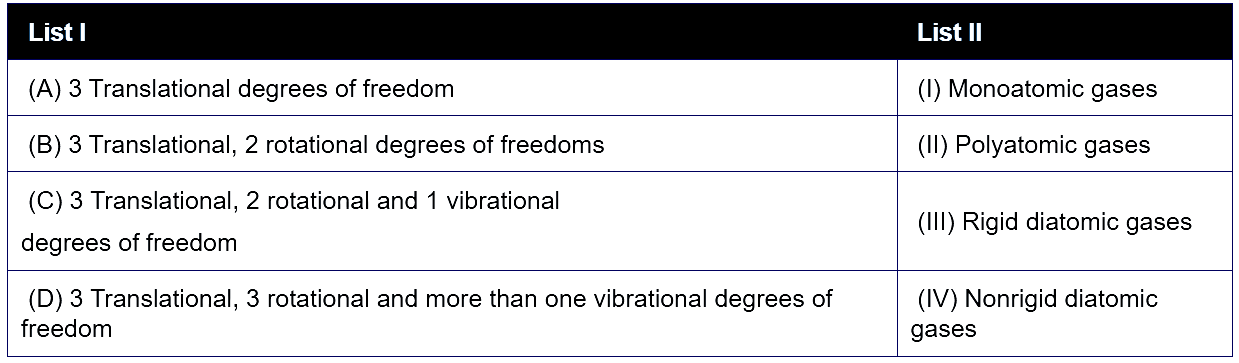
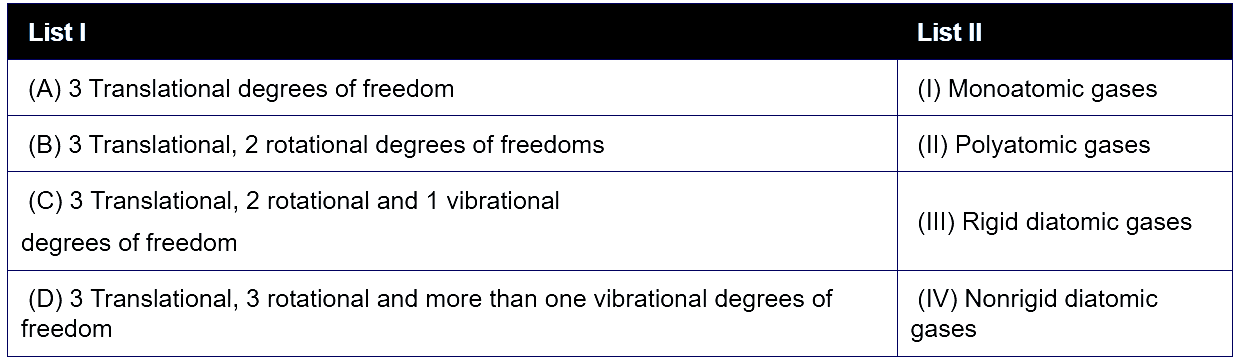
Match List I with List II :

Choose the correct answer from the options given below :
[10-Apr-2023 shift 1]
Match List I with List II :

Choose the correct answer from the options given below :
[10-Apr-2023 shift 1]
Q.23 Correct
Q.23 In-correct
Q.23 Unattempt
A gas mixture consists of 2 moles of oxygen and 4 moles of neon at temperature T. Neglecting all vibrational modes, the total internal energy of the system will be,
[10-Apr-2023 shift 2]
A gas mixture consists of 2 moles of oxygen and 4 moles of neon at temperature T. Neglecting all vibrational modes, the total internal energy of the system will be,
[10-Apr-2023 shift 2]
Q.24 Correct
Q.24 In-correct
Q.24 Unattempt
Three vessels of equal volume contain gases at the same temperature and pressure. The first vessel contains neon (monoatomic), the second contains chlorine (diatomic) and third contains uranium hexafluoride (polyatomic). Arrange these on the basis of their root mean square speed (vrms) and choose the correct answer from the options given below :
[11-Apr-2023 shift 1]
Three vessels of equal volume contain gases at the same temperature and pressure. The first vessel contains neon (monoatomic), the second contains chlorine (diatomic) and third contains uranium hexafluoride (polyatomic). Arrange these on the basis of their root mean square speed (vrms) and choose the correct answer from the options given below :
[11-Apr-2023 shift 1]
Q.25 Correct
Q.25 In-correct
Q.25 Unattempt
The root mean square speed of molecules of nitrogen gas at 27C is approximately : (Given mass of a nitrogen molecule =4.6×1026kg and take Boltzmann constant kB=1.4×10²³JK1 )
[11-Apr-2023 shift 2]
The root mean square speed of molecules of nitrogen gas at 27C is approximately : (Given mass of a nitrogen molecule =4.6×1026kg and take Boltzmann constant kB=1.4×10²³JK1 )
[11-Apr-2023 shift 2]
Q.26 Correct
Q.26 In-correct
Q.26 Unattempt
If the r. m. s speed of chlorine molecule is 490m s at 27C, the r.m. s speed of argon molecules at the same temperature will be (Atomic mass of argon =39.9u, molecular mass of chlorine =70.9u )
[12-Apr-2023 shift 1]
If the r. m. s speed of chlorine molecule is 490m s at 27C, the r.m. s speed of argon molecules at the same temperature will be (Atomic mass of argon =39.9u, molecular mass of chlorine =70.9u )
[12-Apr-2023 shift 1]
Q.27 Correct
Q.27 In-correct
Q.27 Unattempt
The rms speed of oxygen molecule in a vessel at particular temperature is (1+
5
x
)
1
2
v
, where v is the average speed of the molecule. The value of x will be: (Take π=
22
7
)
[13-Apr-2023 shift 1]
The rms speed of oxygen molecule in a vessel at particular temperature is (1+
5
x
)
1
2
v
, where v is the average speed of the molecule. The value of x will be: (Take π=
22
7
)
[13-Apr-2023 shift 1]
Q.28 Correct
Q.28 In-correct
Q.28 Unattempt
The mean free path of molecules of a certain gas at STP is 1500d, where d is the diameter of the gas molecules. While maintaining the standard pressure, the mean free path of the molecules at 373K is approximately :
[13-Apr-2023 shift 2]
The mean free path of molecules of a certain gas at STP is 1500d, where d is the diameter of the gas molecules. While maintaining the standard pressure, the mean free path of the molecules at 373K is approximately :
[13-Apr-2023 shift 2]
Q.29 Correct
Q.29 In-correct
Q.29 Unattempt
A flask contains Hydrogen and Argon in the ratio 2:1 by mass. The temperature of the mixture is 30C. The ratio of average kinetic energy per molecule of the two gases ( K argon/ K hydrogen) is :
(Given : Atomic Weight of Ar=39.9 )
[15-Apr-2023 shift 1]
A flask contains Hydrogen and Argon in the ratio 2:1 by mass. The temperature of the mixture is 30C. The ratio of average kinetic energy per molecule of the two gases ( K argon/ K hydrogen) is :
(Given : Atomic Weight of Ar=39.9 )
[15-Apr-2023 shift 1]
Q.30 Correct
Q.30 In-correct
Q.30 Unattempt
The relation between root mean square speed (vrms) and most probable sped (vp) for the molar mass M of oxygen gas molecule at the temperature of 300K will be:
[25-Jun-2022-Shift-1]
The relation between root mean square speed (vrms) and most probable sped (vp) for the molar mass M of oxygen gas molecule at the temperature of 300K will be:
[25-Jun-2022-Shift-1]
Q.31 Correct
Q.31 In-correct
Q.31 Unattempt
When a gas filled in a closed vessel is heated by raising the temperature by 1C, its pressure increases by 0.4%. The initial temperature of the gas is ____K.
[25-Jun-2022-Shift-2]
When a gas filled in a closed vessel is heated by raising the temperature by 1C, its pressure increases by 0.4%. The initial temperature of the gas is ____K.
[25-Jun-2022-Shift-2]
Q.32 Correct
Q.32 In-correct
Q.32 Unattempt
A flask contains argon and oxygen in the ratio of 3:2 in mass and the mixture is kept at 27C. The ratio of their average kinetic energy per molecule respectively will be :
[26-Jun-2022-Shift-2]
A flask contains argon and oxygen in the ratio of 3:2 in mass and the mixture is kept at 27C. The ratio of their average kinetic energy per molecule respectively will be :
[26-Jun-2022-Shift-2]
Q.33 Correct
Q.33 In-correct
Q.33 Unattempt
A mixture of hydrogen and oxygen has volume 2000cm3, temperature 300K, pressure 100kPa and mass 0.76g. The ratio of number of moles of hydrogen to number of moles of oxy in the mixture will be:
[Take gas constant .R=8.3JK1mol1]
[27-Jun-2022-Shift-1]
A mixture of hydrogen and oxygen has volume 2000cm3, temperature 300K, pressure 100kPa and mass 0.76g. The ratio of number of moles of hydrogen to number of moles of oxy in the mixture will be:
[Take gas constant .R=8.3JK1mol1]
[27-Jun-2022-Shift-1]
Q.34 Correct
Q.34 In-correct
Q.34 Unattempt
According to kinetic theory of gases,
A. The motion of the gas molecules freezes at 0C.
B. The mean free path of gas molecules decreases if the density of molecules is increased.
C. The mean free path of gas molecules increases if temperature is increased keeping pressure constant.
D. Average kinetic energy per molecule per degree of freedom is
3
2
kB
T
(for monoatomic gases).
Choose the most appropriate answer from the options given below :
[27-Jun-2022-Shift-2]
According to kinetic theory of gases,
A. The motion of the gas molecules freezes at 0C.
B. The mean free path of gas molecules decreases if the density of molecules is increased.
C. The mean free path of gas molecules increases if temperature is increased keeping pressure constant.
D. Average kinetic energy per molecule per degree of freedom is
3
2
kB
T
(for monoatomic gases).
Choose the most appropriate answer from the options given below :
[27-Jun-2022-Shift-2]
Q.35 Correct
Q.35 In-correct
Q.35 Unattempt
Given below are two statements :
Statement I : When µ amount of an ideal gas undergoes adiabatic change from state (P1,V1,T1) to state (P2,V2,T2), then work done is W=
µR(T2T1)
1γ
, where γ=
Cp
Cv
and R= universal gas constant.
Statement II : In the above case, when work is done on the gas, the temperature of the gas would rise.
Choose the correct answer from the options given below :
[28-Jun-2022-Shift-1]
Given below are two statements :
Statement I : When µ amount of an ideal gas undergoes adiabatic change from state (P1,V1,T1) to state (P2,V2,T2), then work done is W=
µR(T2T1)
1γ
, where γ=
Cp
Cv
and R= universal gas constant.
Statement II : In the above case, when work is done on the gas, the temperature of the gas would rise.
Choose the correct answer from the options given below :
[28-Jun-2022-Shift-1]
Q.36 Correct
Q.36 In-correct
Q.36 Unattempt
What will be the effect on the root mean square velocity of oxygen molecules if the temperature is doubled and oxygen molecule dissociates into atomic oxygen?
[28-Jun-2022-Shift-2]
What will be the effect on the root mean square velocity of oxygen molecules if the temperature is doubled and oxygen molecule dissociates into atomic oxygen?
[28-Jun-2022-Shift-2]
Q.37 Correct
Q.37 In-correct
Q.37 Unattempt
A vessel contains 16g of hydrogen and 128g of oxygen at standard temperature and pressure. The volume of the vessel in cm3 is :
[29-Jun-2022-Shift-2]
A vessel contains 16g of hydrogen and 128g of oxygen at standard temperature and pressure. The volume of the vessel in cm3 is :
[29-Jun-2022-Shift-2]
Q.38 Correct
Q.38 In-correct
Q.38 Unattempt
Following statements are given :
(A) The average kinetic energy of a gas molecule decreases when the temperature is reduced.
(B) The average kinetic energy of a gas molecule increases with increase in pressure at constant temperature.
(C) The average kinetic energy of a gas molecule decreases with increase in volume.
(D) Pressure of a gas increases with increase in temperature at constant pressure.
(E) The volume of gas decreases with increase in temperature.
Choose the correct answer from the options given below :
[25-Jul-2022-Shift-1]
Following statements are given :
(A) The average kinetic energy of a gas molecule decreases when the temperature is reduced.
(B) The average kinetic energy of a gas molecule increases with increase in pressure at constant temperature.
(C) The average kinetic energy of a gas molecule decreases with increase in volume.
(D) Pressure of a gas increases with increase in temperature at constant pressure.
(E) The volume of gas decreases with increase in temperature.
Choose the correct answer from the options given below :
[25-Jul-2022-Shift-1]
Q.39 Correct
Q.39 In-correct
Q.39 Unattempt
Sound travels in a mixture of two moles of helium and n moles of hydrogen. If rms speed of gas molecules in the mixture is 2 times the speed of sound, then the value of n will be :
[25-Jul-2022-Shift-2]
Sound travels in a mixture of two moles of helium and n moles of hydrogen. If rms speed of gas molecules in the mixture is 2 times the speed of sound, then the value of n will be :
[25-Jul-2022-Shift-2]
Q.40 Correct
Q.40 In-correct
Q.40 Unattempt
A gas has n degrees of freedom. The ratio of specific heat of gas at constant volume to the specific heat of gas at constant pressure will be :
[26-Jul-2022-Shift-2]
A gas has n degrees of freedom. The ratio of specific heat of gas at constant volume to the specific heat of gas at constant pressure will be :
[26-Jul-2022-Shift-2]
Q.41 Correct
Q.41 In-correct
Q.41 Unattempt
Same gas is filled in two vessels of the same volume at the same temperature. If the ratio of the number of molecules is 1:4, then A. The r.m.s. velocity of gas molecules in two vessels will be the same.
B. The ratio of pressure in these vessels will be 1:4.
C. The ratio of pressure will be 1:1.
D. The r.m.s. velocity of gas molecules in two vessels will be in the ratio of 1:4.
Choose the correct answer from the options given below :
[27-Jul-2022-Shift-1]
Same gas is filled in two vessels of the same volume at the same temperature. If the ratio of the number of molecules is 1:4, then A. The r.m.s. velocity of gas molecules in two vessels will be the same.
B. The ratio of pressure in these vessels will be 1:4.
C. The ratio of pressure will be 1:1.
D. The r.m.s. velocity of gas molecules in two vessels will be in the ratio of 1:4.
Choose the correct answer from the options given below :
[27-Jul-2022-Shift-1]
Q.42 Correct
Q.42 In-correct
Q.42 Unattempt
Which statements are correct about degrees of freedom ?
(A) A molecule with n degrees of freedom has n2 different ways of storing energy.
(B) Each degree of freedom is associated with
1
2
RT average energy per mole.
(C) A monatomic gas molecule has 1 rotational degree of freedom where as diatomic molecule has 2 rotational degrees of freedom.
(D) CH4 has a total of 6 degrees of freedom.
Choose the correct answer from the options given below :
[27-Jul-2022-Shift-2]
Which statements are correct about degrees of freedom ?
(A) A molecule with n degrees of freedom has n2 different ways of storing energy.
(B) Each degree of freedom is associated with
1
2
RT average energy per mole.
(C) A monatomic gas molecule has 1 rotational degree of freedom where as diatomic molecule has 2 rotational degrees of freedom.
(D) CH4 has a total of 6 degrees of freedom.
Choose the correct answer from the options given below :
[27-Jul-2022-Shift-2]
Q.43 Correct
Q.43 In-correct
Q.43 Unattempt
Statement I : The average momentum of a molecule in a sample of an ideal gas depends on temperature.
Statement II : The rms speed of oxygen molecules in a gas is v. If the temperature is doubled and the oxygen molecules dissociate into oxygen atoms, the rms speed will become 2v.
In the light of the above statements, choose the correct answer from the options given below:
[28-Jul-2022-Shift-1]
Statement I : The average momentum of a molecule in a sample of an ideal gas depends on temperature.
Statement II : The rms speed of oxygen molecules in a gas is v. If the temperature is doubled and the oxygen molecules dissociate into oxygen atoms, the rms speed will become 2v.
In the light of the above statements, choose the correct answer from the options given below:
[28-Jul-2022-Shift-1]
Q.44 Correct
Q.44 In-correct
Q.44 Unattempt
A vessel contains 14g of nitrogen gas at a temperature of 27C. The amount of heat to be transferred to the gas to double the r.m.s speed of its molecules will be :
Take R=8.32Jmol1k1
[28-Jul-2022-Shift-2]
A vessel contains 14g of nitrogen gas at a temperature of 27C. The amount of heat to be transferred to the gas to double the r.m.s speed of its molecules will be :
Take R=8.32Jmol1k1
[28-Jul-2022-Shift-2]
Q.45 Correct
Q.45 In-correct
Q.45 Unattempt
At a certain temperature, the degrees of freedom per molecule for gas is 8 . The gas performs 150J of work when it expands under constant pressure. The amount of heat absorbed by the gas will be ________ J.
[28-Jul-2022-Shift-2]
At a certain temperature, the degrees of freedom per molecule for gas is 8 . The gas performs 150J of work when it expands under constant pressure. The amount of heat absorbed by the gas will be ________ J.
[28-Jul-2022-Shift-2]
Q.46 Correct
Q.46 In-correct
Q.46 Unattempt
The pressure P1 and density d1 of diatomic gas (γ=
7
5
)
changes suddenly to P2(>P1) and d2 respectively during an adiabatic process. The temperature of the gas increases and becomes _______ times of its initial temperature. (given
d2
d1
=32
)
[29-Jul-2022-Shift-1]
The pressure P1 and density d1 of diatomic gas (γ=
7
5
)
changes suddenly to P2(>P1) and d2 respectively during an adiabatic process. The temperature of the gas increases and becomes _______ times of its initial temperature. (given
d2
d1
=32
)
[29-Jul-2022-Shift-1]
Q.47 Correct
Q.47 In-correct
Q.47 Unattempt
One mole of a monoatomic gas is mixed with three moles of a diatomic gas. The molecular specific heat of mixture at constant volume is
α2
4
RJ
molK
; then the value of α will be _______ . (Assume that the given diatomic gas has no vibrational mode).
[29-Jul-2022-Shift-1]
One mole of a monoatomic gas is mixed with three moles of a diatomic gas. The molecular specific heat of mixture at constant volume is
α2
4
RJ
molK
; then the value of α will be _______ . (Assume that the given diatomic gas has no vibrational mode).
[29-Jul-2022-Shift-1]
Q.48 Correct
Q.48 In-correct
Q.48 Unattempt
The root mean square speed of smoke particles of mass 5×10¹⁷kg in their Brownian motion in air at NTP is approximately. [Given k=1.38×10²³JK1 ]
[29-Jul-2022-Shift-2]
The root mean square speed of smoke particles of mass 5×10¹⁷kg in their Brownian motion in air at NTP is approximately. [Given k=1.38×10²³JK1 ]
[29-Jul-2022-Shift-2]
Q.49 Correct
Q.49 In-correct
Q.49 Unattempt
0.056kg of Nitrogen is enclosed in a vessel at a temperature of 127C. Th amount of heat required to double the speed of its molecules is _____k cal.
Take R=2calmole1K1 )
[24-Jun-2022-Shift-1]
0.056kg of Nitrogen is enclosed in a vessel at a temperature of 127C. Th amount of heat required to double the speed of its molecules is _____k cal.
Take R=2calmole1K1 )
[24-Jun-2022-Shift-1]
Q.50 Correct
Q.50 In-correct
Q.50 Unattempt
The potential energy (U) of a diatomic molecule is a function dependent on r (interatomic distance) as U=
α
r10
β
r5
3
where, α and β are positive constants. The equilibrium distance between two atoms will be (
2α
β
)
a
b
, where a=.........
[25 Feb 2021 Shift 1]
The potential energy (U) of a diatomic molecule is a function dependent on r (interatomic distance) as U=
α
r10
β
r5
3
where, α and β are positive constants. The equilibrium distance between two atoms will be (
2α
β
)
a
b
, where a=.........
[25 Feb 2021 Shift 1]
Q.51 Correct
Q.51 In-correct
Q.51 Unattempt
The root mean square speed of molecules of a given mass of a gas at 27C and 1 atmosphere pressure is 200ms1. The root mean square speed of molecules of the gas at 127C and 2 atmosphere pressure is
x
3
ms1
. The value of x will be
[24 Feb 2021 Shift 2]
The root mean square speed of molecules of a given mass of a gas at 27C and 1 atmosphere pressure is 200ms1. The root mean square speed of molecules of the gas at 127C and 2 atmosphere pressure is
x
3
ms1
. The value of x will be
[24 Feb 2021 Shift 2]
Q.52 Correct
Q.52 In-correct
Q.52 Unattempt
On the basis of kinetic theory of gases, the gas exerts pressure because its molecules
[24 Feb 2021 Shift 2]
On the basis of kinetic theory of gases, the gas exerts pressure because its molecules
[24 Feb 2021 Shift 2]
Q.53 Correct
Q.53 In-correct
Q.53 Unattempt
A container is divided into two chambers by a partition. The volume of first chamber is 4.5L and second chamber is 5.5L. The first chamber contain 3.0mol of gas at pressure 2.0atm and second chamber contain 4.0mol of gas at pressure 3.0atm. After the partition is removed and the mixture attains equilibrium, then the common equilibrium pressure existing in the mixture is x×101 atm. Value of x is .......... .
[26 Feb 2021 Shift 1]
A container is divided into two chambers by a partition. The volume of first chamber is 4.5L and second chamber is 5.5L. The first chamber contain 3.0mol of gas at pressure 2.0atm and second chamber contain 4.0mol of gas at pressure 3.0atm. After the partition is removed and the mixture attains equilibrium, then the common equilibrium pressure existing in the mixture is x×101 atm. Value of x is .......... .
[26 Feb 2021 Shift 1]
Q.54 Correct
Q.54 In-correct
Q.54 Unattempt
The internal energy (U), pressure (p) and volume (V) of an ideal gas are related as U=3pV+4. The gas is
[26 Feb 2021 Shift 2]
The internal energy (U), pressure (p) and volume (V) of an ideal gas are related as U=3pV+4. The gas is
[26 Feb 2021 Shift 2]
Q.55 Correct
Q.55 In-correct
Q.55 Unattempt
Given below are two statements:
Statement I In a diatomic molecule, the rotational energy at a given temperature obeys Maxwell's distribution.
Statement II In a diatomic molecule, the rotational energy at a given temperature equals the translational kinetic energy for each molecule.
In the light of the above statements, choose the correct answer from the options given below.
[25 Feb 2021 Shift 2]
Given below are two statements:
Statement I In a diatomic molecule, the rotational energy at a given temperature obeys Maxwell's distribution.
Statement II In a diatomic molecule, the rotational energy at a given temperature equals the translational kinetic energy for each molecule.
In the light of the above statements, choose the correct answer from the options given below.
[25 Feb 2021 Shift 2]
Q.56 Correct
Q.56 In-correct
Q.56 Unattempt
A diatomic gas having Cp=
7
2
R
and CV=
5
2
R
, is heated at constant pressure. The ratio dU:dQ:dW is
[25 Feb 2021 Shift 1]
A diatomic gas having Cp=
7
2
R
and CV=
5
2
R
, is heated at constant pressure. The ratio dU:dQ:dW is
[25 Feb 2021 Shift 1]
Q.57 Correct
Q.57 In-correct
Q.57 Unattempt
Consider a sample of oxygen behaving like an ideal gas. At 300K, the ratio of root mean square (rms) velocity to the average velocity of gas molecule would be (Molecular weight of oxygen is 32g/mol; R=8.3JK1mol1 )
[18 Mar 2021 Shift 2]
Consider a sample of oxygen behaving like an ideal gas. At 300K, the ratio of root mean square (rms) velocity to the average velocity of gas molecule would be (Molecular weight of oxygen is 32g/mol; R=8.3JK1mol1 )
[18 Mar 2021 Shift 2]
Q.58 Correct
Q.58 In-correct
Q.58 Unattempt
The volume V of an enclosure contains a mixture of three gases, 16g of oxygen, 28g of nitrogen and 44g of carbon dioxide at absolute temperature T. Consider R as universal gas constant. The pressure of the mixture of gases is
[16 Mar 2021 Shift 1]
The volume V of an enclosure contains a mixture of three gases, 16g of oxygen, 28g of nitrogen and 44g of carbon dioxide at absolute temperature T. Consider R as universal gas constant. The pressure of the mixture of gases is
[16 Mar 2021 Shift 1]
Q.59 Correct
Q.59 In-correct
Q.59 Unattempt
Calculate the value of mean free path (λ) for oxygen molecules at temperature 27C and pressure 1.01×10⁵Pa. Assume the molecular diameter 0.3nm and the gas is ideal.
(k=1.38×10²³JK1)
[16 Mar 2021 Shift 2]
Calculate the value of mean free path (λ) for oxygen molecules at temperature 27C and pressure 1.01×10⁵Pa. Assume the molecular diameter 0.3nm and the gas is ideal.
(k=1.38×10²³JK1)
[16 Mar 2021 Shift 2]
Q.60 Correct
Q.60 In-correct
Q.60 Unattempt
What will be the average value of energy along one degree of freedom for an ideal gas in thermal equilibrium at a temperature T? ( kB is Boltzmann constant)
[18 Mar 2021 Shift 1]
What will be the average value of energy along one degree of freedom for an ideal gas in thermal equilibrium at a temperature T? ( kB is Boltzmann constant)
[18 Mar 2021 Shift 1]
Q.61 Correct
Q.61 In-correct
Q.61 Unattempt
If one mole of the polyatomic gas is having two vibrational modes and β is the ratio of molar specific heats for polyatomic gas (β=
Cp
CV
)
, then the value of β is
[17 Mar 2021 Shift 2]
If one mole of the polyatomic gas is having two vibrational modes and β is the ratio of molar specific heats for polyatomic gas (β=
Cp
CV
)
, then the value of β is
[17 Mar 2021 Shift 2]
Q.62 Correct
Q.62 In-correct
Q.62 Unattempt
Two ideal polyatomic gases at temperatures T1 and T2 are mixed so that there is no loss of energy. If f1 and f2,m1 and m2,n1 and n2 be the degrees of freedom, masses, number of molecules of the first and second gas respectively, the temperature of mixture of these two gases is
[17 Mar 2021 Shift 1]
Two ideal polyatomic gases at temperatures T1 and T2 are mixed so that there is no loss of energy. If f1 and f2,m1 and m2,n1 and n2 be the degrees of freedom, masses, number of molecules of the first and second gas respectively, the temperature of mixture of these two gases is
[17 Mar 2021 Shift 1]
Q.63 Correct
Q.63 In-correct
Q.63 Unattempt
A polyatomic ideal gas has 24 vibrational modes. What is the value of γ ?
[17 Mar 2021 Shift 1]
A polyatomic ideal gas has 24 vibrational modes. What is the value of γ ?
[17 Mar 2021 Shift 1]
Q.64 Correct
Q.64 In-correct
Q.64 Unattempt
The number of molecules in one litre of an ideal gas at 300K and 2 atmospheric pressure with mean kinetic energy 2×10⁹J per molecules is :
[27 Jul 2021 Shift 1]
The number of molecules in one litre of an ideal gas at 300K and 2 atmospheric pressure with mean kinetic energy 2×10⁹J per molecules is :
[27 Jul 2021 Shift 1]
Q.65 Correct
Q.65 In-correct
Q.65 Unattempt
A system consists of two types of gas molecules A and B having same number density 2×1025m3. The diameter of A and B are 10Å and 5Å respectively. They suffer collision at room temperature. The ratio of average distance covered by the molecule A to that of B between two successive collision is ______ ×102
[25 Jul 2021 Shift 2]
A system consists of two types of gas molecules A and B having same number density 2×1025m3. The diameter of A and B are 10Å and 5Å respectively. They suffer collision at room temperature. The ratio of average distance covered by the molecule A to that of B between two successive collision is ______ ×102
[25 Jul 2021 Shift 2]
Q.66 Correct
Q.66 In-correct
Q.66 Unattempt
For a gas CPCV=R in a state P andCPCV=1.10R in a state Q,TP and TQ are the temperatures in two different states P and Qrespectively. Then
[25 Jul 2021 Shift 1]
For a gas CPCV=R in a state P andCPCV=1.10R in a state Q,TP and TQ are the temperatures in two different states P and Qrespectively. Then
[25 Jul 2021 Shift 1]
Q.67 Correct
Q.67 In-correct
Q.67 Unattempt
Consider a mixture of gas molecule of types A, B and C having masses mA<mB<mC. The ratio of their root mean square speeds at normal temperature and pressure is :
[20 Jul 2021 Shift 1]
Consider a mixture of gas molecule of types A, B and C having masses mA<mB<mC. The ratio of their root mean square speeds at normal temperature and pressure is :
[20 Jul 2021 Shift 1]
Q.68 Correct
Q.68 In-correct
Q.68 Unattempt
Which of the following graphs represent the behavior of an ideal gas ? Symbols have their usual meaning.
[20 Jul 2021 Shift 2]
Which of the following graphs represent the behavior of an ideal gas ? Symbols have their usual meaning.
[20 Jul 2021 Shift 2]
Q.69 Correct
Q.69 In-correct
Q.69 Unattempt
What will be the average value of energy for a monoatomic gas in thermal equilibrium at temperature T ?
[22 Jul 2021 Shift 2]
What will be the average value of energy for a monoatomic gas in thermal equilibrium at temperature T ?
[22 Jul 2021 Shift 2]
Q.70 Correct
Q.70 In-correct
Q.70 Unattempt
The correct relation between the degrees of freedom f and the ratio of specific heat γ is :
[20 Jul 2021 Shift 2]
The correct relation between the degrees of freedom f and the ratio of specific heat γ is :
[20 Jul 2021 Shift 2]
Q.71 Correct
Q.71 In-correct
Q.71 Unattempt
For an ideal gas the instantaneous change in pressure p with volume V is given by the equation
dp
dV
=ap
. If p=p0 at V = 0 is the given boundary condition, then the maximum temperature one mole of gas can attain is
(Here R is the gas constant)
[31 Aug 2021 Shift 1]
For an ideal gas the instantaneous change in pressure p with volume V is given by the equation
dp
dV
=ap
. If p=p0 at V = 0 is the given boundary condition, then the maximum temperature one mole of gas can attain is
(Here R is the gas constant)
[31 Aug 2021 Shift 1]
Q.72 Correct
Q.72 In-correct
Q.72 Unattempt
A mixture of hydrogen and oxygen has volume 500cm3, temperature 300K, pressure 400kPa and mass 0.76g. The ratio of masses of oxygen to hydrogen will be
[31 Aug 2021 Shift 2]
A mixture of hydrogen and oxygen has volume 500cm3, temperature 300K, pressure 400kPa and mass 0.76g. The ratio of masses of oxygen to hydrogen will be
[31 Aug 2021 Shift 2]
Q.73 Correct
Q.73 In-correct
Q.73 Unattempt
If the rms speed of oxygen molecules at 0°C is 160ms, find the rms speed of hydrogen molecules at 0°C.
[27 Aug 2021 Shift 2]
If the rms speed of oxygen molecules at 0°C is 160ms, find the rms speed of hydrogen molecules at 0°C.
[27 Aug 2021 Shift 2]
Q.74 Correct
Q.74 In-correct
Q.74 Unattempt
An ideal gas is expanding such that pT3=constant. The coefficient of volume expansion of the gas is
[27 Aug 2021 Shift 1]
An ideal gas is expanding such that pT3=constant. The coefficient of volume expansion of the gas is
[27 Aug 2021 Shift 1]
Q.75 Correct
Q.75 In-correct
Q.75 Unattempt
A balloon carries a total load of 185kg at normal pressure and temperature of 27°C. What load will the balloon carry on rising to a height at which the barometric pressure is 45cm of Hg and the temperature is 7°C?
[Assuming, the volume constant.]
[27 Aug 2021 Shift 1]
A balloon carries a total load of 185kg at normal pressure and temperature of 27°C. What load will the balloon carry on rising to a height at which the barometric pressure is 45cm of Hg and the temperature is 7°C?
[Assuming, the volume constant.]
[27 Aug 2021 Shift 1]
Q.76 Correct
Q.76 In-correct
Q.76 Unattempt
A cylindrical container of volume 4.0×10³m3 contains one mole of hydrogen and two moles of carbon dioxide. Assume the temperature of the mixture is 400K. The pressure of the mixture of gases is
[Take, gas constant =8.3Jmol1K1]
[26 Aug 2021 Shift 2]
A cylindrical container of volume 4.0×10³m3 contains one mole of hydrogen and two moles of carbon dioxide. Assume the temperature of the mixture is 400K. The pressure of the mixture of gases is
[Take, gas constant =8.3Jmol1K1]
[26 Aug 2021 Shift 2]
Q.77 Correct
Q.77 In-correct
Q.77 Unattempt
The rms speeds of the molecules of hydrogen, oxygen and carbondioxide at the same temperature are vH,vO and vCO2 respectively, then
[26 Aug 2021 Shift 1]
The rms speeds of the molecules of hydrogen, oxygen and carbondioxide at the same temperature are vH,vO and vCO2 respectively, then
[26 Aug 2021 Shift 1]
Q.78 Correct
Q.78 In-correct
Q.78 Unattempt
The temperature of 3.00mol of an ideal diatomic gas is increased by 40.0°C without changing the pressure of the gas. The molecules in the gas rotate but do not oscillate. If the ratio of change in internal energy of the gas to the amount of workdone by the gas is
x
10
, then the value of
x (round off to the nearest integer) is ............ .
(Given, R=8.31Jmol1K1)
[1 Sep 2021 Shift 2]
The temperature of 3.00mol of an ideal diatomic gas is increased by 40.0°C without changing the pressure of the gas. The molecules in the gas rotate but do not oscillate. If the ratio of change in internal energy of the gas to the amount of workdone by the gas is
x
10
, then the value of
x (round off to the nearest integer) is ............ .
(Given, R=8.31Jmol1K1)
[1 Sep 2021 Shift 2]
Q.79 Correct
Q.79 In-correct
Q.79 Unattempt
Consider two ideal diatomic gases A and B at some temperature T. Molecules of the gas A are rigid, and have a mass m. Molecules of the gas B have an additional vibrational mode, and have a mass
m
4
. The ratio of the specific heats (CVA and CVB) of gas A and B, respectively is:
[9 Jan 2020 I]
Consider two ideal diatomic gases A and B at some temperature T. Molecules of the gas A are rigid, and have a mass m. Molecules of the gas B have an additional vibrational mode, and have a mass
m
4
. The ratio of the specific heats (CVA and CVB) of gas A and B, respectively is:
[9 Jan 2020 I]
Q.80 Correct
Q.80 In-correct
Q.80 Unattempt
Two gases-argon (atomic radius 0.07 nm, atomic weight 40) and xenon (atomic radius 0.1 nm, atomic weight 140) have the same number density and are at the same temperature. The ratio of their respective mean free times is closest to:
[9 Jan 2020 II]
Two gases-argon (atomic radius 0.07 nm, atomic weight 40) and xenon (atomic radius 0.1 nm, atomic weight 140) have the same number density and are at the same temperature. The ratio of their respective mean free times is closest to:
[9 Jan 2020 II]
Q.81 Correct
Q.81 In-correct
Q.81 Unattempt
The plot that depicts the behavior of the mean free time τ (time between two successive collisions) for the molecules of an ideal gas, as a function of temperature (T), qualitatively, is: (Graphs are schematic and not drawn to scale)
[8 Jan. 2020 I]
The plot that depicts the behavior of the mean free time τ (time between two successive collisions) for the molecules of an ideal gas, as a function of temperature (T), qualitatively, is: (Graphs are schematic and not drawn to scale)
[8 Jan. 2020 I]
Q.82 Correct
Q.82 In-correct
Q.82 Unattempt
Consider a mixture of n moles of helium gas and 2n moles of oxygen gas (molecules taken to be rigid) as an ideal gas. Its CPCV value will be:
[8 Jan. 2020 II]
Consider a mixture of n moles of helium gas and 2n moles of oxygen gas (molecules taken to be rigid) as an ideal gas. Its CPCV value will be:
[8 Jan. 2020 II]
Q.83 Correct
Q.83 In-correct
Q.83 Unattempt
Two moles of an ideal gas with
Cp
CV
=
5
3
are mixed with 3 moles of another ideal gas with
Cp
CV
=
4
3
. The value of
Cp
CV
for the mixture is:
[7 Jan. 2020 I]
Two moles of an ideal gas with
Cp
CV
=
5
3
are mixed with 3 moles of another ideal gas with
Cp
CV
=
4
3
. The value of
Cp
CV
for the mixture is:
[7 Jan. 2020 I]
Q.84 Correct
Q.84 In-correct
Q.84 Unattempt
Initially a gas of diatomic molecules is contained in a cylinder of volume V1 at a pressure P1 and temperature 250K . Assuming that 25% of the molecules get dissociated causing a change in number of moles. The pressure of the resultinggas at temperature 2000K , when contained in a volume 2V1 is given by P2 . The ratio P2P1 is
[NA Sep. 06, 2020 (I)]
Initially a gas of diatomic molecules is contained in a cylinder of volume V1 at a pressure P1 and temperature 250K . Assuming that 25% of the molecules get dissociated causing a change in number of moles. The pressure of the resultinggas at temperature 2000K , when contained in a volume 2V1 is given by P2 . The ratio P2P1 is
[NA Sep. 06, 2020 (I)]
Q.85 Correct
Q.85 In-correct
Q.85 Unattempt
The change in the magnitude of the volume of an ideal gas when a small additional pressure ΔP is applied at a constant temperature, is the same as the change when the temperature is reduced by a small quantity ΔT at constant pressure. The initial temperature and pressure of the gaswere 300 K and 2 atm. respectively. If |ΔT|=C||ΔP|,then value of C in (K/atm.) is __________.
[NA Sep. 04, 2020 (II)]
The change in the magnitude of the volume of an ideal gas when a small additional pressure ΔP is applied at a constant temperature, is the same as the change when the temperature is reduced by a small quantity ΔT at constant pressure. The initial temperature and pressure of the gaswere 300 K and 2 atm. respectively. If |ΔT|=C||ΔP|,then value of C in (K/atm.) is __________.
[NA Sep. 04, 2020 (II)]
Q.86 Correct
Q.86 In-correct
Q.86 Unattempt
Number of molecules in a volume of 4cm3 of a perfect monoatomic gas at some temperature T and at a pressure of 2cm of mercury is close to? (Given, mean kinetic energy of a molecule (at T ) is 4×10¹⁴ erg, g=980cms2, density of mercury =13.6gcm3)
[Sep. 05, 2020 (I)]
Number of molecules in a volume of 4cm3 of a perfect monoatomic gas at some temperature T and at a pressure of 2cm of mercury is close to? (Given, mean kinetic energy of a molecule (at T ) is 4×10¹⁴ erg, g=980cms2, density of mercury =13.6gcm3)
[Sep. 05, 2020 (I)]
Q.87 Correct
Q.87 In-correct
Q.87 Unattempt
Nitrogen gas is at 300°C temperature. The temperature (in K) at which the rms speed of a H2 molecule would be equal to the rms speed of a nitrogen molecule, is _____________. (Molar mass of N2 gas 28 g);
[NA Sep. 05, 2020 (II)]
Nitrogen gas is at 300°C temperature. The temperature (in K) at which the rms speed of a H2 molecule would be equal to the rms speed of a nitrogen molecule, is _____________. (Molar mass of N2 gas 28 g);
[NA Sep. 05, 2020 (II)]
Q.88 Correct
Q.88 In-correct
Q.88 Unattempt
Molecules of an ideal gas are known to have three translational degrees of freedom and two rotational degrees of freedom. The gas is maintained at a temperature of T.
The total internal energy, U of a mole of this gas, and the value of γ(=
Cp
Cv
)
are given, respectively, by:
[Sep. 06, 2020 (I)]
Molecules of an ideal gas are known to have three translational degrees of freedom and two rotational degrees of freedom. The gas is maintained at a temperature of T.
The total internal energy, U of a mole of this gas, and the value of γ(=
Cp
Cv
)
are given, respectively, by:
[Sep. 06, 2020 (I)]
Q.89 Correct
Q.89 In-correct
Q.89 Unattempt
In a dilute gas at pressure P and temperature T, the mean time between successive collisions of a molecule varies with T is:
[Sep. 06, 2020 (II)]
In a dilute gas at pressure P and temperature T, the mean time between successive collisions of a molecule varies with T is:
[Sep. 06, 2020 (II)]
Q.90 Correct
Q.90 In-correct
Q.90 Unattempt
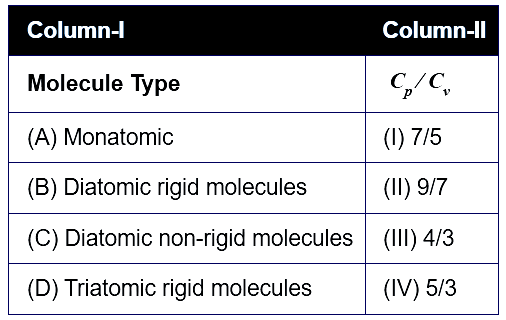
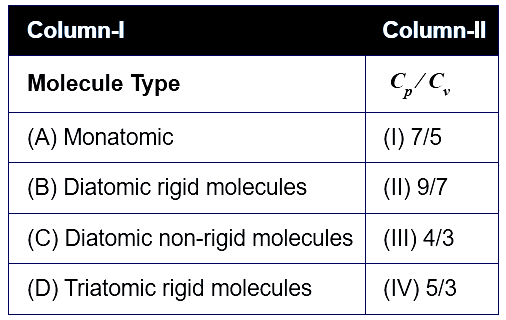
Match the CpCv ratio for ideal gases with different type of molecules :

[Sep. 04, 2020 (I)]
Match the CpCv ratio for ideal gases with different type of molecules :

[Sep. 04, 2020 (I)]
Q.91 Correct
Q.91 In-correct
Q.91 Unattempt
A closed vessel contains 0.1 mole of a monatomic ideal gas at 200 K. If 0.05 mole of the same gas at 400 K is added to it, the final equilibrium temperature (in K) of the gas in the vessel will be close to _________.
[NA Sep. 04, 2020 (I)]
A closed vessel contains 0.1 mole of a monatomic ideal gas at 200 K. If 0.05 mole of the same gas at 400 K is added to it, the final equilibrium temperature (in K) of the gas in the vessel will be close to _________.
[NA Sep. 04, 2020 (I)]
Q.92 Correct
Q.92 In-correct
Q.92 Unattempt
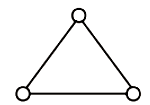
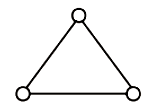
Consider a gas of triatomic molecules. The molecules are assumed to be triangular and made of massless rigid rods whose vertices are occupied by atoms. The internal energy of a mole of the gas at temperature T is :
[Sep. 03, 2020 (I)]

Consider a gas of triatomic molecules. The molecules are assumed to be triangular and made of massless rigid rods whose vertices are occupied by atoms. The internal energy of a mole of the gas at temperature T is :
[Sep. 03, 2020 (I)]
Q.93 Correct
Q.93 In-correct
Q.93 Unattempt
To raise the temperature of a certain mass of gas by 50°C at a constant pressure, 160 calories of heat is required. When the same mass of gas is cooled by 100°C at constant volume, 240 calories of heat is released. How many degrees of freedom does each molecule of this gas have (assume gas to be ideal)?
[Sep. 03, 2020 (II)]
To raise the temperature of a certain mass of gas by 50°C at a constant pressure, 160 calories of heat is required. When the same mass of gas is cooled by 100°C at constant volume, 240 calories of heat is released. How many degrees of freedom does each molecule of this gas have (assume gas to be ideal)?
[Sep. 03, 2020 (II)]
Q.94 Correct
Q.94 In-correct
Q.94 Unattempt
A gas mixture consists of 3 moles of oxygen and 5 moles of argon at temperature T. Assuming the gases to be ideal and the oxygen bond to be rigid, the total internal energy (in units of RT) of the mixture is :
[Sep. 02, 2020 (I)]
A gas mixture consists of 3 moles of oxygen and 5 moles of argon at temperature T. Assuming the gases to be ideal and the oxygen bond to be rigid, the total internal energy (in units of RT) of the mixture is :
[Sep. 02, 2020 (I)]
Q.95 Correct
Q.95 In-correct
Q.95 Unattempt
An ideal gas in a closed container is slowly heated. As its temperature increases, which of the following statements are true?
(1) The mean free path of the molecules decreases
(2) The mean collision time between the molecules decreases
(3) The mean free path remains unchanged
(4) The mean collision time remains unchanged
[Sep. 02, 2020 (II)]
An ideal gas in a closed container is slowly heated. As its temperature increases, which of the following statements are true?
(1) The mean free path of the molecules decreases
(2) The mean collision time between the molecules decreases
(3) The mean free path remains unchanged
(4) The mean collision time remains unchanged
[Sep. 02, 2020 (II)]
Q.96 Correct
Q.96 In-correct
Q.96 Unattempt
A mixture of 2 moles of helium gas (atomic mass = 4u), and 1 mole of argon gas (atomic mass = 40u) is kept at 300 K in a container. The ratio of their rms speeds
[
Vrms( helium)
Vrms( argon )
]
is close to
[9 Jan. 2019 I]
A mixture of 2 moles of helium gas (atomic mass = 4u), and 1 mole of argon gas (atomic mass = 40u) is kept at 300 K in a container. The ratio of their rms speeds
[
Vrms( helium)
Vrms( argon )
]
is close to
[9 Jan. 2019 I]
Q.97 Correct
Q.97 In-correct
Q.97 Unattempt
A vertical closed cylinder is separated into two parts by a frictionless piston of mass m and of negligible thickness. The piston is free to move along the length of the cylinder. The length of the cylinder above the piston is l1, and that below the piston is l2, such that l1>l2. Each part of the cylinder contains n moles of an ideal gas at equal temperature T. If the piston is stationary, its mass, m, will be given by:
(R is universal gas constant and g is the acceleration due to gravity)
[12 Jan. 2019 II]
A vertical closed cylinder is separated into two parts by a frictionless piston of mass m and of negligible thickness. The piston is free to move along the length of the cylinder. The length of the cylinder above the piston is l1, and that below the piston is l2, such that l1>l2. Each part of the cylinder contains n moles of an ideal gas at equal temperature T. If the piston is stationary, its mass, m, will be given by:
(R is universal gas constant and g is the acceleration due to gravity)
[12 Jan. 2019 II]
Q.98 Correct
Q.98 In-correct
Q.98 Unattempt
An ideal gas occupies a volume of 2m3 at a pressure of 3 ×10⁶Pa. The energy of the gas:
[12 Jan. 2019 I]
An ideal gas occupies a volume of 2m3 at a pressure of 3 ×10⁶Pa. The energy of the gas:
[12 Jan. 2019 I]
Q.99 Correct
Q.99 In-correct
Q.99 Unattempt
An ideal gas is enclosed in a cylinder at pressure of 2 atm and temperature, 300K. The mean time between two successive collisions is 6×10⁸s. If the pressure is doubled and temperature is increased to 500K, the mean time between two successive collisions wiil be close to:
[12 Jan. 2019 II]
An ideal gas is enclosed in a cylinder at pressure of 2 atm and temperature, 300K. The mean time between two successive collisions is 6×10⁸s. If the pressure is doubled and temperature is increased to 500K, the mean time between two successive collisions wiil be close to:
[12 Jan. 2019 II]
Q.100 Correct
Q.100 In-correct
Q.100 Unattempt
A gas mixture consists of 3 moles of oxygen and 5 moles of argon at temperature T. Considering only translational and rotational modes, the total internal energy of the system is :
[11 Jan. 2019 I]
A gas mixture consists of 3 moles of oxygen and 5 moles of argon at temperature T. Considering only translational and rotational modes, the total internal energy of the system is :
[11 Jan. 2019 I]
Q.101 Correct
Q.101 In-correct
Q.101 Unattempt
In a process, temperature and volume of one mole of an ideal monoatomic gas are varied according to the relation VT=K, where K is a constant. In this process the temperature of the gas is increased by ΔT. The amount of heat absorbed by gas is (R is gas constant):
[11 Jan. 2019 II]
In a process, temperature and volume of one mole of an ideal monoatomic gas are varied according to the relation VT=K, where K is a constant. In this process the temperature of the gas is increased by ΔT. The amount of heat absorbed by gas is (R is gas constant):
[11 Jan. 2019 II]
Q.102 Correct
Q.102 In-correct
Q.102 Unattempt
Two kg of a monoatomic gas is at a pressure of 4×10⁴ Nm2. The density of the gas is 8kgm3. What is the order of energy of the gas due to its thermal motion?
[10 Jan 2019 II]
Two kg of a monoatomic gas is at a pressure of 4×10⁴ Nm2. The density of the gas is 8kgm3. What is the order of energy of the gas due to its thermal motion?
[10 Jan 2019 II]
Q.103 Correct
Q.103 In-correct
Q.103 Unattempt
A 15 g mass of nitrogen gas is enclosed in a vessel at a temperature 27°C. Amount of heat transferred to the gas, so that rms velocity of molecules is doubled, is about: [Take R = 8.3 J/K mole]
[9 Jan. 2019 II]
A 15 g mass of nitrogen gas is enclosed in a vessel at a temperature 27°C. Amount of heat transferred to the gas, so that rms velocity of molecules is doubled, is about: [Take R = 8.3 J/K mole]
[9 Jan. 2019 II]
Q.104 Correct
Q.104 In-correct
Q.104 Unattempt
The number density of molecules of a gas depends on their distance r from the origin as, n(r)=n0eαr4. Then the total number of molecules is proportional to :
[12 April 2019 II]
The number density of molecules of a gas depends on their distance r from the origin as, n(r)=n0eαr4. Then the total number of molecules is proportional to :
[12 April 2019 II]
Q.105 Correct
Q.105 In-correct
Q.105 Unattempt
For a given gas at 1 atm pressure, rms speed of the molecules is 200 m/s at 127°C. At 2 atm pressure and at 227°C, the rms speed of the molecules will be:
[9 April 2019 I]
For a given gas at 1 atm pressure, rms speed of the molecules is 200 m/s at 127°C. At 2 atm pressure and at 227°C, the rms speed of the molecules will be:
[9 April 2019 I]
Q.106 Correct
Q.106 In-correct
Q.106 Unattempt
If 1022 gas molecules each of mass 1026kg collide with a surface (perpendicular to it) elastically per second over an area 1m2 with a speed 104ms, the pressure exerted by the gas molecules will be of the order of :
[8 April 2019 I]
If 1022 gas molecules each of mass 1026kg collide with a surface (perpendicular to it) elastically per second over an area 1m2 with a speed 104ms, the pressure exerted by the gas molecules will be of the order of :
[8 April 2019 I]
Q.107 Correct
Q.107 In-correct
Q.107 Unattempt
The temperature, at which the root mean square velocity of hydrogen molecules equals their escape velocity from the earth, is closest to :
[Boltzmann Constant kB=1.38×10²³JK
Avogadro Number NA=6.02×1026kg
Radius of Earth :6.4×10⁶m
Gravitational acceleration on Earth =10ms2]
[8 April 2019 II]
The temperature, at which the root mean square velocity of hydrogen molecules equals their escape velocity from the earth, is closest to :
[Boltzmann Constant kB=1.38×10²³JK
Avogadro Number NA=6.02×1026kg
Radius of Earth :6.4×10⁶m
Gravitational acceleration on Earth =10ms2]
[8 April 2019 II]
Q.108 Correct
Q.108 In-correct
Q.108 Unattempt
Two moles of helium gas is mixed with three moles of hydrogen molecules (taken to be rigid). What is the molar specific heat of mixture at constant volume?
(R = 8.3 J/mol K)
[12 April 2019 I]
Two moles of helium gas is mixed with three moles of hydrogen molecules (taken to be rigid). What is the molar specific heat of mixture at constant volume?
(R = 8.3 J/mol K)
[12 April 2019 I]
Q.109 Correct
Q.109 In-correct
Q.109 Unattempt
A diatomic gas with rigid molecules does 10 J of work when expanded at constant pressure. What would be the heat energy absorbed by the gas, in this process ?
[12 April 2019 II]
A diatomic gas with rigid molecules does 10 J of work when expanded at constant pressure. What would be the heat energy absorbed by the gas, in this process ?
[12 April 2019 II]
Q.110 Correct
Q.110 In-correct
Q.110 Unattempt
A 25×103m3 volume cylinder is filled with 1 mol of O2 gas at room temperature (300 K) . The molecular diameter of O2 , and its root mean square speed, are found to be 0.3 nm and 200 m/s, respectively. What is the average collision rate (per second) for an O2 molecule?
[10 April 2019 I]
A 25×103m3 volume cylinder is filled with 1 mol of O2 gas at room temperature (300 K) . The molecular diameter of O2 , and its root mean square speed, are found to be 0.3 nm and 200 m/s, respectively. What is the average collision rate (per second) for an O2 molecule?
[10 April 2019 I]
Q.111 Correct
Q.111 In-correct
Q.111 Unattempt
When heat Q is supplied to a diatomic gas of rigid molecules, at constant volume its temperature increases by ΔT. The heat required to produce the same change in temperature, at a constant pressure is :
[10 April 2019 II]
When heat Q is supplied to a diatomic gas of rigid molecules, at constant volume its temperature increases by ΔT. The heat required to produce the same change in temperature, at a constant pressure is :
[10 April 2019 II]
Q.112 Correct
Q.112 In-correct
Q.112 Unattempt
An HCl molecule has rotational, translational and vibrational motions. If the rms velocity of HCl molecules in its gaseous phase is v,m is its mass and kB is Boltzmann constant, then its temperature will be:
[9 April 2019 I]
An HCl molecule has rotational, translational and vibrational motions. If the rms velocity of HCl molecules in its gaseous phase is v,m is its mass and kB is Boltzmann constant, then its temperature will be:
[9 April 2019 I]
Q.113 Correct
Q.113 In-correct
Q.113 Unattempt
The specific heats, Cp and Cv of a gas of diatomic molecules, A, are given (in units of Jmol1k1 ) by 29 and 22, respectively. Another gas of diatomic molecules, B has the corresponding values 30 and 21. If they are treated as ideal gases, then:
[9 April 2019 II]
The specific heats, Cp and Cv of a gas of diatomic molecules, A, are given (in units of Jmol1k1 ) by 29 and 22, respectively. Another gas of diatomic molecules, B has the corresponding values 30 and 21. If they are treated as ideal gases, then:
[9 April 2019 II]
Q.114 Correct
Q.114 In-correct
Q.114 Unattempt
Two moles of an ideal monoatomic gas occupies a volume V at 27°C. The gas expands adiabatically to a volume 2 V.
Calculate (1) the final temperature of the gas and (2) change in its internal energy.
[2018]
Two moles of an ideal monoatomic gas occupies a volume V at 27°C. The gas expands adiabatically to a volume 2 V.
Calculate (1) the final temperature of the gas and (2) change in its internal energy.
[2018]
Q.115 Correct
Q.115 In-correct
Q.115 Unattempt
Two moles of helium are mixed with n with moles of hydrogen. If
CP
CV
=
3
2
for the mixture, then the value of n is
[Online April 16, 2018]
Two moles of helium are mixed with n with moles of hydrogen. If
CP
CV
=
3
2
for the mixture, then the value of n is
[Online April 16, 2018]
Q.116 Correct
Q.116 In-correct
Q.116 Unattempt
The temperature of an open room of volume 30m3 increases from 17°C to 27°C due to sunshine. The atmospheric pressure in the room remains 1×10⁵Pa. If ni and nf are the number of molecules in the room before and after heating, then nfni will be :
[2017]
The temperature of an open room of volume 30m3 increases from 17°C to 27°C due to sunshine. The atmospheric pressure in the room remains 1×10⁵Pa. If ni and nf are the number of molecules in the room before and after heating, then nfni will be :
[2017]
Q.117 Correct
Q.117 In-correct
Q.117 Unattempt
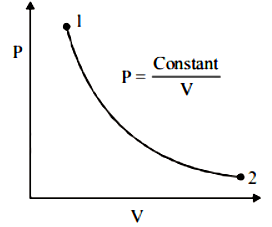
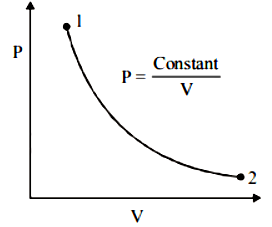
For the P-V diagram given for an ideal gas,

out of the following which one correctly represents the T-P diagram ?
[Online April 9, 2017]
For the P-V diagram given for an ideal gas,

out of the following which one correctly represents the T-P diagram ?
[Online April 9, 2017]
Q.118 Correct
Q.118 In-correct
Q.118 Unattempt
N moles of a diatomic gas in a cylinder are at a temperature T. Heat is supplied to the cylinder such that the temperature remains constant but n moles of the diatomic gas get converted into monoatomic gas. What is the change in the total kinetic energy of the gas ?
[Online April 9, 2017]
N moles of a diatomic gas in a cylinder are at a temperature T. Heat is supplied to the cylinder such that the temperature remains constant but n moles of the diatomic gas get converted into monoatomic gas. What is the change in the total kinetic energy of the gas ?
[Online April 9, 2017]
Q.119 Correct
Q.119 In-correct
Q.119 Unattempt
Cp and Cv are specific heats at constant pressure and constant volume respectively. It is observed that
CpCv= a for hydrogen gas
CpCv=b for nitrogen gas
The correct relation between a and b is:
[2017]
Cp and Cv are specific heats at constant pressure and constant volume respectively. It is observed that
CpCv= a for hydrogen gas
CpCv=b for nitrogen gas
The correct relation between a and b is:
[2017]
Q.120 Correct
Q.120 In-correct
Q.120 Unattempt
An ideal gas has molecules with 5 degrees of freedom.
The ratio of specific heats at constant pressure (Cp) and at constant volume (Cv) is :
[Online April 8, 2017]
An ideal gas has molecules with 5 degrees of freedom.
The ratio of specific heats at constant pressure (Cp) and at constant volume (Cv) is :
[Online April 8, 2017]
Q.121 Correct
Q.121 In-correct
Q.121 Unattempt
An ideal gas undergoes a quasi static, reversible process in which its molar heat capacity C remains constant. If during this process the relation of pressure P and volume V is given by PVn= constant, then n is given by ( Here CP and CV are molar specific heat at constant pressure and constant volume, respectively):
[2016]
An ideal gas undergoes a quasi static, reversible process in which its molar heat capacity C remains constant. If during this process the relation of pressure P and volume V is given by PVn= constant, then n is given by ( Here CP and CV are molar specific heat at constant pressure and constant volume, respectively):
[2016]
Q.122 Correct
Q.122 In-correct
Q.122 Unattempt
In an ideal gas at temperature T, the average force that a molecule applies on the walls of a closed container depends on T as Tq. A good estimate for q is:
[Online April 10,2015]
In an ideal gas at temperature T, the average force that a molecule applies on the walls of a closed container depends on T as Tq. A good estimate for q is:
[Online April 10,2015]
Q.123 Correct
Q.123 In-correct
Q.123 Unattempt
Using equipartition of energy, the specific heat (in J kg1 K1) of aluminium at room temperature can be estimated to be (atomic weight of aluminium = 27)
[Online April 11, 2015]
Using equipartition of energy, the specific heat (in J kg1 K1) of aluminium at room temperature can be estimated to be (atomic weight of aluminium = 27)
[Online April 11, 2015]
Q.124 Correct
Q.124 In-correct
Q.124 Unattempt
A gas molecule of mass M at the surface of the Earth has kinetic energy equivalent to 0°C. If it were to go up straight without colliding with any other molecules, how high it would rise? Assume that the height attained is much less than radius of the earth. (kB. is Boltzmann constant).
[Online April 19, 2014]
A gas molecule of mass M at the surface of the Earth has kinetic energy equivalent to 0°C. If it were to go up straight without colliding with any other molecules, how high it would rise? Assume that the height attained is much less than radius of the earth. (kB. is Boltzmann constant).
[Online April 19, 2014]
Q.125 Correct
Q.125 In-correct
Q.125 Unattempt
At room temperature a diatomic gas is found to have an r.m.s. speed of 1930ms1. The gas is:
[Online April 12, 2014]
At room temperature a diatomic gas is found to have an r.m.s. speed of 1930ms1. The gas is:
[Online April 12, 2014]
Q.126 Correct
Q.126 In-correct
Q.126 Unattempt
Modern vacuum pumps can evacuate a vessel down to a pressure of 4.0×10¹⁵ atm. at room temperature (300 K). Taking R=8.0JK1mole1,1atm=105 Pa and NAvogadro=6×10²³mole1, the mean distance between molecules of gas in an evacuated vessel will be of the order of:
[Online April 9, 2014]
Modern vacuum pumps can evacuate a vessel down to a pressure of 4.0×10¹⁵ atm. at room temperature (300 K). Taking R=8.0JK1mole1,1atm=105 Pa and NAvogadro=6×10²³mole1, the mean distance between molecules of gas in an evacuated vessel will be of the order of:
[Online April 9, 2014]
Q.127 Correct
Q.127 In-correct
Q.127 Unattempt
There are two identical chambers, completely thermally insulated from surroundings. Both chambers have a partition wall dividing the chambers in two compartments.
Compartment 1 is filled with an ideal gas and Compartment 3 is filled with a real gas. Compartments 2 and 4 are vacuum. A small hole (orifice) is made in the partition walls and the gases are allowed to expand in vacuum.
Statement-1: No change in the temperature of the gas takes place when ideal gas expands in vacuum. However, the temperature of real gas goes down (cooling) when it expands in vacuum.
Statement-2: The internal energy of an ideal gas is only kinetic. The internal energy of a real gas is kinetic as well as potential.
[Online April 9, 2013]
There are two identical chambers, completely thermally insulated from surroundings. Both chambers have a partition wall dividing the chambers in two compartments.
Compartment 1 is filled with an ideal gas and Compartment 3 is filled with a real gas. Compartments 2 and 4 are vacuum. A small hole (orifice) is made in the partition walls and the gases are allowed to expand in vacuum.
Statement-1: No change in the temperature of the gas takes place when ideal gas expands in vacuum. However, the temperature of real gas goes down (cooling) when it expands in vacuum.
Statement-2: The internal energy of an ideal gas is only kinetic. The internal energy of a real gas is kinetic as well as potential.
[Online April 9, 2013]
Q.128 Correct
Q.128 In-correct
Q.128 Unattempt
In the isothermal expansion of 10g of gas from volume V to 2V the work done by the gas is 575J. What is the root mean square speed of the molecules of the gas at that temperature?
[Online April 25, 2013]
In the isothermal expansion of 10g of gas from volume V to 2V the work done by the gas is 575J. What is the root mean square speed of the molecules of the gas at that temperature?
[Online April 25, 2013]
Q.129 Correct
Q.129 In-correct
Q.129 Unattempt
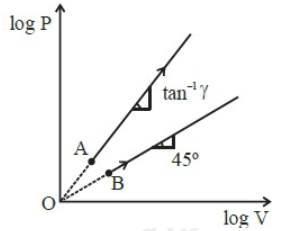
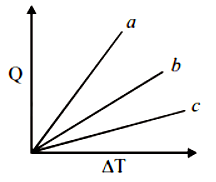
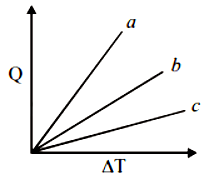
Figure shows the variation in temperature (DT) with the amount of heat supplied (Q) in an isobaric process corresponding to a monoatomic (M), diatomic (D) and a polyatomic (P) gas. The initial state of all the gases are the same and the scales for the two axes coincide. Ignoring vibrational degrees of freedom, the lines a, b and c respectively correspond to :

[Online April 9, 2013]
Figure shows the variation in temperature (DT) with the amount of heat supplied (Q) in an isobaric process corresponding to a monoatomic (M), diatomic (D) and a polyatomic (P) gas. The initial state of all the gases are the same and the scales for the two axes coincide. Ignoring vibrational degrees of freedom, the lines a, b and c respectively correspond to :

[Online April 9, 2013]
Q.130 Correct
Q.130 In-correct
Q.130 Unattempt
A perfect gas at 27°C is heated at constant pressure so as to double its volume. The final temperature of the gas will be, close to
[Online May 7, 2012]
A perfect gas at 27°C is heated at constant pressure so as to double its volume. The final temperature of the gas will be, close to
[Online May 7, 2012]
Q.131 Correct
Q.131 In-correct
Q.131 Unattempt
A given ideal gas with γ=
Cp
Cv
=1.5
at a temperature T. If the gas is compressed adiabatically to one-fourth of its initial volume, the final temperature will be
[Online May 12, 2012]
A given ideal gas with γ=
Cp
Cv
=1.5
at a temperature T. If the gas is compressed adiabatically to one-fourth of its initial volume, the final temperature will be
[Online May 12, 2012]
Q.132 Correct
Q.132 In-correct
Q.132 Unattempt
A thermally insulated vessel contains an ideal gas of molecular mass M and ratio of specific heats γ. It is moving with speed v and it's suddenly brought to rest. Assuming no heat is lost to the surroundings, its temperature increases by:
[2011]
A thermally insulated vessel contains an ideal gas of molecular mass M and ratio of specific heats γ. It is moving with speed v and it's suddenly brought to rest. Assuming no heat is lost to the surroundings, its temperature increases by:
[2011]
Q.133 Correct
Q.133 In-correct
Q.133 Unattempt
Three perfect gases at absolute temperatures T1,T2 and T3 are mixed. The masses of molecules are m1,m2 and m3 and the number of molecules are n1,n2 and n3 respectively. Assuming no loss of energy, the final temperature of the mixture is :
[2011]
Three perfect gases at absolute temperatures T1,T2 and T3 are mixed. The masses of molecules are m1,m2 and m3 and the number of molecules are n1,n2 and n3 respectively. Assuming no loss of energy, the final temperature of the mixture is :
[2011]
Q.134 Correct
Q.134 In-correct
Q.134 Unattempt
One kg of a diatomic gas is at a pressure of 8×10⁴Nm2. The density of the gas is 4kgm3. What is the energy of the gas due to its thermal motion?
[2009]
One kg of a diatomic gas is at a pressure of 8×10⁴Nm2. The density of the gas is 4kgm3. What is the energy of the gas due to its thermal motion?
[2009]
Q.135 Correct
Q.135 In-correct
Q.135 Unattempt
The speed of sound in oxygen (O2) at a certain temperature is 460ms1. The speed of sound in helium (He) at the same temperature will be (assume both gases to be ideal)
[2008]
The speed of sound in oxygen (O2) at a certain temperature is 460ms1. The speed of sound in helium (He) at the same temperature will be (assume both gases to be ideal)
[2008]
Q.136 Correct
Q.136 In-correct
Q.136 Unattempt
If CP and CV denote the specific heats of nitrogen per unit mass at constant pressure and constant volume respectively, then
[2007]
If CP and CV denote the specific heats of nitrogen per unit mass at constant pressure and constant volume respectively, then
[2007]
Q.137 Correct
Q.137 In-correct
Q.137 Unattempt
A gaseous mixture consists of 16 g of helium and 16 g of oxygen. The ratio
Cp
Cv
of the mixture is
[2005]
A gaseous mixture consists of 16 g of helium and 16 g of oxygen. The ratio
Cp
Cv
of the mixture is
[2005]
Q.138 Correct
Q.138 In-correct
Q.138 Unattempt
One mole of ideal monatomic gas (γ=53) is mixed with one mole of diatomic gas (γ=75). What is gamma for the mixture? γ Denotes the ratio of specific heat at constant pressure, to that at constant volume
[2004]
One mole of ideal monatomic gas (γ=53) is mixed with one mole of diatomic gas (γ=75). What is gamma for the mixture? γ Denotes the ratio of specific heat at constant pressure, to that at constant volume
[2004]
Q.139 Correct
Q.139 In-correct
Q.139 Unattempt
During an adiabatic process, the pressure of a gas is found to be proportional to the cube of its absolute temperature. The ratio CPCV for the gas is
[2003]
During an adiabatic process, the pressure of a gas is found to be proportional to the cube of its absolute temperature. The ratio CPCV for the gas is
[2003]
Q.140 Correct
Q.140 In-correct
Q.140 Unattempt
Cooking gas containers are kept in a lorry moving with uniform speed. The temperature of the gas molecules inside will
[2002]
Cooking gas containers are kept in a lorry moving with uniform speed. The temperature of the gas molecules inside will
[2002]
Q.141 Correct
Q.141 In-correct
Q.141 Unattempt
At what temperature is the r.m.s velocity of a hydrogen molecule equal to that of an oxygen molecule at 47°C?
[2002]
At what temperature is the r.m.s velocity of a hydrogen molecule equal to that of an oxygen molecule at 47°C?
[2002]
Mockers logo Get latest Exam Updates
& Study Material Alerts!
No, Thanks
Arrow pointer icon
Click on Allow to receive notifications
Notification bell icon ×
Open Now