Please wait...
Given below are two statements. One is labelled as Assertion (A) and the other is labelled as Reason (R).
Assertion (A) : A simple pendulum is taken to a planet of mass and radius, 4 times and 2 times, respectively, than the Earth. The time period of the pendulum remains same on earth and the planet.
Reason (R) : The mass of the pendulum remains unchanged at Earth and the other planet.
In the light of the above statements, choose the correct answer from the options given below :
A light hollow cube of side length 10 cm and mass 10 g , is floating in water. It is pushed down and released to execute simple harmonic oscillations. The time period of oscillations is $y \pi \times 10^{-2} \mathrm{~s}$, where the value of $y$ is(Acceleration due to gravity, $g=10 \mathrm{~m} / \mathrm{s}^2$, density of water $=10^3 \mathrm{~kg} / \mathrm{m}^3$ )
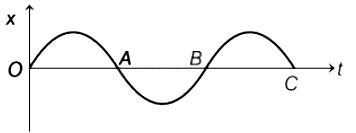
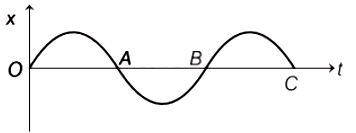
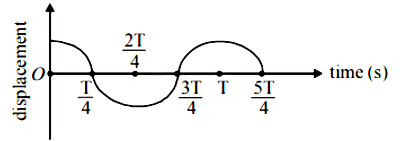
A particle oscillates along the $x$-axis according to the law, $x(\mathrm{t})=x_0 \sin ^2\left(\frac{\mathrm{t}}{2}\right)$ where $x_0=1 \mathrm{~m}$. The kinetic energy $(\mathrm{K})$ of the particle as a function of $x$ is correctly represented by the graph
Assertion (A) : Knowing initial position $\mathrm{x}_0$ and initial momentum $p_0$ is enough to determine the position and momentum at any time $t$ for a simple harmonic motion with a given angular frequency $\omega$.
Reason (R) : The amplitude and phase can be expressed in terms of $\mathrm{X}_0$ an $\mathrm{p}_0$.
Given below are two statements: one is labelled as Assertion (A) and the other is labelled as Reason (R).
Assertion (A) : Time period of a simple pendulum is longer at the top of a mountain than that at the base of the mountain.
Reason (R) : Time period of a simple pendulum decreases with increasing value of acceleration due to gravity and vice-versa.
In the light of the above statements, choose the most appropriate answer from the options given below :
Two bodies A and B of equal mass are suspended from two massless springs of spring constant k1 and k2, respectively. If the bodies oscillate vertically such that their amplitudes are equal, the ratio of the maximum velocity of A to the maximum velocity of B is
A particle is subjected to two simple harmonic motions as :$$x_1=\sqrt{7} \sin 5 \mathrm{tcm}$$and $x_2=2 \sqrt{7} \sin \left(5 t+\frac{\pi}{3}\right) \mathrm{cm}$where $x$ is displacement and $t$ is time in seconds.The maximum acceleration of the particle is $x \times 10^{-2} \mathrm{~ms}^{-2}$. The value of $x$ is :
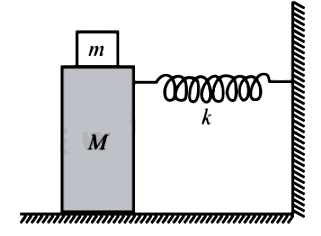
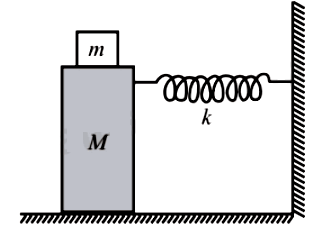
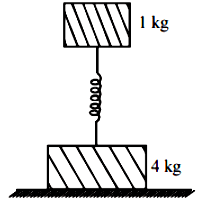
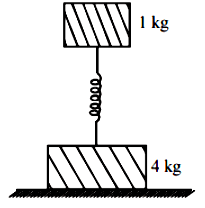
Two blocks of masses $m$ and $M,(M>m)$, are placed on a frictionless table as shown in figure. A massless spring with spring constant k is attached with the lower block. If the system is slightly displaced and released, then ( $\mu=$ coefficient of friction between the two blocks)
A. The time period of small oscillation of the two blocks is $T=2 \pi \sqrt{\frac{(m+M)}{k}}$
B. The acceleration of the blocks is $a=-\frac{k x}{M+m}$ ( $x=$ displacement of the blocks from the mean position)
C. The magnitude of the frictional force on the upper block is $\frac{m \mu|x|}{M+m}$
D. The maximum amplitude of the upper block, if it does not slip, is $\frac{\mu(M+m) g}{k}$
E. Maximum frictional force can be $\mu(\mathrm{M}+\mathrm{m}) \mathrm{g}$.
Choose the correct answer from the options given below :
Two simple pendulums having lengths $l_1$ and $l_2$ with negligible string mass undergo angular displacements $\theta_1$ and $\theta_2$, from their mean positions, respectively. If the angular accelerations of both pendulums are same, then which expression is correct?
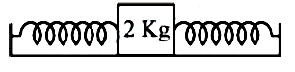
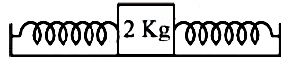
A block of mass 2 kg is attached to one end of a massless spring whose other end is fixed at a wall. The spring-mass system moves on a frictionless horizontal table. The spring's natural length is 2 m and spring constant is 200 N/m. The block is pushed such that the length of the spring becomes 1 m and then released. At distance x m (x < 2) from the wall, the speed of the block will be
A particle executes simple harmonic motion with an amplitude of 4cm. At the mean position, velocity of the particle is 10cm∕ s. The distance of the particle from the mean position when its speed becomes 5cm∕ s is √α cm, where α = ___
[27-Jan-2024 Shift 1]
A ball suspended by a thread swings in a vertical plane so that its magnitude of acceleration in the extreme position and lowest position are equal. The angle (θ) of thread deflection in the extreme position will be :
[27-Jan-2024 Shift 2]
When the displacement of a simple harmonic oscillator is one third of its amplitude, the ratio of total energy to the kinetic energy is x/8, where x =____
[29-Jan-2024 Shift 1]
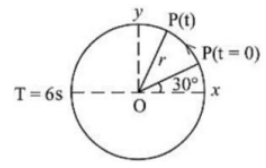
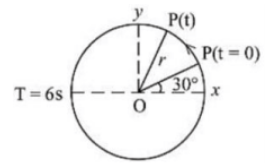
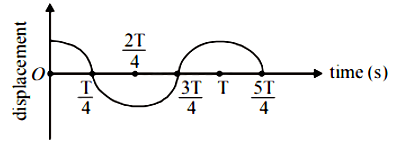
A simple harmonic oscillator has an amplitude A and time period 6π second. Assuming the oscillation starts from its mean position, the time required by it to travel from x = A to x = √3/2 A will be π/x s, where x = _____:
[29-Jan-2024 Shift 2]
A simple pendulum is placed at a place where its distance from the earth's surface is equal to the radius of the earth. If the length of the string is 4m, then the time period of small oscillations will be _____s. [. take g = π2 ms−2]
[30-Jan-2024 Shift 2]
A particle performs simple harmonic motion with amplitude A. Its speed is increased to three times at an instant when its displacement is 2A/3. The new amplitude of motion is nA/3. The value of n is___
[31-Jan-2024 Shift 1]
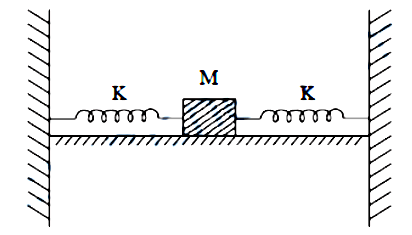
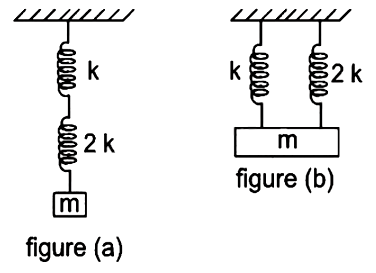
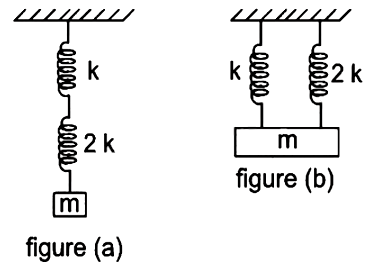
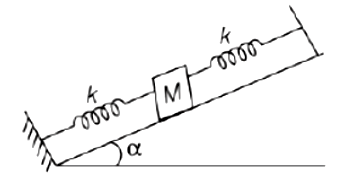
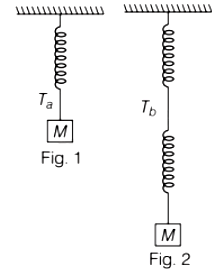
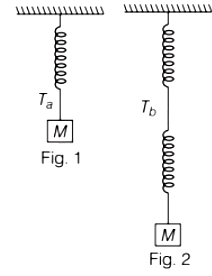
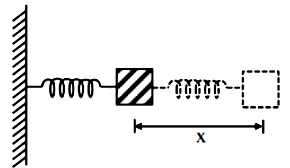
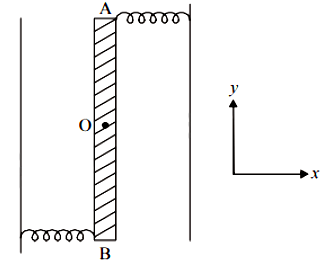
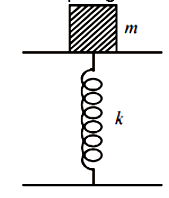
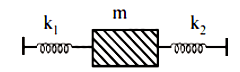
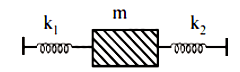
The time period of simple harmonic motion of mass M in the given figure is π where the value of α is _____
[31-Jan-2024 Shift 2]
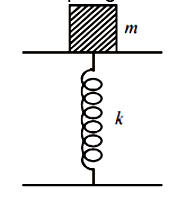
A mass m is suspended from a spring of negligible mass and the system oscillates with a frequency f1. The frequency of oscillations if a mass 9m is suspended from the same spring is f2. The value of f1/f2 is:
[1-Feb-2024 Shift 2]



 ×
×
 Bank
Bank


 SSC
SSC


 Railway


 State
State


 Other
Other


 Teaching


 Insurance


 Medical


 Engineering


 Defence


 GATE
GATE


 NTA CUET

 UPSC
UPSC

 MBA Entrance


 LAW
LAW

 ReNEET UG 2026
 SSC Selection Post (Phase 14) 2026
 RRB NTPC 2026
 SSC CGL Tier-I 2026
 SSC JE 2026
 SBI PO Prelims 2026
 SSC Steno Grade C & D 2026
 SBI Clerk Prelims 2026
 IBPS PO Prelims 2026
 IBPS Clerk Prelims 2026
 SSC CPO Tier I 2026
 NDA II 2026
 CDS II 2026

 where the value of α is _____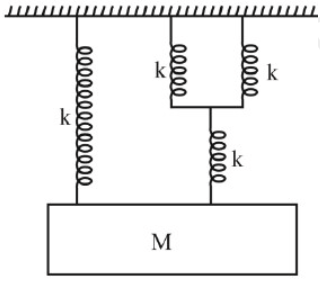




 Get latest Exam Updates