Please wait...
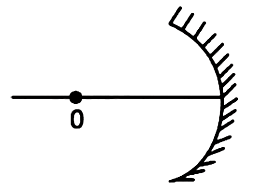
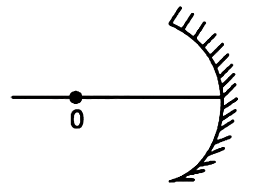
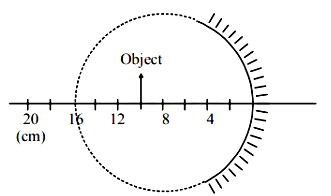
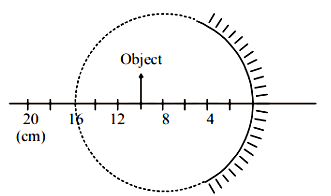
The driver sitting inside a parked car is watching vehicles approaching from behind with the help of his side view mirror, which is a convex mirror with radius of curvature $\mathrm{R}=2 \mathrm{~m}$. Another car approaches him from behind with a uniform speed of $90 \mathrm{~km} / \mathrm{hr}$. When the car is at a distance of 24 m from him, the magnitude of the acceleration of the image of the car in the side view mirror is ' $a$ '. The value of $100 a$ is __________ $\mathrm{m} / \mathrm{s}^2$.
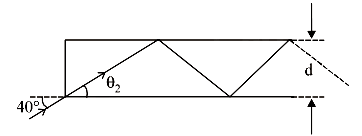
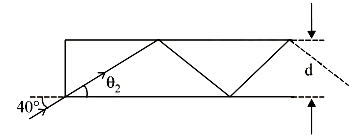
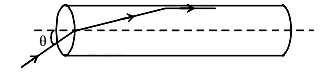
Two light beams fall on a transparent material block at point 1 and 2 with angle $\theta_1$ and $\theta_2$, respectively, as shown in figure. After refraction, the beams intersect at point 3 which is exactly on the interface at other end of the block. Given : the distance between 1 and 2, $\mathrm{d}=4 \sqrt{3} \mathrm{~cm}$ and $\theta_1=\theta_2=\cos ^{-1}\left(\frac{n_2}{2 n_1}\right)$. where refractive index of the block $n_2>$ refractive index of the outside medium $\mathrm{n}_1$, then the thickness of the block is ______ cm .
Light from a point source in air falls on a spherical glass surface (refractive index, $\mu=1.5$ and radius of curvature $=50 \mathrm{~cm}$ ). The image is formed at a distance of 200 cm from the glass surface inside the glass. The magnitude of distance of the light source from the glass surface is ___________m.
Distance between object and its image (magnified by $-\frac{1}{3}$ ) is 30 cm . The focal length of the mirror used is $\left(\frac{x}{4}\right) \mathrm{cm}$,where magnitude of value of $x$ is _________.
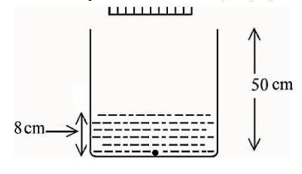
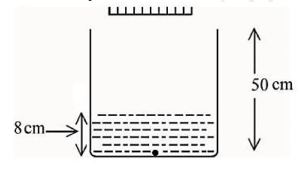
A container contains a liquid with refractive index of 1.2 up to a height of 60 cm and another liquid having refractive index 1.6 is added to height H above first liquid. If viewed from above, the apparent shift in the position of bottom of container is 40 cm . The value of H is ________ cm . (Consider liquids are immisible)
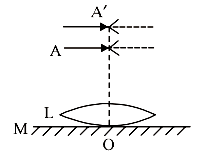
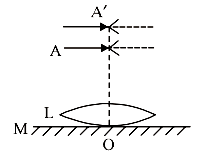
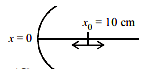
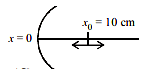
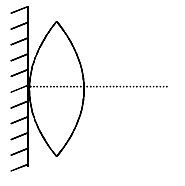
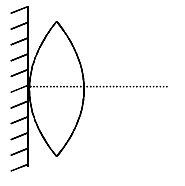
Given is a thin convex lens of glass (refractive index $\mu$ ) and each side having radius of curvature $R$. One side is polished for complete reflection. At what distance from the lens, an object be placed on the optic axis so that the image gets formed on the object itself?
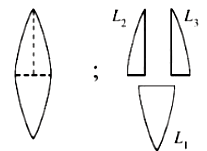
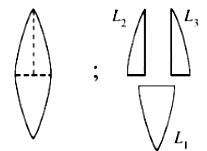
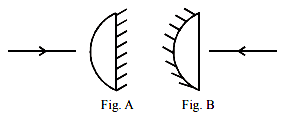
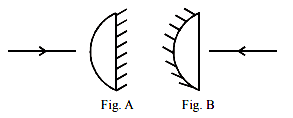
In the diagram given below, there are three lenses formed. Considering negligible thickness of each of them as compared to $\left|R_1\right|$ and $\left|R_2\right|$, i.e., the radii of curvature for upper and lower surfaces of the glass lens, the power of the combination is
A symmetric thin biconvex lens is cut into four equal parts by two planes $A B$ and $C D$ as shown in figure. If the power of original lens is 4D then the power of a part of the divided lens is
Given a thin convex lens (refractive index $\mu_2$ ), kept in a liquid (refractive index $\mu_1, \mu_1<\mu_2$ ) having radii of curvatures $\left|R_1\right|$ and $\left|R_2\right|$. Its second surface is silver polished. Where should an object be placed on the optic axis so that a real and inverted image is formed at the same place?
A spherical surface of radius of curvature $R$, separates air from glass (refractive index $=1.5$ ). The centre of curvature is in the glass medium. A point object ' $O$ ' placed in air on the optic axis of the surface, so that its real image is formed at 'I' inside glass. The line OI intersects the spherical surface at $P$ and $P O=P I$. The distance $P O$ equals to
What is the lateral shift of a ray refracted through a parallel-sided glass slab of thickness ' $h$ ' in terms of the angle of incidence ' $i$ ' and angle of refraction ' $r$ ', if the glass slab is placed in air medium?
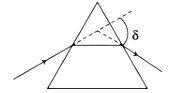
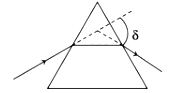
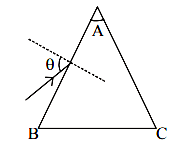
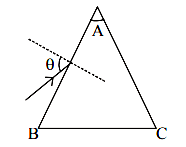
The refractive index of the material of a glass prism is $\sqrt{3}$. The angle of minimum deviation is equal to the angle of the prism. What is the angle of the prism?
A concave mirror of focal length $f$ in air is dipped in a liquid of refractive index $\mu$. Its focal length in the liquid will be:
A plano-convex lens having radius of curvature of first surface 2 cm exhibits focal length of $f_1$ in air. Another plano-convex lens with first surface radius of curvature 3 cm has focal length of $f_2$ when it is immersed in a liquid of refractive index 1.2. If both the lenses are made of same glass of refractive index 1.5 , the ratio of $f_1$ and $f_2$ will be
A thin plano convex lens made of glass of refractive index 1.5 is immersed in a liquid of refractive index 1.2. When the plane side of the lens is silver coated for complete reflection, the lens immersed in the liquid behaves like a concave mirror of focal length 0.2 m . The radius of curvature of the curved surface of the lens is
What is the relative decrease in focal length of a lens for an increase in optical power by 0.1 D from 2.5D ? ['D' stands for dioptre]
A photograph of a landscape is captured by a drone camera at a height of 18 km . The size of the camera film is $2 \mathrm{~cm} \times 2 \mathrm{~cm}$ and the area of the landscape photographed is $400 \mathrm{~km}^2$. The focal length of the lens in the drone camera is :
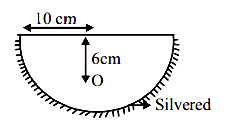
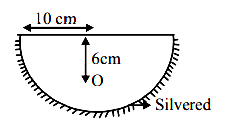
A hemispherical vessel is completely filled with a liquid of refractive index $\mu$. A small coin is kept at the lowest point $(\mathrm{O})$ of the vessel as shown in figure. The minimum value of the refractive index of the liquid so that a person can see the coin from point E (at the level of the vessel) is _________.
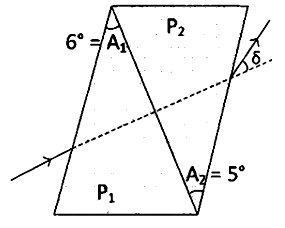
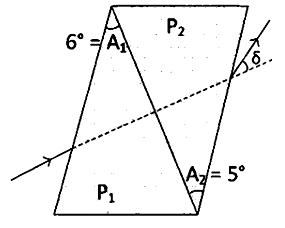
A thin prism $\mathrm{P}_1$ with angle $4^{\circ}$ made of glass having refractive index 1.54 , is combined with another thin prism $\mathrm{P}_2$ made of glass having refractive index 1.72 to get dispersion without deviation. The angle of the prism $\mathrm{P}_2$ in degrees is
A concave mirror produces an image of an object such that the distance between the object and image is 20 cm. If the magnification of the image is –3, then the magnitude of the radius of curvature of the mirror is :
Let u and v be the distances of the object and the image from a lens of focal length f. The correct graphical representation of u and v for a convex lens when |u| > f, is
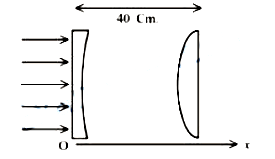
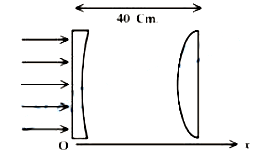
Two identical symmetric double convex lenses of focal length f are cut into two equal parts L1, L2 by AB plane and L3, L4 by XY plane as shown in figure respectively. The ratio of focal lengths of lenses L1 and L3 is
Two concave refracting surfaces of equal radii of curvature and refractive index 1.5 face each other in air as shown in figure. A point object O is placed midway, between P and B. The separation between the images of O, formed by each refracting surface is :
A convex lens made of glass (refractive index = 1.5) has focal length 24 cm in air. When it is totally immersed in water (refractive index = 1.33), its focal length changes to
A slanted object $A B$ is placed on one side of convex lens as shown in the diagram. The image is formed on the opposite side. Angle made by the image with principal axis is :
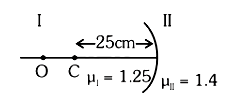
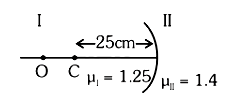
A spherical surface separates two media of refractive indices 1 and 1.5 as shown in figure. Distance of the image of an object ' O ', is :
( C is the center of curvature of the spherical surface and R is the radius of curvature)
Consider following statements for refraction of light through prism, when angle of deviation is minimum.
A. The refracted ray inside prism becomes parallel to the base.
B. Larger angle prisms provide smaller angle of minimum deviation.
C. Angle of incidence and angle of emergence becomes equal.
D. There are always two sets of angle of incidence for which deviation will be same except at minimum deviation setting.
E. Angle of refraction becomes double of prism angle.
Choose the correct answer from the options given below :
When an object is placed 40 cm away from a spherical mirror an image of magnification $\frac{1}{2}$ is produced. To obtain an image with magnification of $\frac{1}{3}$, the object is to be moved :
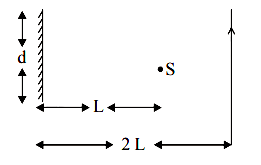
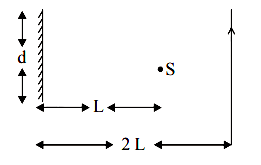
A finite size object is placed normal to the principal axis at a distance of 30 cm from a convex mirror of focal length 30 cm . A plane mirror is now placed in such a way that the image produced by both the mirrors coincide with each other. The distance between the two mirrors is :
A lens having refractive index 1.6 has focal length of 12 cm , when it is in air. Find the focal length of the lens when it is placed in water.(Take refractive index of water as 1.28)
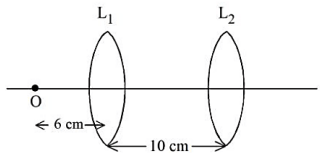
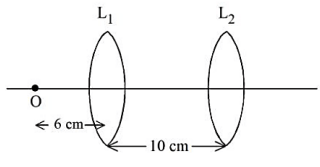
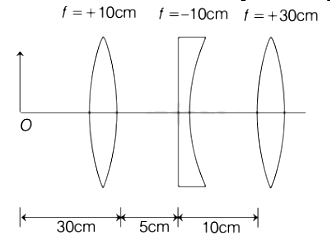
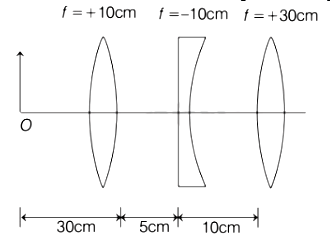
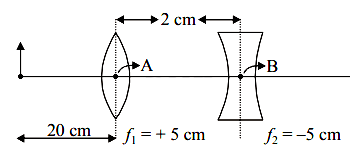
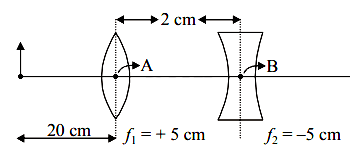
Two thin convex lenses of focal lengths 30 cm and 10 cm are placed coaxially, 10 cm apart. The power of this combination is:
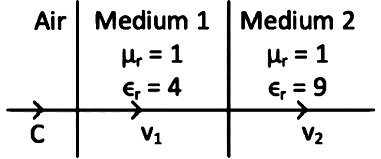
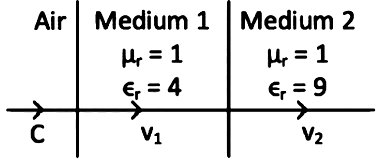
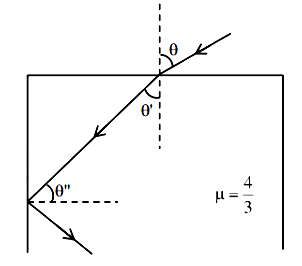
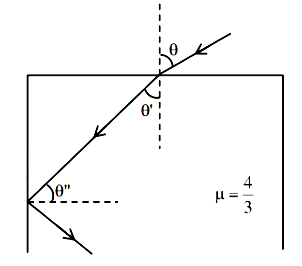
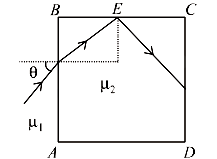
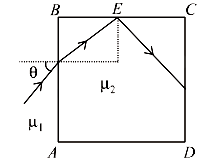
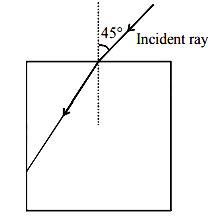
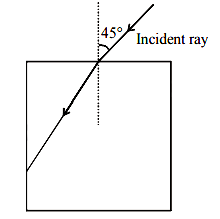
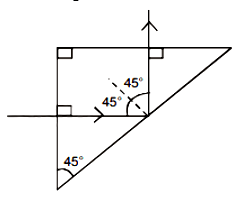
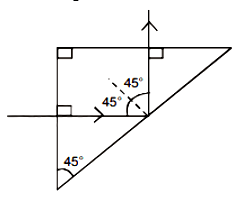
A transparent block A having refractive index $\mu = 1.25$ is surrounded by another medium of refractive index $\mu = 1.0$ as shown in the figure. A light ray is incident on the flat face of the block with incident angle $\theta$ as shown in the figure. What is the maximum value of $\theta$ for which light suffers total internal reflection at the top surface of the block?
A mirror is used to produce an image with magnification of $\frac{1}{4}$. If the distance between object and its image is 40 cm, then the focal length of the mirror is ________.
Given below are two statements: one is labelled as Assertion (A) and the other is labelled as Reason (R).
Assertion (A): Refractive index of glass is higher than that of air.
Reason (R): Optical density of a medium is directly proportionate to its mass density which results in a proportionate refractive index.
In the light of the above statements, choose the most appropriate answer from the options given below:
A concave-convex lens of refractive index 1.5 and the radii of curvature of its surfaces are 30 cm and 20 cm, respectively. The concave surface is upwards and is filled with a liquid of refractive index 1.3. The focal length of the liquid-glass combination will be
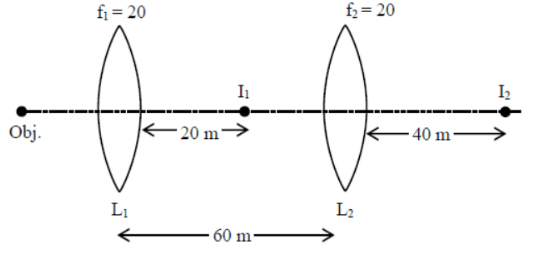
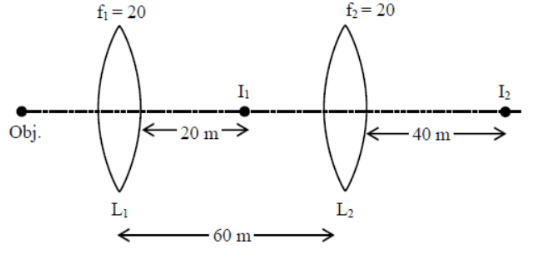
A convex lens of focal length 30 cm is placed in contact with a concave lens of focal length 20 cm. An object is placed at 20 cm to the left of this lens system. The distance of the image from the lens in cm is ________.
A convex lens of focal length 40cm forms an image of an extended source of light on a photoelectric cell. A current I is produced. The lens is replaced by another convex lens having the same diameter but focal length 20cm. The photoelectric current now is :
[27-Jan-2024 Shift 1]
If the refractive index of the material of a prism is cot (A/2), where A is the angle of prism then the angle of minimum deviation will be
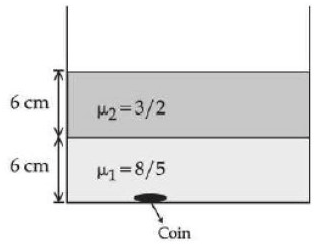
Two immiscible liquids of refractive indices 8/5 and 3/2 respectively are put in a beaker as shown in the figure. The height of each column is 6cm. A coin is placed at the bottom of the beaker. For near normal vision, the apparent depth of the coin is α/4 cm. The value of α is_______
A convex mirror of radius of curvature 30cm forms an image that is half the size of the object. The object distance is :
[29-Jan-2024 Shift 1]
A biconvex lens of refractive index 1.5 has a focal length of 20cm in air. Its focal length when immersed in a liquid of refractive index 1.6 will be:
If the distance between object and its two times magnified virtual image produced by a curved mirror is 15cm, the focal length of the mirror must be :
[29-Jan-2024 Shift 2]
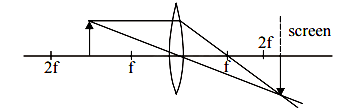
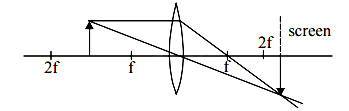
The distance between object and its two times magnified real image as produced by a convex lens is 45cm. The focal length of the lens used is ____cm.
[30-Jan-2024 Shift 1]
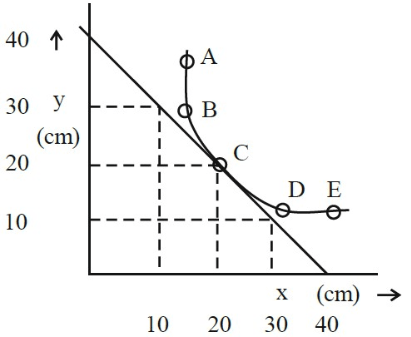
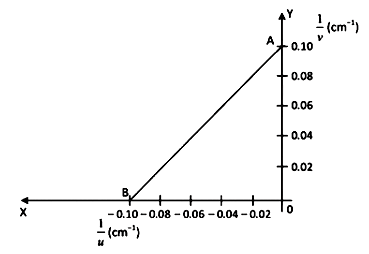
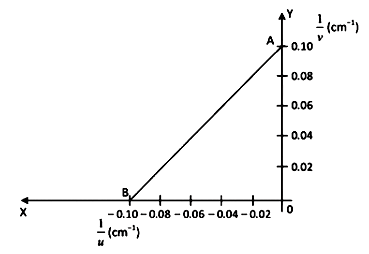
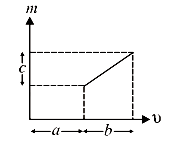
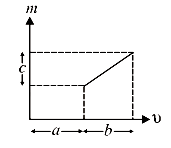
In an experiment to measure the focal length (f) of a convex lens, the magnitude of object distance (x) and the image distance (y) are measured with reference to the focal point of the lens. The y − x plot is shown in figure.
The focal length of the lens is _____cm.
[30-Jan-2024 Shift 2]
The refractive index of a prism with apex angle A is cotA∕2. The angle of minimum deviation is :
[31-Jan-2024 Shift 1]
Light from a point source in air falls on a convex curved surface of radius 20cm and refractive index 1.5. If the source is located at 100cm from the convex surface, the image will be formed at ______cm from the object.
[31-Jan-2024 Shift 2]
The distance between object and its 3 times magnified virtual image as produced by a convex lens is 20cm. The focal length of the lens used is ______cm.
[1-Feb-2024 Shift 1]



 ×
×
 Bank
Bank


 SSC
SSC


 Railway


 State
State


 Other
Other


 Teaching


 Insurance


 Medical


 Engineering


 Defence


 GATE
GATE


 NTA CUET

 UPSC
UPSC

 MBA Entrance


 LAW
LAW

 ReNEET UG 2026
 SSC Selection Post (Phase 14) 2026
 RRB NTPC 2026
 SSC CGL Tier-I 2026
 SSC JE 2026
 SBI PO Prelims 2026
 SSC Steno Grade C & D 2026
 SBI Clerk Prelims 2026
 IBPS PO Prelims 2026
 IBPS Clerk Prelims 2026
 SSC CPO Tier I 2026
 NDA II 2026
 CDS II 2026















 Get latest Exam Updates