Please wait...
A double slit interference experiment performed with a light of wavelength 600 nm forms an interference fringe pattern on a screen with 10 th bright fringe having its centre at a distance of 10 mm from the central maximum. Distance of the centre of the same 10 th bright fringe from the central maximum when the source of light is replaced by another source of wavelength 660 nm would be ________ mm .
If the measured angular separation between the second minimum to the left of the central maximum and the third minimum to the right of the central maximum is $30^{\circ}$ in a single slit diffraction pattern recorded using 628 nm light, then the width of the slit is _______ $\mu$m.
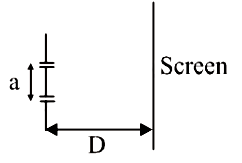
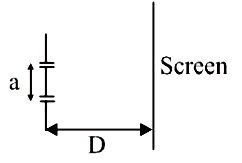
In a Young's double slit experiment, two slits are located 1.5 mm apart. The distance of screen from slits is 2 m and the wavelength of the source is 400 nm . If the 20 maxima of the double slit pattern are contained within the central maximum of the single slit diffraction pattern, then the width of each slit is $x \times 10^{-3} \mathrm{~cm}$, where $x$-value is _________ .
Given below are two statements : one is labelled as Assertion (A) and the other is labelled as Reason (R).
Assertion-(A) : If Young's double slit experiment is performed in an optically denser medium than air, then the consecutive fringes come closer.Reason-(R) : The speed of light reduces in an optically denser medium than air while its frequency does not change.
In the light of the above statements, choose the most appropriate answer from the options given below :
Given below are two statements. One is labelled as Assertion (A) and the other is labelled as Reason (R).
Assertion (A) : In Young's double slit experiment, the fringes produced by red light are closer as compared to those produced by blue light.
Reason (R) : The fringe width is directly proportional to the wavelength of light.
In the light of the above statements, choose the correct answer from the options given below :
A transparent film of refractive index, 2.0 is coated on a glass slab of refractive index, 1.45. What is the minimum thickness of transparent film to be coated for the maximum transmission of Green light of wavelength 550 nm . [Assume that the light is incident nearly perpendicular to the glass surface.]
The width of one of the two slits in Young's double slit experiment is d while that of the other slit is $x \mathrm{~d}$. If the ratio of the maximum to the minimum intensity in the interference pattern on the screen is $9: 4$ then what is the value of $x$ ?(Assume that the field strength varies according to the slit width.)
The Young's double slit interference experiment is performed using light consisting of 480 nm and 600 nm wavelengths to form interference patterns. The least number of the bright fringes of 480 nm light that are required for the first coincidence with the bright fringes formed by 600 nm light is
Young's double slit inteference apparatus is immersed in a liquid of refractive index 1.44. It has slit separation of 1.5 mm . The slits are illuminated by a parallel beam of light whose wavelength in air is 690 nm . The fringe-width on a screen placed behind the plane of slits at a distance of 0.72 m , will be:
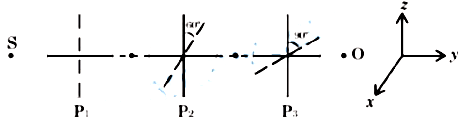
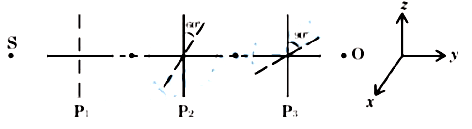
In a Young's double slit experiment, three polarizers are kept as shown in the figure. The transmission axes of $P_1$ and $P_2$ are orthogonal to each other. The polarizer $P_3$ covers both the slits with its transmission axis at $45^{\circ}$ to those of $P_1$ and $P_2$. An unpolarized light of wavelength $\lambda$ and intensity $I_0$ is incident on $P_1$ and $P_2$. The intensity at a point after $P_3$ where the path difference between the light waves from $s_1$ and $s_2$ is $\frac{\lambda}{3}$, is
A light wave is propagating with plane wave fronts of the type $x+y+z=$ constant. Th angle made by the direction of wave propagation with the $x$-axis is :
A monochromatic light of frequency $5 \times 10^{14} \mathrm{~Hz}$ travelling through air, is incident on a medium of refractive index ' 2 '. Wavelength of the refracted light will be :
Width of one of the two slits in a Young's double slit interference experiment is half of the other slit. The ratio of the maximum to the minimum intensity in the interference pattern is :
In a Young's double slit experiment, the slits are separated by 0.2 mm . If the slits separation is increased to 0.4 mm , the percentage change of the fringe width is :
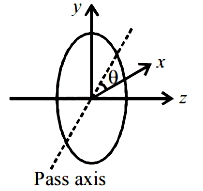
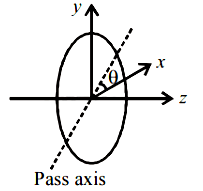
Two polarisers $P_1$ and $P_2$ are placed in such a way that the intensity of the transmitted light will be zero. A third polariser $P_3$ is inserted in between $P_1$ and $P_2$, at particular angle between $P_2$ and $P_3$. The transmitted intensity of the light passing the through all three polarisers is maximum. The angle between the polarisers $P_2$ and $P_3$ is :
Two plane polarized light waves combine at a certain point whose electric field components are
$$\begin{aligned}& E_1=E_0 \operatorname{Sin} \omega t \\& E_2=E_0 \operatorname{Sin}\left(\omega t+\frac{\pi}{3}\right)\end{aligned}$$
Find the amplitude of the resultant wave.
In a Young's double slit experiment, the source is white light. One of the slits is covered by red filter and another by a green filter. In this case:



 ×
×
 Bank
Bank


 SSC
SSC


 Railway


 State
State


 Other
Other


 Teaching


 Insurance


 Medical


 Engineering


 Defence


 GATE
GATE


 NTA CUET

 UPSC
UPSC

 MBA Entrance


 LAW
LAW

 ReNEET UG 2026
 SSC Selection Post (Phase 14) 2026
 RRB NTPC 2026
 SSC CGL Tier-I 2026
 SSC JE 2026
 SBI PO Prelims 2026
 SSC Steno Grade C & D 2026
 SBI Clerk Prelims 2026
 IBPS PO Prelims 2026
 IBPS Clerk Prelims 2026
 SSC CPO Tier I 2026
 NDA II 2026
 CDS II 2026



 Get latest Exam Updates