Please wait...
An electron in the ground state of the hydrogen atom has the orbital radius of $5.3 \times 10^{-11} \mathrm{~m}$ while that for the electron in third excited state is $8.48 \times 10^{-10} \mathrm{~m}$. The ratio of the de Broglie wavelengths of electron in the ground state to that in the excited state is
The work functions of cesium (Cs) and lithium (Li) metals are 1.9 eV and 2.5 eV , respectively. If we incident a light of wavelength 550 nm on these two metal surfaces, then photo-electric effect is possible for the case of
A light source of wavelength $\lambda$ illuminates a metal surface and electrons are ejected with maximum kinetic energy of 2 eV . If the same surface is illuminated by a light source of wavelength $\frac{\lambda}{2}$, then the maximum kinetic energy of ejected electrons will be (The work function of metal is 1 eV )
A sub-atomic particle of mass $10^{-30} \mathrm{~kg}$ is moving with a velocity $2.21 \times 10^6 \mathrm{~m} / \mathrm{s}$. Under the matter wave consideration, the particle will behave closely like $\qquad$ $\left(\mathrm{h}=6.63 \times 10^{-34} \mathrm{~J} . \mathrm{s}\right)$
In photoelectric effect an em-wave is incident on a metal surface and electrons are ejected from the surface. If the work function of the metal is 2.14 eV and stopping potential is 2 V , what is the wavelength of the em-wave?(Given $\mathrm{hc}=1242 \mathrm{eVnm}$ where h is the Planck's constant and c is the speed of light in vaccum.)
An electron of mass ' m ' with an initial velocity $\overrightarrow{\mathrm{v}}=\mathrm{v}_0 \hat{i}\left(\mathrm{v}_0>0\right)$ enters an electric field $\overrightarrow{\mathrm{E}}=-\mathrm{E}_{\mathrm{o}} \hat{\mathrm{k}}$. If the initial de Broglie wavelength is $\lambda_0$, the value after time t would be
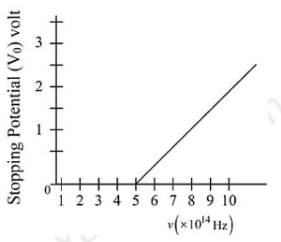
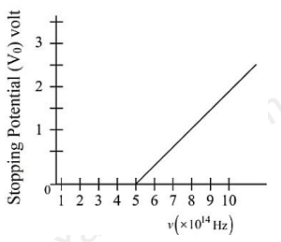
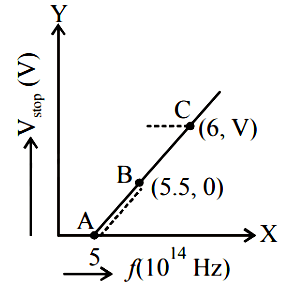
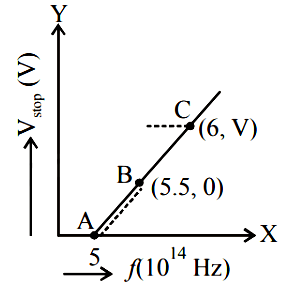
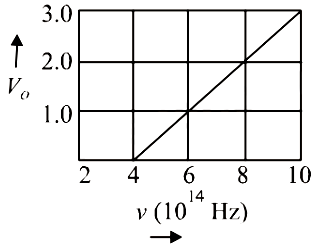
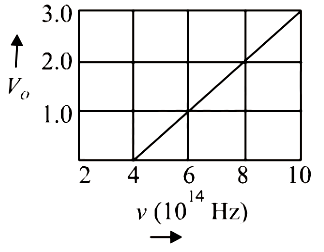
In photoelectric effect, the stopping potential $\left(\mathrm{V}_0\right) \mathrm{v} / \mathrm{s}$ frequency $(v)$ curve is plotted.
( h is the Planck's constant and $\phi_0$ is work function of metal )
(A) $\mathrm{V}_0 \mathrm{v} / \mathrm{s} v$ is linear.
(B) The slope of $\mathrm{V}_0 \mathrm{v} / \mathrm{s} v$ curve $=\frac{\phi_0}{\mathrm{~h}}$
(C) h constant is related to the slope of $\mathrm{V}_0 \mathrm{v} / \mathrm{s} v$ line.
(D) The value of electric charge of electron is not required to determine h using the $\mathrm{V}_0 \mathrm{v} / \mathrm{s} v$ curve.
(E) The work function can be estimated without knowing the value of $h$.
Choose the correct answer from the options given below :
A proton of mass ' $m_P$ ' has same energy as that of a photon of wavelength ' $\lambda$ '. If the proton is moving at non-relativistic speed, then ratio of its de Broglie wavelength to the wavelength of photon is.
Which of the following phenomena cannot be explained by wave theory of light?
Given below are two statements: one is labelled as Assertion (A) and the other is labelled as Reason (R).
Assertion (A) : Emission of electrons in photoelectric effect can be suppressed by applying a sufficiently negative electron potential to the photoemissive substance.
Reason (R) : A negative electric potential, which stops the emission of electrons from the surface of a photoemissive substance, varies linearly with frequency of incident radiation.
In the light of the above statements, choose the most appropriate answer from the options given below :
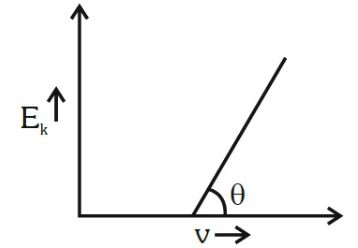
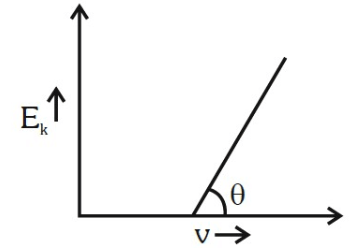
If $\lambda$ and $K$ are de Broglie wavelength and kinetic energy, respectively, of a particle with constant mass. The correct graphical representation for the particle will be :
In an experiment with photoelectric effect, the stopping potential,
A monochromatic light is incident on a metallic plate having work function $\phi$. An electron, emitted normally to the plate from a point A with maximum kinetic energy, enters a constant magnetic field, perpendicular to the initial velocity of electron. The electron passes through a curve and hits back the plate at a point $B$. The distance between $A$ and $B$ is :(Given : The magnitude of charge of an electron is e and mass is $\mathrm{m}, \mathrm{h}$ is Planck's constant and c is velocity of light. Take the magnetic field exists throughout the path of electron)
An electron with mass ' m ' with an initial velocity $(\mathrm{t}=0) \overrightarrow{\mathrm{v}}=\mathrm{v}_0 \hat{i}\left(\mathrm{v}_0>0\right)$ enters a magnetic field $\overrightarrow{\mathrm{B}}=\mathrm{B}_0 \hat{j}$. If the initial de-Broglie wavelength at $\mathrm{t}=0$ is $\lambda_0$ then its value after time ' t ' would be :
Given below are two statements: one is labelled as Assertion A and the other is labelled as Reason $\mathbf{R}$
Assertion A : In photoelectric effect, on increasing the intensity of incident light the stopping potential increases.
Reason R : Increase in intensity of light increases the rate of photoelectrons emitted, provided the frequency of incident light is greater than threshold frequency.
In the light of the above statements, choose the correct answer from the options given below
A small mirror of mass $m$ is suspended by a massless thread of length $l$. Then the small angle through which the thread will be deflected when a short pulse of laser of energy E falls normal on the mirror
($\mathrm{c}=$ speed of light in vacuum and $g=$ acceleration due to gravity)
A photoemissive substance is illuminated with a radiation of wavelength $\lambda_i$ so that it releases electrons with de-Broglie wavelength $\lambda_e$. The longest wavelength of radiation that can emit photoelectron is $\lambda_o$. Expression for de-Broglie wavelength is given by:
(m: mass of the electron, h: Planck's constant and c: speed of light)
The ratio of the power of a light source $S_1$ to that the light source $S_2$ is $2 . S_1$ is emitting $2 \times 10^{15}$ photons per second at 600 nm . If the wavelength of the source $S_2$ is 300 nm , then the number of photons per second emitted by $S_2$ is __________ $\times 10^{14}$.
An electron is released from rest near an infinite non-conducting sheet of uniform charge density '$-\sigma$'. The rate of change of de-Broglie wave length associated with the electron varies inversely as nth power of time. The numerical value of n is _____.



 ×
×
 Bank
Bank


 SSC
SSC


 Railway


 State
State


 Other
Other


 Teaching


 Insurance


 Medical


 Engineering


 Defence


 GATE
GATE


 NTA CUET

 UPSC
UPSC

 MBA Entrance


 LAW
LAW

 ReNEET UG 2026
 SSC Selection Post (Phase 14) 2026
 RRB NTPC 2026
 SSC CGL Tier-I 2026
 SSC JE 2026
 SBI PO Prelims 2026
 SSC Steno Grade C & D 2026
 SBI Clerk Prelims 2026
 IBPS PO Prelims 2026
 IBPS Clerk Prelims 2026
 SSC CPO Tier I 2026
 NDA II 2026
 CDS II 2026


 Get latest Exam Updates