Please wait...
Let $\mathrm{S}=\mathbf{N} \cup\{0\}$. Define a relation R from S to $\mathbf{R}$ by :
$$ \mathrm{R}=\left\{(x, y): \log _{\mathrm{e}} y=x \log _{\mathrm{e}}\left(\frac{2}{5}\right), x \in \mathrm{~S}, y \in \mathbf{R}\right\} . $$
Then, the sum of all the elements in the range of $R$ is equal to :
मान लें $\mathrm{S}=\mathbf{N} \cup\{0\}$। से $\mathrm{S}$ से $\mathbf{R}$ में एक संबंध R को इस प्रकार परिभाषित करें:
तब, $R$ के क्षेत्र के सभी तत्वों का योग निम्नलिखित के बराबर है :
Let $A = [a_{ij}]$ be a $2 \times 2$ matrix such that $a_{ij} \in \{0, 1\}$ for all $i$ and $j$. Let the random variable $X$ denote the possible values of the determinant of the matrix $A$. Then, the variance of $X$ is:
मान लें $A = [a_{ij}]$ एक $2 \times 2$ मैट्रिक्स है जिसमें $a_{ij} \in \{0, 1\}$ सभी $i$ और $j$ के लिए। यादृच्छिक चर $X$ $A$ के नियतांक के संभावित मानों को निरूपित करता है। तब, $X$ का विचलन निम्नलिखित है:
Let a straight line $L$ pass through the point $P(2, -1, 3)$ and be perpendicular to the lines $ \frac{x - 1}{2} = \frac{y + 1}{1} = \frac{z - 3}{-2} $ and $ \frac{x - 3}{1} = \frac{y - 2}{3} = \frac{z + 2}{4} $. If the line $L$ intersects the $yz$-plane at the point $Q$, then the distance between the points $P$ and $Q$ is:
मान लें एक सीधी रेखा $L$ बिंदु $P(2, -1, 3)$ से गुजरती है और रेखाओं के लंबवत है $ \frac{x - 1}{2} = \frac{y + 1}{1} = \frac{z - 3}{-2} $ और $ \frac{x - 3}{1} = \frac{y - 2}{3} = \frac{z + 2}{4} $। यदि रेखा $L$ $yz$-समतल को बिंदु $Q$ पर काटती है, तो बिंदु $P$ और $Q$ के बीच की दूरी निम्नलिखित है:
If the domain of the function $ \log_5(18x - x^2 - 77) $ is $ (\alpha, \beta) $ and the domain of the function $ \log_{(x-1)} \left( \frac{2x^2 + 3x - 2}{x^2 - 3x - 4} \right) $ is $(\gamma, \delta)$, then $ \alpha^2 + \beta^2 + \gamma^2 $ is equal to:
यदि फंक्शन $ \log_5(18x - x^2 - 77) $ का डोमेन $ (\alpha, \beta) $ है और फंक्शन $ \log_{(x-1)} \left( \frac{2x^2 + 3x - 2}{x^2 - 3x - 4} \right) $ का डोमेन $(\gamma, \delta)$ है, तो $ \alpha^2 + \beta^2 + \gamma^2 $ निम्नलिखित के बराबर है:
Let $ \hat{a} $ be a unit vector perpendicular to the vectors $ \vec{b} = \hat{i} - 2\hat{j} + 3\hat{k} $ and $ \vec{c} = 2\hat{i} + 3\hat{j} - \hat{k} $, and $ \hat{a} $ makes an angle of $ \cos^{-1} \left( -\frac{1}{3} \right) $ with the vector $ \hat{i} + \hat{j} + \hat{k} $. If $ \hat{a} $ makes an angle of $ \frac{\pi}{3} $ with the vector $ \hat{i} + \alpha\hat{j} + \hat{k} $, then the value of $ a $ is:
मान लें $ \hat{a} $ एक इकाई सदिश है जो सदिशों $ \vec{b} = \hat{i} - 2\hat{j} + 3\hat{k} $ और $ \vec{c} = 2\hat{i} + 3\hat{j} - \hat{k} $ के लंबवत है, और $ \hat{a} $, सदिश $ \hat{i} + \hat{j} + \hat{k} $ के साथ $ \cos^{-1} \left( -\frac{1}{3} \right) $ का कोण बनाता है। यदि $ \hat{a} $ सदिश $ \hat{i} + \alpha\hat{j} + \hat{k} $ के साथ $ \frac{\pi}{3} $ का कोण बनाता है, तो $ a $ का मान निम्नलिखित है:
Let $ \alpha, \beta \ (\alpha \neq \beta) $ be the values of $ m $, for which the equations $ x+y+z=1 $, $ x+2y+4z=m $ and $ x+4y+10z=m^2 $ have infinitely many solutions. Then the value of $ \sum\limits_{n=1}^{10} (n^{\alpha}+n^{\beta}) $ is equal to :
वे $ \alpha, \beta \ (\alpha \neq \beta) $ वो $ m $ के मान हैं, जिनके लिए समीकरण $ x+y+z=1 $, $ x+2y+4z=m $ और $ x+4y+10z=m^2 $ के अनंत समाधान हैं। तब $ \sum\limits_{n=1}^{10} (n^{\alpha}+n^{\beta}) $ का मान है :
Let the line x + y = 1 meet the axes of x and y at A and B, respectively. A right angled triangle AMN is inscribed in the triangle OAB, where O is the origin and the points M and N lie on the lines OB and AB, respectively. If the area of the triangle AMN is $ \frac{4}{9} $ of the area of the triangle OAB and AN : NB = $ \lambda : 1 $, then the sum of all possible value(s) of $ \lambda $ is:
रेखा x + y = 1 क्रमशः x और y अक्षों पर A और B पर मिलती है। एक समकोण त्रिभुज AMN, त्रिभुज OAB में अंकित है, जहाँ O मूल है और बिंदु M और N क्रमशः रेखाओं OB और AB पर स्थित हैं। यदि त्रिभुज AMN का क्षेत्रफल, त्रिभुज OAB के क्षेत्रफल का $ \frac{4}{9} $ है और AN : NB = $ \lambda : 1 $ है, तो $ \lambda $ के सभी संभावित मानों का योग है:
Bag 1 contains 4 white balls and 5 black balls, and Bag 2 contains n white balls and 3 black balls. One ball is drawn randomly from Bag 1 and transferred to Bag 2. A ball is then drawn randomly from Bag 2. If the probability, that the ball drawn is white, is $ \frac{29}{45} $, then n is equal to:
बैग 1 में 4 सफेद गेंदें और 5 काली गेंदें हैं, और बैग 2 में n सफेद गेंदें और 3 काली गेंदें हैं। बैग 1 से यादृच्छिक रूप से एक गेंद निकाली जाती है और बैग 2 में डाल दी जाती है। फिर बैग 2 से यादृच्छिक रूप से एक गेंद निकाली जाती है। यदि संभावना यह है कि निकाली गई गेंद सफेद है, $ \frac{29}{45} $ है, तो n का मान है:
The remainder, when $7^{103}$ is divided by 23, is equal to:
जब $7^{103}$ को 23 से विभाजित किया जाता है, तो शेषफल है:
Let a circle C pass through the points (4, 2) and (0, 2), and its centre lie on 3x + 2y + 2 = 0. Then the length of the chord, of the circle C, whose mid-point is (1, 2), is:
एक वृत्त C बिंदुओं (4, 2) और (0, 2) से गुजरता है, और जिसका केंद्र 3x + 2y + 2 = 0 पर स्थित है। तो उस वृत्त C की जीव की लंबाई, जिसका मध्य बिंदु (1, 2) है:
If for the solution curve $y=f(x)$ of the differential equation $\frac{d y}{d x}+(\tan x) y=\frac{2+\sec x}{(1+2 \sec x)^2}$, $x \in\left(\frac{-\pi}{2}, \frac{\pi}{2}\right), f\left(\frac{\pi}{3}\right)=\frac{\sqrt{3}}{10}$, then $f\left(\frac{\pi}{4}\right)$ is equal to:
यदि विभेदक समीकरण $\frac{d y}{d x}+(\tan x) y=\frac{2+\sec x}{(1+2 \sec x)^2}$ के हल वक्र $y=f(x)$ के लिए, $x \in\left(\frac{-\pi}{2}, \frac{\pi}{2}\right), f\left(\frac{\pi}{3}\right)=\frac{\sqrt{3}}{10}$, तो $f\left(\frac{\pi}{4}\right)$ का मान है:
Let $\mathrm{A}=\left[a_{i j}\right]$ be a matrix of order $3 \times 3$, with $a_{i j}=(\sqrt{2})^{i+j}$. If the sum of all the elements in the third row of $A^2$ is $\alpha+\beta \sqrt{2}, \alpha, \beta \in \mathbf{Z}$, then $\alpha+\beta$ is equal to :
मान लें कि $\mathrm{A}=\left[a_{i j}\right]$ एक $3 \times 3$ क्रम का मैट्रिक्स है, जहाँ $a_{i j}=(\sqrt{2})^{i+j}$। यदि $A^2$ की तीसरी पंक्ति के सभी तत्वों का योग $\alpha+\beta \sqrt{2}$ है, जहाँ $\alpha, \beta \in \mathbf{Z}$, तो $\alpha+\beta$ कितना है:
If $\sin x + \sin^2 x = 1$, $x \in \left(0, \frac{\pi}{2}\right)$, then
$(\cos^{12} x + \tan^{12} x) + 3(\cos^{10} x + \cos^8 x + \tan^8 x) + (\cos^6 x + \tan^6 x)$ is equal to:
यदि $\sin x + \sin^2 x = 1$, $x \in \left(0, \frac{\pi}{2}\right)$, तब
$(\cos^{12} x + \tan^{12} x) + 3(\cos^{10} x + \cos^8 x + \tan^8 x) + (\cos^6 x + \tan^6 x)$ का मान है:
Let the area enclosed between the curves $|y| = 1 - x^2$ and $x^2 + y^2 = 1$ be $\alpha$. If $9\alpha = \beta \pi + \gamma; \beta, \gamma$ are integers, then the value of $|\beta - \gamma|$ equals:
परवलय वक्र $|y| = 1 - x^2$ और वृत्त $x^2 + y^2 = 1$ के बीच घिरी हुई क्षेत्रफल $\alpha$ हो। यदि $9\alpha = \beta \pi + \gamma; \beta, \gamma$ पूर्णांक हैं, तो $|\beta - \gamma|$ का मान है:
Let P be the foot of the perpendicular from the point $(1,2,2)$ on the line $\mathrm{L}: \frac{x-1}{1}=\frac{y+1}{-1}=\frac{z-2}{2}$. Let the line $\vec{r}=(-\hat{i}+\hat{j}-2 \hat{k})+\lambda(\hat{i}-\hat{j}+\hat{k}), \lambda \in \mathbf{R}$, intersect the line L at Q . Then $2(\mathrm{PQ})^2$ is equal to :
मान लीजिए कि P बिंदु $(1,2,2)$ से रेखा $\mathrm{L}: \frac{x-1}{1}=\frac{y+1}{-1}=\frac{z-2}{2}$ पर लंबवत भ्रमण का पाद है। रेखा $\vec{r}=(-\hat{i}+\hat{j}-2 \hat{k})+\lambda(\hat{i}-\hat{j}+\hat{k}), \lambda \in \mathbf{R}$, रेखा L को Q पर प्रतिच्छेदन करती है। तब $2(\mathrm{PQ})^2$ का मान है :
If all the words with or without meaning made using all the letters of the word "KANPUR" are arranged as in a dictionary, then the word at 440th position in this arrangement is :
यदि शब्द "KANPUR" के सभी अक्षरों का उपयोग करते हुए अर्थसहित या अर्थरहित सभी शब्द बनाए जाते हैं और उन्हें एक शब्दकोश में व्यवस्थित किया जाता है, तो इस क्रम में 440वाँ स्थान कौन सा शब्द है :
If $ 24 \int\limits_0^{\frac{\pi}{4}} \bigg[\sin \left| 4x - \frac{\pi}{12} \right| + [2 \sin x] \bigg] dx = 2\pi + \alpha $, where $[\cdot]$ denotes the greatest integer function, then $\alpha$ is equal to ________.
यदि $ 24 \int\limits_0^{\frac{\pi}{4}} \bigg[\sin \left| 4x - \frac{\pi}{12} \right| + [2 \sin x] \bigg] dx = 2\pi + \alpha $, जहाँ $[\cdot]$ महानतम पूर्णांक फलन को दर्शाता है, तो $\alpha$ बराबर है ________.
Let $y^2=12 x$ be the parabola and $S$ be its focus. Let $P Q$ be a focal chord of the parabola such that $(S P)(S Q)=\frac{147}{4}$. Let $C$ be the circle described taking $P Q$ as a diameter. If the equation of a circle $C$ is $64 x^2+64 y^2-\alpha x-64 \sqrt{3} y=\beta$, then $\beta-\alpha$ is equal to $\qquad$ .
मान लीजिए $y^2=12 x$ एक परवली है और $S$ इसका फोकस है। $P Q$ पराबोला की एक फोकल चॉर्ड है ऐसी कि $(S P)(S Q)=\frac{147}{4}$। $C$ वह वृत्त है जो $P Q$ को व्यास बनाकर बनाया गया है। यदि वृत्त $C$ का समीकरण $64 x^2+64 y^2-\alpha x-64 \sqrt{3} y=\beta$ है, तब $\beta-\alpha$ के बराबर है $\qquad$ ।
Let $a_1, a_2, \ldots, a_{2024}$ be an Arithmetic Progression such that $a_1+\left(a_5+a_{10}+a_{15}+\ldots+a_{2020}\right)+a_{2024}=2233$. Then $a_1+a_2+a_3+\ldots+a_{2024}$ is equal to _________.
मान लीजिए $a_1, a_2, \ldots, a_{2024}$ एक अंकगणितीय प्रगति है ऐसी कि $a_1+\left(a_5+a_{10}+a_{15}+\ldots+a_{2020}\right)+a_{2024}=2233$। तब $a_1+a_2+a_3+\ldots+a_{2024}$ के बराबर है _________।
Given below are two statements :
Statement (I): On nitration of m-xylene with $\mathrm{HNO}_3, \mathrm{H}_2 \mathrm{SO}_4$ followed by oxidation, 4-nitrobenzene-1,3-dicarboxylic acid is obtained as the major product.
Statement (II) : $-\mathrm{CH}_3$ group is o/p-directing while $-\mathrm{NO}_2$ group is m-directing group.
In the light of the above statements, choose the correct answer from the options given below :
नीचे दिए गए दो कथन हैं :
कथन (I): $\mathrm{HNO}_3, \mathrm{H}_2 \mathrm{SO}_4$ के साथ m-xylene के नाइट्रेशन और ऑक्सीकरण के बाद, 4-नाइट्रोबेंजीन-1,3-डिकार्बोक्सिलिक अम्ल मुख्य उत्पाद के रूप में प्राप्त होता है।
कथन (II): $-\mathrm{CH}_3$ समूह o/p-निर्देशित है जबकि $-\mathrm{NO}_2$ समूह m-निर्देशित समूह है।
उपरोक्त कथनों के प्रकाश में, नीचे दिए गए विकल्पों में से सही उत्तर चुनें :
Identify the essential amino acids from below:
(A) Valine
(B) Proline
(C) Lysine
(D) Threonine
(E) Tyrosine
Choose the correct answer from the options given below:
निम्नलिखित में से आवश्यक एमिनो एसिड की पहचान करें:
नीचे दिए गए विकल्पों में से सही उत्तर चुनें:
Statement (I): NaCl is added to the ice at 0°C, present in the ice cream box to prevent the melting of ice cream.
Statement (II): On addition of NaCl to ice at 0°C, there is a depression in freezing point.
कथन (I): आइसक्रीम बॉक्स में 0°C पर बर्फ में NaCl मिलाया जाता है ताकि आइसक्रीम पिघल न जाए।
कथन (II): 0°C पर बर्फ में NaCl मिलाने पर, जमने के बिंदु में कमी होती है।
Statement (I): In partition chromatography, stationary phase is thin film of liquid present in the inert support.
Statement (II): In paper chromatography, the material of paper acts as a stationary phase.
कथन (I): विभाजक क्रोमैटोग्राफी में स्थिर चरण जड़ता समर्थन में उपस्थित एक पतली तरल फिल्म होती है।
कथन (II): पेपर क्रोमैटोग्राफी में, कागज का पदार्थ स्थिर चरण के रूप में कार्य करता है।
0.1 M solution of KI reacts with excess of $\mathrm{H}_2 \mathrm{SO}_4$ and $\mathrm{KIO}_3$ solutions. According to equation
$$ 5 \mathrm{I}^{-}+\mathrm{IO}_3^{-}+6 \mathrm{H}^{+} \rightarrow 3 \mathrm{I}_2+3 \mathrm{H}_2 \mathrm{O} $$
Identify the correct statements :
(A) 200 mL of KI solution reacts with 0.004 mol of $\mathrm{KIO}_3$
(B) 200 mL of KI solution reacts with 0.006 mol of $\mathrm{H}_2 \mathrm{SO}_4$
(C) 0.5 L of KI solution produced 0.005 mol of $\mathrm{I}_2$
(D) Equivalent weight of $\mathrm{KIO}_3$ is equal to ( $\frac{\text { Molecular weight }}{5}$ )
Choose the correct answer from the options given below :
0.1 M KI विलयन $\mathrm{H}_2 \mathrm{SO}_4$ और $\mathrm{KIO}_3$ विलयनों के अधिकता के साथ अभिक्रिया करता है। समीकरण के अनुसार:
सही कथनों की पहचान करें :
(A) 200 mL KI विलयन 0.004 mol $\mathrm{KIO}_3$ के साथ अभिक्रिया करता है
(B) 200 mL KI विलयन 0.006 mol $\mathrm{H}_2 \mathrm{SO}_4$ के साथ अभिक्रिया करता है
(C) 0.5 L KI विलयन 0.005 mol $\mathrm{I}_2$ का उत्पादन करता है
(D) $\mathrm{KIO}_3$ का समतुल्य भार बराबर होता है ( $\frac{\text { आणविक भार }}{5}$ )
नीचे दिए गए विकल्पों में से सही उत्तर चुनें :
The type of oxide formed by the element among Li, Na, Be, Mg, B and Al that has the least atomic radius is :
Li, Na, Be, Mg, B और Al में से उस तत्व द्वारा बनने वाले ऑक्साइड का प्रकार जो सबसे कम परमाण्विक त्रिज्या वाला है :
Which one of the following reaction sequences will give an azo dye?
निम्नलिखित में से कौन सी प्रतिक्रिया श्रृंखला एक एज़ो डाई को जन्म देगी?
Identify the homoleptic complexes with odd number of $d$ electrons in the central metal :
(A) $\left[\mathrm{FeO}_4\right]^{2-}$
(B) $\left[\mathrm{Fe}(\mathrm{CN})_6\right]^{3-}$
(C) $\left[\mathrm{Fe}(\mathrm{CN})_5 \mathrm{NO}\right]^{2-}$
(D) $\left[\mathrm{CoCl}_4\right]^{2-}$
(E) $\left[\mathrm{Co}\left(\mathrm{H}_2 \mathrm{O}\right)_3 \mathrm{~F}_3\right]$
होलोप्टिक सम्मिश्रण में से ऐसे की पहचाने जिनमें केंद्रीय धातु में d इलेक्ट्रॉनों की विषम संख्या है :
नीचे दिए गए विकल्प से सही उत्तर का चयन करें :
Match List - I with List - II :
सूची - I को सूची - II से मिलाएं :
नीचे दिए गए विकल्प से सही उत्तर चुनें :
Which one of the following, with HBr will give a phenol?
निम्नलिखित में से कौन सा HBr के साथ फीनोल देगा?
The calculated spin-only magnetic moments of $K_3[Fe(OH)_6]$ and $K_4[Fe(OH)_6]$ respectively are :
$K_3[Fe(OH)_6]$ और $K_4[Fe(OH)_6]$ की गणना की गई केवल-घूर्णन चुंबकीय क्षण क्रमशः क्या हैं :
Consider the equilibrium
$$ \mathrm{CO}(\mathrm{g})+3 \mathrm{H}_2(\mathrm{~g}) \rightleftharpoons \mathrm{CH}_4(\mathrm{~g})+\mathrm{H}_2 \mathrm{O}(\mathrm{~g}) $$
If the pressure applied over the system increases by two fold at constant temperature then
(A) Concentration of reactants and products increases.
(B) Equilibrium will shift in forward direction.
(C) Equilibrium constant increases since concentration of products increases.
(D) Equilibrium constant remains unchanged as concentration of reactants and products remain same.
संतुलन पर विचार करें
यदि तापमान को स्थिर रखते हुए प्रणाली पर लागू दबाव दो गुना बढ़ा दिया जाता है तो
(A) अभिक्रियकों और उत्पादों की सांद्रता बढ़ जाती है।
(B) संतुलन अग्रगामी दिशा में स्थानांतरित होगा।
(C) संतुलन स्थिरांक बढ़ जाता है क्योंकि उत्पादों की सांद्रता बढ़ जाती है।
(D) संतुलन स्थिरांक अपरिवर्तित रहता है क्योंकि अभिक्रियकों और उत्पादों की सांद्रता समान रहती है।
First ionisation enthalpy values of first four group 15 elements are given below. Choose the correct value for the element that is a main component of apatite family :
पहली आयनीकरण एंथैल्पी के पहले चार समूह 15 तत्वों के मान नीचे दिए गए हैं। उस तत्व के लिए सही मान चुनें जो apatite परिवार का मुख्य घटक है:
For hydrogen like species, which of the following graphs provides the most appropriate representation of E vs Z plot for a constant n?
[E : Energy of the stationary state, Z : atomic number, n = principal quantum number]
हाइड्रोजन जैसे प्रजातियों के लिए, निम्नलिखित में से कौन सा ग्राफ E बनाम Z प्लॉट के लिए एक स्थिर n के लिए सबसे उपयुक्त प्रतिनिधित्व प्रदान करता है?
[E : स्थिर अवस्था की ऊर्जा, Z : परमाणु संख्या, n = प्रमुख अद्वितीय संख्या]
If $\quad C$ (diamond $) \rightarrow C$ (graphite) $+X \mathrm{~kJ} \mathrm{~mol}^{-1}$
C (diamond) $+\mathrm{O}_2(\mathrm{~g}) \rightarrow \mathrm{CO}_2(\mathrm{~g})+\mathrm{Y} \mathrm{kJ} \mathrm{mol}{ }^{-1}$
C (graphite) $+\mathrm{O}_2(\mathrm{~g}) \rightarrow \mathrm{CO}_2(\mathrm{~g})+\mathrm{Z} \mathrm{kJ} \mathrm{mol}^{-1}$
at constant temperature. Then
यदि $\quad C$ (हीरा $) \rightarrow C$ (ग्रेफाइट) $+X \mathrm{~kJ} \mathrm{~mol}^{-1}$
C (हीरा) $+\mathrm{O}_2(\mathrm{~g}) \rightarrow \mathrm{CO}_2(\mathrm{~g})+\mathrm{Y} \mathrm{kJ} \mathrm{mol}{ }^{-1}$
C (ग्रेफाइट) $+\mathrm{O}_2(\mathrm{~g}) \rightarrow \mathrm{CO}_2(\mathrm{~g})+\mathrm{Z} \mathrm{kJ} \mathrm{mol}^{-1}$
नियत तापमान पर। तब
Statement (I): It is impossible to specify simultaneously with arbitrary precision, both the linear momentum and the position of a particle.
Statement (II) : If the uncertainty in the measurement of position and uncertainty in measurement of momentum are equal for an electron, then the uncertainty in the measurement of velocity is $\geqslant \sqrt{\frac{h}{\pi}} \times \frac{1}{2 m}$.
नीचे दो कथन दिए गए हैं:
कथन (I): किसी कण की रैखिक संवेग और स्थिति दोनों को एक साथ मनमाने सटीकता के साथ निर्दिष्ट करना असंभव है।
कथन (II): यदि किसी इलेक्ट्रॉन के लिए स्थिति के मापन में अनिश्चितता और संवेग के मापन में अनिश्चितता समान है, तो वेग के मापन में अनिश्चितता $\geqslant \sqrt{\frac{h}{\pi}} \times \frac{1}{2 m}$ होगी।
उपरोक्त कथनों के आलोक में, नीचे दिए गए विकल्पों में से सही उत्तर चुनें:
Total number of sigma (σ) _______ and pi(π) ______ bonds respectively present in hex-1-en-4-yne are:
हेक्स-1-एन-4-इन में क्रमशः कुल संख्या सिग्मा (σ) _______ और पाई(π) ______ बंध हैं:
Which among the following halides will generate the most stable carbocation in the nucleophilic substitution reaction?
निम्नलिखित में से कौन सा हैलाइड न्यूक्लियोफिलिक प्रतिस्थापन अभिक्रिया में सबसे स्थिर कार्बोकैटायन उत्पन्न करेगा?
Drug $X$ becomes ineffective after $50 \%$ decomposition. The original concentration of drug in a bottle was $16 \mathrm{mg} / \mathrm{mL}$ which becomes $4 \mathrm{mg} / \mathrm{mL}$ in 12 months. The expiry time of the drug in months is _________.
Assume that the decomposition of the drug follows first order kinetics.
दवा $X$ $50 \%$ अपघटन के बाद अप्रभावी हो जाती है। एक बोतल में दवा का प्रारंभिक सांद्रण $16 \mathrm{mg} / \mathrm{mL}$ था जो 12 महीनों में $4 \mathrm{mg} / \mathrm{mL}$ रह गया। दवा की समाप्ति अवधि महीनों में _________ है।
मान लें कि दवा का अपघटन प्रथम क्रम की गतिजिकी का अनुसरण करता है।
$\mathrm{O}_2$ gas will be evolved as a product of electrolysis of :
(A) an aqueous solution of $\mathrm{AgNO}_3$ using silver electrodes.
(B) an aqueous solution of $\mathrm{AgNO}_3$ using platinum electrodes.
(C) a dilute solution of $\mathrm{H}_2 \mathrm{SO}_4$ using platinum electrodes.
(D) a high concentration solution of $\mathrm{H}_2 \mathrm{SO}_4$ using platinum electrodes.
विद्युत अपघटन के उत्पाद के रूप में $\mathrm{O}_2$ गैस किसके द्वारा विकसित होगी:
(A) चांदी के इलेक्ट्रोड का उपयोग करते हुए $\mathrm{AgNO}_3$ का जलीय विलयन।
(B) प्लैटिनम इलेक्ट्रोड का उपयोग करते हुए $\mathrm{AgNO}_3$ का जलीय विलयन।
(C) प्लैटिनम इलेक्ट्रोड का उपयोग करते हुए $\mathrm{H}_2 \mathrm{SO}_4$ का पतला विलयन।
(D) प्लैटिनम इलेक्ट्रोड का उपयोग करते हुए $\mathrm{H}_2 \mathrm{SO}_4$ का उच्च सांद्रण विलयन।
Total number of non-bonded electrons present in NO2$-$ ion based on Lewis theory is ______.
लुईस सिद्धांत के आधार पर NO2$-$ आयन में उपस्थित गैर-बॉन्डेड इलेक्ट्रॉनों की कुल संख्या ______ है।
Consider the following low-spin complexes
$$ \mathrm{K}_3\left[\mathrm{Co}\left(\mathrm{NO}_2\right)_6\right], \mathrm{K}_4\left[\mathrm{Fe}(\mathrm{CN})_6\right], \mathrm{K}_3\left[\mathrm{Fe}(\mathrm{CN})_6\right], \mathrm{Cu}_2\left[\mathrm{Fe}(\mathrm{CN})_6\right] \text { and } \mathrm{Zn}_2\left[\mathrm{Fe}(\mathrm{CN})_6\right] $$
The sum of the spin-only magnetic moment values of complexes having yellow colour is ________ B.M. (answer in nearest integer)
निम्नलिखित कम-घूर्णन परिसरों पर विचार करें
$$ \mathrm{K}_3\left[\mathrm{Co}\left(\mathrm{NO}_2\right)_6\right], \mathrm{K}_4\left[\mathrm{Fe}(\mathrm{CN})_6\right], \mathrm{K}_3\left[\mathrm{Fe}(\mathrm{CN})_6\right], \mathrm{Cu}_2\left[\mathrm{Fe}(\mathrm{CN})_6\right] \text { और } \mathrm{Zn}_2\left[\mathrm{Fe}(\mathrm{CN})_6\right] $$
पीले रंग के परिसरों के स्पिन-केवल चुम्बकीय आघूर्ण मूल्यों का योग ________ बी.एम. (निकटतम पूर्णांक में उत्तर दें) है।
In the sulphur estimation, 0.20 g of a pure organic compound gave 0.40 g of barium sulphate. The percentage of sulphur in the compound is __________ $\times 10^{-1} \%$.
(Molar mass : $\mathrm{O}=16, \mathrm{~S}=32, \mathrm{Ba}=137$ in $\mathrm{g} ~\mathrm{mol}^{-1}$ )
सल्फर निर्धारण में, 0.20 ग्राम शुद्ध कार्बनिक यौगिक ने 0.40 ग्राम बेरियम सल्फेट दिया। यौगिक में सल्फर का प्रतिशत __________ $\times 10^{-1} \%$ है।
(मोलर द्रव्यमान : $\mathrm{O}=16, \mathrm{~S}=32, \mathrm{Ba}=137$ $\mathrm{g} ~\mathrm{mol}^{-1}$ में )
Isomeric hydrocarbons → negative Baeyer’s test
(Molecular formula C9H12)
The total number of isomers from above with four different non-aliphatic substitution sites is -
समांगी हाइड्रोकार्बन → नकारात्मक बेयर परीक्षण
(आणविक सूत्र C9H12)
ऊपर दिए गए में से चार विभिन्न गैर-एलीफैटिक प्रतिस्थापन स्थलों वाले समांगी यौगिकों की कुल संख्या -
Three equal masses $m$ are kept at vertices $(A, B, C)$ of an equilateral triangle of side a in free space. At $t=0$, they are given an initial velocity $\overrightarrow{V_A}=V_0 \overrightarrow{A C}, \overrightarrow{V_B}=V_0 \overrightarrow{B A}$ and $\overrightarrow{V_C}=V_0 \overrightarrow{C B}$. Here, $\overrightarrow{A C}, \overrightarrow{C B}$ and $\overrightarrow{B A}$ are unit vectors along the edges of the triangle. If the three masses interact gravitationally, then the magnitude of the net angular momentum of the system at the point of collision is :
समभुज त्रिभुज के शीर्षों $(A, B, C)$ पर मुक्त अंतरिक्ष में तीन समान द्रव्यमान $m$ रखे गए हैं जिनकी भुजा की लंबाई a है। $t=0$ पर, उन्हें प्रारंभिक वेग $\overrightarrow{V_A}=V_0 \overrightarrow{A C}, \overrightarrow{V_B}=V_0 \overrightarrow{B A}$ और $\overrightarrow{V_C}=V_0 \overrightarrow{C B}$ दिया गया है। यहाँ, $\overrightarrow{A C}, \overrightarrow{C B}$ और $\overrightarrow{B A}$ त्रिभुज के किनारों के साथ इकाई सदिश हैं। यदि तीन द्रव्यमान गुरुत्वाकर्षण रूप से संपर्क करते हैं, तो टकराव के बिंदु पर प्रणाली के शुद्ध कोणीय संवेग का परिमाण है:
In an experiment with photoelectric effect, the stopping potential,
प्रकाशवैधुत प्रभाव के एक प्रयोग में, रोकने वाली विभव,
The number of spectral lines emitted by atomic hydrogen that is in the 4th energy level, is
परमाणु हाइड्रोजन द्वारा उत्सर्जित स्पेक्ट्रल लाइनों की संख्या जो 4वीं ऊर्जा स्तर में है,
The difference of temperature in a material can convert heat energy into electrical energy. To harvest the heat energy, the material should have
किसी पदार्थ में तापमान के अंतर को ऊष्मा ऊर्जा को विद्युत ऊर्जा में बदलने के लिए उपयोग किया जा सकता है। ऊष्मा ऊर्जा प्राप्त करने के लिए, पदार्थ में होना चाहिए
Given below are two statements. One is labelled as Assertion (A) and the other is labelled as Reason (R).
Assertion (A) : With the increase in the pressure of an ideal gas, the volume falls off more rapidly in an isothermal process in comparison to the adiabatic process.
Reason (R) : In isothermal process, PV = constant, while in adiabatic process $PV^{\gamma}$ = constant. Here $\gamma$ is the ratio of specific heats, P is the pressure and V is the volume of the ideal gas.
In the light of the above statements, choose the correct answer from the options given below:
नीचे दो कथन दिए गए हैं। एक को अभिकथन (A) और दूसरे को कारण (R) के रूप में चिह्नित किया गया है।
अभिकथन (A): आदर्श गैस के दबाव में वृद्धि के साथ, एक समतापी प्रक्रिया में आयतन अधिक तेजी से गिरता है की तुलना में एक ऐसाइबेटिक प्रक्रिया।
कारण (R): समतापी प्रक्रिया में, PV = स्थिर होता है, जबकि ऐसाइबेटिक प्रक्रिया में $PV^{\gamma}$ = स्थिर होता है। यहाँ $\gamma$ विशिष्ट ऊष्माओं का अनुपात है, P दबाव है और V आदर्श गैस का आयतन है।
उपरोक्त कथनों के प्रकाश में, नीचे दिए गए विकल्पों में से सही उत्तर चुनें:
A sand dropper drops sand of mass m(t) on a conveyer belt at a rate proportional to the square root of speed (v) of the belt, i.e., $\frac{dm}{dt} \propto \sqrt{v}$. If P is the power delivered to run the belt at constant speed then which of the following relationship is true?
एक बालू गिराने वाला उपकरण कन्वेयर बेल्ट पर बालू की मात्रा m(t) इतनी गिराता है कि इसकी दर बेल्ट की गति (v) के वर्गमूल के अनुपात में होती है, अर्थात् $\frac{dm}{dt} \propto \sqrt{v}$। यदि P बेल्ट को एक स्थिर गति पर चलाने के लिए दी जाने वाली शक्ति है, तो निम्नलिखित में से कौन सा संबंध सत्य है?
A plane electromagnetic wave propagates along the + x direction in free space. The components of the electric field, $\vec{E}$ and magnetic field, $\vec{B}$ vectors associated with the wave in Cartesian frame are
एक समतल विद्युत चुम्बकीय तरंग मुक्त स्थान में + x दिशा में प्रसारित होती है। Cartesian फ्रेम में इस तरंग से संबंधित विद्युत क्षेत्र $\vec{E}$ और चुम्बकीय क्षेत्र $\vec{B}$ वेक्टर के घटक हैं:
A cup of coffee cools from 90°C to 80°C in t minutes when the room temperature is 20°C. The time taken by the similar cup of coffee to cool from 80°C to 60°C at the same room temperature is:
कॉफी का एक कप कमरे के तापमान 20°C पर t मिनट में 90°C से 80°C पर ठंडा हो जाता है। समान कमरे के तापमान पर उसी प्रकार के एक कप कॉफी को 80°C से 60°C तक ठंडा होने में लगने वाला समय कितना है?
A convex lens made of glass (refractive index = 1.5) has focal length 24 cm in air. When it is totally immersed in water (refractive index = 1.33), its focal length changes to
कांच (प्रतिसरणांक = 1.5) से बनी एक उत्तल लेंस की फोकस दूरी वायु में 24 सेमी है। जब इसे पूरी तरह से पानी में (प्रतिसरणांक = 1.33) डुबाया जाता है, तो इसकी फोकस दूरी कितनी होती है?
Two bodies A and B of equal mass are suspended from two massless springs of spring constant k1 and k2, respectively. If the bodies oscillate vertically such that their amplitudes are equal, the ratio of the maximum velocity of A to the maximum velocity of B is
दोनों शरीर A और B का द्रव्यमान समान है और इनको दो भार रहित स्प्रिंग्स के द्वारा लटकाया गया है, जिनके स्प्रिंग के स्थिरांक k1 और k2 हैं। यदि शरीरें ऊर्ध्वाधर रूप से इस तरह से कम्पन्न करती हैं कि उनकी अम्प्लीट्यूड समान है, तो A की अधिकतम चाल का B की अधिकतम चाल से अनुपात क्या होगा?
Match List - I with List - II.
सूची - I का सूची - II के साथ मिलान करें।
Two concave refracting surfaces of equal radii of curvature and refractive index 1.5 face each other in air as shown in figure. A point object O is placed midway, between P and B. The separation between the images of O, formed by each refracting surface is :
हवा में 1.5 अपवर्तनांक और समान वक्रता त्रिज्या वाले दो अवतल अपवर्तन सतहें एक-दूसरे के सामने हैं जैसा कि चित्र में दिखाया गया है। एक बिंदु वस्तु O, P और B के बीच में रखी गई है। O के छवियां, प्रत्येक अपवर्तन सतह द्वारा बनने वाली, के बीच की दूरी कितनी है:
The truth table for the circuit given below is:
नीचे दिए गए सर्किट की सत्य सारणी है:
A poly-atomic molecule $\left(C_V=3 R, C_P=4 R\right.$, where $R$ is gas constant) goes from phase space point $\mathrm{A}\left(\mathrm{P}_{\mathrm{A}}=10^5 \mathrm{~Pa}, \mathrm{~V}_{\mathrm{A}}=4 \times 10^{-6} \mathrm{~m}^3\right)$ to point $\mathrm{B}\left(\mathrm{P}_{\mathrm{B}}=5 \times 10^4 \mathrm{~Pa}, \mathrm{~V}_{\mathrm{B}}=6 \times 10^{-6} \mathrm{~m}^3\right)$ to point $\mathrm{C}\left(\mathrm{P}_{\mathrm{C}}=10^4\right.$ $\mathrm{Pa}, \mathrm{V}_C=8 \times 10^{-6} \mathrm{~m}^3$ ). A to $B$ is an adiabatic path and $B$ to $C$ is an isothermal path.
The net heat absorbed per unit mole by the system is :
एक बहु-परमाणु अणु $\left(C_V=3 R, C_P=4 R\right.$, जहाँ $R$ गैस स्थिरांक है) चरण अंतरिक्ष बिंदु $\mathrm{A}\left(\mathrm{P}_{\mathrm{A}}=10^5 \mathrm{~Pa}, \mathrm{~V}_{\mathrm{A}}=4 \times 10^{-6} \mathrm{~m}^3\right)$ से बिंदु $\mathrm{B}\left(\mathrm{P}_{\mathrm{B}}=5 \times 10^4 \mathrm{~Pa}, \mathrm{~V}_{\mathrm{B}}=6 \times 10^{-6} \mathrm{~m}^3\right)$ से बिंदु $\mathrm{C}\left(\mathrm{P}_{\mathrm{C}}=10^4\right.$ $\mathrm{Pa}, \mathrm{V}_C=8 \times 10^{-6} \mathrm{~m}^3$ ) तक जाता है। A से $B$ एक ऐडियबेटिक पथ है और $B$ से $C$ एक स्थिर तापमान पथ है।
प्रति मोल प्रणाली द्वारा अवशोषित की गई कुल उष्मा कितनी है:
Two identical symmetric double convex lenses of focal length f are cut into two equal parts L1, L2 by AB plane and L3, L4 by XY plane as shown in figure respectively. The ratio of focal lengths of lenses L1 and L3 is
दो समान सममित डबल उत्तल लेंस जिसमें फोकस लंबाई f है, को दो बराबर भागों में काटा जाता है L1, L2 AB तल के द्वारा और L3, L4 XY तल के द्वारा, जैसा कि चित्र में दिखाया गया है। L1 और L3 के लेंस के फोकल लंबाई का अनुपात क्या है?
A point charge causes an electric flux of $-2 \times 10^4 \mathrm{Nm}^2 \mathrm{C}^{-1}$ to pass through a spherical Gaussian surface of 8.0 cm radius, centred on the charge. The value of the point charge is :
(Given $\epsilon_0=8.85 \times 10^{-12} \mathrm{C}^2 \mathrm{~N}^{-1} \mathrm{~m}^{-2}$ )
एक बिंदु आवेश 8.0 cm त्रिज्या वाले गोलाकार गाउसियन पृष्ठ से $-2 \times 10^4 \mathrm{Nm}^2 \mathrm{C}^{-1}$ का विद्युत फ्लक्स उत्पन्न करता है, जिसका केंद्र आवेश पर है। बिंदु आवेश का मान क्या है :
(दिया गया $\epsilon_0=8.85 \times 10^{-12} \mathrm{C}^2 \mathrm{~N}^{-1} \mathrm{~m}^{-2}$ )
A capacitor, $C_1 = 6 \mu F$ is charged to a potential difference of $V_0 = 5V$ using a 5V battery. The battery is removed and another capacitor, $C_2 = 12 \mu F$ is inserted in place of the battery. When the switch 'S' is closed, the charge flows between the capacitors for some time until equilibrium condition is reached. What are the charges ($q_1$ and $q_2$) on the capacitors $C_1$ and $C_2$ when equilibrium condition is reached.
एक कैपेसिटर, $C_1 = 6 \mu F$ को 5V बैटरी का उपयोग करके $V_0 = 5V$ की विभव भेद से चार्ज किया जाता है। बैटरी हटा दी जाती है और एक अन्य कैपेसिटर, $C_2 = 12 \mu F$ को बैटरी के स्थान पर जोड़ा जाता है। जब स्विच 'S' बंद होता है, तो कुछ समय के लिए कैपेसिटर के बीच चार्ज प्रवाहित होता है जब तक समतुल्यता स्थिति तक नहीं पहुँचती। समतुल्यता स्थिति में पहुँचने पर कैपेसिटर $C_1$ और $C_2$ पर चार्ज ($q_1$ और $q_2$) क्या होंगे।
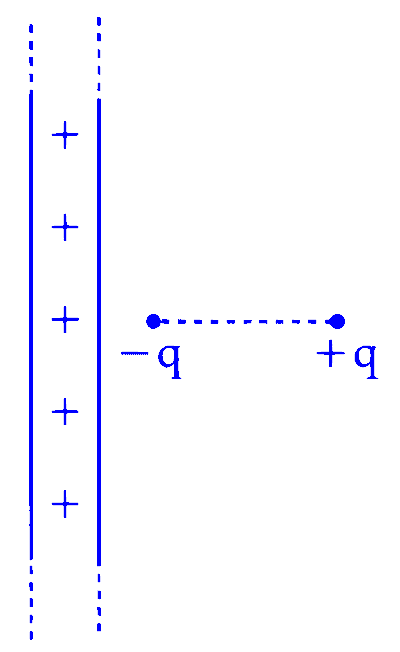
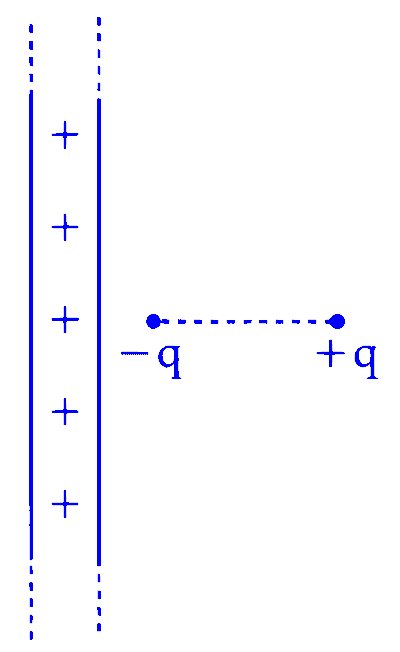
An electric dipole is placed at a distance of 2 cm from an infinite plane sheet having positive charge density $\sigma_{\mathrm{o}}$. Choose the correct option from the following.
एक विद्युत द्विध्रुव को 2 cm की दूरी पर एक अनंत तल शीट के पास सकारात्मक आवेश घनत्व $\sigma_{\mathrm{o}}$ के साथ रखा गया है। निम्नलिखित में से सही विकल्प चुनें।
Assertion (A): Three identical spheres of same mass undergo one dimensional motion as shown in figure with initial velocities $v_{\mathrm{A}}=5 \mathrm{~m} / \mathrm{s}, v_{\mathrm{B}}=2 \mathrm{~m} / \mathrm{s}, v_{\mathrm{C}}=4 \mathrm{~m} / \mathrm{s}$. If we wait sufficiently long for elastic collision to happen, then $v_{\mathrm{A}}=4 \mathrm{~m} / \mathrm{s}, v_{\mathrm{B}}=2 \mathrm{~m} / \mathrm{s}$, $v_{\mathrm{C}}=5 \mathrm{~m} / \mathrm{s}$ will be the final velocities.
Reason (R): In an elastic collision between identical masses, two objects exchange their velocities.
नीचे दो कथन दिए गए हैं। एक को कथन (A) और दूसरे को कारण (R) के रूप में लेबल किया गया है।
कथन (A): तीन समान गोले एक ही द्रव्यमान के एक आयामिक गति में चित्र के अनुसार चलते हैं जिनकी प्रारंभिक वेग $v_{\mathrm{A}}=5 \mathrm{~m} / \mathrm{s}, v_{\mathrm{B}}=2 \mathrm{~m} / \mathrm{s}, v_{\mathrm{C}}=4 \mathrm{~m} / \mathrm{s}$ हैं। यदि हम लचीली टकराव के होने के लिए पर्याप्त समय तक प्रतीक्षा करते हैं, तो $v_{\mathrm{A}}=4 \mathrm{~m} / \mathrm{s}, v_{\mathrm{B}}=2 \mathrm{~m} / \mathrm{s}$, $v_{\mathrm{C}}=5 \mathrm{~m} / \mathrm{s}$ अंतिम वेग होंगे।
कारण (R): समान द्रव्यमान के बीच एक लचीली टकराव में, दो वस्तुएं अपने वेगों का आदान-प्रदान करती हैं।
$\text { A physical quantity } Q \text { is related to four observables } a, b, c, d \text { as follows : }$
$Q = \frac{ab^4}{cd}$
where, $\mathrm{a}=(60 \pm 3) \mathrm{Pa} ; \mathrm{b}=(20 \pm 0.1) \mathrm{m} ; \mathrm{c}=(40 \pm 0.2) \mathrm{Nsm}^{-2}$ and $\mathrm{d}=(50 \pm 0.1) \mathrm{m}$, then the percentage error in Q is $\frac{x}{1000}$, where $x=$ _________ .
$\text { एक भौतिक राशि } Q \text { चार प्रेक्षणीय मान } a, b, c, d \text { से इस प्रकार संबंधित है : }$
जहाँ, $\mathrm{a}=(60 \pm 3) \mathrm{Pa} ; \mathrm{b}=(20 \pm 0.1) \mathrm{m} ; \mathrm{c}=(40 \pm 0.2) \mathrm{Nsm}^{-2}$ और $\mathrm{d}=(50 \pm 0.1) \mathrm{m}$, तो Q में प्रतिशत त्रुटि $\frac{x}{1000}$ है, जहाँ $x=$ _________ ।
Two cars P and Q are moving on a road in the same direction. Acceleration of car P increases linearly with time whereas car Q moves with a constant acceleration. Both cars cross each other at time t = 0, for the first time. The maximum possible number of crossing(s) (including the crossing at t = 0) is ________.
दो कारें P और Q एक सड़क पर एक ही दिशा में चल रही हैं। कार P का त्वरण समय के साथ रेखीय रूप से बढ़ता है जबकि कार Q स्थिर त्वरण के साथ चलती है। दोनों कारें पहली बार t = 0 पर एक-दूसरे को पार करती हैं। पार करने की अधिकतम संभावित संख्या (t = 0 पर पार करना शामिल है) ________ है।
Two planets, $A$ and $B$ are orbiting a common star in circular orbits of radii $R_A$ and $R_B$, respectively, with $R_B=2 R_A$. The planet $B$ is $4 \sqrt{2}$ times more massive than planet $A$. The ratio $\left(\frac{\mathrm{L}_{\mathrm{B}}}{\mathrm{L}_{\mathrm{A}}}\right)$ of angular momentum $\left(L_B\right)$ of planet $B$ to that of planet $A\left(L_A\right)$ is closest to integer ________.
दो ग्रह, $A$ और $B$ एक समान तारे के चारों ओर क्रमशः $R_A$ और $R_B$ त्रिज्या की वृत्तीय कक्षाओं में परिक्रमा कर रहे हैं, जहाँ $R_B=2 R_A$ है। ग्रह $B$, ग्रह $A$ की तुलना में $4 \sqrt{2}$ गुना अधिक भारी है। कोणीय संवेग के अनुपात $\left(\frac{\mathrm{L}_{\mathrm{B}}}{\mathrm{L}_{\mathrm{A}}}\right)$, जहाँ ग्रह $B$ का संवेग $L_B$ और ग्रह $A$ का संवेग $L_A$ उसके निकटतम पूर्णांक ________ है।
A parallel plate capacitor consisting of two circular plates of radius 10 cm is being charged by a constant current of 0.15 A . If the rate of change of potential difference between the plates is $7 \times 10^8 \mathrm{~V} / \mathrm{s}$ then the integer value of the distance between the parallel plates is
10 सेमी त्रिज्या के दो वृत्तीय प्लेटों से मिलकर बनने वाली एक समांतर प्लेट संधारित्र को 0.15 ए की स्थिर धारा से चार्ज किया जा रहा है। यदि प्लेटों के बीच विभवान्तर परिवर्तन की दर $7 \times 10^8 \mathrm{~V} / \mathrm{s}$ है, तो प्लेटों के बीच की दूरी का पूर्णांक मान



 ×
×
 Bank
Bank


 SSC
SSC


 Railway


 State
State


 Other
Other


 Teaching


 Insurance


 Medical


 Engineering


 Defence


 GATE
GATE


 NTA CUET

 UPSC
UPSC

 MBA Entrance


 LAW
LAW

 ReNEET UG 2026
 SSC Selection Post (Phase 14) 2026
 RRB NTPC 2026
 SSC CGL Tier-I 2026
 SSC JE 2026
 SBI PO Prelims 2026
 SSC Steno Grade C & D 2026
 SBI Clerk Prelims 2026
 IBPS PO Prelims 2026
 IBPS Clerk Prelims 2026
 SSC CPO Tier I 2026
 NDA II 2026
 CDS II 2026












 Three identical spheres of same mass undergo one dimensional motion as shown in figure with initial velocities $v_{\mathrm{A}}=5 \mathrm{~m} / \mathrm{s}, v_{\mathrm{B}}=2 \mathrm{~m} / \mathrm{s}, v_{\mathrm{C}}=4 \mathrm{~m} / \mathrm{s}$. If we wait sufficiently long for elastic collision to happen, then $v_{\mathrm{A}}=4 \mathrm{~m} / \mathrm{s}, v_{\mathrm{B}}=2 \mathrm{~m} / \mathrm{s}$, $v_{\mathrm{C}}=5 \mathrm{~m} / \mathrm{s}$ will be the final velocities.
 तीन समान गोले एक ही द्रव्यमान के एक आयामिक गति में चित्र के अनुसार चलते हैं जिनकी प्रारंभिक वेग $v_{\mathrm{A}}=5 \mathrm{~m} / \mathrm{s}, v_{\mathrm{B}}=2 \mathrm{~m} / \mathrm{s}, v_{\mathrm{C}}=4 \mathrm{~m} / \mathrm{s}$ हैं। यदि हम लचीली टकराव के होने के लिए पर्याप्त समय तक प्रतीक्षा करते हैं, तो $v_{\mathrm{A}}=4 \mathrm{~m} / \mathrm{s}, v_{\mathrm{B}}=2 \mathrm{~m} / \mathrm{s}$, $v_{\mathrm{C}}=5 \mathrm{~m} / \mathrm{s}$ अंतिम वेग होंगे।


 Get latest Exam Updates