Please wait...
If the horizontal range of a body projected with a velocity ' $u$ ' is 3 times the maximum height reached by it, then the range of the body is
( $g=$ Acceleration due to gravity)
If the velocity at the maximum height of a projectile projected at an angle of $45^{\circ}$ is $20 \mathrm{~ms}^{-1}$, then the maximum height reached by the projectile is (Acceleration due to gravity $=10 \mathrm{~ms}^{-2}$ )
If a body of mass 2 kg moving with initial velocity of $4 \mathrm{~ms}^{-1}$ is subjected to a force of 3 N for a time of 2 s normal to the direction of its initial velocity, then the resultant velocity of the body is
If the range of a body projected with a velocity of $60 \mathrm{~ms}^{-1}$ is $180 \sqrt{3} \mathrm{~m}$, then the angle of projection of the body is
(Acceleration due to gravity $=10 \mathrm{~ms}^{-2}$ )
If the height of a projectile at a time of 2 s from the beginning of motion is 60 m , then the time of flight of the projectile is
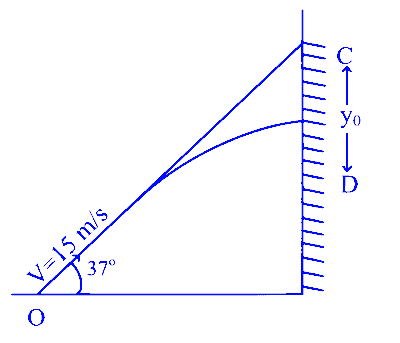
The angle of projection of a projectile whose path is shown in the given figure is
If the equation of motion of a projectile is $y=A x-B x^2$, then the ratio of the maximum height reached and the range of the projectile is
The height of ceiling in an auditorium is 30 m . A ball is thrown with a speed of $30 \mathrm{~ms}^{-1}$ from the entrance such that it just moves very near to the ceiling without touching it and then it reaches the ground at the end of the auditorium. Then, the length of auditorium is [Acceleration due to gravity $=10 \mathrm{~ms}^{-2}$ ]
A particle crossing the origin at time $t=0$ moves in the $X Y$-plane with a constant acceleration ' $a$ ' in $y$-direction. If the equation of motion of the particle is $y=b x^2$ (where $b$ is a constant), then its velocity component in the $x$-direction is
If a ball projected vertically upwards with certain initial velocity from the ground crosses a point at a height of 25 m twice in a time interval of 4 s , then the initial velocity of the ball is
A car is moving with a velocity of $4 \mathrm{~ms}^{-1}$ towards east. After a time of 4 s , if it is heading north-east with a velocity of $4 \sqrt{2} \mathrm{~ms}^{-1}$, then the average velocity of the car is
A body of mass 5 kg starts from the origin with an initial velocity $(30 \hat{\mathbf{i}}+40 \hat{\mathbf{j}}) \mathrm{ms}^{-1}$. If a constant force $-(\hat{\mathbf{i}}+5 \hat{\mathbf{j}}) \mathrm{N}$ acts on the body, then the time in which the $y$-component of its velocity becomes zero is
A ball is projected from a point with a speed $V_0$ at certain angle with the horizontal. From the same point and at the same instant, a person starts running with a constant speed $0.5 V_0$ to catch the ball. If the person catches the ball after some time, then the angle of projection of the ball is
Path of projectile is given by the equation $Y=P x-Q x^2$, match the following accordingly (acceleration due to gravity $=g$ )
$$ \begin{array}{llll} \hline \text { a. } & \text { Range } & \text { i } & \frac{P}{Q} \\ \hline \text { b. } & \text { Maximum height } & \text { ii } & P \\ \hline \text { c. } & \text { Time of flight } & \text { iii } & \frac{P^2}{4 Q} \\ \hline \text { d. } & \text { Tangent of projection } & \text { iv } & \left(\sqrt{\frac{2}{g Q}}\right) P \\ \hline \end{array} $$
The relation between the horizontal displacement $x$ (in metre) and the vertical displacement $y$ (in metre) of a projectile is $y=3 x-0.8 x^2$. The time of flight of the projectile is (Acceleration due to gravity, $g=10 \mathrm{~ms}^{-2}$ )
A boy weighing 50 kg finished long jump at a distance of 8 m . Considering that he moved along a parabolic path and his angle of jump is $45^{\circ}$, his initial KE is
A projectile is launched from the ground, such that it hits a target on the ground which is 90 m away. The minimum velocity of projectile to hit the target is (acceleration due to gravity $$=10 \mathrm{~ms}^{-2}$$)
A force $$\mathbf{F}_1$$ of magnitude 4 N acts on an object of mass 1 kg , at origin in a direction $$30^{\circ}$$ above the positive $$X$$-axis. A second $$F_2$$ of magnitude 4 N acts on the same object in the direction of the positive $$Y$$-axis. The magnitude of the acceleration of the object is nearly.
A car travels with a speed of $$40 \mathrm{~km} \mathrm{~h}^{-1}$$. Rain drops are falling at a constant speed vertically. The traces of the rain on the side windows of the car make an angle of $$30^{\circ}$$ with the vertical. The magnitude of the velocity of the rain with respect to the car is
A projectile with speed $$50 \mathrm{~ms}^{-1}$$ is thrown at an angle of $$60^{\circ}$$ with the horizontal. The maximum height that can be reached is (acceleration due to gravity $$=10 \mathrm{~ms}^{-2}$$)
A hiker stands on the edge of a cliff $$490 \mathrm{~m}$$ above the ground and throws a stone horizontally with an initial speed of $$15 \mathrm{~ms}^{-1}$$. The speed with which it hits the ground is
Two paper screens $$A$$ and $$B$$ are separated by $$150 \mathrm{~m}$$. A bullet pierces $$A$$ and than $$B$$. The hole in $$B$$ is $$15 \mathrm{~cm}$$ below the hole in $$A$$. If the bullet is travelling horizontally at the time of hitting $$A$$, then the velocity of the bullet at $$A$$ is $$\left(\mathrm{g}=10 \mathrm{~ms}^{-2}\right)$$
A boy throws a cricket ball from theboundary to the wicket keeper. If thefrictional force due to air $$(f_a )$$ cannot beignored, the forces acting on the ball at theposition X are represented by
A particle of mass m is projected with avelocity u making an angle $$\theta$$ with thehorizontal. The magnitude of angularmomentum of the projectile about the pointof projection when the particle is at itsmaximum height is
When a ball is thrown with a velocity of 50 ms$$^{-1}$$ at an angle 30$$\Upsilon$$ with the horizontal, it remains in the air for ......... s.
(Take, g = 10 ms$$^{-2}$$)



 ×
×
 Bank
Bank


 SSC
SSC


 Railway


 State
State


 Other
Other


 Teaching


 Insurance


 Medical


 Engineering


 Defence


 GATE
GATE


 NTA CUET

 UPSC
UPSC

 MBA Entrance


 LAW
LAW

 ReNEET UG 2026
 SSC Selection Post (Phase 14) 2026
 RRB NTPC 2026
 SSC CGL Tier-I 2026
 SSC JE 2026
 SBI PO Prelims 2026
 SSC Steno Grade C & D 2026
 SBI Clerk Prelims 2026
 IBPS PO Prelims 2026
 IBPS Clerk Prelims 2026
 SSC CPO Tier I 2026
 NDA II 2026
 CDS II 2026




 Get latest Exam Updates