Please wait...
If some heat is given to a metal of mass 100 g , its temperature rises by $20^{\circ} \mathrm{C}$. If the same heat is given to 20 g of water, the change in its temperature (in ${ }^{\circ} \mathrm{C}$ ) is (The ratio of specific heat capacities of metal and water is $1: 10$ )
The ratio of the efficiencies of two Carnot engines $A$ and $B$ is 1.25 and the temperature difference between the source and the sink is same in both the engines. The ratio of the absolute temperature of the sources of the engines $A$ and $B$ is
The heat supplied to a gas at a constant pressure of $5 \times 10^5 \mathrm{~Pa}$ is 1000 kJ . If the volume of gas changes from $1 \mathrm{~m}^3$ to $2.5 \mathrm{~m}^3$, then the change in internal energy of the gas is
When an ideal diatomic gas undergoes adiabatic expansion, if the increase in its volume is $0.5 \%$, then the change in the pressure of the gas is
To increase the rms speed of gas molecules by $25 \%$, the percentage increase in absolute temperature of the gas is to be
If a body cools from a temperature of $62^{\circ} \mathrm{C}$ to $50^{\circ} \mathrm{C}$ in 10 minutes and to $42^{\circ} \mathrm{C}$ in the next 10 minutes, then the temperature of the surroundings is
If the ratio of universal gas constant and specific heat capacity at constant volume of a gas is given by 0.67 , then the gas is
The internal energy of 4 moles of a monoatomic gas at a temperature of $77^{\circ} \mathrm{C}$ is
( $R=$ Universal gas constant)
If 5.6 litres of a monoatomic gas at STP is adiabatically compressed to 0.7 litres, then the work done on the gas is nearly ( $R=$ Universal gas constant)
If the rms speed of the molecules of a diatomic gas at a temperature of 322 K is $2000 \mathrm{~ms}^{-1}$, then the gas is (Universal gas constant $=8.31 \mathrm{Jmol}^{-1} \mathrm{~K}^{-1}$ )
When 80 J of heat is supplied to a gas at constant pressure, if the work done by the gas is 20 J , then the ratio of the specific heat capacities of the gas is
A refrigerator of coefficient of performance 5 that extracts heat from the cooling compartment at the rate of 250 J per cycle is placed in a room. The heat released per cycle to the room by the refrigerator is
In a container of volume $16.62 \mathrm{~m}^3$ at $0{ }^{\circ} \mathrm{C}$ temperature, 2 moles of oxygen 5 moles of nitrogen and 3 moles of hydrogen are present, then the pressure in the container is
(Universal gas constant $=8.31 \mathrm{~J} \mathrm{~mol}^{-1} \mathrm{~K}^{-1}$ )
A small quantity of water of mass ' $m$ ' at temperature $\theta^{\circ} \mathrm{C}$ is mixed with a large mass ' $M$ ' of ice which is at its melting point. If ' $s$ ' is specific heat capacity of water and ' $L$ ' is the latent heat of fusion of ice, then the mass of ice melted is
In a Carnot engine, if the absolute temperature of the source is $25 \%$ more than the absolute temperature of the sink, then the efficiency of the engine is
The work done by 6 moles of helium gas when its temperature increases by $20^{\circ} \mathrm{C}$ at constant pressure is (Universal gas constant $=8.31 \mathrm{Jmol}^{-1} \mathrm{~K}^{-1}$ )
If a heat engine and a refrigerator are working between the same two temperatures $T_1$ and $T_2\left(T_1>T_2\right)$, then the ratio of efficiency of heat engine to coefficient of performance of refrigerator is
If the internal energy of 3 moles of a gas at a temperature of $27^{\circ} \mathrm{C}$ is 2250 R , then the number of degrees of freedom of the gas is
In a Carnot engine if the work done during isothermal expansion is $25 \%$ more than the work done during isothermal compression, then the efficiency of the engine is
The work done to increase the volume of 2 moles of an ideal gas from V to 2 V at a constant temperature $T$ is W . The work to be done to increase the volume of 2 moles of the same gas from 2 V to 4 V at the same constant temperature $T$ is
If the given graph shows the logarithmic values of pressure ( $p$ ) and volume ( $V$ ) of an ideal gas, then the ratio of the specific heat capacities of the gas is
The internal energy of one mole of a rigid diatomic gas at absolute temperature $T$ is
If the wavelengths of maximum intensity of radiation emitted by two black bodies $A$ and $B$ are $0.5 \mu \mathrm{~m}$ and 0.1 mm respectively, then ratio of the temperatures of the bodies $A$ and $B$ is
Water of mass 5 kg in a closed vessel is at a temperature of $20^{\circ} \mathrm{C}$. If the temperature of the water when heated for a time of 10 minutes becomes $30^{\circ} \mathrm{C}$, then the increase in the internal energy of the water is (Specific heat capacity of water $=4200 \mathrm{~J} \mathrm{~kg}^{-1} \mathrm{~K}^{-1}$ )
A Carnot engine $A$ working between temperatures 600 K and $T(<600 \mathrm{~K})$ and another Carnot engine $B$ working between temperatures $T(>400 \mathrm{~K})$ and 400 K are connected in series. If the work done by both the engines is same, then $T=$
When an ideal diatomic gas is heated at constant pressure, the fraction of the heat utilised to increase the internal energy of the gas is
If the degrees of freedom of a gas molecule is 6 , then the total internal energy of the gas molecule at a temperature of $47^{\circ} \mathrm{C}$ (in eV ) is
(Boltzmann constant $=1.38 \times 10^{-23} \mathrm{JK}^{-1}$ )
If the values of the temperature of a body in Fahrenheit and Celsius scales are in the ratio of $13: 5$, then the temperature of the body is
A Carnot heat engine absorbs 600 J of heat from a source at a temperature of $127^{\circ} \mathrm{C}$ and rejects 400 J of heat to a sink in each cycle. The temperature of the sink is
During adiabatic expansion, if the temperature of 3 moles of a diatomic gas decreases by $50^{\circ} \mathrm{C}$, then the work done by the gas is
The fundamental limitation to the coefficient of performance of a refrigerator is given by
If the ratio of specific heats of a gas at constant pressure and at constant volume is $\gamma$, then the number of degrees of freedom of the rigid molecules of the gas is
If a gas of volume 400 cc at an initial pressure $p$ is suddenly compressed to 100 cc , then its final pressure is
(The ratio of the specific heat capacities of the gas at constant pressure and constant volume is 1.5 )
A Carnot engine having efficiency $60 \%$ receives heat from a source at a temperature 600 K . For the same sink temperature, to increase its efficiency to $80 \%$, then the temperature of the source is
A gaseous mixture consists of 2 moles of oxygen and 4 moles of argon at an absolute temperature $T$. Neglecting all vibrational modes, the total internal energy of the mixture of the gases is
The average translational kinetic energy of the oxygen molecules at a temperature of $127^{\circ} \mathrm{C}$ is
An electric kettle takes 4 A current at 220 V . If the entire electric energy is converted into heat energy, then the time (in minutes) taken to increase the temperature of 1 kg of water from $34^{\circ} \mathrm{C}$ to $100^{\circ} \mathrm{C}$ is
According to Zeroth law of thermodynamics, the physical quantity which is same for two bodies in thermal equilibrium is
If a refrigerator of coefficient of performance of 5 has a freezer at a temperature of $-13^{\circ} \mathrm{C}$, then the room temperature is
From the figure shown for a thermodynamic system, match the curves with their respective thermodynamic processes.
( $p=$ Pressure and $V=$ volume )
$$ \begin{array}{llll} \hline & \text { Curve } & & \text { Process } \\ \hline \text { (i) } & \text { I } & \text { A } & \text { Adiabatic } \\ \hline \text { (ii) } & \text { II } & \text { B } & \text { Isobaric } \\ \hline \text { (iii) } & \text { III } & \text { C } & \text { Isochoric } \\ \hline \text { (iv) } & \text { IV } & \text { D } & \text { Isothermal } \\ \hline \end{array} $$
If 2 moles of an ideal monoatomic gas at a temperature of $27^{\circ} \mathrm{C}$ is mixed with 4 moles of another ideal monoatomic gas at a temperature of $327^{\circ} \mathrm{C}$, then the temperature of mixture of the two gases is
Water of mass $m$ at $30^{\circ} \mathrm{C}$ is mixed with with 5 g of ice at $-20^{\circ} \mathrm{C}$. If the resultant temperature of the mixture is $6^{\circ} \mathrm{C}$, then the value of $m$ is (specific heat capacity of ice $=0.5 \mathrm{cal} \mathrm{g}^{-10} \mathrm{C}^{-1}$, specific heat capacity of water $=1$ calg ${ }^{-1}{ }^{\circ} \mathrm{C}^{-1}$ and latent heat of fusion of ice $=80 \mathrm{cal} \mathrm{g}^{-1}$ )
The total internal energy of 2 moles of a monoatomic gas at a temperature $27^{\circ} \mathrm{C}$ is $U$. The total internal energy of 3 moles of a diatomic gas at a temperature $127^{\circ} \mathrm{C}$ is
A metal ball of mass 100 g at $20^{\circ} \mathrm{C}$ is dropped in 200 g of water at $80^{\circ} \mathrm{C}$. If the resultant temperature is $70^{\circ} \mathrm{C}$, then the ratio of specific heat of the metal to that of water is
Initially the pressure of 1 mole of an ideal gas is $10^5 \mathrm{Nm}^{-2}$ and its volume is 16 L . When it is adiabatically compressed, its final volume is 2 L . Work-done on the gas is
An ideal gas is taken around $A B C A$ as shown in the $P^{\prime \prime}$ diagram. The work done during the cycle is
The ratio of kinetic energy of a diatomic gas molecule at a high temperature to that of NTP is
Match the following ( $f$ is number of degrees of freedom)
Heat energy absorbed by a system going through the cyclic process shown in the figure is
5 g of ice at $$-30^{\circ} \mathrm{C}$$ and 20 g of water at $$35^{\circ} \mathrm{C}$$ are mixed together in a calorimeter.The final temperature of the mixture is (Neglect heat capacity of the calorimeter, specific heat capacity of ice $$=0.5 \mathrm{cal} \mathrm{g}^{-1}{ }^{\circ} \mathrm{C}^{-1}$$ and latent heat of fusion of ice $$=80 \mathrm{cal} \mathrm{g}^{-1}$$ and specific heat. capacity of water $$=1 \mathrm{cal} \mathrm{g}^{-1}{ }^{\circ} \mathrm{C}^{-1}$$)
An iron sphere having diameter $$D$$ and mass $$M$$ is immersed in hot water so that the temperature of the sphere increases by $$\delta T$$. If $$\alpha$$ is the coefficient of linear expansion of the iron then the change in the surface area of the sphere is
The work done by a Carnot engine operating between 300 K and 400 K is 400 J. The energy exhausted by the engine is
The slopes of the isothermal and adiabatic $$p-V$$ graphs of a gas are by $$S_I$$ and $$S_A$$ respectively. If the heat capacity ratio of the gas is $$\frac{3}{2}$$, then $$\frac{S_I}{S_A}=$$
The number of rotational degrees of freedom of a diatomic molecule
A metal tape is calibrated at $$25^{\circ} \mathrm{C}$$. On a cold day when the temperature is $$-15^{\circ} \mathrm{C}$$, the percentage error in the measurement of length is
(Coefficient of linear expansion of metal $$=1 \times 10^{-5}{ }^{\circ} \mathrm{C}^{-1}$$)
A gas is expanded from an initial state to a final state along a path on a $$p$$-$$V$$ diagram. The path consists of (i) an isothermal expansion of work 50 J , (ii) an adiabatic expansion and (iii) an isothermal expansion of work 20 J . If the internal energy of gas is changed by $$-$$30 J , then the work done by gas during adiabatic expansion is
The temperature of the sink of a Carnot engine is 250 K . In order to increase the efficiency of the Carnot engine from $$25 \%$$ to $$50 \%$$, the temperature of the sink should be increased by
In non-rigid diatomic molecule with an additional vibrational mode
A sphere of surface area $$4 \mathrm{~m}^2$$ at temperature 400 K and having emissivity 0.5 is located in an environment of temperature 200 K. The net rate of energy exchange of the sphere is (Stefan Boltzmann constant, $$\sigma=5.67 \times 10^{-8} \mathrm{Wm}^{-2} \mathrm{~K}^4)$$
A Carnot engine operates between a source and a sink. The efficiency of the engine is $$40 \%$$ and the temperature of the sink is $$27^{\circ} \mathrm{C}$$. If the efficiency is to be increased to $$50 \%$$, then the temperature of the source must be increased by
A car engine has a power of 20 kW. The car makes a roundtrip of 1 h. If the thermal efficiency of the engine is $$40 \%$$ and the ambient temperature is 300 K . The energy generated by fuel combustion is
The number of vibrational degree of freedom of a diatomic molecule is
A glass vessel of volume $$V_o$$ is completely filled with a liquid and its temperature is raised by $$\Delta T$$. What volume of the liquid will flow over, if the coefficient of linear expansion of glass is $$\alpha_g$$ and coefficient of volume expansion of the liquid is $$\gamma_l$$ ?
A Carnot engine whose heat sink is at 27$$^\circ$$Chas an efficiency of 40%. By how muchshould its source temperature be changed, soas to increase its efficiency to 60%?
A diatomic gas is heated at constantpressure, what fraction of the heat energy isused to increase the internal energy?
An ideal gas is taken from state-1 to state- 2 through optional path $$A, B, C$$ and $$D$$ as shown in the $$p$$ - $$V$$ diagram. Let $$Q, W$$ and $$U$$ represent the heat supplied, work done and change in internal energy respectively, then
When the temperature of an ideal gas is increased from 27$$^\circ$$C to 127$$^\circ$$C. Calculate the percentage increase in its $$v_{rms}$$.
Boiling water is changing into steam. The specific heat of boiling water is
If the volume of a block of metal changes by $$0.12 \%$$ when heated through $$20^{\circ} \mathrm{C}$$, then find its coefficient of linear expansion.
Isothermal process is the graph between
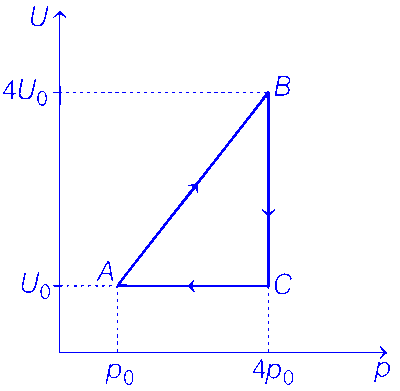
For a monoatomic ideal gas is following thecyclic process ABCA shown in the U versus pplot, identify the incorrect option.
The pressure of a gas is proportional to
Expansion during heating
Match the following.
Which of the following is not a reversibleprocess?
Which one of the graphs below bestillustrates the relationship between internalenergy U of an ideal gas and temperature T ofthe gas in K?
A refrigerator with coefficient ofperformance 0.25 releases 250 J of heat to ahot reservoir. The work done on the workingsubstance is
A vessel has 6 g of oxygen at pressure p andtemperature 400 K. A small hole is made init, so that oxygen leaks out. How muchoxygen leaks out if the final pressure is p/2and temperature is 300 K?
In a steady state, the temperature at the end $$A$$ and end $$B$$ of a $$20 \mathrm{~cm}$$ long rod $$A B$$ are $$100 \Upsilon$$ and $$0^{\circ} \mathrm{C}$$. The temperature of a point $$9 \mathrm{~cm}$$ from $$A$$ is
If two rods of length $$L$$ and $$2 L$$, having coefficients of linear expansion $$\alpha$$ and $$2 \alpha$$ respectively are connected end-to-end, then find the average coefficient of linear expansion of the composite rod.
A system is taken from state-A to state-Balong two different paths. The heat absorbedand work done by the system along thesetwo paths are Q$$_1$$, Q$$_2$$ and W$$_1$$, W$$_2$$ respectively, then
A gas ($$\gamma$$ = 1.5 ) is suddenly compressed to(1/4 )th its initial volume. Then, find the ratioof its final to initial pressure.
A cylinder has a piston at temperature of $$30 \Upsilon$$C. There is all round clearance of $$0.08 \mathrm{~mm}$$ between the piston and cylinder wall if internal diameter of the cylinder is $$15 \mathrm{~cm}$$. What is the temperature at which piston will fit into the cylinder exactly?
$$\left(\alpha_p=1.6 \times 10^{-5} / \Upsilon\mathrm{C} \text { and } \alpha_c=1.2 \times 10^{-5} / \Upsilon\mathrm{C}\right)$$
A balloon contains 1500 m$$^3$$ of He at 27$$\Upsilon$$C and 4 atmospheric pressure, the volume of He at $$-3\Upsilon$$C temperature and 2 atmospheric pressure will be



 ×
×
 Bank
Bank


 SSC
SSC


 Railway


 State
State


 Other
Other


 Teaching


 Insurance


 Medical


 Engineering


 Defence


 GATE
GATE


 NTA CUET

 UPSC
UPSC

 MBA Entrance


 LAW
LAW

 ReNEET UG 2026
 SSC Selection Post (Phase 14) 2026
 RRB NTPC 2026
 SSC CGL Tier-I 2026
 SSC JE 2026
 SBI PO Prelims 2026
 SSC Steno Grade C & D 2026
 SBI Clerk Prelims 2026
 IBPS PO Prelims 2026
 IBPS Clerk Prelims 2026
 SSC CPO Tier I 2026
 NDA II 2026
 CDS II 2026







 Get latest Exam Updates