Please wait...
Account that record all international transactions of assets is.1. Current Account2. Balance of Trade3. Capital Account4. Balance on Invisible
In the first seven plans, trade was characterized by what is commonly called an inward looking trade strategy. Technically, this strategy is called ___________.1. Export promotion strategy2. Trade strategy3. Outward looking trade strategy4. Import substitution strategy
Arrange the following events, in order of their occurrence. A. Planning commission formed a study group B. Twelfth five year plan C. Second five year plan D. Task force on projection of minimum needs and effective consumption demand was formed
Choose the correct answer from the options given below: 1. A, B, C, D 2. C, A, D, B 3. A, C, B, D 4. C, A, B, D
Identify the correct chain of action from the following, A. Investment multiplier rises B. Economy grows C. MPC rises D. Income rises
Choose the correct answer from the options given below: 1. A, C, B, D 2. A, B, C, D 3. D, A, C, B 4. C, A, D, B
For C = 80 +0.8y, the value of multiplier will be.1. 1.52. 103. 154. 20
Sale of assets like sale of share of an Indian Company to a foreigner customer is a ___________ account. item on capital
1. Visible 2. Debit 3. Current 4. Credit
Which of the available technologies to adopt in the production of each of the goods? The above question relates to which Central problem of the economy ?
1. Why to produce? 2. What to produce? 3. How to produce? 4. For whom to produce?
Select the correct statements regarding Fisheries from following A. Fish production is more from Marine Fishing B. The major problems in fishing community are illiteracy and indebtedness C. High per capita income is available to fishermen D. Aqua culture means traditional method of fishing E. Women are not involved in active fishing
Choose the correct answer from the options given below: 1. A and C only 2. C and D only 3. D and A only 4. B and E only
Current Account surplus can be denoted by.
1. Receipts on current account < Payments on current account 2. Receipts on current account = Payments on current account 3. Receipts on current account ≤ Payments on current account 4. Receipts on current account > Payments on current account
Four sector economy refers to which of the following.
1. Closed Economy 2. Mixed Economy 3. Planned Economy 4. Open Economy
Among the following personnel, identify the employee who is working in the informal sector?
1. A police constable 2. A cycle-rickshaw puller 3. A clerk in the electricity office 4. A nurse in a government hospital
Which of the following is a flow?
1. Bank deposits 2. Wealth 3. Capital 4. Depreciation
Identify the term/ concept which is not included in the estimation of National Income of an economy.
1. Retained earning of Residents companies in Abroad 2. Bonus 3. Scholarships 4. Royalty
Which of the following is not a property of indifference curve?
1. Downward sloping 2. Convex to the origin 3. Higher indifference curve shows higher satisfaction 4. Concave to the origin
The difference between value of exports and value of imports of goods of a country in a given period of time is.
1. Balance of Payment 2. Balance of Trade 3. Balance of Capital Account 4. Balance of Invisibles
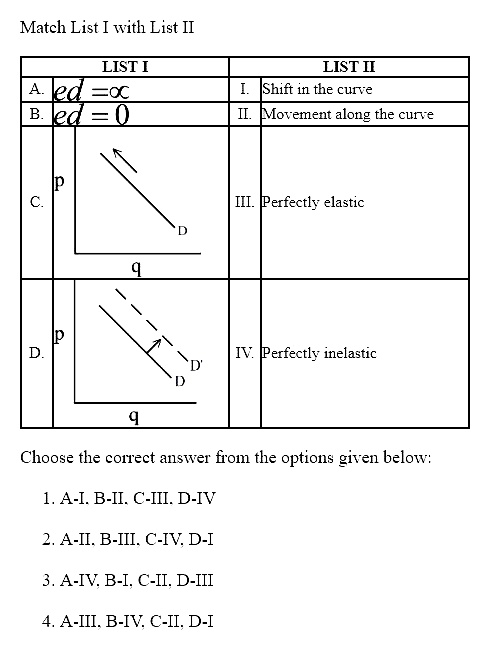
Match List I with List II
Choose the correct answer from the options given below: 1. A-I. B-III, C-II, D-IV 2. A-III. B-II. C-IV, D-I 3. A-IV, B-I. C-III, D-II 4. A-II, B-IV. C-I, D-III
If Balance of Trade is (-) ₹600 crore and value of exports is ₹500 crore, then the value of imports will be.
1. ₹1500 crore 2. ₹1100 crore 3. ₹100 crore 4. 2200 crore
Who all are considered as working in the formal sector out of the following? A. Cycle rickshaw puller B. A clerk in the electricity office C. A police constable D. A construction worker E. Nurse in government hospital
Choose the correct answer from the options given below: 1. A, B and C only 2. B, C and E only 3. D, E and A only 4. A, B and E only
Which is not an implication of fiscal deficit?
1. Debt trap 2. Stabilisation 3. Inflation 4. Foreign dependency
Arrange the following incidents/policy implementation on the basis of their occurrence related to development in India and its neighbour. A. Reforms in Pakistan B. One child policy introduced in China C. Great proletarian cultural revolution D. The great leap forward campaign E. Reforms in India
Choose the correct answer from the options given below: 1. C, B, D, E, A 2. D, C, A, E, B 3. C, B, D, E, A 4. D, C, B, A, E
Arrange the following in order of occurrence. A. Industrial policy resolution based on schedules B. Second phase of Green Revolution C. Directive principles of Indian constitution D. Foreign exchange reforms E. Demonetisation
Choose the correct answer from the options given below: 1. E, A, B, C, D 2. A, B, D, C, E 3. E, A, B, D, C 4. C, A, B, D, E
Identify the incorrect statements in the context of demographic indicators of India, China and Pakistan; A. China-adopted the one-child norm policy B. Urbanisation is highest in India followed by Pakistan C. Sex-ratio is biased in all the three countries D. Fertility rate is highest in India, followed by China E. India is the second largest country after China
Choose the correct answer from the options given below: 1. A and B only 2. B and C only 3. C and E only 4. B and D only
Arrange the following steps in the ascending order of their occurrence. A. Leads to rise in unemployment B. Workers abstain from work C. Lack of proper drinking water and sanitation D. Proneness to fall ill
Choose the correct answer from the options given below: 1. A, B, C, D 2. B, D, C, A 3. C, D, B, A 4. D, C, B, A
If Foreign Exchange rate changes from 1 = 80 to 1 = 83 at a given point of time, what does this indicate for Indian currency ?
1. Appreciation of currency 2. Depreciation of currency 3. Devaluation 4. Revaluation
Domestic income is the sum of factor incomes accruing to.
1. Residents 2. Residents and non-residents 3. Nationals 4. Economic territory
What is the correct answer of the opportunity cost from the given options?
1. There is a cost of having more goods which are used for additional good 2. The Scare resources have alternative usages on a particular price 3. There is always a cost of having a little more of one good in term of the amount of the other good that has to be forgone 4. There is always a cost of having one good in term of the amount of other good which has being used
According to the Keynesian economics, the value of APC can never be.
1. Zero 2. Unity 3. More than one 4. Less thane one
Revenue deficit will be calculated through…………………………………
1. Total Expenditure - Revenue Receipts 2. Fiscal Deficit - Interest Payments 3. Fiscal Deficit - Revenue Receipts 4. Revenue Expenditure - Revenue Receipts
Choose the correct answer from the options given below:
1. A-II. B-I, C-III. D-IV
2. A-I. B-II, C-III. D-IV
3. A-III, B-I, C-II, D-IV
4. A-I. B-III, C-II. D-IV
Ozone depletion is caused by high level of_______________and__________________compounds in the stratosphere. A. Chlorine B. Bromine C. Neon D. Hydrogen
Choose the correct answer from the options given below: 1. A and B only 2. A and C only 3. A, C and D only 4. B and D only
What are the benefits provided by the government under labour laws to protect workers rights? A. More holidays B. Protection of wages C. Compensation for loss D. Right to form trade union E. Providing unemployment allowances
Choose the correct answer from the options given below: 1. A. B. C only 2. A, D, E only 3. C, D, E only 4. B, C, D only
LIST I
LIST II
A. GNP
I. GNP − NFIA
B. GDP
II. NDP + NFIA
C. NDP
II. Depreciation + NNP
D. NNP
IV. GDP − Depreciation
A-I, B-II, C-III, D-IV
A-III, B-I, C-IV, D-II
A-II, B-IV, C-I, D-III
A-IV, B-III, C-II, D-I
Choose the correct answer from the options given below: 1. A-I. B-II, C-III, D-IV 2. Α-Ι. Β-II, C-IV. D-III 3. A-II. B-III, C-IV, D-I 4. A-II, B-III. C-I, D-IV
Which of the following statement is correct for positive economic analysis?
1. We study whether these mechanisms are desirable or not 2. We study when the different mechanism function 3. We study how the different mechanism function 4. We study the particular mechanism function
When does the Budget line shift?
1. Change in income 2. Change in interest rate 3. Change in opportunity cost 4. Change in economic condition
Identify the correct formula for elasticity of demand.
ed=ΔQ/Q×P/ΔP
ed=Q/ΔQ×P/ΔP
ed=Q/ΔQ×ΔP/P
ed=ΔQ/Q×ΔP/P
The market in which national currencies are traded for one another is known as the.
1. Open economy market 2. Stock exchange market 3. Foreign exchange market 4. Perfect exchange market
Reverse Repo rate is defined as.
1. Rate at which RBI gives loans to commercial banks 2. Rate at which commercial banks give loans to customers 3. Rate at which Central Bank sell securities through an agreement which has specification about rate and price 4. Rate at which RBI sells the bonds
Lender of last resort function of RBI means
1. It increases money supply in Economy 2. It issues currency 3. It provides funds all times to commercial banks 4. It decreases money supply
Which is the only institution which issues currency?
1. SBI 2. RBI 3. PNB 4. ICICI bank
Selling of bonds by RBI, result in which of the following?
1. It decreases money supply in economy 2. It increases money supply in economy 3. It changes interest rate 4. It issues currency
Bank Rate is defined as.
1. The rate at which RBI gives loans to commercial banks 2. The rate at which the money is lent without agreement 3. The rate at which money is lent through an agreement 4. The rate at which commercial bank gives loan to customers
Which state is more benefited due to Green Revolution?
1. Kerala 2. Punjab 3. Bihar 4. Orissa
Which is not the main element of Green Revolution?
1. HYV seeds 2. Extension of irrigational facilities 3. Use of fertilizers 4. Use of labour intensive technique
Which crop benefited most due to Green Revolution?
1. Wheat 2. Rice 3. Bajra 4. Maize
Which is not the achievement of Green Revolution?
1. Marketed surplus 2. Self sufficiency 3. Promotion of rich farmers 4. Buffor stock
Green Revolution helped increase in the production of.
1. Cash crops 2. Food grains in short period 3. Area under maize 4. Fertilizers



 ×
×
 Bank
Bank


 SSC
SSC


 Railway


 State
State


 Other
Other


 Teaching


 Insurance


 Medical


 Engineering


 Defence


 GATE
GATE


 NTA CUET

 UPSC
UPSC

 MBA Entrance


 LAW
LAW

 ReNEET UG 2026
 SSC Selection Post (Phase 14) 2026
 RRB NTPC 2026
 SSC CGL Tier-I 2026
 SSC JE 2026
 SBI PO Prelims 2026
 SSC Steno Grade C & D 2026
 SBI Clerk Prelims 2026
 IBPS PO Prelims 2026
 IBPS Clerk Prelims 2026
 SSC CPO Tier I 2026
 NDA II 2026
 CDS II 2026
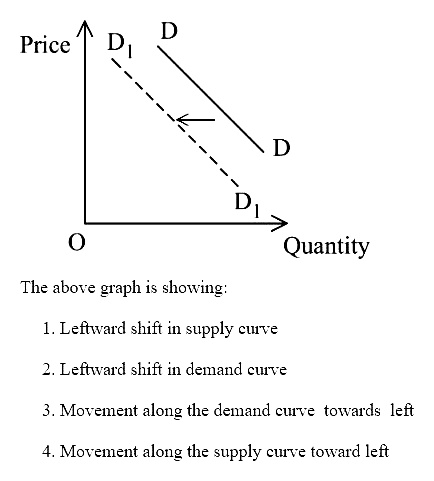
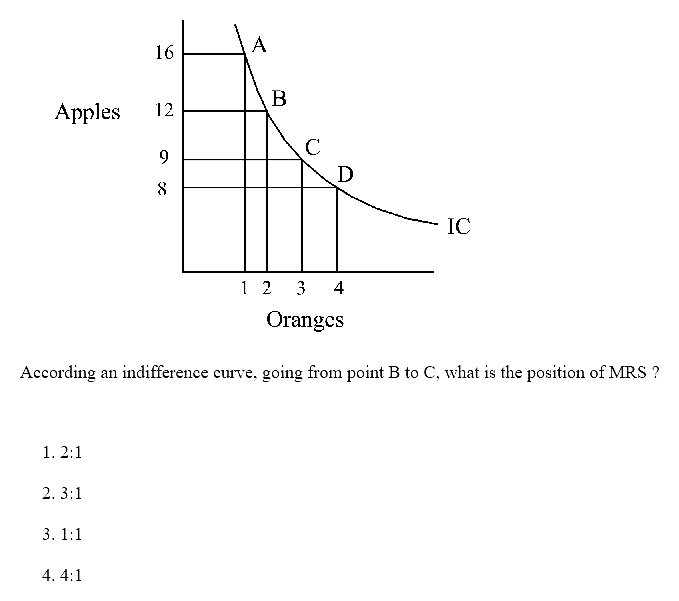


 Get latest Exam Updates