-
Question 1/45
1 / -0.25
Directions For Questions
Direction: Study the following data carefully and answer the questions accordingly.
Seven people live in a seven-story building. One person lives on one floor. The ground floor is numbered 1 and the top floor is numbered 7. Three people live between D and F, where D lives below F. Two people live between C and D. Four people live between B and D. E lives adjacent to B. F and D do not live adjacent to A. G does not live adjacent to B.
...view full instructions
How many people live between G and E?
-
Question 2/45
1 / -0.25
Directions For Questions
Direction: Study the following data carefully and answer the questions accordingly.
Seven people live in a seven-story building. One person lives on one floor. The ground floor is numbered 1 and the top floor is numbered 7. Three people live between D and F, where D lives below F. Two people live between C and D. Four people live between B and D. E lives adjacent to B. F and D do not live adjacent to A. G does not live adjacent to B.
...view full instructions
How many people live above C?
-
Question 3/45
1 / -0.25
Directions For Questions
Direction: Study the following data carefully and answer the questions accordingly.
Seven people live in a seven-story building. One person lives on one floor. The ground floor is numbered 1 and the top floor is numbered 7. Three people live between D and F, where D lives below F. Two people live between C and D. Four people live between B and D. E lives adjacent to B. F and D do not live adjacent to A. G does not live adjacent to B.
...view full instructions
Who lives between D and A?
-
Question 4/45
1 / -0.25
Directions For Questions
Direction: Study the following data carefully and answer the questions accordingly.
Seven people live in a seven-story building. One person lives on one floor. The ground floor is numbered 1 and the top floor is numbered 7. Three people live between D and F, where D lives below F. Two people live between C and D. Four people live between B and D. E lives adjacent to B. F and D do not live adjacent to A. G does not live adjacent to B.
...view full instructions
E lives on the floor numbered as ___.
-
Question 5/45
1 / -0.25
Directions For Questions
Direction: Study the following data carefully and answer the questions accordingly.
Seven people live in a seven-story building. One person lives on one floor. The ground floor is numbered 1 and the top floor is numbered 7. Three people live between D and F, where D lives below F. Two people live between C and D. Four people live between B and D. E lives adjacent to B. F and D do not live adjacent to A. G does not live adjacent to B.
...view full instructions
Who lives on floor numbered as 2?
-
Question 6/45
1 / -0.25
Directions For Questions
Direction: Study the following information carefully and answer the following questions.
Ten people are sitting in two parallel rows. A, B, C, D, E are sitting in row - 1 and facing south and P, Q, R, S, T are sitting in row - 2 and facing north such that the people sitting in row - 1 are sitting opposite to the people sitting in row – 2 . All the information is not necessarily in the same order.
A sits third to the right of the one who faces R. P sits opposite to the one who sits adjacent to A. Two people sit between P and Q. E sits two places away from the one who faces Q. One person sits between B and E who does not face T. C does not sit adjacent to B.
...view full instructions
How many people sit to the left of D?
-
Question 7/45
1 / -0.25
Directions For Questions
Direction: Study the following information carefully and answer the following questions.
Ten people are sitting in two parallel rows. A, B, C, D, E are sitting in row - 1 and facing south and P, Q, R, S, T are sitting in row - 2 and facing north such that the people sitting in row - 1 are sitting opposite to the people sitting in row – 2 . All the information is not necessarily in the same order.
A sits third to the right of the one who faces R. P sits opposite to the one who sits adjacent to A. Two people sit between P and Q. E sits two places away from the one who faces Q. One person sits between B and E who does not face T. C does not sit adjacent to B.
...view full instructions
Who sits opposite to T?
-
Question 8/45
1 / -0.25
Directions For Questions
Direction: Study the following information carefully and answer the following questions.
Ten people are sitting in two parallel rows. A, B, C, D, E are sitting in row - 1 and facing south and P, Q, R, S, T are sitting in row - 2 and facing north such that the people sitting in row - 1 are sitting opposite to the people sitting in row – 2 . All the information is not necessarily in the same order.
A sits third to the right of the one who faces R. P sits opposite to the one who sits adjacent to A. Two people sit between P and Q. E sits two places away from the one who faces Q. One person sits between B and E who does not face T. C does not sit adjacent to B.
...view full instructions
What is the position of P with respect to T?
-
Question 9/45
1 / -0.25
Directions For Questions
Direction: Study the following information carefully and answer the following questions.
Ten people are sitting in two parallel rows. A, B, C, D, E are sitting in row - 1 and facing south and P, Q, R, S, T are sitting in row - 2 and facing north such that the people sitting in row - 1 are sitting opposite to the people sitting in row – 2 . All the information is not necessarily in the same order.
A sits third to the right of the one who faces R. P sits opposite to the one who sits adjacent to A. Two people sit between P and Q. E sits two places away from the one who faces Q. One person sits between B and E who does not face T. C does not sit adjacent to B.
...view full instructions
Who sits second to the right of the one who sits opposite to Q?
-
Question 10/45
1 / -0.25
Directions For Questions
Direction: Study the following information carefully and answer the following questions.
Ten people are sitting in two parallel rows. A, B, C, D, E are sitting in row - 1 and facing south and P, Q, R, S, T are sitting in row - 2 and facing north such that the people sitting in row - 1 are sitting opposite to the people sitting in row – 2 . All the information is not necessarily in the same order.
A sits third to the right of the one who faces R. P sits opposite to the one who sits adjacent to A. Two people sit between P and Q. E sits two places away from the one who faces Q. One person sits between B and E who does not face T. C does not sit adjacent to B.
...view full instructions
Four of the following five are alike ina certain way and hence form a group. Which amongst the following does not belong to that group?
-
Question 11/45
1 / -0.25
Directions For Questions
Direction: In the following questions assuming the given statement to be true, find which of the conclusion(s) among given conclusions is/are definitely true, and then give your answers accordingly.
...view full instructions
Statement:
A ≥ J ≥ K > L = F > G < H = S ≤ D
Conclusion:
I. F > S
II. L < A
-
Question 12/45
1 / -0.25
Directions For Questions
Direction: In the following questions assuming the given statement to be true, find which of the conclusion(s) among given conclusions is/are definitely true, and then give your answers accordingly.
...view full instructions
Statement:
Z = S < X > C > D = F ≤ V ≤ B ≥ G ≥ H = N
Conclusion:
I. B > D
II. N ≤ B
-
Question 13/45
1 / -0.25
Directions For Questions
Direction: In the following questions assuming the given statement to be true, find which of the conclusion(s) among given conclusions is/are definitely true, and then give your answers accordingly.
...view full instructions
Statement:
Y ≥ H = G > T = R < F < D ≤ E
Conclusion:
I. Y ≥ E
II. E = T
-
Question 14/45
1 / -0.25
Directions For Questions
Direction: In the following questions assuming the given statement to be true, find which of the conclusion(s) among given conclusions is/are definitely true, and then give your answers accordingly.
...view full instructions
Statement:
P > L < O ≤ I = K ≤ J ≥ U = Y ≥ H > T
Conclusion:
I. J > L
II. T < U
-
Question 15/45
1 / -0.25
Directions For Questions
Direction: In the question below are given three statements followed by the conclusions. You have to take the given statements to be true even if they seem to be at variance with commonly known facts. Read all the conclusions and then decide which of the given conclusions logically follows from the given statements disregarding commonly known facts.
...view full instructions
Statements:
Only a few Friends are Relatives.
All Relatives are Family.
No Family is Parent.
Conclusions:
I. Some Friends are not Relatives
II. No Relatives are Parents
-
Question 16/45
1 / -0.25
Directions For Questions
Direction: In the question below are given three statements followed by the conclusions. You have to take the given statements to be true even if they seem to be at variance with commonly known facts. Read all the conclusions and then decide which of the given conclusions logically follows from the given statements disregarding commonly known facts.
...view full instructions
Statements:
No Months are Years.
All Years are Days.
Only a few Days are Dates.
Conclusions:
I. Some Years are Dates
II. No Years are Dates
-
Question 17/45
1 / -0.25
Directions For Questions
Direction: In the question below are given three statements followed by the conclusions. You have to take the given statements to be true even if they seem to be at variance with commonly known facts. Read all the conclusions and then decide which of the given conclusions logically follows from the given statements disregarding commonly known facts.
...view full instructions
Statements:
Only a few Papers are Cards.
Only a few Cards are Greetings.
All Greetings are Pages.
Conclusions:
I. Some Papers are not Cards
II. Some Cards are Pages
-
Question 18/45
1 / -0.25
Directions For Questions
Direction: In the question below are given three statements followed by the conclusions. You have to take the given statements to be true even if they seem to be at variance with commonly known facts. Read all the conclusions and then decide which of the given conclusions logically follows from the given statements disregarding commonly known facts.
...view full instructions
Statements:
All Androids are Windows.
No Windows are Linux.
Only a few Linux are Unix.
Conclusions:
I. Some Unix are not Windows
II. Some Androids can be Linux
-
Question 19/45
1 / -0.25
Directions For Questions
Direction: Study the following information carefully and answer the following questions.
Point C is 10m east of point A. Point N is 11m north of point M. Point D is 6m south of point C. Point M is 4m east of point D. Point P is 10m west of point N. Point S is to the south of point P and to the west of point D.
...view full instructions
What is the direction of point S with respect to point C?
-
Question 20/45
1 / -0.25
Directions For Questions
Direction: Study the following information carefully and answer the following questions.
Point C is 10m east of point A. Point N is 11m north of point M. Point D is 6m south of point C. Point M is 4m east of point D. Point P is 10m west of point N. Point S is to the south of point P and to the west of point D.
...view full instructions
What is the direction of Point N with respect to Point S?
-
Question 21/45
1 / -0.25
Directions For Questions
Direction: Study the following information carefully and answer the following questions.
Point C is 10m east of point A. Point N is 11m north of point M. Point D is 6m south of point C. Point M is 4m east of point D. Point P is 10m west of point N. Point S is to the south of point P and to the west of point D.
...view full instructions
What is the distance between Point P and Point S?
-
Question 22/45
1 / -0.25
Directions For Questions
Direction: Study the following data carefully and answer the questions accordingly.
657 864 324 256 186
...view full instructions
If the positions of the second and the third digit in each number are interchanged then, how many even numbers will be formed?
-
Question 23/45
1 / -0.25
Directions For Questions
Direction: Study the following data carefully and answer the questions accordingly.
657 864 324 256 186
...view full instructions
If all the digits in each number are arranged in ascending order within the number from left to right then, which of the following number will become the second lowest?
-
Question 24/45
1 / -0.25
Directions For Questions
Direction: Study the following data carefully and answer the questions accordingly.
657 864 324 256 186
...view full instructions
If two is subtracted from the last digit of each number then, how many numbers thus formed will be divisible by three?
-
Question 25/45
1 / -0.25
Directions For Questions
Direction: Study the following data carefully and answer the questions accordingly.
657 864 324 256 186
...view full instructions
What is the difference between the third lowest number and the highest number?
-
Question 26/45
1 / -0.25
Directions For Questions
Direction: In the following number series, only one number is wrong. Find out the wrong number.
...view full instructions
16, 97, 197, 318, 462, 649
-
Question 27/45
1 / -0.25
Directions For Questions
Direction: In the following number series, only one number is wrong. Find out the wrong number.
...view full instructions
53, 65, 79, 99, 125, 157
-
Question 28/45
1 / -0.25
Directions For Questions
Direction: In the following number series, only one number is wrong. Find out the wrong number.
...view full instructions
132, 173, 214, 253, 296, 337
-
Question 29/45
1 / -0.25
Directions For Questions
Direction: In the following number series, only one number is wrong. Find out the wrong number.
...view full instructions
65, 73, 100, 164, 296, 505
-
Question 30/45
1 / -0.25
Directions For Questions
Direction: In the following number series, only one number is wrong. Find out the wrong number.
...view full instructions
249, 256, 267, 280, 297, 320
-
Question 31/45
1 / -0.25
Directions For Questions
Direction: Study the following information carefully and answer the question:
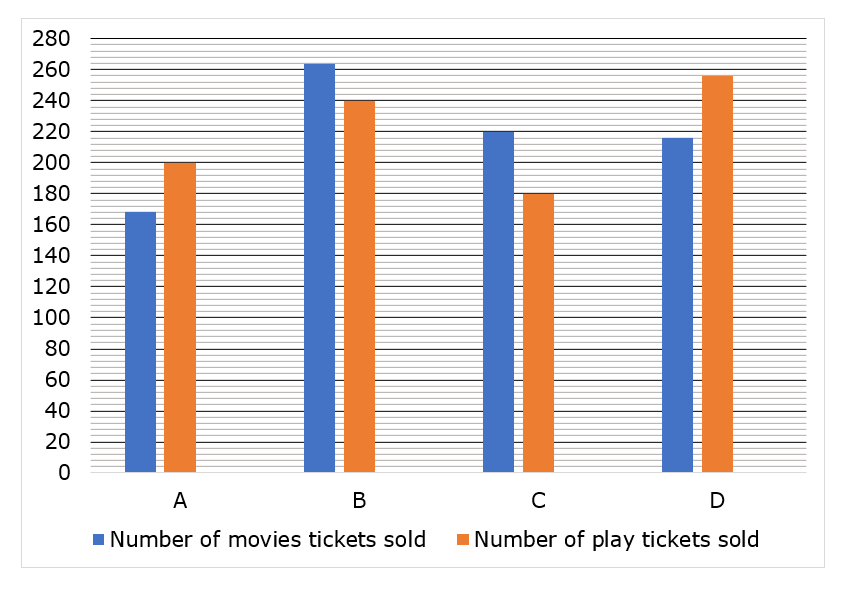
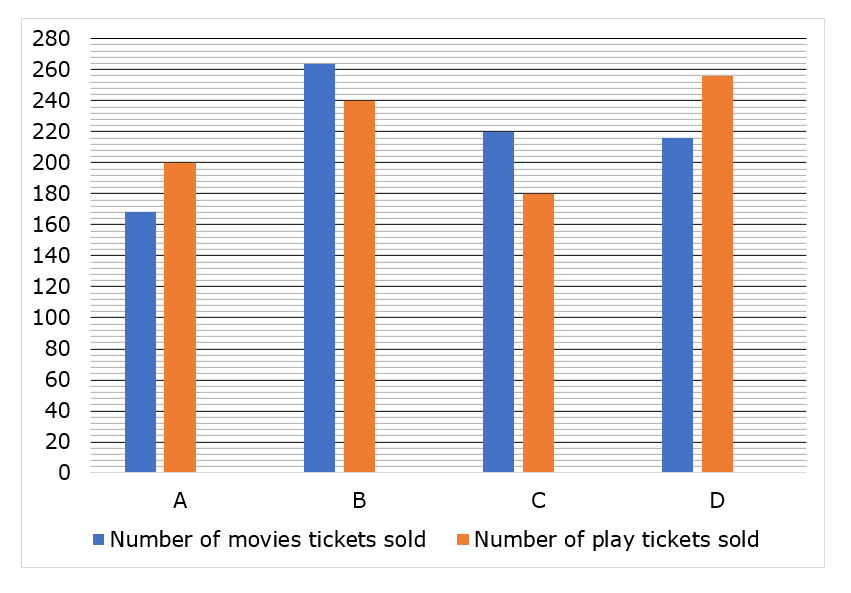
The bar graph shown below shows the number of movie tickets and play tickets sold in four halls A, B, C and D.
...view full instructions
The number of movies tickets sold in hall A is what percent of the number of play tickets sold in hall B?
-
Question 32/45
1 / -0.25
Directions For Questions
Direction: Study the following information carefully and answer the question:
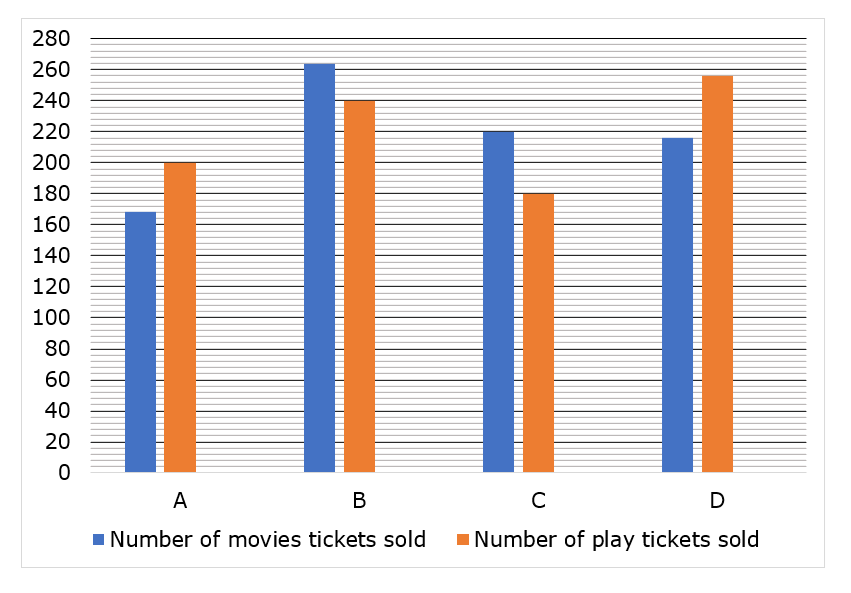
The bar graph shown below shows the number of movie tickets and play tickets sold in four halls A, B, C and D.
...view full instructions
What is the ratio between the number of movie tickets sold in hall D to the number of play tickets sold in hall C?
-
Question 33/45
1 / -0.25
Directions For Questions
Direction: Study the following information carefully and answer the question:
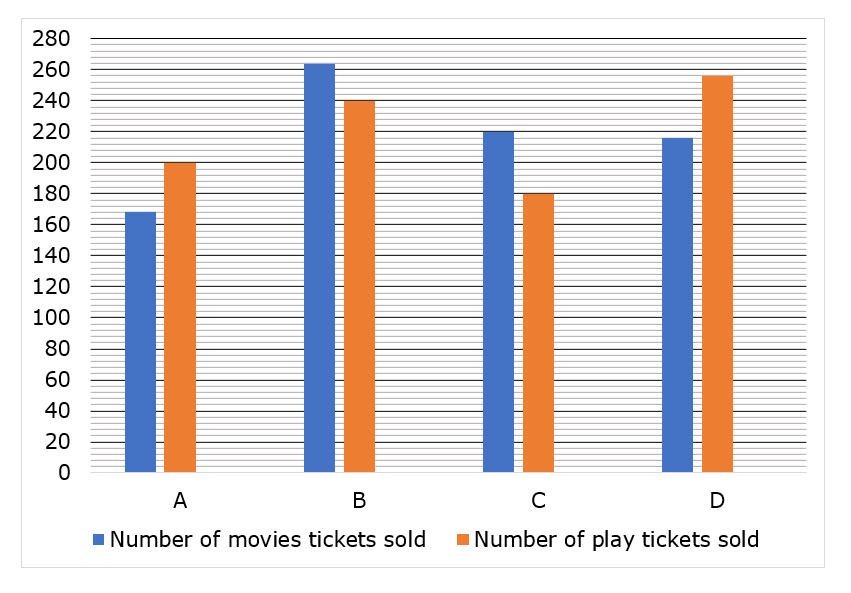
The bar graph shown below shows the number of movie tickets and play tickets sold in four halls A, B, C and D.
...view full instructions
What is the difference between the number of play tickets sold in all four halls and the number of movies tickets sold in hall B, C and D?
-
Question 34/45
1 / -0.25
Directions For Questions
Direction: Study the following information carefully and answer the question:
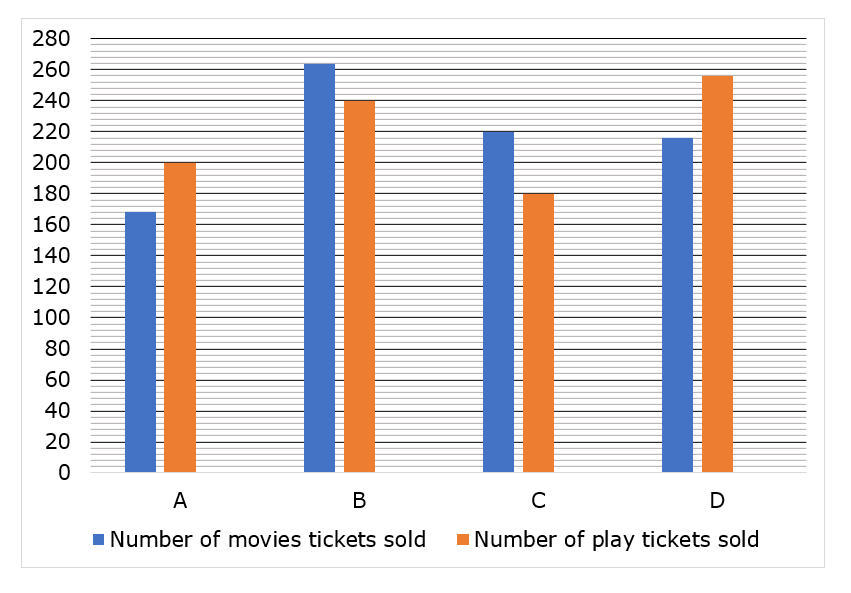
The bar graph shown below shows the number of movie tickets and play tickets sold in four halls A, B, C and D.
...view full instructions
If the price of a play ticket sold in hall A is Rs. 42 and the price of a movie ticket in the same hall is Rs. 50, what is the total price of all the movie and play tickets in hall A?
-
Question 35/45
1 / -0.25
Directions For Questions
Direction: Study the following information carefully and answer the question:
The bar graph shown below shows the number of movie tickets and play tickets sold in four halls A, B, C and D.
...view full instructions
All the tickets are sold in either online or offline mode. If the ratio of movie tickets sold online and offline mode in hall B is 8 : 3, how many movie tickets in hall B are sold in offline mode?
-
Question 36/45
1 / -0.25
Directions For Questions
Direction: Study the following information carefully and answer the question:
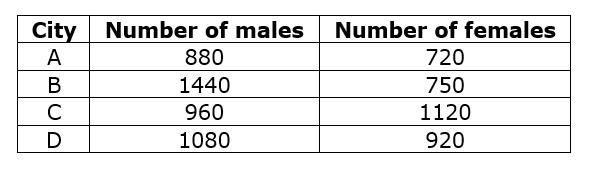
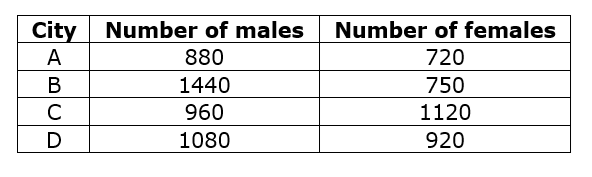
The table given below shows the number of males and females in four cities A, B, C and D.
...view full instructions
What is the ratio of number of males in city D to the number of females in city B?
-
Question 37/45
1 / -0.25
Directions For Questions
Direction: Study the following information carefully and answer the question:
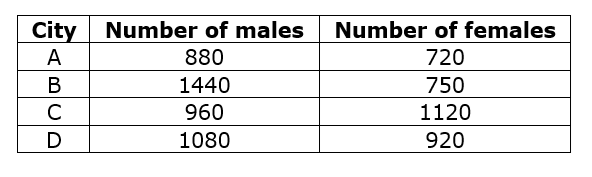
The table given below shows the number of males and females in four cities A, B, C and D.
...view full instructions
The number of females in city A is what percent of the number of males in city C?
-
Question 38/45
1 / -0.25
Directions For Questions
Direction: Study the following information carefully and answer the question:
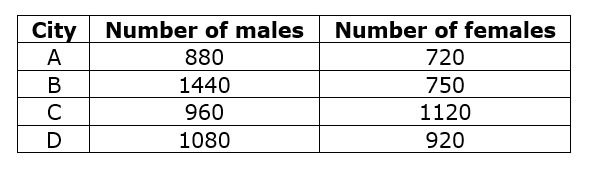
The table given below shows the number of males and females in four cities A, B, C and D.
...view full instructions
The total number of females in city A and D is how much more than the number of males in city B?
-
Question 39/45
1 / -0.25
Directions For Questions
Direction: Study the following information carefully and answer the question:
The table given below shows the number of males and females in four cities A, B, C and D.
...view full instructions
If the number of males in city E is 5% more than the number of females in city C and the ratio of number of females in city E to the number of males in city C is 7 : 8, what is the total population of city E?
-
Question 40/45
1 / -0.25
Directions For Questions
Direction: Study the following information carefully and answer the question:
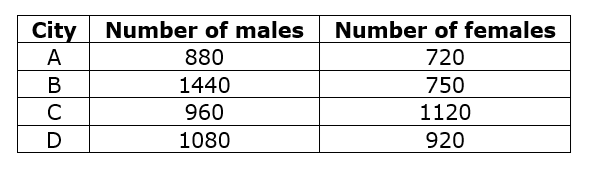
The table given below shows the number of males and females in four cities A, B, C and D.
...view full instructions
What is the average number of males in cities B, C and D?
-
Question 41/45
1 / -0.25
Directions For Questions
Direction: What should come in place of the question mark '?' in the following question?
...view full instructions
 ÷ 4 × 19 – 108 = ?
-
Question 42/45
1 / -0.25
Directions For Questions
Direction: What should come in place of the question mark '?' in the following question?
...view full instructions
432 ÷ ?3 + 212 = 457
-
Question 43/45
1 / -0.25
The profit obtained by selling an article is Rs. 60 . If the profit percentage on the article is 25% and the selling price is Rs. X, what is the value of (1.5X – 150)?
-
Question 44/45
1 / -0.25
In a mixture of milk and water the ratio of milk to water is 7 : 3. 10 litre of mixture is taken out and then 25 litre of water is added in the mixture. If the final ratio of milk to water is 3 : 2, find the initial quantity of water in the mixture.
-
Question 45/45
1 / -0.25
A sum is invested for 3 years at a rate of 10% per annum. If the simple interest obtained is Rs. 1320 . If the same sum is invested at compound interest for same rate, what will be the interest received at the end of 2 years?
 ReNEET UG 2026
 JEE Advanced 2026
 CUET UG 2026
 UP Police Constable 2026
 SSC Selection Post (Phase 14) 2026
 SSC GD 2025-26
 RRB NTPC 2026
 SSC CGL Tier-I 2026
 SSC JE 2026
 UPSC (CSE) 2026
 SBI PO Prelims 2026
 SSC Steno Grade C & D 2026
 SBI Clerk Prelims 2026
 IBPS PO Prelims 2026
 IBPS Clerk Prelims 2026
 SSC CPO Tier I 2026
 Bank
Bank


 SSC
SSC


 Railway


 State
State


 Other
Other


 Teaching


 Insurance


 Medical


 Engineering


 Defence


 GATE
GATE


 NTA CUET

 UPSC
UPSC

 MBA Entrance


 LAW
LAW





 Get latest Exam Updates