Please wait...

IBPS RRB OS-1 2024 Reasoning Test - 9
Menu grid icon
Result Result point icon
IBPS RRB OS-1 2024 Reasoning Test - 9
  • Goals icon

    /

    Score
  • Trophy icon

    -

    Rank
White alarm icon Time Taken: -
Result frame illustration
  • Question 1/10
    1 / -0.25

    Directions For Questions

    Direction: Study the following information carefully and answer the questions given below:

    There are nine persons namely P, Q, R, S, T, U, V, W and X has born in the same month of different year i.e. 1970, 1976, 1985, 1989, 1995, 2000, 2009, 2015 and 2019. There ages are considered as on the same month of base year 2024.

    V was born in an even number year, but not born in the year, which is divisible by 4. Q is 48 years old now. There is a difference of six years between S and T, who is younger than S. The age of R is a multiple of 13. U, who was born in an even numbered year is not the eldest among all. The difference between the ages of W and X is the square of the smallest even number. W was not the youngest person among all. P was not born in even numbered year neither he is of the age of any prime number.

    ...view full instructions


    How many people were born between the one who is 29 years of age and V?

    Solutions

    Given: Nine persons namely P, Q, R, S, T, U, V, W and X

    Born in the same month of different year i.e. 1970, 1976, 1985, 1989, 1995, 2000, 2009, 2015 and 2019.

    Having base year 2024

    1) V was born in an even number year, but not born in the year, which is divisible by 4. Q is 48 years old now.

    2) There is a difference of six years between S and T, who is younger than S.
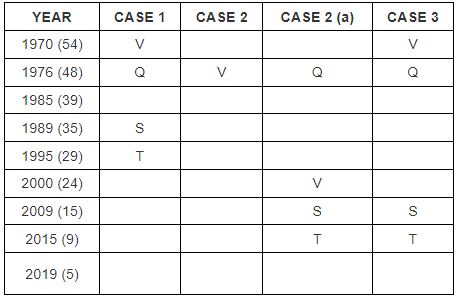
    As the age of Q is 48 years which is clearly given in the question, CASE 2 cannot be possible. Thus, it gets eliminated.

    3) The age of R is a multiple of 13. U, who is born in an even numbered year is not the eldest among all.

    4) The difference between the ages of W and X is the square of the smallest even number. W is not the youngest person among all.
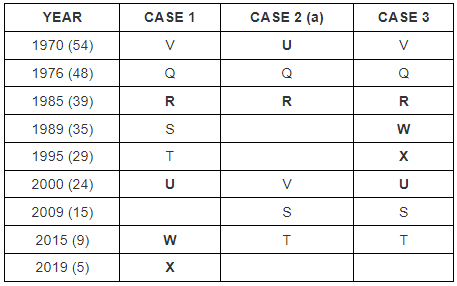
    U is born in an even numbered and he is not the eldest among all, thus CASE 2(a) also cannot be the possible case and gets eliminated. The difference between the ages of W and X is 4 which is the square of smallest even number.

    5) P was not born in even numbered year neither he is of the age of any prime number.
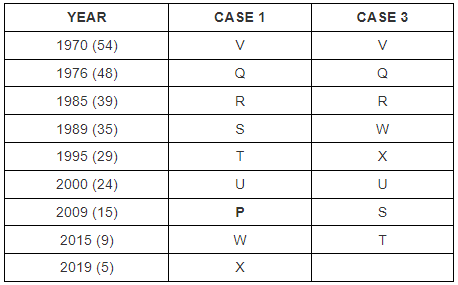
    As P is not born in any even numbered year neither he is of prime number age, thus CASE 3 also gets eliminated. And we have the final arrangement in CASE 1
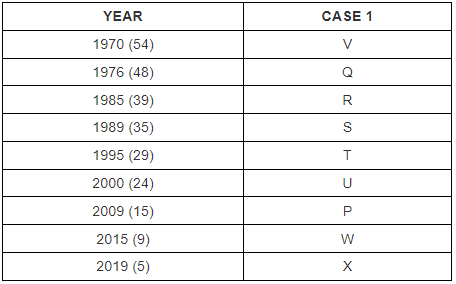
    Hence, the correct answer is "Three".

  • Question 2/10
    1 / -0.25

    Directions For Questions

    Direction: Study the following information carefully and answer the questions given below:

    There are nine persons namely P, Q, R, S, T, U, V, W and X has born in the same month of different year i.e. 1970, 1976, 1985, 1989, 1995, 2000, 2009, 2015 and 2019. There ages are considered as on the same month of base year 2024.

    V was born in an even number year, but not born in the year, which is divisible by 4. Q is 48 years old now. There is a difference of six years between S and T, who is younger than S. The age of R is a multiple of 13. U, who was born in an even numbered year is not the eldest among all. The difference between the ages of W and X is the square of the smallest even number. W was not the youngest person among all. P was not born in even numbered year neither he is of the age of any prime number.

    ...view full instructions


    Position of how many persons will change if they are made to sit in alphabetical order starting from the eldest person?

    Solutions

    Given: Nine persons namely P, Q, R, S, T, U, V, W and X

    Born in the same month of different year i.e. 1970, 1976, 1985, 1989, 1995, 2000, 2009, 2015 and 2019.

    Having base year 2024

    1) V was born in an even number year, but not born in the year, which is divisible by 4. Q is 48 years old now.

    2) There is a difference of six years between S and T, who is younger than S.

    As the age of Q is 48 years which is clearly given in the question, CASE 2 cannot be possible. Thus, it gets eliminated.

    3) The age of R is a multiple of 13. U, who is born in an even numbered year is not the eldest among all.

    4) The difference between the ages of W and X is the square of the smallest even number. W is not the youngest person among all.

    U is born in an even numbered and he is not the eldest among all, thus CASE 2(a) also cannot be the possible case and gets eliminated. The difference between the ages of W and X is 4 which is the square of smallest even number.

    5) P was not born in an odd numbered year neither he is of the age of any prime number.

    As P is not born in any odd numbered year neither he is of prime number age, thus CASE 3 also gets eliminated. And we have the final arrangement in CASE 1

    Hence, the correct answer is "Two".

  • Question 3/10
    1 / -0.25

    Directions For Questions

    Direction: Study the following information carefully and answer the questions given below:

    There are nine persons namely P, Q, R, S, T, U, V, W and X has born in the same month of different year i.e. 1970, 1976, 1985, 1989, 1995, 2000, 2009, 2015 and 2019. There ages are considered as on the same month of base year 2024.

    V was born in an even number year, but not born in the year, which is divisible by 4. Q is 48 years old now. There is a difference of six years between S and T, who is younger than S. The age of R is a multiple of 13. U, who was born in an even numbered year is not the eldest among all. The difference between the ages of W and X is the square of the smallest even number. W was not the youngest person among all. P was not born in even numbered year neither he is of the age of any prime number.

    ...view full instructions


    Four of the following five are alike in a certain way and thus forms a group. Select the one which is different from others?

    Solutions

    Given: Nine persons namely P, Q, R, S, T, U, V, W and X

    Born in the same month of different year i.e. 1970, 1976, 1985, 1989, 1995, 2000, 2009, 2015 and 2019.

    Having base year 2024

    1) V was born in an even number year, but not born in the year, which is divisible by 4. Q is 48 years old now.

    2) There is a difference of six years between S and T, who is younger than S.

    As the age of Q is 48 years which is clearly given in the question, CASE 2 cannot be possible. Thus, it gets eliminated.

    3) The age of R is a multiple of 13. U, who is born in an even numbered year is not the eldest among all.

    4) The difference between the ages of W and X is the square of the smallest even number. W is not the youngest person among all.

    U is born in an even numbered and he is not the eldest among all, thus CASE 2(a) also cannot be the possible case and gets eliminated. The difference between the ages of W and X is 4 which is the square of smallest even number.

    5) P was not born in even numbered year neither he is of the age of any prime number.

    As P is not born in any even numbered year neither he is of prime number age, thus CASE 3 also gets eliminated. And we have the final arrangement in CASE 1

    From the above arrangement all the other pairs apart from VQ are born in a odd number years.

    Hence, the correct answer is "VQ".

  • Question 4/10
    1 / -0.25

    Directions For Questions

    Direction: Study the following information carefully and answer the questions given below:

    There are nine persons namely P, Q, R, S, T, U, V, W and X has born in the same month of different year i.e. 1970, 1976, 1985, 1989, 1995, 2000, 2009, 2015 and 2019. There ages are considered as on the same month of base year 2024.

    V was born in an even number year, but not born in the year, which is divisible by 4. Q is 48 years old now. There is a difference of six years between S and T, who is younger than S. The age of R is a multiple of 13. U, who was born in an even numbered year is not the eldest among all. The difference between the ages of W and X is the square of the smallest even number. W was not the youngest person among all. P was not born in even numbered year neither he is of the age of any prime number.

    ...view full instructions


    Who among the following will be the fourth elder to W?

    Solutions

    Given: Nine persons namely P, Q, R, S, T, U, V, W and X

    Born in the same month of different year i.e. 1970, 1976, 1985, 1989, 1995, 2000, 2009, 2015 and 2019.

    Having base year 2024

    1) V was born in an even number year, but not born in the year, which is divisible by 4. Q is 48 years old now.

    2) There is a difference of six years between S and T, who is younger than S.

    As the age of Q is 48 years which is clearly given in the question, CASE 2 cannot be possible. Thus, it gets eliminated.

    3) The age of R is a multiple of 13. U, who is born in an even numbered year is not the eldest among all.

    4) The difference between the ages of W and X is the square of the smallest even number. W is not the youngest person among all.

    U is born in an even numbered and he is not the eldest among all, thus CASE 2(a) also cannot be the possible case and gets eliminated. The difference between the ages of W and X is 4 which is the square of smallest even number.

    5) P was not born in even numbered year neither he is of the age of any prime number.

    As P is not born in any even numbered year neither he is of prime number age, thus CASE 3 also gets eliminated. And we have the final arrangement in CASE 1

    Hence, the correct answer is "S".

  • Question 5/10
    1 / -0.25

    Directions For Questions

    Direction: Study the following information carefully and answer the questions given below:

    There are nine persons namely P, Q, R, S, T, U, V, W and X has born in the same month of different year i.e. 1970, 1976, 1985, 1989, 1995, 2000, 2009, 2015 and 2019. There ages are considered as on the same month of base year 2024.

    V was born in an even number year, but not born in the year, which is divisible by 4. Q is 48 years old now. There is a difference of six years between S and T, who is younger than S. The age of R is a multiple of 13. U, who was born in an even numbered year is not the eldest among all. The difference between the ages of W and X is the square of the smallest even number. W was not the youngest person among all. P was not born in even numbered year neither he is of the age of any prime number.

    ...view full instructions


    Which among the following pairs represents respectively the eldest and the youngest ones among all?

    Solutions

    Given: Nine persons namely P, Q, R, S, T, U, V, W and X

    Born in the same month of different year i.e. 1970, 1976, 1985, 1989, 1995, 2000, 2009, 2015 and 2019.

    Having base year 2024

    1) V was born in an even number year, but not born in the year, which is divisible by 4. Q is 48 years old now.

    2) There is a difference of six years between S and T, who is younger than S.

    As the age of Q is 48 years which is clearly given in the question, CASE 2 cannot be possible. Thus, it gets eliminated.

    3) The age of R is a multiple of 13. U, who is born in an even numbered year is not the eldest among all.

    4) The difference between the ages of W and X is the square of the smallest even number. W is not the youngest person among all.

    U is born in an even numbered and he is not the eldest among all, thus CASE 2(a) also cannot be the possible case and gets eliminated. The difference between the ages of W and X is 4 which is the square of smallest even number.

    5) P was not born in even numbered year neither he is of the age of any prime number.

    As P is not born in any even numbered year neither he is of prime number age, thus CASE 3 also gets eliminated. And we have the final arrangement in CASE 1

    Hence, the correct answer is "VX".

  • Question 6/10
    1 / -0.25

    In the following question, assuming the given statement to be true, find which of the conclusion(s) among the given conclusions is/are definitely true, and then give your answers accordingly.

    Statement:

    A > Y ≥ O > Z; O > U < S

    Conclusions:

    I. U ≥ A

    II. U < A

    Solutions

    Given statements: A > Y ≥ O > Z; O > U < S

    On combining: A > Y ≥ O > U < S, Z < O > U < S

    Conclusions:

    I. U ≥ A → False (as A > Y ≥ O > U, so U is smaller than A.)

    II. U < A → True (as A > Y ≥ O > U, so it is definite that A is greater than U.)

    U is not greater than or equal to A so the first conclusion doesn't follow. A is greater than U so the second conclusion follows.

    Hence, the correct answer is Only II follows.

  • Question 7/10
    1 / -0.25

    In the following question assuming the given statements to be true, find which of the conclusion among given some conclusion is/are definitely true and then give your answers accordingly:

    Statement:

    C < R < I ≤ S ≤ E ≤ A = N > O < G < Y > B ≥ D

    Conclusions:

    I. C < G

    II. R < O

    III. I > O

    Solutions

    Statement:

    C < R < I ≤ S ≤ E ≤ A = N > O < G < Y > B ≥ D

    Conclusions:

    I. C < G → False (C < R < I ≤ S ≤ E ≤ A = N > O < G → No definite relation between the two can be determined)

    II. R < O → False (R < I ≤ S ≤ E ≤ A = N > O → No definite relation between the two can be determined)

    III. I > O → False (I ≤ S ≤ E ≤ A = N > O → No definite relation between the two can be determined)

    Hence, None is true.

  • Question 8/10
    1 / -0.25

    In the following question assuming the given statements to be true. find which of the conclusions among given conclusions is/are definitely true and then give your answers accordingly.

    Statements:  P ≥ Q < R = S; Q < T = U

    Conclusion:

    I. P ≥ U

    II. T < S

    Solutions

    Statements:  P ≥ Q < R = S; Q < T = U

    On Combining: P ≥ Q < R = S; P ≥ Q < T = U; S = R > Q < T = U

    Conclusion:

    I. P ≥ U → FALSE (As P ≥ Q < T = U, so there is no direct relation between P & U).

    II. T < S → FALSE (As S = R > Q < T = U, so there is no direct relation between S & T).

    Hence, Neither I nor II Follows.

  • Question 9/10
    1 / -0.25

    In these questions, a relationship between different elements is shown in the statements. The statements are followed by two conclusions. Give answer

    Statement: M ≥ K > A = Q; C > D < A > S > E > B = H

    Conclusion:

    I. Q ≥ H

    II. H < Q

    Solutions

    Given Statement:

    M ≥ K > A = Q; C > D < A > S > E > B = H

    On combining: 

    M ≥ K > Q = A > S > E > B = H

    Or

    M ≥ K > Q = A > D < C

    Conclusion:

    I. Q ≥ H: False : (As M ≥ K > A = Q > S > E > B = H. Therefore, H is less than Q is true.)

    II. H < Q: True : (As M ≥ K > A = Q > S > E > B = H. Therefore, H is less than Q is true.)

    Hence, only conclusion II is true.

  • Question 10/10
    1 / -0.25

    Directions For Questions

    Directions: Read the following information carefully and answer the questions.

    An uncertain number of persons are sitting in a row facing towards North. G sits sixth from one of the extreme ends of the row. Only one person sits between P and T. R, who sits third to the right of T is an immediate neighbour of W. Only two persons sit between G and S, who sits third from the left end of the row. T sits eighth from the right end of the row. F, who sits to the immediate right of G, is seated second to the left of P. W doesn’t sit to the right of R. Only five people sit to the right of W. V sits sixth to the right of T.

    ...view full instructions


    How many persons are seated in the row?

    Solutions

    Given: An uncertain number of persons are sitting in a row facing the North.

    From the given conditions, we get the following possibilities-

    1. G sits sixth from one of the extreme ends of the row. Only two persons sit between G and S, who sits third from the left end of the row. From these two conditions, we get-

    2. F, who sits to the immediate right of G, is seated second to the left of P. From this we get-

    3. Only one person sits between P and T. R, who sits third to the right of T is an immediate neighbour of W. From these conditions, we get-

    4. W doesn’t sit to the right of R. Only five people sit to the right of W. V sits sixth to the right of T. From these conditions, we get the final arrangement as follows:

    From the above final arrangement, we see that a total of 18 persons are sitting.

    Hence,  total of 18 persons are sitting in the row

Close button icon
User Profile
-

Correct (-)

Wrong (-)

Skipped (-)


  • 1
  • 2
  • 3
  • 4
  • 5
  • 6
  • 7
  • 8
  • 9
  • 10
Mockers logo Get latest Exam Updates
& Study Material Alerts!
No, Thanks
Arrow pointer icon
Click on Allow to receive notifications
Notification bell icon ×
Open Now
