Please wait...

IBPS Clerk 2024 Reasoning Test - 4
Menu grid icon
Result Result point icon
IBPS Clerk 2024 Reasoning Test - 4
  • Goals icon

    /

    Score
  • Trophy icon

    -

    Rank
White alarm icon Time Taken: -
Result frame illustration
  • Question 1/10
    1 / -0.25

    Directions For Questions

    Directions: Study the following information carefully and answer the questions that follow.

    Eight people L, M, N, O, P, Q, R, and S are sitting in a row facing North. N is sitting at one, end and only two people are sitting between N and L. Q is an immediate neighbor of one who is sitting at extreme end. No one is sitting between Q and M, who is sitting at extreme end. P is sitting to the immediate left of L and only two persons are sitting between P and O. R is an immediate neighbor of neither O nor Q.

    ...view full instructions


    Who is sitting second to left of S?

    Solutions

    1) N is sitting at one end, and only two people are sitting between N and L.

    2) Q is an immediate neighbor of one who is sitting at extreme end. No one is sitting between Q and M, who is sitting at extreme end

    3) P is sitting to the immediate left of L and only two persons are sitting between P and O

    4) R is an immediate neighbor of neither O nor Q

    Hence, case 2 gets canceled.

    So, the final arrangement will be

    Hence, P is sitting second to the left of S.

  • Question 2/10
    1 / -0.25

    Directions For Questions

    Directions: Study the following information carefully and answer the questions that follow.

    Eight people L, M, N, O, P, Q, R, and S are sitting in a row facing North. N is sitting at one, end and only two people are sitting between N and L. Q is an immediate neighbor of one who is sitting at extreme end. No one is sitting between Q and M, who is sitting at extreme end. P is sitting to the immediate left of L and only two persons are sitting between P and O. R is an immediate neighbor of neither O nor Q.

    ...view full instructions


    How many people are sitting between R and O?

    Solutions

    1) N is sitting at one end, and only two people are sitting between N and L.

    2) Q is an immediate neighbor of one who is sitting at extreme end. No one is sitting between Q and M, who is sitting at extreme end

    3) P is sitting to the immediate left of L and only two persons are sitting between P and O

    4) R is an immediate neighbor of neither O nor Q

    Hence, case 2 gets canceled.

    So, the final arrangement will be

    Hence, Three people are sitting between R and O.

  • Question 3/10
    1 / -0.25

    Directions For Questions

    Directions: Study the following information carefully and answer the questions that follow.

    Eight people L, M, N, O, P, Q, R, and S are sitting in a row facing North. N is sitting at one, end and only two people are sitting between N and L. Q is an immediate neighbor of one who is sitting at extreme end. No one is sitting between Q and M, who is sitting at extreme end. P is sitting to the immediate left of L and only two persons are sitting between P and O. R is an immediate neighbor of neither O nor Q.

    ...view full instructions


    Which of the following statement is true?

    Solutions

    1) N is sitting at one end, and only two people are sitting between N and L.

    2) Q is an immediate neighbor of one who is sitting at extreme end. No one is sitting between Q and M, who is sitting at extreme end

    3) P is sitting to the immediate left of L and only two persons are sitting between P and O

    4) R is an immediate neighbor of neither O nor Q

    Hence, case 2 gets canceled.

    So, the final arrangement will be

    Hence, M is sitting fourth to the right of L.

  • Question 4/10
    1 / -0.25

    Directions For Questions

    Directions: Study the following information carefully and answer the questions that follow.

    Eight people L, M, N, O, P, Q, R, and S are sitting in a row facing North. N is sitting at one, end and only two people are sitting between N and L. Q is an immediate neighbor of one who is sitting at extreme end. No one is sitting between Q and M, who is sitting at extreme end. P is sitting to the immediate left of L and only two persons are sitting between P and O. R is an immediate neighbor of neither O nor Q.

    ...view full instructions


    Who is sitting third to the right of P?

    Solutions

    1) N is sitting at one end, and only two people are sitting between N and L.

    2) Q is an immediate neighbor of one who is sitting at extreme end. No one is sitting between Q and M, who is sitting at extreme end

    3) P is sitting to the immediate left of L and only two persons are sitting between P and O

    4) R is an immediate neighbor of neither O nor Q

    Hence, case 2 gets canceled.

    So, the final arrangement will be

    Hence, O is sitting third to the right of P.

  • Question 5/10
    1 / -0.25

    Directions For Questions

    Directions: Study the following information carefully and answer the questions that follow.

    Eight people L, M, N, O, P, Q, R, and S are sitting in a row facing North. N is sitting at one, end and only two people are sitting between N and L. Q is an immediate neighbor of one who is sitting at extreme end. No one is sitting between Q and M, who is sitting at extreme end. P is sitting to the immediate left of L and only two persons are sitting between P and O. R is an immediate neighbor of neither O nor Q.

    ...view full instructions


    Who is sitting second to the right of one, who is sitting immediate to the left of O?

    Solutions

    1) N is sitting at one end, and only two people are sitting between N and L.

    2) Q is an immediate neighbor of one who is sitting at extreme end. No one is sitting between Q and M, who is sitting at extreme end

    3) P is sitting to the immediate left of L and only two persons are sitting between P and O

    4) R is an immediate neighbor of neither O nor Q

    Hence, case 2 gets canceled.

    So, the final arrangement will be

    Immediate to the left of O → S

    Second to the right of S → Q

    Hence, Q is sitting second to the right of one, who is sitting immediate to the left of O.

  • Question 6/10
    1 / -0.25

    In the following question assuming the given statements to be true, find which of the conclusion(s) among given conclusions is/are definitely true and then give your answers accordingly.

    Statement:

    E ≤ K > L > R = X > Q

    Conclusions:

    I. E > R

    II. K > Q

    Solutions

    Given statement,

    E ≤ K > L > R = X > Q

    Conclusions:

    I. E > R → False (E ≤ K > L > R → a clear relation between E and R cannot be determined).

    II. K > Q → True (K > L > R = X > Q → K > Q).

    Hence, the correct answer is only conclusion II follows.

  • Question 7/10
    1 / -0.25

    In the following question assuming the given statements to be True, find which of the conclusion among given conclusions is / are definitely true and then give your answers accordingly.

    Statements: D ≥ S = J ≥ E; W > Y ≤ O; W > X > D;

    Conclusions:

    I. X > E

    II. W > D

    Solutions

    Given statements:  D ≥ S = J ≥ E; W > Y ≤ O; W > X > D;

    After combining: O ≥ Y < W > X > D ≥ S = J ≥ E

    Conclusions:

    I. X > E  → True (as X > D ≥ S = J ≥ E)

    II. W > D → True (as W > X > D)

    Hence, Both conclusion I and II are true. 

  • Question 8/10
    1 / -0.25

    In each of the following questions assuming the given statement to be true, find which of the conclusions among given conclusions is / are definitely true and then give your answers accordingly.

    Statement: H < B > U ≥ W = T ≥ Y > I < A ≥ Y

    Conclusions:

    I. B > I

    II. A > W

    Solutions

    Statement: H < B > U ≥ W = T ≥ Y > I < A ≥ Y

    Conclusions:

    I. B > I → True (B > U ≥ W = T ≥ Y > I → B > I)

    II. A > W → False (W = T ≥ Y > I < A, no direct relationship between A and W can be determined).

    Hence, Only Conclusion I follows.

  • Question 9/10
    1 / -0.25

    In each of the following questions assuming the given statement to be true, find which of the conclusions among given conclusions is / are definitely true and then give your answers accordingly.

    Statement: H > K ≤ L = M < N < Q = S

    Conclusions:

    I. M < S

    II. Q < K

    Solutions

    Given Statement: H > K ≤ L = M < N < Q = S

    Conclusions:

    I. M < S → True (M < N ≤ Q = S → M < S)

    II. Q < K → False (K ≤ L = M < N < Q → K < Q)

    Hence, Only conclusion I follows.

  • Question 10/10
    1 / -0.25

    Directions For Questions

    Directions: Study the following information and answer the given questions.

    Eight boxes namely H to O are placed in a rack one above the other. The lowermost rack is numbered 1 and above is 2 and so on. Three boxes are between the box O and the box M but the box O is above the box M. Box L is immediate above the box N but below the box M. Four boxes are between the box L and the box J. Box K is above the box M and below the box J. Box I is below the box K and above the box L. Two boxes are between the box I and the box H.

    ...view full instructions


    ​Which box is between the box N and the box I.

    Solutions

    Eight boxes namely H to O are placed in a rack one above the other.

    1. Three boxes are between the box O and the box M but the box O is above the box M.

    Here we have four cases according to this Condition.
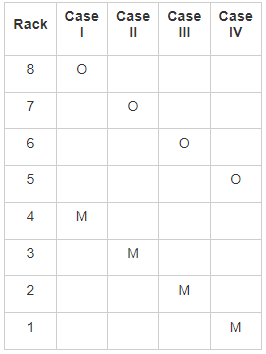
    2. Box L is immediate above the box N but below the box M.

    (Case III and Case IV not follows because in the question given box L and box N are below the box M but it is not possible in these cases) 

    Case I Splits into one more case i.e. Case I(a)
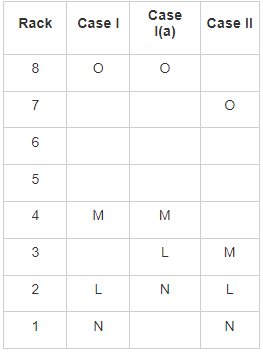
    3. Four boxes are between the box L and the box J.

    (Case I(a) and Case II not follows because in the question given Four boxes are between the box L and the box J but it is not possible in these cases)
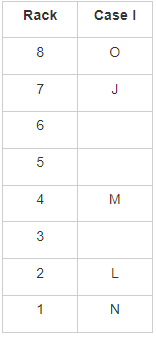
    4. Box K is above the box M and below the box J.

    Again case I Splits into two more cases i.e. Case I and Case II 
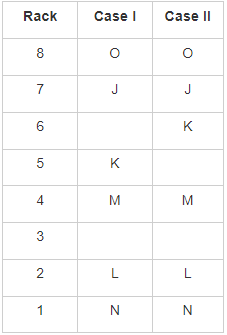
    5. Box I is below the box K and above the box L.

    Again case II Splits into one more case i.e. case II(a)
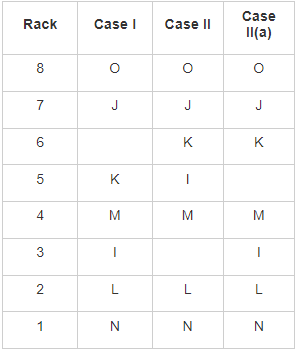
    6. Two boxes are between the box I and the box H.

    (Case II and Case II(a) not follows because in the question given Two boxes are between the box I and the box H but it is not possible in these cases)
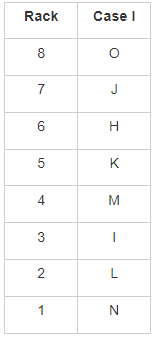
    Hence, box L is between the box N and the box I.

Close button icon
User Profile
-

Correct (-)

Wrong (-)

Skipped (-)


  • 1
  • 2
  • 3
  • 4
  • 5
  • 6
  • 7
  • 8
  • 9
  • 10
Mockers logo Get latest Exam Updates
& Study Material Alerts!
No, Thanks
Arrow pointer icon
Click on Allow to receive notifications
Notification bell icon ×
Open Now