Please wait...

IBPS RRB (OA) 2024 Reasoning Test - 7
Menu grid icon
Result Result point icon
IBPS RRB (OA) 2024 Reasoning Test - 7
  • Goals icon

    /

    Score
  • Trophy icon

    -

    Rank
White alarm icon Time Taken: -
Result frame illustration
  • Question 1/10
    1 / -0.25

    Study the information given below carefully and answer the question given below.

    E is 8 km south of F. G is 5 km north of F. D is 15 km east of E and 8 km south of C. B is 10 km west of C. A is 5 km north of B.

    C is in which direction of E?

    Solutions

    We have drawn the figure according to the information given in the question,

    Now C is north east direction of E.

  • Question 2/10
    1 / -0.25

    Study the information given below carefully and answer the question given below.

    E is 8 km south of F. G is 5 km north of F. D is 15 km east of E and 8 km south of C. B is 10 km west of C. A is 5 km north of B.

    What is the distance between B and F?

    Solutions

    We have drawn the figure according to the information given in the question,

    Hence, the distance between F and B is 5 km.

  • Question 3/10
    1 / -0.25

    Study the information given below carefully and answer the question given below.

    E is 8 km south of F. G is 5 km north of F. D is 15 km east of E and 8 km south of C. B is 10 km west of C. A is 5 km north of B.

    If H is 5 km east of E, then what is the shortest distance between B and H?

    Solutions

    We have drawn the figure according to the information given in the question,

    Hence, the distance between B and H is 8 km.

  • Question 4/10
    1 / -0.25

    In the question below are given two statements followed by four conclusions numbered I and II. You have to take the given statements to be true even if they seem to be at variance with commonly known facts. Read all the conclusions and then decide which of the given conclusions logically follows from the given statements disregarding commonly known facts.

    Statements

    No ball is a bat

    All bat are helmet

    Some ball are football

    Conclusions

    I. Some football are helmet

    II. No helmet is a ball

    Solutions

    The least possible Venn diagram for the given statements is as follows

    Conclusions:

    I. Some football are helmet → False ( Some part of football are ball and there is no relation between football and helmet so its false)

    II. No helmet is a ball → False ( it is possible but not definite so it's false)

    Hence, None follows is the correct answer.

  • Question 5/10
    1 / -0.25

    In the question below are given two statements followed by two conclusions numbered I, and II.You have to take the given statements to be true even if they seem to be at variance with commonly known facts. Read all the conclusions and then decide which of the given conclusions logically follows from the given statements disregarding commonly known facts.

    Statements

    All C are A

    No A is B

    Only a few D are C

    Conclusions

    I. All D being A is a possibility

    II. All C being D is a possibility

    Solutions

    Venn diagram

    Conclusions:

    I All D being A is a possibility -True (Given Only a few D is C means some D are not C but the relation between D and A is not definite so it is true).

    II All C being D is a possibility - True (Only a few D is C means some D are not C but all C can be D).

    Hence, Both I and II follows.

  • Question 6/10
    1 / -0.25

    In the question below are given four statements followed by four conclusions numbered I, II, III and IV. You have to take the given statements to be true even if they seem to be at variance with commonly known facts. Read all the conclusions and then decide which of the given conclusions logically follows from the given statements disregarding commonly known facts.

    Statements:

    Only a few Z are A.

    Only a few A are T.

    No T is B. 

    Conclusions:

    I. Some Z can be T.

    II. Some A can be B.

    Solutions

    The least possible Venn diagram for the given statements is as follows

    Conclusions:

    I. Some Z can be T → True (The possibility is true, As no direct relation between the two is given).

    II. Some A can be B → True (The possibility is true, As no direct relation between the two is given).

    Hence, Both I and II follow.

  • Question 7/10
    1 / -0.25

    In the question below are given two statements followed by two conclusions numbered I, and II. You have to take the given statements to be true even if they seem to be at variance with commonly known facts. Read all the conclusions and then decide which of the given conclusions logically follows from the given statements disregarding commonly known facts.

    Statements:

    I. Some dogs are cats.

    II. Only a few dogs are rabbits.

    Conclusions:

    I. No cats are rabbits

    II. Some dogs are not rabbits.

    Solutions

    The least possible Venn diagram for the given statements is as follows:

    Conclusions:

    I. No cats are rabbits → False (We can say but it is not definite)

    II. Some dogs are not rabbits → True (As in this case the concept of “only a few” is applied and in this concept “some” and “some + not” both are true)

    Hence, only conclusion II follows.

  • Question 8/10
    1 / -0.25

    Directions For Questions

    Direction: Study the information given below carefully and answer the questions that follow.

    There are Eight people R, K, B, D, Q, E, S, and Z sitting around a square table, in such a way that four people sit at four corners of the table while four people sit at the middle of each of the four sides of the table. They all are facing towards the centre.

    B sits immediate left of Q. K sits at one of the corners. There are four persons sitting between Z and Q when counted clockwise from Z. D is sitting at one of the corners but is not an immediate neighbour of B and S. Only one person sits between D and E also between R and S. No person sits immediately next to one another according to the alphabetical order i.e. (D – E, Q – R and R – S not sits next to one another). Z sits third to the right of K.

    ...view full instructions


    Who sits second to the right of B?

    Solutions

    Given:

    Eight People: R, K, B, D, Q, E, S, and Z

    1) K sits at one of the corners.

    2) Z sits third to the right of K.

    3) There are four persons sitting between Z and Q when counted clockwise from Z.
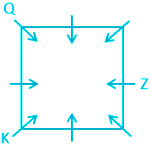
    4) B sits immediate left of Q.

    5) D is sitting at one of the corners but is not an immediate neighbour of B and S.
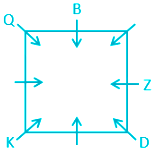
    6) Only one person sits between D and E also between R and S.

    7) No person sits immediately next to one another according to the alphabetical order i.e. (D – E, Q – R, and R – S do not sit next to one another).

    So, the final arrangement,
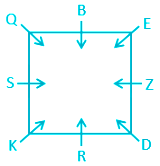
    Hence, “S” sits second to the right of B.

  • Question 9/10
    1 / -0.25

    Directions For Questions

    Direction: Study the information given below carefully and answer the questions that follow.

    There are Eight people R, K, B, D, Q, E, S, and Z sitting around a square table, in such a way that four people sit at four corners of the table while four people sit at the middle of each of the four sides of the table. They all are facing towards the centre.

    B sits immediate left of Q. K sits at one of the corners. There are four persons sitting between Z and Q when counted clockwise from Z. D is sitting at one of the corners but is not an immediate neighbour of B and S. Only one person sits between D and E also between R and S. No person sits immediately next to one another according to the alphabetical order i.e. (D – E, Q – R and R – S not sits next to one another). Z sits third to the right of K.

    ...view full instructions


    How many persons sit between E and S when counted clockwise from E?

    Solutions

    Given:

    Eight People: R, K, B, D, Q, E, S, and Z

    1) K sits at one of the corners.

    2) Z sits third to the right of K.

    3) There are four persons sitting between Z and Q when counted clockwise from Z.

    4) B sits immediate left of Q.

    5) D is sitting at one of the corners but is not an immediate neighbour of B and S.

    6) Only one person sits between D and E also between R and S.

    7) No person sits immediately next to one another according to the alphabetical order i.e. (D – E, Q – R, and R – S do not sit next to one another).

    So, the final arrangement,

    Hence, “4” persons sit between E and S when counted clockwise from E.

  • Question 10/10
    1 / -0.25

    Directions For Questions

    Direction: Study the information given below carefully and answer the questions that follow.

    There are Eight people R, K, B, D, Q, E, S, and Z sitting around a square table, in such a way that four people sit at four corners of the table while four people sit at the middle of each of the four sides of the table. They all are facing towards the centre.

    B sits immediate left of Q. K sits at one of the corners. There are four persons sitting between Z and Q when counted clockwise from Z. D is sitting at one of the corners but is not an immediate neighbour of B and S. Only one person sits between D and E also between R and S. No person sits immediately next to one another according to the alphabetical order i.e. (D – E, Q – R and R – S not sits next to one another). Z sits third to the right of K.

    ...view full instructions


    Which of the following statement is not correct?

    Solutions

    Eight People: R, K, B, D, Q, E, S, and Z

    1) K sits at one of the corners.

    2) Z sits third to the right of K.

    3) There are four persons sitting between Z and Q when counted clockwise from Z.

    4) B sits immediate left of Q.

    5) D is sitting at one of the corners but is not an immediate neighbour of B and S.

    6) Only one person sits between D and E also between R and S.

    7) No person sits immediately next to one another according to the alphabetical order i.e. (D – E, Q – R, and R – S do not sit next to one another).

    So, the final arrangement,

    Checking each option,

    1) Only one person sits between Z and R → True

    2) E is sitting at one of the corners → True

    3) S faces D → False ( S faces Z)

    4) R faces B → True

    Hence, “Option 3” is not correct according to the arrangement.

Close button icon
User Profile
-

Correct (-)

Wrong (-)

Skipped (-)


  • 1
  • 2
  • 3
  • 4
  • 5
  • 6
  • 7
  • 8
  • 9
  • 10
Mockers logo Get latest Exam Updates
& Study Material Alerts!
No, Thanks
Arrow pointer icon
Click on Allow to receive notifications
Notification bell icon ×
Open Now
