Please wait...

IBPS RRB OS-1 2024 Reasoning Test - 11
Menu grid icon
Result Result point icon
IBPS RRB OS-1 2024 Reasoning Test - 11
  • Goals icon

    /

    Score
  • Trophy icon

    -

    Rank
White alarm icon Time Taken: -
Result frame illustration
  • Question 1/10
    1 / -0.25

    Directions For Questions

    Direction: Study the following information carefully to answer the given questions.

    There are 8 persons Prince, Priya, Rishu, Sneha, Bhanu, Ram, Sriya, and Sunny, living in a building having 8 floors but not necessarily in the same order. The ground floor is numbered 1 and the floor above it is number 2 and so on. The topmost floor is numbered 8. Only one person lives on each floor.

    Two-person live between the floor of Prince and Priya.The number of people who live above Priya is equal to the number of people who live below the floor of Rishu. Bhanu lives on an even numbered floor. Prince lives on an even numbered floor below floor 5. Two person lives between Rishu and Sneha. Ram lives immediately above the floor on which Sneha lives. Ram lives on one of the floors above Sriya and below the floor of Sunny. Sriya doesn't live on the bottom floor.

    ...view full instructions


    Four of the following five are alike in a certain way and hence they form a group, which one of the following does not belong to the group?

    Solutions

    Persons: Prince, Priya, Rishu, Sneha, Bhanu, Ram, Sriya, and Sunny.

    1) Prince lives on an even-numbered floor below floor 5 ( This means Prince lives either on the 4th or 2nd floor).
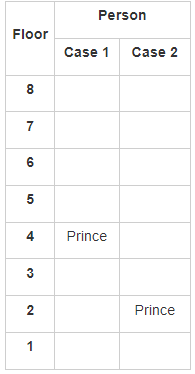
    2) Two-person live between the floor of Prince and Priya.

    3) The number of people who live above Priya is equal to the number of people who live below the floor of Rishu.
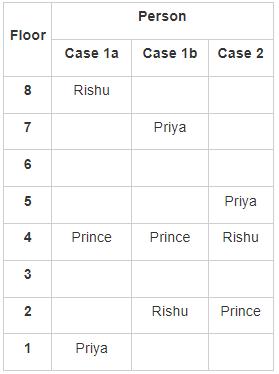
    4) Two-person lives between Rishu and Sneha.

    5) Ram lives immediately above the floor on which Sneha lives.
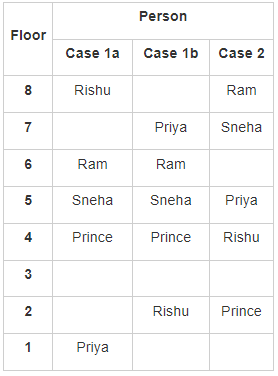
    6) Ram lives on one of the floors above Sriya and below the floor of Sunny. ( From here Case 2 gets eliminated as there is no place for Sunny above Ram).

    7) Sriya doesn't live on the bottom floor.

    8) Bhanu lives on an even-numbered floor.  ( From here Case 1b gets eliminated, as there is no even placed left for Bhanu in Case 1b).

    The final arrangement:
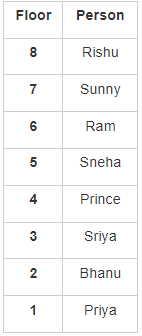
    Prince, Rishu, Ram, and Bhanu live on the even-number floors and Sriya lives on the odd-numbered floor. 

    Hence, Sriya does not belong to the group.

  • Question 2/10
    1 / -0.25

    Directions For Questions

    Direction: Study the following information carefully to answer the given questions.

    There are 8 persons Prince, Priya, Rishu, Sneha, Bhanu, Ram, Sriya, and Sunny, living in a building having 8 floors but not necessarily in the same order. The ground floor is numbered 1 and the floor above it is number 2 and so on. The topmost floor is numbered 8. Only one person lives on each floor.

    Two-person live between the floor of Prince and Priya.The number of people who live above Priya is equal to the number of people who live below the floor of Rishu. Bhanu lives on an even numbered floor. Prince lives on an even numbered floor below floor 5. Two person lives between Rishu and Sneha. Ram lives immediately above the floor on which Sneha lives. Ram lives on one of the floors above Sriya and below the floor of Sunny. Sriya doesn't live on the bottom floor.

    ...view full instructions


    which of the following statement is not correct?

    Solutions

    Persons: Prince, Priya, Rishu, Sneha, Bhanu, Ram, Sriya, and Sunny.

    1) Prince lives on an even-numbered floor below floor 5 ( This means Prince lives either on the 4th or 2nd floor).

    2) Two-person live between the floor of Prince and Priya.

    3) The number of people who live above Priya is equal to the number of people who live below the floor of Rishu.

    4) Two-person lives between Rishu and Sneha.

    5) Ram lives immediately above the floor on which Sneha lives.

    6) Ram lives on one of the floors above Sriya and below the floor of Sunny. ( From here Case 2 gets eliminated as there is no place for Sunny above Ram).

    7) Sriya doesn't live on the bottom floor.

    8) Bhanu lives on an even-numbered floor.  ( From here Case 1b gets eliminated, as there is no even placed left for Bhanu in Case 1b).

    The final arrangement:

    Hence, Ram lives on an odd number floor is not correct.

  • Question 3/10
    1 / -0.25

    In the question below are given three statements followed by three conclusions numbered I, II and III. You have to take the given statements to be true even if they seem to be at variance with commonly known facts. Read all the conclusions and then decide which of the given conclusions logically follows from the given statements disregarding commonly known facts.

    Statements:

    All Circles are Rectangle.

    Only Square are Triangle.

    Only a few Squares are Rectangle.

    Conclusions:

    I. All Rectangles can be Square.

    II. Some Circles are Square.

    III. No Triangle is Rectangle.

    Solutions

    The least possible Venn diagram for the given statements is as follows -

    Conclusions:

    I. All Rectangles can be Square. → True (Only a few Squares are Rectangles means Some Squares are Rectangles and Some Squares are not Rectangles. But it is possible that All Rectangles are Square. So, it follows.)

    II. Some Circles are Square. → False (It is possible but not definite as there is no direct relation given between them. So, it doesn't follow.)

    III. No Triangle is Rectangle. → True (Only Square are Triangle means All Triangles are Squares and Triangles cannot be related to any other element except Squares. So, it is definite that No Triangle is Rectangle. Hence, it follows.)

    Hence, the correct answer is Both I and III follow.

  • Question 4/10
    1 / -0.25

    In the question below are given three statements followed by three conclusions numbered I, II and III. You have to take the given statements to be true even if they seem to be at variance with commonly known facts. Read all the conclusions and then decide which of the given conclusions logically follows from the given statements disregarding commonly known facts.

    Statements:

    Some P are R.

    Only a few R are S.

    All S are T.

    Conclusions:

    I. All P can be S.

    II. All R can be T.

    III. All S can never be R.

    Solutions

    The least possible Venn diagram for the given statements is as follows -

    Conclusions:

    I. All P can be S. → True (As there is no direct relation given between them, it is possible that All P are S. Hence, it follows.)

    II. All R can be T. → True (As there is no negative relation given between them, it is possible that All R are T. Hence, it follows.

    III. All S can never be R. → False (All S can never be R means Some S are not R. Only a few R are S means Some R are S and Some R are not S because from R to S possibility of all will be true. But All S can be R. So, it doesn't follow.)

    Hence, the correct answer is Only I and II follow.

  • Question 5/10
    1 / -0.25

    In the question below there are three statements followed by three conclusions I, II & III. You have to take the given statements to be true even if they seem to be at variance from commonly known facts and then decide which of the given conclusions logically follows from the three statements disregarding commonly known facts.

    Statements:

    No shirt is a T-shirt.

    Some T-shirts are pants.

    Only a few pants are jeans.

    Conclusions:

    I. No jeans is a shirt.

    II. Some T-shirts being jeans is a possibility.

    III. All pants are T-shirts.

    Solutions

    The least possible Venn diagram is shown below.

    Conclusions:

    I. No jeans is a shirt → False (It is possible but not definite)

    II. Some T-shirts being jeans is a possibility → True (No direct relation between jeans and t-shirt is given so the possibility is true)

    III. All pants are T-shirts → False (It is possible but not definite)

    Hence, the correct answer is Only conclusion II follows.

  • Question 6/10
    1 / -0.25

    In the question below there are three statements followed by three conclusions I, II & III. You have to take the given statements to be true even if they seem to be at variance from commonly known facts and then decide which of the given conclusions logically follows from the three statements disregarding commonly known facts.

    Statements:

    All mobiles are tablets.

    Only a few tablets are laptops.

    No laptop is a keyboard.

    Conclusions:

    I. All keyboards can be tablets.

    II. All tablets can be laptops.

    III. Some mobiles being laptops is a possibility.

    Solutions

    The least possible Venn diagram is shown below.

    Conclusions:

    I. All keyboards can be tablets. → True (It is possible conclusion as Keyboard can be enclosed by tablet without contradicting the other statement)

    II. All tablets can be laptops. → False (Only a few tablets are laptops which means that some tablets are laptop and some tablets are not laptops hence all tablets cannot be inclosed by laptop as it will contradict the meaning "some tablets are not laptops")

    III. Some mobiles being laptops is a possibility. → True (It is possible as there is no direct relation given)

    Hence, the correct answer is both conclusion I and conclusion III follow.

  • Question 7/10
    1 / -0.25

    Directions For Questions

    Directions: Read the given information carefully and answer the following questions.

    There are eight persons in a family. A, B, C, D, E, F, G, and H in the family. There are three married couples in the family. Husband of C has two grandchildren. A is the brother-in-law of E. G is the granddaughter of H. B is the sister of A. F is the Aunt of D who is a male. E is the Son-in-law of C. B has only one child.

    ...view full instructions


    How is H related to F?

    Solutions

    We follow the given symbols to illustrate the relations:

    1) B is the sister of A. A is the brother-in-law of E. E is the Son-in-law of C. We come to know the gender of A, B, and E. But we have no information about C gender yet.

    2) Husband of C has two grandchildren. G is the granddaughter of H. F is the Aunt of D who is a male. B has only one child.

    Hence, H is the Father-in-law of F.

  • Question 8/10
    1 / -0.25

    Directions For Questions

    Directions: Read the given information carefully and answer the following questions.

    There are eight persons in a family. A, B, C, D, E, F, G, and H in the family. There are three married couples in the family. Husband of C has two grandchildren. A is the brother-in-law of E. G is the granddaughter of H. B is the sister of A. F is the Aunt of D who is a male. E is the Son-in-law of C. B has only one child.

    ...view full instructions


    How is B related to G?

    Solutions

    We follow the given symbols to illustrate the relations:

    1) B is the sister of A. A is the brother-in-law of E. E is the Son-in-law of C. We come to know the gender of A, B, and E. But we have no information about C gender yet.

    2) Husband of C has two grandchildren. G is the granddaughter of H. F is the Aunt of D who is a male. B has only one child.

    Hence, B is the Aunt of G.

  • Question 9/10
    1 / -0.25

    Directions For Questions

    Directions: Study the information below carefully and answer the following questions.

    Eight persons Mano, Nisha, Ovya, Pami, Jamu, Kavi, Guna, and Hari are sitting around a rectangular table – 2 persons on each side. The persons who are sitting on the longer side are facing inside and the persons who are sitting on the smaller side are facing outside. Ovya is sitting 2nd to the right of Kavi who is sitting opposite to the one who is an immediate neighbour of Hari who sits on the smaller side of the table. Pami sits immediate left of Nisha and vice versa. Guna faces one of the immediate neighbours of Mano. Jamu neither sits opposite to Nisha nor sits on the smaller side of the table. Ovya is not an immediate neighbour of Mano.

    ...view full instructions


    Which of the following is true?

    Solutions

    Persons: Mano, Nisha, Ovya, Pami, Jamu, Kavi, Guna, and Hari

    1. Ovya is sitting 2nd to the right of Kavi who is sitting opposite to the one who is an immediate neighbour of Hari who sits on the smaller side of the table.

    2. Pami sits immediate left of Nisha and vice versa. So, Case 3 is eliminated.

    3. Guna faces one of the immediate neighbours of Mano.

    4. Ovya is not an immediate neighbour of Mano.

    5. Jamu neither sits opposite to Nisha nor sits on the smaller side of the table. So, Case 2 and Case 1a is eliminated.

    The final arrangement is,

    Thus, Guna sits to the immediate right of Hari is true.

  • Question 10/10
    1 / -0.25

    Directions For Questions

    Directions: Read the given information carefully and answer the following questions.

    There are eight persons in a family. A, B, C, D, E, F, G, and H in the family. There are three married couples in the family. Husband of C has two grandchildren. A is the brother-in-law of E. G is the granddaughter of H. B is the sister of A. F is the Aunt of D who is a male. E is the Son-in-law of C. B has only one child.

    ...view full instructions


    Which of the following statement is correct?

    Solutions

    We follow the given symbols to illustrate the relations:

    1) B is the sister of A. A is the brother-in-law of E. E is the Son-in-law of C. We come to know the gender of A, B, and E. But we have no information about C gender yet.

    2) Husband of C has two grandchildren. G is the granddaughter of H. F is the Aunt of D who is a male. B has only one child.

    Hence, B is the wife of E is the correct statement.

Close button icon
User Profile
-

Correct (-)

Wrong (-)

Skipped (-)


  • 1
  • 2
  • 3
  • 4
  • 5
  • 6
  • 7
  • 8
  • 9
  • 10
Mockers logo Get latest Exam Updates
& Study Material Alerts!
No, Thanks
Arrow pointer icon
Click on Allow to receive notifications
Notification bell icon ×
Open Now
