Please wait...

IBPS Clerk 2024 Reasoning Test - 6
Menu grid icon
Result Result point icon
IBPS Clerk 2024 Reasoning Test - 6
  • Goals icon

    /

    Score
  • Trophy icon

    -

    Rank
White alarm icon Time Taken: -
Result frame illustration
  • Question 1/10
    1 / -0.25

    Directions For Questions

    Directions: Study the following information carefully to answer the given questions.

    There are 8 friends Shalu, Annu, Neha, Komal, Preeti, Gunjan, Chinu and Radha. They all are going for a party and sitting in a circular table facing inside but not necessarily in the same order.

    Only one people sit between Radha and Preeti. Neha is immediate left of Preeti. Chinu is 3rd to the right of Komal. Only one person sit between Radha and Chinu. Gunjan is immediate left of Chinu. Annu is immediate right of Chinu and immediate left of Radha.

    ...view full instructions


    Where Gunjan is sitting with respect to Radha?

    Solutions

    Eight People - Shalu, Annu, Neha, Komal, Preeti, Gunjan, Chinu and Radha. All are facing inside.

    1) Only 1 person sit between Radha and Preeti.

    2) Neha is immediate left of Preeti.

    3) Only one person sit between Radha and Chinu.

    4) Gunjan is immediate left of Chinu.

    5) Chinu is 3rd to the right of Komal.

    6) Annu is the immediate right of Chinu and the immediate left of Radha. 

    (Case II is eliminated because Komal is sitting immediate left of Radha)

    7) There is only one place left so Shalu is sitting Between Komal and Gunjan.

    Final Solution:

    Hence, Gunjan is sitting to the left of Radha.

  • Question 2/10
    1 / -0.25

    Directions For Questions

    Directions: Study the following information carefully to answer the given questions.

    There are 8 friends Shalu, Annu, Neha, Komal, Preeti, Gunjan, Chinu and Radha. They all are going for a party and sitting in a circular table facing inside but not necessarily in the same order.

    Only one people sit between Radha and Preeti. Neha is immediate left of Preeti. Chinu is 3rd to the right of Komal. Only one person sit between Radha and Chinu. Gunjan is immediate left of Chinu. Annu is immediate right of Chinu and immediate left of Radha.

    ...view full instructions


    Who is sitting fourth to right of Neha?

    Solutions

    Eight People - Shalu, Annu, Neha, Komal, Preeti, Gunjan, Chinu and Radha. All are facing inside.

    1) Only 1 person sit between Radha and Preeti.

    2) Neha is immediate left of Preeti.

    3) Only one person sit between Radha and Chinu.

    4) Gunjan is immediate left of Chinu.

    5) Chinu is 3rd to the right of Komal.

    6) Annu is the immediate right of Chinu and the immediate left of Radha. 

    (Case II is eliminated because Komal is sitting immediate left of Radha)

    7) There is only one place left so Shalu is sitting Between Komal and Gunjan.

    Final Solution:

    Hence, Gunjan is sitting fourth to the right of Neha.

  • Question 3/10
    1 / -0.25

    Directions For Questions

    Directions: Study the following information carefully to answer the given questions.

    There are 8 friends Shalu, Annu, Neha, Komal, Preeti, Gunjan, Chinu and Radha. They all are going for a party and sitting in a circular table facing inside but not necessarily in the same order.

    Only one people sit between Radha and Preeti. Neha is immediate left of Preeti. Chinu is 3rd to the right of Komal. Only one person sit between Radha and Chinu. Gunjan is immediate left of Chinu. Annu is immediate right of Chinu and immediate left of Radha. 

    ...view full instructions


    How many persons are sitting between Chinu and Shalu when counting from left of Chinu?

    Solutions

    Eight People - Shalu, Annu, Neha, Komal, Preeti, Gunjan, Chinu and Radha. All are facing inside.

    1) Only 1 person sit between Radha and Preeti.

    2) Neha is immediate left of Preeti.

    3) Only one person sit between Radha and Chinu.

    4) Gunjan is immediate left of Chinu.

    5) Chinu is 3rd to the right of Komal.

    6) Annu is the immediate right of Chinu and the immediate left of Radha. 

    (Case II is eliminated because Komal is sitting immediate left of Radha)

    7) There is only one place left so Shalu is sitting Between Komal and Gunjan.

    Final Solution:

    Hence, 1 person is sitting between Chinu and Shalu.

  • Question 4/10
    1 / -0.25

    The following questions are based on the five three-digit numbers given below.

    672 354 927 453 835

    If the first and second digits of each of the numbers are added the resulting sum of which of the following numbers will be exactly divisible by 4?

    Solutions

    Given series: 672 354 927 453 835

    On adding first and second digits:

    672 → 13

    354 → 8

    927 → 11

    453 → 9

    835 → 11

    Here only 8 is divisible by 4.

    Hence, answer is 354.

  • Question 5/10
    1 / -0.25

    The following questions are based on the five three-digit numbers given below.

    672 354 927 453 835

    If the positions of the first and the second digit within each number are interchanged, which of the following will be the second lowest number?

    Solutions

    Given series: 672 354 927 453 835

    Interchanging first and the second digit: 762 534 297 543 385

    So, 385 is the second-lowest number which came from 835.

  • Question 6/10
    1 / -0.25

    The following questions are based on the five three-digit numbers given below.

    672 354 927 453 835

    If 2 is added to the last digit of each number and then the positions of the first and the second digits are interchanged, which of the following will be the lowest number?

    Solutions

    Given series: 672 354 927 453 835

    Adding 2 to the last digit: 674 356 929 455 837

    Interchanging first and the second digit: 764 536 299 545 387

    So, 299 is the lowest number which came from 927.

  • Question 7/10
    1 / -0.25

    Directions For Questions

    Directions: Study the following information and answer the given questions.

    Six persons (F, G, P, Y, T and Q) bought different number of units 12, 15, 17, 10, 19 and 13 of three items viz. bags, watches and masks. Each item has been bought by at least one person and at most two persons. G bought 12 bags. P bought four more unit than that of Y, who does not buy watches. Q and P bought same item. One person bought 10 watches. Neither P nor Y bought bags. T bought 15 units. Y and F bought same item. Nobody bought 15 masks or watches.

    ...view full instructions


    ___ has bought ___ Watches.

    Solutions

    Six persons: F, G, P, Y, T, Q

    Number of units: 12, 15, 17, 10, 19, 13

    Three items: Bags, Watches, Masks

    1) G bought 12 bags.

    2) P bought four more units than that of Y, who does not buy watches.

    3) Q and P bought the same item.
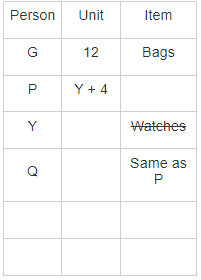
    4) One person bought 10 watches.

    5) Neither P nor Y bought bags.

    6) T bought 15 units.
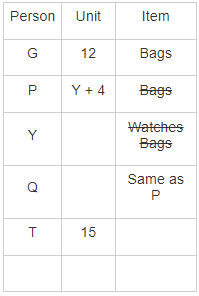
    6) Y and F bought the same item.

    7) Nobody bought 15 masks or watches.
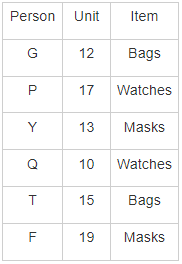
    So, the above is the final arrangement.

    Hence, Q has bought 10 watches.

  • Question 8/10
    1 / -0.25

    Directions For Questions

    Directions: Study the following information and answer the given questions.

    Six persons (F, G, P, Y, T and Q) bought different number of units 12, 15, 17, 10, 19 and 13 of three items viz. bags, watches and masks. Each item has been bought by at least one person and at most two persons. G bought 12 bags. P bought four more unit than that of Y, who does not buy watches. Q and P bought same item. One person bought 10 watches. Neither P nor Y bought bags. T bought 15 units. Y and F bought same item. Nobody bought 15 masks or watches.

    ...view full instructions


    Who has bought maximum number of units?

    Solutions

    Six persons: F, G, P, Y, T, Q

    Number of units: 12, 15, 17, 10, 19, 13

    Three items: Bags, Watches, Masks

    1) G bought 12 bags.

    2) P bought four more units than that of Y, who does not buy watches.

    3) Q and P bought the same item.

    4) One person bought 10 watches.

    5) Neither P nor Y bought bags.

    6) T bought 15 units.

    6) Y and F bought the same item.

    7) Nobody bought 15 masks or watches.

    So, the above is the final arrangement.

    Hence, F has bought the maximum number of units.

  • Question 9/10
    1 / -0.25

    Directions For Questions

    Directions: Study the following information and answer the given questions.

    Six persons (F, G, P, Y, T and Q) bought different number of units 12, 15, 17, 10, 19 and 13 of three items viz. bags, watches and masks. Each item has been bought by at least one person and at most two persons. G bought 12 bags. P bought four more unit than that of Y, who does not buy watches. Q and P bought same item. One person bought 10 watches. Neither P nor Y bought bags. T bought 15 units. Y and F bought same item. Nobody bought 15 masks or watches.

    ...view full instructions


    Who has bought Bags?

    Solutions

    Six persons: F, G, P, Y, T, Q

    Number of units: 12, 15, 17, 10, 19, 13

    Three items: Bags, Watches, Masks

    1) G bought 12 bags.

    2) P bought four more units than that of Y, who does not buy watches.

    3) Q and P bought the same item.

    4) One person bought 10 watches.

    5) Neither P nor Y bought bags.

    6) T bought 15 units.

    6) Y and F bought the same item.

    7) Nobody bought 15 masks or watches.

    So, the above is the final arrangement.

    Hence, The one who has bought 12 units (G), has bought bags.

  • Question 10/10
    1 / -0.25

    Directions For Questions

    Directions: Study the following information and answer the given questions.

    Six persons (F, G, P, Y, T and Q) bought different number of units 12, 15, 17, 10, 19 and 13 of three items viz. bags, watches and masks. Each item has been bought by at least one person and at most two persons. G bought 12 bags. P bought four more unit than that of Y, who does not buy watches. Q and P bought same item. One person bought 10 watches. Neither P nor Y bought bags. T bought 15 units. Y and F bought same item. Nobody bought 15 masks or watches.

    ...view full instructions


    Find odd one.

    Solutions

    Six persons: F, G, P, Y, T, Q

    Number of units: 12, 15, 17, 10, 19, 13

    Three items: Bags, Watches, Masks

    1) G bought 12 bags.

    2) P bought four more units than that of Y, who does not buy watches.

    3) Q and P bought the same item.

    4) One person bought 10 watches.

    5) Neither P nor Y bought bags.

    6) T bought 15 units.

    6) Y and F bought the same item.

    7) Nobody bought 15 masks or watches.

    So, the above is the final arrangement.

    Hence, Y : 17 is odd here.

Close button icon
User Profile
-

Correct (-)

Wrong (-)

Skipped (-)


  • 1
  • 2
  • 3
  • 4
  • 5
  • 6
  • 7
  • 8
  • 9
  • 10
Mockers logo Get latest Exam Updates
& Study Material Alerts!
No, Thanks
Arrow pointer icon
Click on Allow to receive notifications
Notification bell icon ×
Open Now
