Please wait...

Reasoning Test 177
Menu grid icon
Result Result point icon
Reasoning Test 177
  • Goals icon

    /

    Score
  • Trophy icon

    -

    Rank
White alarm icon Time Taken: -
Result frame illustration
  • Question 1/10
    1 / -0.33

    Select the correct mirror image of the given combination when the mirror is placed at MN as shown below.

    Solutions

    The mirror image of the given figure is shown below,

    Hence, the correct answer is "Option 2".


  • Question 2/10
    1 / -0.33

    Today is Megha's birthday. One year from now, she will be twice as old as she was eight years ago. How old is Megha today?

    Solutions

    Let Megha's present age be 'x'.

    Megha's age after one year = (x + 1)

    Megha's age before before 8 years = (x - 8)

    According to the question:

    (x + 1) = 2 (x - 8)

    ⇒ x + 1 = 2x - 16

    ⇒ x = 17

    Therefore, Megha's present age will be 17 years.

    Hence, the correct answer is "Option (2)".


  • Question 3/10
    1 / -0.33

    Select the option that represents the combination of letter that, when sequentially placed from left to right in the blanks below, will complete the letter-series.

    _cdd_dd_ddc_

    Solutions

    The logic followed here is:

    Given Sequence: _cdd_dd_ddc_

    Now, putting the letters in the blank spaces given in the option one by one:

    Option 1) dccd → dcd / dcd / dcd / dcd

    Here, 'Option 1' followed a pattern.

    Option 2) cddc → ccd / ddd / ddd / dcc

    Option 3) cdcd→ ccd / ddd / dcd / dcd

    Option 4) dcdc → dcd / dcd / ddd / dcc

    Hence, the correct answer is "Option 1".


  • Question 4/10
    1 / -0.33

    Three statements are given followed by three conclusions numbered 1, 2 and 3. Assuming the statements to be true, even if they seem to be at variance with commonly known facts, decide which of the conclusions logically follow(s) from the statements.

    Statements:

    1. All cottons are silks.

    2. All silks are wools.

    3. All wools are jutes.

    Conclusions:

    1. Some jutes are silks.

    2. Some wools are cottons.

    3. Some jutes are cottons.

    Solutions

    Given Statements:

    1. All cottons are silks.

    2. All silks are wools.

    3. All wools are jutes.

    The least possible Venn diagram for the given statement is:
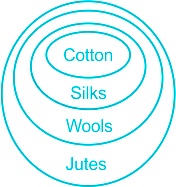
    Conclusions:

    I. Some jutes are silks - True (Because, All silks are wools and All wools are jutes, so Some jutes are silks will be definitely true).

    II. Some wools are cottons - True (Because, All cottons are silks and All silks are wools, so Some wools are cottons will be definitely true).

    III. Some jutes are cottons - True (Because, All silks are wools, All wools are jutes and All wools are jutes, so Some jutes are cottons will be definitely true).

    So, All conclusions 1, 2 and 3 follow.

    Hence, the correct answer is "Option 3".


  • Question 5/10
    1 / -0.33

    Consider the statement and the following statements and decide which of the arguments are strong with respect to the statement.

    Statement:

    The government should work to popularize the medicines available in alternative medicine for cancer treatment.

    Argument:

    I. Yes, if medicines are available, people should be aware of it and the government is responsible for creating awareness for this treatment.

    II. No, those affected will approach alternative medicine centers if necessary.

    Solutions

    The statement highlights the need to popularize alternative medicines for cancer treatment.

    • It is reasonable to expect that the government should take responsibility to spread awareness about available alternative cancer treatments. Ensuring the outreach of adequate and appropriate healthcare facilities to the citizens is one of the primary responsibilities of a government. Thus, argument I is strong.
    • If the affected people aren't aware of the availability of alternative medicines, they won't be able to approach such centers. Thus, argument II does not hold strong. 

    Hence the correct answer is option 2.


  • Question 6/10
    1 / -0.33

    In each question below are given two events (A) and (B). These statements can be either independent causes or they can be effects of independent causes. One of these statements can be an effect of the other statement. Read both the statements and decide which of the following answer choices best represents the relationship between the two statements:

    A) The Supreme Court has set a time limit for the verification of documents.

    B) The Recruitment Agency is working on urgent basis.

    Solutions

    Event A: The Supreme Court has set a time limit for the verification of documents.

    Event B: The Recruitment Agency is working on urgent basis.

    The Recruitment Agency is working on urgent basis because The Supreme Court has set a time limit for the verification of documents.

    Clearly, Event (A) is the cause and event (B) is its effect.

    Hence, The correct answer is "Option (2)"


  • Question 7/10
    1 / -0.33

    Select the triad in which the numbers are related in the same way as are the numbers of the following triads.

    14 - 15 - 145

    12 - 27 - 195

    (NOTE: Operations should be performed on the whole numbers, without breaking down the numbers into its constituent digits. E.g. 13 - Operations on 13 such as adding subtracting/multiplying etc. to 13 can be performed. Breaking down 13 into 1 and 3 and then performing mathematical operations on 1 and 3 is not allowed)

    Solutions

    The logic followed here is:

    Logic: (1st number + 2nd number) × 5 = 3rd number.

    Given,

    14 - 15 - 145

    ⇒ (14 + 15) × 5

    ⇒ 29 × 5 = 145.

    And, 12 - 27 - 195

    ⇒ (12 + 27) × 5

    ⇒ 39 × 5 = 195.

    Similarly, for Option 2: 17 - 31 - 240

    ⇒ (17 + 31) × 5

    ⇒ 48 × 5 = 240.

     Hence, the correct option is "Option 2".

  • Question 8/10
    1 / -0.33

    Seven boxes W, X, Y, Z, A, B and C are kept in a stack from top to bottom but not necessarily in the same order. Box Z is kept four boxes above box C which is kept at the third position from the bottom. There are three boxes between box A and box X. Box X is kept at the bottommost position and is below box A. Box W is not kept adjacent to box X. Box Y is kept below box W. Box B is not placed at any position above C. How many boxes are kept below box B?

    Solutions

    Given :

    • Seven boxes - H, I, J, K, L, M and N
    • They are kept in a stack from top to bottom.

    ​Explanation :

    1) Box Z is kept four boxes above box C which is kept at the third position from the bottom.

    Box
    Z


    C


    2) There are three boxes between box A and box X.

    3) Box X is kept at the bottommost position and is below box A.

    Box
    Case -1
    Z
     
    A
     
    C
     
    X

    4) Box W is not kept adjacent to box X.

    5) Box Y is kept below box W.

    6) Box B is not placed at any position above C.

    Box
    Case -1
    Z
    W
    A
    Y
    C
    B
    X

    Thus, according to final arrangement there are five boxes kept below box B.

    Hence, "one" is the correct answer.


  • Question 9/10
    1 / -0.33

    Select the term that will come in place of the question mark (?) in the given series and logically complete the series?

    D6W, G7T, M11N, V20E, ?

    Solutions

    According to the English alphabets and their positional values:

    Hence, the correct answer is "Option 1".


  • Question 10/10
    1 / -0.33

    In a certain code language,

    P # Q means P is the wife of Q,

    P - Q means P is the mother of Q,

    P + Q means P is the father of Q,

    P & Q means P is the son of Q.

    Based on the above, how is E related to L in C # D + E # G + L?

    Solutions

    Preparing the family tree diagram by using the following symbols:

    As per the given information:

    P is

    Symbol

    #

    -

    +

    &

    Means

    Wife

    Mother

    Father

    Son

    of Q

    Given expression: 'C # D + E # G + L'

    C is the wife of D, D is the father of E, E is the wife of G and G is the father of L.

    Here, E is the mother of L.

    Hence, the correct answer is "Option (1)".


Close button icon
User Profile
-

Correct (-)

Wrong (-)

Skipped (-)


  • 1
  • 2
  • 3
  • 4
  • 5
  • 6
  • 7
  • 8
  • 9
  • 10
Mockers logo Get latest Exam Updates
& Study Material Alerts!
No, Thanks
Arrow pointer icon
Click on Allow to receive notifications
Notification bell icon ×
Open Now
