Please wait...

IBPS RRB OS-1 2024 Reasoning Test - 14
Menu grid icon
Result Result point icon
IBPS RRB OS-1 2024 Reasoning Test - 14
  • Goals icon

    /

    Score
  • Trophy icon

    -

    Rank
White alarm icon Time Taken: -
Result frame illustration
  • Question 1/10
    1 / -0

    Directions For Questions

    Direction: Read the given information carefully and answer the following questions:

    Nine persons A, B, C, D, E, F, G, H, and I had celebrated their birthdays in different months of the same year which are January, February, March, April, May, June, July, August, September but not necessarily in the same order.

    F celebrates his birthday in the month which has 30 days but before June. Three persons celebrate birthday between F and E. E is exactly between G and C, and G is not the last person to celebrate birthday. B is the first person to celebrate birthday. Two persons celebrate birthday between A and H, and  A is not an immediate neighbour of B, but he celebrates his birthday in the month which has 31 days. Two persons are there between D and I and D celebrates birthday before I. I is not celebrating after H.

    ...view full instructions


    How many persons celebrates birthday between the one who is immediately after B and immediately before C?

    Solutions

    Given: Nine persons A, B, C, D, E, F, G, H, and I 

    Celebrated their birthdays in different months of the same year which are January, February, March, April, May, June, July, August, September.

    January, March, May, July and August being the months having 31 days.

    1) F celebrates his birthday in the month which has 30 days but before June.

    2) Three persons celebrate birthday between F and E. E is exactly between G and C, and G is not the last person to celebrate birthday.

    3) B is the first person to celebrate birthday.
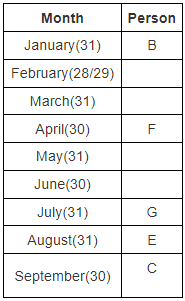
    4) Two persons celebrate birthday between A and H, and  A is not an immediate neighbour of B, but he celebrates his birthday in the month which has 31 days.
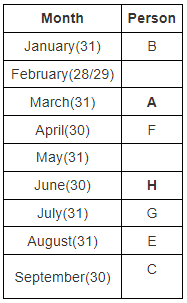
    5) Two persons are there between D and I and D celebrates birthday before I. I is not celebrating after H.

    Thus, the person immediately after B is D and person immediately before C is E, and there are five people between D and E.

    Hence, the correct answer is "five".

  • Question 2/10
    1 / -0

    Directions For Questions

    Direction: Read the given information carefully and answer the following questions:

    Nine persons A, B, C, D, E, F, G, H, and I had celebrated their birthdays in different months of the same year which are January, February, March, April, May, June, July, August, September but not necessarily in the same order.

    F celebrates his birthday in the month which has 30 days but before June. Three persons celebrate birthday between F and E. E is exactly between G and C, and G is not the last person to celebrate birthday. B is the first person to celebrate birthday. Two persons celebrate birthday between A and H, and  A is not an immediate neighbour of B, but he celebrates his birthday in the month which has 31 days. Two persons are there between D and I and D celebrates birthday before I. I is not celebrating after H.
    ...view full instructions


    Who among the following celebrates his birthday two months after I's birthday celebration?

    Solutions

    Given: Nine persons A, B, C, D, E, F, G, H, and I 

    Celebrated their birthdays in different months of the same year which are January, February, March, April, May, June, July, August, September.

    January, March, May, July and August being the months having 31 days.

    1) F celebrates his birthday in the month which has 30 days but before June.

    2) Three persons celebrate birthday between F and E. E is exactly between G and C, and G is not the last person to celebrate birthday.

    3) B is the first person to celebrate birthday.

    4) Two persons celebrate birthday between A and H, and  A is not an immediate neighbour of B, but he celebrates his birthday in the month which has 31 days.

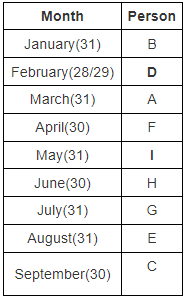
    5) Two persons are there between D and I and D celebrates birthday before I. I is not celebrating after H.

    Thus, G celebrates his birthday two months after the celebration of I.

    Hence, the correct answer is "G".

  • Question 3/10
    1 / -0

    How many such pairs of letters are there in the word 'TECHNIQUE' which has as many letters between them as in the English alphabetical order (both forward and backward)?

    Solutions

    Given word:- TECHNIQUE

    Forward Pair - EI

    Backward Pair - No such pair.

    Thus, there is only one such pair of letters in the word “TECHNIQUE” which has as many letters between them as in the English alphabetical series (both in forward and backward directions).

    Hence, the correct answer is One.

  • Question 4/10
    1 / -0

    If the even digits of the number ‘82357947’ are divided by 2 and the odd digits are decreased by 3, then what will be the sum of the third digit from the left and the seventh digit from the right?

    Solutions

    Given number: 82357947

    Third digit from the left = 0

    Seventh digit from the right = 1

    Required sum = 0 + 1 = 1

    Hence, 1 is the correct answer.

  • Question 5/10
    1 / -0

    Directions For Questions

    Direction: Study the following information carefully and answer the questions given below:

    Twelve persons are sitting on the two parallel rows and opposite to each other. In Row 1 A, B, C. D. E, and F are sitting and facing south. In Row 2 P, Q, R, S, T and U are sitting and facing north but not necessarily in the same order.

    R is sitting third to the left of T. At least one person is sitting to the right of T. The one who is sitting opposite to R is sitting second to the right of E. Only one person is sitting between E and C. The number of persons sitting to the left of C is the same as the number of persons sitting to the right of B. A is sitting second to the left of B. S is sitting third to the right of U. Neither U nor P is sitting opposite to B. F is sitting to the right of D who is not sitting opposite to S.

    ...view full instructions


    In which of the following statements the first person is sitting exactly between the second and third person in the final arrangement?

    I. BFA

    II. PTS

    III. AFE

    Solutions

    Given:

    Row 1 - A, B, C. D. E, and F - Facing south.

    Row 2 - P, Q, R, S, T, and U - Facing north.

    Now,

    1) R is sitting third to the left of T.

    2) At least one person is sitting to the right of T. 

    3) The one who is sitting opposite to R is sitting second to the right of E.

    3) Only one person is sitting between E and C.

    4) The number of persons sitting to the left of C is the same as the number of persons sitting to the right of B.

    5) A is sitting second to the left of B. This is not possible in Case I (a) and Case II (a) so they get eliminated.

    6) S is sitting third to the right of U.

    7) Neither U nor P is sitting opposite to B. This condition is not satisfied in Case I (b) (i) and Case II (b) (i) so they get canceled.

    7) F is sitting to the right of D who is not sitting opposite to S. This is not possible in Case I (b) (iI) so it gets eliminated.

    The final arrangement is -

    Only in AFE, the first person A is sitting exactly between the second and third person i.e. E and F in the final arrangement.

    Hence, the correct answer is Only III.

  • Question 6/10
    1 / -0

    Directions For Questions

    Direction: Study the following information carefully and answer the questions given below:

    Twelve persons are sitting on the two parallel rows and opposite to each other. In Row 1 A, B, C. D. E, and F are sitting and facing south. In Row 2 P, Q, R, S, T and U are sitting and facing north but not necessarily in the same order.

    R is sitting third to the left of T. At least one person is sitting to the right of T. The one who is sitting opposite to R is sitting second to the right of E. Only one person is sitting between E and C. The number of persons sitting to the left of C is the same as the number of persons sitting to the right of B. A is sitting second to the left of B. S is sitting third to the right of U. Neither U nor P is sitting opposite to B. F is sitting to the right of D who is not sitting opposite to S.

    ...view full instructions


    Four of the five among the following are similar in such a way to form a group, who among the following doesn't belong to the group?

    Solutions

    Given:

    Row 1 - A, B, C. D. E, and F - Facing south.

    Row 2 - P, Q, R, S, T, and U - Facing north.

    Now,

    1) R is sitting third to the left of T.

    2) At least one person is sitting to the right of T. 

    3) The one who is sitting opposite to R is sitting second to the right of E.

    3) Only one person is sitting between E and C.

    4) The number of persons sitting to the left of C is the same as the number of persons sitting to the right of B.

    5) A is sitting second to the left of B. This is not possible in Case I (a) and Case II (a) so they get eliminated.

    6) S is sitting third to the right of U.

    7) Neither U nor P is sitting opposite to B. This condition is not satisfied in Case I (b) (i) and Case II (b) (i) so they get canceled.

    7) F is sitting to the right of D who is not sitting opposite to S. This is not possible in Case I (b) (iI) so it gets eliminated.

    The final arrangement is -

    All except QT have one person between them.

    Hence, the correct answer is QT.

  • Question 7/10
    1 / -0

    Directions For Questions

    Direction: Study the following information carefully and answer the questions given below:

    Twelve persons are sitting on the two parallel rows and opposite to each other. In Row 1 A, B, C. D. E, and F are sitting and facing south. In Row 2 P, Q, R, S, T and U are sitting and facing north but not necessarily in the same order.

    R is sitting third to the left of T. At least one person is sitting to the right of T. The one who is sitting opposite to R is sitting second to the right of E. Only one person is sitting between E and C. The number of persons sitting to the left of C is the same as the number of persons sitting to the right of B. A is sitting second to the left of B. S is sitting third to the right of U. Neither U nor P is sitting opposite to B. F is sitting to the right of D who is not sitting opposite to S.

    ...view full instructions


    Who among the following is sitting second to the left of A?

    Solutions

    Given:

    Row 1 - A, B, C. D. E, and F - Facing south.

    Row 2 - P, Q, R, S, T, and U - Facing north.

    Now,

    1) R is sitting third to the left of T.

    2) At least one person is sitting to the right of T. 

    3) The one who is sitting opposite to R is sitting second to the right of E.

    3) Only one person is sitting between E and C.

    4) The number of persons sitting to the left of C is the same as the number of persons sitting to the right of B.

    5) A is sitting second to the left of B. This is not possible in Case I (a) and Case II (a) so they get eliminated.

    6) S is sitting third to the right of U.

    7) Neither U nor P is sitting opposite to B. This condition is not satisfied in Case I (b) (i) and Case II (b) (i) so they get canceled.

    7) F is sitting to the right of D who is not sitting opposite to S. This is not possible in Case I (b) (iI) so it gets eliminated.

    The final arrangement is -

    D, who is sitting immediate left of E, is sitting second to the left of A.

    Hence, the correct answer is The one who is sitting immediate left of E.

  • Question 8/10
    1 / -0

    Directions For Questions

    Direction: Study the following information carefully and answer the questions given below:

    Twelve persons are sitting on the two parallel rows and opposite to each other. In Row 1 A, B, C. D. E, and F are sitting and facing south. In Row 2 P, Q, R, S, T and U are sitting and facing north but not necessarily in the same order.

    R is sitting third to the left of T. At least one person is sitting to the right of T. The one who is sitting opposite to R is sitting second to the right of E. Only one person is sitting between E and C. The number of persons sitting to the left of C is the same as the number of persons sitting to the right of B. A is sitting second to the left of B. S is sitting third to the right of U. Neither U nor P is sitting opposite to B. F is sitting to the right of D who is not sitting opposite to S.

    ...view full instructions


    Which of the following statement/s is/are false?

    I. Only one person is sitting between R and P.

    II. T is sitting immediate left of S.

    III. B and S are diagonally opposite to each other.

    Solutions

    Given:

    Row 1 - A, B, C. D. E, and F - Facing south.

    Row 2 - P, Q, R, S, T, and U - Facing north.

    Now,

    1) R is sitting third to the left of T.

    2) At least one person is sitting to the right of T. 

    3) The one who is sitting opposite to R is sitting second to the right of E.

    3) Only one person is sitting between E and C.

    4) The number of persons sitting to the left of C is the same as the number of persons sitting to the right of B.

    5) A is sitting second to the left of B. This is not possible in Case I (a) and Case II (a) so they get eliminated.

    6) S is sitting third to the right of U.

    7) Neither U nor P is sitting opposite to B. This condition is not satisfied in Case I (b) (i) and Case II (b) (i) so they get canceled.

    7) F is sitting to the right of D who is not sitting opposite to S. This is not possible in Case I (b) (iI) so it gets eliminated.

    The final arrangement is -

    All the given statements are true.

    Hence, the correct answer is None of the statements is false.

  • Question 9/10
    1 / -0

    Directions For Questions

    Direction: Study the following information carefully and answer the questions given below:

    Twelve persons are sitting on the two parallel rows and opposite to each other. In Row 1 A, B, C. D. E, and F are sitting and facing south. In Row 2 P, Q, R, S, T and U are sitting and facing north but not necessarily in the same order.

    R is sitting third to the left of T. At least one person is sitting to the right of T. The one who is sitting opposite to R is sitting second to the right of E. Only one person is sitting between E and C. The number of persons sitting to the left of C is the same as the number of persons sitting to the right of B. A is sitting second to the left of B. S is sitting third to the right of U. Neither U nor P is sitting opposite to B. F is sitting to the right of D who is not sitting opposite to S.

    ...view full instructions


    How many persons are sitting between B and the one who sits opposite to T?

    Solutions

    Given:

    Row 1 - A, B, C. D. E, and F - Facing south.

    Row 2 - P, Q, R, S, T, and U - Facing north.

    Now,

    1) R is sitting third to the left of T.

    2) At least one person is sitting to the right of T. 

    3) The one who is sitting opposite to R is sitting second to the right of E.

    3) Only one person is sitting between E and C.

    4) The number of persons sitting to the left of C is the same as the number of persons sitting to the right of B.

    5) A is sitting second to the left of B. This is not possible in Case I (a) and Case II (a) so they get eliminated.

    6) S is sitting third to the right of U.

    7) Neither U nor P is sitting opposite to B. This condition is not satisfied in Case I (b) (i) and Case II (b) (i) so they get canceled.

    7) F is sitting to the right of D who is not sitting opposite to S. This is not possible in Case I (b) (iI) so it gets eliminated.

    The final arrangement is -

    Three persons are sitting between B and D who sits opposite to T.

    Hence, the correct answer is Three.

  • Question 10/10
    1 / -0

    Four of the following five are alike in a certain way and so form a group. Which is the one that does not belong to that group?

    Solutions

    The pattern followed here is;

    As per the English alphabetical series,

    C + 4 = G; G + 3 = J; J - 2 = H,

    L + 4 = P; P + 2 = R; R - 1 = Q,

    P + 4 = T; T + 3 = W; W - 2 = U,

    K + 4 = O; O + 3 = R; R - 2 = P,

    I + 4 = M; M + 3 = P; P - 2 = N

    Hence, 'LPRQ' is the odd one out.

Close button icon
User Profile
-

Correct (-)

Wrong (-)

Skipped (-)


  • 1
  • 2
  • 3
  • 4
  • 5
  • 6
  • 7
  • 8
  • 9
  • 10
Mockers logo Get latest Exam Updates
& Study Material Alerts!
No, Thanks
Arrow pointer icon
Click on Allow to receive notifications
Notification bell icon ×
Open Now
