Please wait...

SSC CGL 2024 Aptitude Test - 7
Menu grid icon
Result Result point icon
SSC CGL 2024 Aptitude Test - 7
  • Goals icon

    /

    Score
  • Trophy icon

    -

    Rank
White alarm icon Time Taken: -
Result frame illustration
  • Question 1/10
    2 / -0.5

    If (cos2θ –1)(1 + tan2θ) + 2tan2θ = 1, 0° ≤ θ ≤ 90° then θ is:

    Solutions

    (cos2θ –1)(1 + tan2θ) + 2tan2θ = 1

    ⇒ (-sin2 θ) sec2 θ + 2 tan2 θ = 1

    ⇒ (-sin2 θ/cos2 θ) + 2 tan2 θ = 1

    ⇒ (-tan2 θ) + 2 tan2 θ = 1

    ⇒ tan2 θ = 1

    ⇒ tan θ = 1

    And 0° ≤ θ ≤ 90°

    ∴ θ = 45

    Shortcut Trick

    (cos2θ –1)(1 + tan2θ) + 2tan2θ = 1

    Put θ = 45

    (cos245 –1)(1 + tan245) + 2tan245 = 1

    ⇒ (1/2 – 1) (1 + 1) + 2 × 1 = 1

    ⇒ (-1/2) × 2 + 2 = 1

    ⇒ (-1) + 2 = 1

    ⇒ 1 = 1 (satisfied)

  • Question 2/10
    2 / -0.5

    Directions For Questions

    Study the given pie-chart and answer the question that follows.

    The pie-chart shows the percentage of question asked in a competitive examination.

    ...view full instructions


    If the total number of question asked in the examination was 350, how many questions were asked in History, Law and Language taken together?

    Solutions

    Given:

    Calculations:

    According to question,

    (17% + 19% + 16%) of 350

    = 52% of 350

    = 0.52 × 350

    = 182

    Hence, The Required value is 182.

  • Question 3/10
    2 / -0.5

    If a3 + b3 = 152 and a + b = 8, then what is the value of ab?

    Solutions

    Given a + b = 8, Cubing both sides

    ⇒ (a + b)3 = a3 + b3 + 3ab (a + b) ,

    Using given data

    ⇒ 83 = 152 + 3ab × (8)

    ⇒ (512 – 152)/24 = ab

    ⇒ ab = 15

    ∴ the value of ab is 15

  • Question 4/10
    2 / -0.5

    The average age of three persons P, Q and R is 24 years, the ratio of the ages of P to Q is 3 : 2, and the LCM of the ages of P and Q is 48, then what is the LCM of the ages of all the three persons?

    Solutions

    Given:

    Average age = 24 years

    Age, P : Q = 3 : 2

    LCM (age of P, Q) = 48

    Calculation:

    Let the ages of P and Q be ‘3x’ and ‘2x’ respectively.

    ⇒ LCM of ages of P and Q = 3 × 2x = 48

    ⇒ 6x = 48

    ⇒ x = 8

    Age of P = 3x = 24 years

    Age of Q = 2x = 16 years

    Let age of R be ‘R’

    Now,

    (24 + 16 + R)/3 = 24

    ⇒ 40 + R = 72

    ⇒ R = 32 years

    ∴ LCM of ages of P, Q and R = LCM of 24, 16 and 32 = 96

  • Question 5/10
    2 / -0.5

    In the given figure, in Δ ABC, DE || BC, AD = 7 cm, AE = 3.5 cm and DB = 6 cm, What is the value of AC? [Note: Diagram is not drawn to scale or measurements indicated.)

    Solutions

    Given:

    In Δ ABC, DE || BC

    AD = 7 cm

    AE = 3.5 cm

    DB = 6 cm

    Concept used:

    Basic Proportionality Theorem - According to this rule, if a line is drawn parallel to one side of a triangle and intersects the other two sides as well, the line will always split the two sides in the same proportion, i.e., if DE || BC, then 

    Calculation:

  • Question 6/10
    2 / -0.5

    In the given figure, if L1 || L2, then the values of x, y, z respectively are -

    Solutions

    Given:

    L1 || L2

    Concept:

    Alternate angles are equal if lines are parallel.

    The Sum of the interior angles of a triangle is 180º.

    The sum of interior and exterior angle is 180º.

    Calculation:

    From △QRS,

    ⇒ 20° + z + 62° = 180°

    ⇒ z = 180° - 62° - 20°

    ⇒ z = 98°.

    L1 || L2

    Alternative angles ∠USP = ∠SPQ (Alternative angles)

    ∠USP = ∠SPQ = 46°

    ⇒ 46° + y + z = 180°

    ⇒ 46° + y + 98° = 180°  (⇒ z = 98°)

    ⇒ y = 180° - 144° = 36° 

    From △PQS

    ⇒ x + y + 46° = 180°

    ⇒ x + 36° + 46° = 180°

    ⇒ x = 180° - 46° - 36°

    ⇒ x = 98°

    Therefore, the values of x, y, z are 98°, 36°, 98°.

  • Question 7/10
    2 / -0.5

    What is the difference (in Rs.) between the simple interest and the compound interest on a sum of Rs. 8000 for  years at the rate of 10% p.a. when the interest is compounded yearly?

    Solutions

    Given:

    Principal = Rs. 8000

    Rate = 10%

    Formula used:

    SI = (P × t × r)/100

    CI = P(1 + r/100)t - P

    P = Principal

    t = time

    r = rate

    Calculation:

    SI = (8000 × 12 × 10)/(100 × 5)

    ⇒ Rs. 1920

    CI = 8000[1 + 10/100]2 × [1 + 4/100] - 8000

    ⇒ 8000 × 11/10 × 11/10 × 26/25 - 8000

    ⇒ 10067.2 - 8000

    ⇒ 2067.2

    Difference = 2067.2 - 1920 = 147.2

    ∴ Required difference is Rs. 147.2

    Shortcut Trick

    So, the difference of CI and SI = 80 + 32 + 32 + 3.2

    ∴ The Difference of CI and SI = 147.2.

  • Question 8/10
    2 / -0.5

    A fruit seller sells 45% of the oranges that he has along with one more orange to a customer. He then sells 20% of the remaining oranges and 2 more oranges to a second customer. He then sells 90% of the now remaining oranges to a third customer and is still left with 5 oranges. How many oranges did the fruit seller have initially?

    Solutions

    Calculation:

    Let the initial oranges with the fruit seller be x.

    1st selling = 0.45x + 1

    Remaining = x - (0.45x + 1) = 0.55x - 1

    2nd selling = 1/5 × (0.55x - 1) = 0.11x - 0.2 + 2 = 0.11x + 1.8

    Remaining after second selling = 0.55x - 1 - (0.11x + 1.8) = 0.55x - 0.11x - 1 - 1.8 = 0.44x - 2.8

    3rd selling = 90% × (0.44x - 2.8)

    Remaining after 3rd selling = 0.1 × (0.44x - 2.8) = 0.044x - 0.28

    According to the question-

    ⇒ 0.044x - 0.28 = 5

    ⇒ 0.044x = 5.28
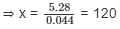
    ∴ The number of oranges was 120.

    Alternate Method

    At last, he sells 90% of the remaining oranges after selling the oranges to a second customer, then he has 10% of the remaining oranges.

    10% of the remaining oranges after selling the oranges to the second customer = 5

    So remaining oranges after selling the oranges to the second customer = 100% of the remaining oranges after selling the oranges to the second customer = 50 oranges

    He gave 2 extra oranges to the second customer, so the remaining oranges = 50 + 2

    He sells 20% of the remaining oranges to the second customer, so he has 80% of the remaining oranges = 52

    100% of remaining oranges after selling the oranges to the first customer = (52/4) * 5 = 65 oranges

    He gave 1 extra orange to the first customer, so the total oranges after selling 45% of the oranges = 65 + 1 = 66 oranges

    (100% - 45% = 55%) of total oranges = 66

    so

    100% of oranges = (66/55) * 100 = 120 oranges

  • Question 9/10
    2 / -0.5

    The three angles of a quadrilateral are equal. Measure of the fourth angle is 120°. Then, value of each equal angle is:

    Solutions

    Concept used:

    Sum of all the angles of a quadrilateral is 360°

    Calculation:

    Let's assume that, each of the three equal angles be k, then

    3k + 120 = 360

    ⇒ 3k = (360 - 120)

    ⇒ k = 240/3 = 80° 

    ∴ The value of each equal angle is 80°

  • Question 10/10
    2 / -0.5

    What will come in the place of ? in 323 ÷ 17 × √841 + 122 = ?

    Solutions

    Given:

    The expression 323 ÷ 17 × √841 + 122

    Concept used:

    Following the BODMAS rule according to the table given below:

    Calculation:

    323 ÷ 17 × √841 + 122

    = 19 × 29 + 122

    = 551 + 144

    = 695

Close button icon
User Profile
-

Correct (-)

Wrong (-)

Skipped (-)


  • 1
  • 2
  • 3
  • 4
  • 5
  • 6
  • 7
  • 8
  • 9
  • 10
Mockers logo Get latest Exam Updates
& Study Material Alerts!
No, Thanks
Arrow pointer icon
Click on Allow to receive notifications
Notification bell icon ×
Open Now