Please wait...
/
-
Verify mobile number to view the solution
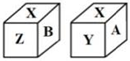
X is common in both the dice
X B Z
X A Y
X is opposite to W.
Hence, option C is the correct answer.
Four different positions of the same dice are shown. Select the symbol on the face opposite the face showing ‘%’ ?
From dice 1 and 2
% is common in both dice
% # ±
% * @
So % is opposite to &
Hence, option B is the correct answer.
Four different positions of the same dice are shown, the six faces of which are numbered from 1 to 6 . Select the number will be on the face opposite to the having the number '1'.
On considering the 1st and fourth dice we see that ‘1’ is the common face and adjacent numbers of '4' are '5' and '2' thus number opposite to '1' is either '3' or '6'.
So, ‘4’ is opposite of either ‘6’ or ‘3’.
In 3rd we can see '4' is adjacent to '3' so, '6' is opposite to '4'.
Thus it is clear that ‘1’ is opposite to ‘3’.
Three different positions of the same dice are shown. Find the number on the face opposite the face showing '1'.
1 and 5 is common in first two dice
6 is opposite to 4
1 and 4 is common in last two dice
2 is opposite to 5
And 1 is opposite to 3
Hence, option D is the correct answer.
Two different positions of the same dice are shown, the surfaces of which are numbered from 1 to 6. Select the number that will be on the face opposite to the one showing '1'.
The face 6 is the same in both the dice, thus, 2, 3, 4 and 5 will be adjacent to 6. Thus, 1 is opposite 6.
Two different positions of the same dice are shown, the six faces of which are numbered from 1 to 6. Select the number that will be on the face opposite to the one showing ‘4’.
4 is common in both the dice
4 2 5
4 6 3
So 4 is opposite is 1
Two different positions of the same dice are shown, the six faces of which are marked from A to F. Select the letter that will be on the face opposite to the one showing ‘E’.
B and C is common in both the dice so A is opposite to E.
5 and 2 is common in both the dice so 4 is opposite to 1.
Two different positions of the same dice are shown, the six faces of which are numbered from 1 to 6 . Select the number that will be on the face opposite to the face showing '2'.
4 and 6 is common in both the dice so 2 is opposite to 5.
Hence, option A is the correct answer.
The opposite faces in the folded dice would be –
6 – 2
5 – 3
1 – 4
We can see that only dice B has one element from each pair and thus, it can be formed.
Correct (-)
Wrong (-)
Skipped (-)


 Time Taken: -
 Bank
Bank


 SSC
SSC


 Railway


 State
State


 Other
Other


 Teaching


 Insurance


 Medical


 Engineering


 Defence


 GATE
GATE


 NTA CUET

 UPSC
UPSC

 MBA Entrance


 LAW
LAW

 ReNEET UG 2026
 CUET UG 2026
 UP Police Constable 2026
 SSC Selection Post (Phase 14) 2026
 SSC GD 2025-26
 RRB NTPC 2026
 SSC CGL Tier-I 2026
 SSC JE 2026
 UPSC (CSE) 2026
 SBI PO Prelims 2026
 SSC Steno Grade C & D 2026
 SBI Clerk Prelims 2026
 IBPS PO Prelims 2026
 IBPS Clerk Prelims 2026
 SSC CPO Tier I 2026