Please wait...

SSC GD 2025 Aptitude Test - 1
Menu grid icon
Result Result point icon
SSC GD 2025 Aptitude Test - 1
  • Goals icon

    /

    Score
  • Trophy icon

    -

    Rank
White alarm icon Time Taken: -
Result frame illustration
  • Question 1/10
    2 / -0.5

    A dishonest shopkeeper uses a faulty measuring rod, which measures 90cm for a meter. Find the actual profit percent, if he claims to be selling at a profit of 10% only?

    Solutions

    Let cost price per cm = Rs 1,

    Hence, cost price of 90cm = Rs 90

    And, cost price of 100cm = Rs 100

    Selling price of 100cm = 100 + 10% = Rs 110

    ∴ Actual profit percent = {(110 – 90)/90} × 100%

    = (2/9) × 100% = 22.22%

    Hence, the actual profit percent gained by the shopkeeper is 22.22%.

  • Question 2/10
    2 / -0.5

    The average of seven consecutive even numbers is 36. What is the difference between the highest and lowest numbers?

    Solutions

    Given:

    Average of 7 consecutive even number is 36.

    Concept Used:

    Average = Sum of number / Total Number

    Calculation:

    Let the 7 consecutive even numbers be x, x + 2, x + 4, x + 6, x + 8, x + 10, x + 12

    ⇒ Sum of 7 consecutive even numbers = 36 × 7 = 252

    ⇒ x + x + 2 + x + 4 + x + 6 + x + 8 + x + 10 + x + 12 = 252

    ⇒ 7x + 42 = 252

    ⇒ 7(x + 6) = 252

    ⇒ x + 6 = 36

    ⇒ x = 30

    ∴ lowest number x = 30

    and highest number x + 12 = 42

    ∴ The difference between highest and lowest number = 42 - 30 = 12.

  • Question 3/10
    2 / -0.5

    A and B together are supposed to do 13/15 of the work and B and C together 11/20 of the work. If the difference between wages of A and C is Rs. 7600, then the total wages of A and C is:

    Solutions

    Given:

    Difference between wages of A and C = Rs. 7600

    Formula Used:

    Share in wages = Work done/Total work × Total wages

    Calculation:

    Let total work be 60 unit,

    Work done by A and B = 13/15 × 60 = 52 unit

    ⇒ Work done by C = 60 – 52 = 8 unit

    Work done by B and C = 11/20 × 60 = 33 unit

    ⇒ Work done by A = 60 – 33 = 27 unit

    Work done by B = 60 – 27 – 8 = 25 unit

    According to the question,

    27 – 8 = 19 unit = 7600

    ⇒ 1 unit = 400

    Total wages of A and C = (27 + 8) = 35 units = 35 × 400 = Rs. 14000

  • Question 4/10
    2 / -0.5

    A seller calculated his intended selling price at 5% profit on the cost of a product. If profit is reduced by ₹120, then profit percentage is reduced to 3.5%. What is the cost price of the product?

    Solutions

    Given:

    Estimated profit = 5%

    Reduction in profit = Rs.120

    Percentage reduction in profit = 3.5%

    Calculation:

    By going through the ratio method,

    ⇒ CP    SP

    20      21

    200    210

    Here, CP must be same

    ∴ CP    SP

    ⇒ 200  210

    200  207

    Change in profit = 10 - 7 = 3

    ⇒ 3 = 120

    ⇒ 1 = 40

    CP will be 200 × 40 = 8000

    ∴ The correct answer is Rs.8000.

  • Question 5/10
    2 / -0.5

    After a certain time period, a sum of Rs. 24,000 invested in a bank will amount to Rs. 26,460 when the compound rate of interest is 5% p.a., being compounded annually. In how many months will it amount to Rs. 26,460?

    Solutions

    Given:

    Principal = Rs. 24,000

    Amount = Rs. 26,460

    Rate of interest = 5% p.a.

    Concept Used:

    The formula for compound interest is: A = P (1 + r/n)^(nt), where n is the number of times interest is compounded per time period t.

    Solution:

    ⇒ 26,460 = 24,000 (1 + 5/100)(t)

    ⇒ (26,460/24,000) = (21/20)(t)

    ⇒ t = log[(26,460/24,000)] / log[1.05] ≈ 2 years

    ⇒ In months, t = 2 x 12 = 24 months

    Therefore, it will take 24 months for the sum to amount to Rs. 26,460.

  • Question 6/10
    2 / -0.5

    Which one of the following has the same value of H.C.F as the value of the H.C.F of 

    Solutions

  • Question 7/10
    2 / -0.5

    What is the total surface area of a hemispherical solid having radius 14 cm?

    Solutions

    Given:-

    Radius of hemispherical solid = 14 cm

    ⇒ π = 22/7

    Formula used:- 

    Total surface area = 2πr2 + πr2 = 3πr2

    Calculation:-

    Total surface area = 3 × (22/7) × 142

    Total surface area = 3 × 22 × 14 × 2

    Total surface area = 1848 cm2

    Additional Information

  • Question 8/10
    2 / -0.5

    If f(x) = (x - 2)(x2 + Px + 4) and (x - 3) is a factor of f(x), then what is the value of P?

    Solutions

    Concept used:

    If f(-a) = 0, then (x + a) is a factor of the polynomial f(x)

    Calculation:

    F(x) = (x – 2)(x2 + Px + 4)

    If (x – 3) is factor of f(x) then put x = 3 in equation (i) –

    F(x) = 0

    ⇒ 0 = (3 – 2)(9 + 3P + 4)

    ⇒ (13 + 3P) = 0

    ⇒ P = -13/3

  • Question 9/10
    2 / -0.5

    The difference between Peter and Preeti’s ages is 5 years. When they married each other 35 years ago, 4 times Peter’s age was the same as 5 times the age of Preeti’s. What is the current sum of their ages?

    Solutions

    Let Peter and Preeti's age be A and B respectively.

    The difference between Peter and Preeti’s ages is 5 years,

    ⇒ A – B = 5

    35 years ago, 4 times Peter’s age was the same as 5 times the age of Preeti’s,

    ⇒ 4(A – 35) = 5(B – 35)

    ⇒ 4A – 140 = 5B – 175

    ⇒ 5B – 4A = 35

    Solving,

    ⇒ 5B – 4(5 + B) = 35

    ⇒ 5B – 20 – 4B = 35

    ⇒ B = 55

    ⇒ A = 60

    ∴ Sum of their present ages = 60 + 55 = 115 years

  • Question 10/10
    2 / -0.5

    A thief noticing a policeman from a distance of 500 metres starts running at a speed of 8 km/h. The policeman chased him with a speed of 11 km/h. What is the distance run by the thief before he was caught? (Rounded off to two decimal places, if required)

    Solutions

    Given:

    Initial distance between thief and policeman = 500 m

    Speed of thief = 8 km/h

    Speed of policeman = 11 km/h

    Concept used:

    Relative speed and time = distance/speed

    Solution:

    Relative speed = speed of policeman - speed of thief = 11 km/h - 8 km/h = 3 km/h = 3 ×  (1000/3600) m/s = 5/6 m/s

    Time taken to catch the thief = initial distance / relative speed 

    Time taken to catch the thief = 500 m / (5/6 m/s) = 600 seconds

    Distance run by the thief before he was caught = Speed of thief ×  time = (8 ×  1000/3600) m/s ×  600 s = 1333.33 meters

    Therefore, the distance run by the thief before he was caught is approximately 1333.33 meters.

    Shortcut Trick

    Here, the thief and the police is running for the same time. So, time = constant.

    When time is constant Speed ∝ Distance
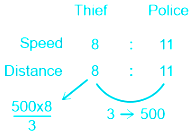
    Distance between the thief and the police  = 3 unit = 500 km

    ⇒ 1 unit = 500/3 

    ⇒ 8 unit = (500 × 8)/3 = 1333.33 m

    Therefore, the distance run by the thief before he was caught is approximately 1333.33 meters.

Close button icon
User Profile
-

Correct (-)

Wrong (-)

Skipped (-)


  • 1
  • 2
  • 3
  • 4
  • 5
  • 6
  • 7
  • 8
  • 9
  • 10
Mockers logo Get latest Exam Updates
& Study Material Alerts!
No, Thanks
Arrow pointer icon
Click on Allow to receive notifications
Notification bell icon ×
Open Now
