Please wait...

CDS I 2025 GK Test - 7
Menu grid icon
Result Result point icon
CDS I 2025 GK Test - 7
  • Goals icon

    /

    Score
  • Trophy icon

    -

    Rank
White alarm icon Time Taken: -
Result frame illustration
  • Question 1/10
    1 / -0.33

    Which of the following seasons in India is known as the transition season?

    Solutions

    Key Points:

    Retreating monsoons:

    • During October-November, with the apparent movement of the sun towards the south, the monsoon trough or the low-pressure trough over the northern plains becomes weaker.
    • This is gradually replaced by a high-pressure system.
    • The south-west monsoon winds weaken and start withdrawing gradually.
    • By the beginning of October, the monsoon withdraws from the Northern Plains.
    • The months of October-November form a period of transition from hot rainy season to dry winter conditions.
    • The retreat of the monsoon is marked by clear skies and a rise in temperature.
    • While day temperatures are high, nights are cool and pleasant.
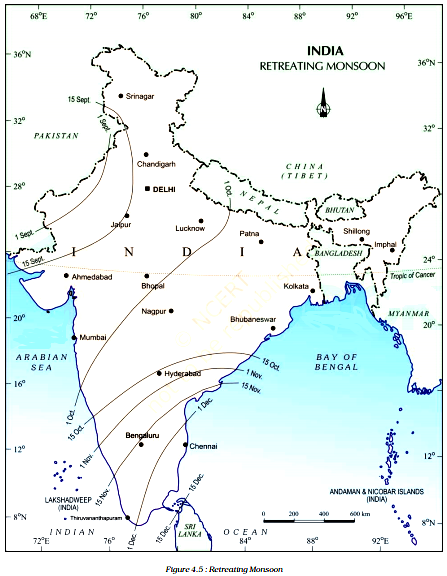
    Thus, October-November months are associated with retreating monsoons/the transition season.

    Additional Information

    Southwest monsoon season:

    • The period June to September is referred to as the 'Southwest Monsoon' period.
    • The Southwest Monsoon period is the principal rainy season for the Indian subcontinent.
    • This is the summer monsoon period where the southwest monsoon holds away over the country.
    • The whole country receives nearly 75% of its rainfall during this period.

    Monsoon:

    • Monsoon, a major wind system that seasonally reverses its direction, such as one that blows for approximately six months from the northeast and six months from the southwest. 
    • The primary cause of monsoons lies in different warming trends over land and sea, though other factors may be involved.
    • There are two monsoons (or rainy seasons) in India.
    • The summer monsoon season in India, otherwise known as the southwest monsoon, lasts from June to September and affects the whole of India.
    • Then the northeast or winter monsoon brings seasonal rainfall to Southeast India from October to December.
  • Question 2/10
    1 / -0.33

    Which campaign did the Government of India launch to boost patriotic sentiment leading up to Independence Day?

    Solutions

    In News

    • The Government of India launched the campaign from August 9 to 15, 2024.

    Key Points

    • It aims to boost patriotic sentiment in the lead-up to Independence Day.
    • The campaign encourages citizens to participate by uploading selfies with the national flag and features cultural programs and a Tiranga Bike Rally.

    Additional Information

    • The Government of India launched the ‘Har Ghar Tiranga’ campaign from August 9 to 15 to boost patriotic sentiment leading up to Independence Day.
    • Culture Minister Gajendra Singh Shekhawat urged participation, encouraging citizens to upload selfies with the national flag on the official website.
    • The campaign will feature 200+ cultural programs and a Tiranga Bike Rally on August 13.
  • Question 3/10
    1 / -0.33

    Which of the following is / are characteristic(s) of the Ryotwari system?

    1. It was the brainchild of Thomas Munro

    2. It was meant to reduce intermediaries 

    3. Cultivating peasants were gradually impoverished by the system

    4. It was introduced in parts of Madras and Bengal Presidency

    Select the correct answer using the code given below:

    Solutions

    The correct answer is 1,2 and 3 only.

    • Ryotwari System was introduced by Thomas Munro, Governor of Madras in 1820.
      • Major areas of introduction include Madras, Bombay, parts of Assam, and Coorgh provinces of British India.
      • In this system, the peasants or cultivators were regarded as the owners of the land. They had ownership rights, could sell, mortgage, or gift the land.
      • British Government collected taxes directly from the peasants.
      • Ryot means peasant cultivators.
      • The revenue rates of the Ryotwari System were 50% where the lands were dry and 60% in irrigated land.

    Additional Information

    • Mahalwari System was introduced in 1833 during the period of William Bentick, Governor-General of India (1828 to 1835).
      • It was introduced in Central Province, North-West Frontier, Agra, Punjab, Gangetic Valley of British India.
      • The Mahalwari system had many provisions of both the Zamindari System and the Ryotwari System.
      • In this system, the land was divided into Mahals. Each Mahal comprises one or more villages.
      • Ownership rights were vested with the peasants.
      • The villages committee was held responsible for the collection of the taxes.
  • Question 4/10
    1 / -0.33

    Consider the following statements:

    1. A bill amending the Constitution requires a prior recommendation of the President of India.

    2. When a Constitution Amendment Bill is presented to the President of India, it is obligatory for the President of India to give his/her assent.

    3. A Constitution Amendment Bill must be passed by both the Lok Sabha and the Rajya Sabha by a special majority and there is no provision for joint sitting.

    Which of the statements given above are correct?

    Solutions

    Key Points

    • The mechanism for amending the Constitution is outlined in Article 368.
    • An amendment to this Constitution may be initiated only by the introduction of a Bill for the purpose in either House of Parliament, and when the Bill is passed by a special majority of the total membership of that House present and voting in each House, it shall be presented to the President, who shall give his assent to the Bill. 
    • The 24th Constitutional Amendment Act of 1971 made it obligatory for the President to give his assent to a constitutional Amendment Bill. 
    • The president has no veto power in respect of a constitutional amendment bill. Hence, statement 2 is correct.
    • A Constitutional amendment bill doesn't require the prior recommendation of the President to be introduced. Hence, statement 1 is incorrect.
    • There is no provision for calling a joint session of parliament in the event of a disagreement between the two houses. Hence, statement 3 is correct.

    Additional Information

    • ​24th Amendment 1971 important provisions- 
      • When a Constitution Amendment Bill is given to the President for his approval after being enacted by both Houses of Parliament, the Act states that he must give his consent. When a Constitution Amendment Bill is given to the president, he is required to provide his assent.
      • It gave Parliament the unrestricted power to change any provision of the Constitution, including Part III (fundamental rights). The 24th Amendment was largely reversed in 1973 when the Supreme Court ruled in Kesavananda Bharati v. the State of Kerala that parliament could not modify the Constitution's "fundamental structure."
      • Article 13(4) and 368(3) were inserted through 24th Amendment
  • Question 5/10
    1 / -0.33

    The Indian Hockey Federation was established in the year ______.

    Solutions

    Key Points

    • Indian Hockey Federation (IHF) was the apex governing body of field hockey in India formed on 7 November 1925 in Gwalior. 
    • It is the first Non-European Country which was a part of International Hockey Federation
    • As a member of the International Hockey Federation, it represented India in all international matches under the former leadership of KPS Gill & the secretary of the federation, K.Jyothikumaran. 
    • The women's team was directed by the Indian Women's Hockey Federation.
    • R. K. Shetty was elected as a new IHF president in 2010.
  • Question 6/10
    1 / -0.33

    Which of the following equipments were also tested in the Pokhran Test of 1998?

    I. Aircraft Hansa-3

    II. Surface-to-air missile Trishul.

    III. Air-to-air missile Akash

    Solutions

    Key Points

    • Operation Shakti was the code name of the nuclear tests conducted by India in Pokhran in 1998.
    • Pokhran-II tests, initiated on 11 May 1998, consisted of five detonations.
    • The first detonation was a fusion bomb and the remaining four were detonations of fission bombs. The tests were assigned the code- Operation Shakti.
    • The five nuclear bombs were designated Shakti-I, Shakti-II, Shakti-III, Shakti-IV, and Shakti-V.
    • The four of the devices were weapons-grade plutonium and the other one was Thorium/U-233.
    • The development and test teams were led by Bhabha Atomic Research Center and DRDO.
    • On the same day, India also tested its first indigenous aircraft Hansa-3 which was designed by the National Aerospace Laboratory and took flight in Bengaluru.
      • It was a light two-seater aircraft built to serve surveillance, pilot training, and other reconnaissance purposes. Hence, statement I is correct.
    • India also conducted the successful completion of the test firing of the surface-to-air missile Trishul.
      • The tests were conducted by the (DRDO) under the Integrated Guided Missile Development Programme of India.
      • It was inducted into the Indian Army and the Indian Air Force.
      • Hence, statement II is correct.
  • Question 7/10
    1 / -0.33

    Which of the following provides official sources of data on Unemployment in India?

    1. National Statistical Organisation (NSO)

    2. Director General of Employment and Training

    3. Census of India

    Select the correct answer using the code given below.

    Solutions

    Key Points

    Unemployment:

    • Unemployment occurs when a person who is actively searching for employment is unable to find work.
    • Unemployment is often used as a measure of the health of the economy.
    • The most frequent measure of unemployment is the unemployment rate, which is the number of unemployed people divided by the number of people in the labour force.
    • National Sample Survey Organisation (NSSO) defines employment and unemployment on the following activity statuses of an individual:
      • Working (engaged in economic activity) i.e. 'Employed'.
      • Seeking or available for work i.e. 'Unemployed'.
      • Neither seeking nor available for work.
      • The first two constitute the labour force and the unemployment rate is the per cent of the labour force that is without work.
      • Unemployment rate = (Unemployed Workers / Total labour force) × 100
    • The three official sources of data on unemployment in India are:
      • Data of the National Statistical Organisation (NSO) under the Ministry of Statistics and Programme Implementation. Hence, statement 1 is correct.
      • Data by the Director General of Employment and Training. Hence, statement 2 is correct.
      • The report of Census of India. Hence, statement 3 is correct.
    • ​In India census is conducted as a decennial exercise.
      • Census provides information on the distribution of the labour force by various categories at the national, state, and district levels.
      • The distribution of the unemployed is given by age, sex, education, and rural and urban residence at the three levels.
    • Director General of Employment and Training: 
      • The Directorate General of Employment (DGE) in the Ministry of Labour is the apex organization for development and coordination at the National level for the programmes relating to National Employment Services.
      • Employment service is operated through a countrywide network of Employment Exchanges. Development of these programmes at the national level, particularly in the area concerning uniform policies, standards and procedures is the responsibility of the DGE.
  • Question 8/10
    1 / -0.33

    D.K. Basu's judgment recently seen in the news is related to

    Solutions

    In News

    • The Hindu: Kheda flogging incident is a case of ‘police atrocity’, says Supreme Court.

    Key Points

    D.K. Basu's judgment:

    • The DK Basu case is a landmark in Indian criminal jurisprudence.
    • It established guidelines to protect the rights and dignity of individuals in police custody. Hence option 2 is correct.
    • The Supreme Court emphasized the need for visible identification of police officers, the preparation of an arrest memo, and the right of the detainee to have a friend or relative informed about their arrest.
    • The Supreme Court, in DK Basu vs State of West Bengal, referring to the case of Neelabati Bahera v. State of Orissa (AIR 1993 SC 1960), reiterated that prisoners and detainees should not be deprived of their Fundamental Rights under Article 21. Only legally permissible restrictions can be imposed on the enjoyment of their Fundamental Rights.
    • The DK Basu versus State of West Bengal case led to the inclusion of these guidelines in the Criminal Procedure Code in 2008.
    • D.K. Basu Guidelines: In light of this, the Apex Court laid down the following guidelines for the arrest and detention of individuals:
      • Police officers involved in the arrest and interrogation of an arrestee must wear clear, visible identification and name tags with their designations. Details of all police personnel handling the interrogation must be recorded in a register.
      • The police officer affecting the arrest must prepare a memo of arrest at the time of the arrest. It should be witnessed by at least one person who may be a family member or a respected individual from the area where the arrest occurs. The memo should also be countersigned by the arrested person and include the time and date of the arrest.
      • Any person arrested and held in custody has the right to have a friend, relative, or someone known to them informed about their arrest and detention as soon as possible unless the witness to the arrest is such a friend or relative.
      • The police must notify the time, place of arrest, and place of custody of the arrestee to the next of kin if they live outside the district or town. This notification should be made through the Legal Aid Organisation in the district and the concerned area’s police station within 8 to 12 hours after the arrest.
      • The person arrested must be informed of their right to have someone informed of their arrest or detention as soon as they are taken into custody.
      • An entry regarding the arrest must be made in the case diary at the place of detention. This entry should also include the name of the person informed about the arrest (next of kin) and the names and details of the police officials responsible for the arrestee.
      • The arrestee, upon request, should be examined at the time of arrest and any visible injuries on their body, major or minor, should be documented. Both the arrestee and the police officer should sign an “Inspection Memo,” and a copy should be provided to the arrestee.
      • The arrestee should undergo a medical examination by a qualified doctor every 48 hours during their custody. These doctors should be on a panel of approved doctors appointed by the Director of Health Services in the respective State or Union Territory. Such a panel should be prepared for all Tehsils and Districts.
      • Copies of all documents, including the memo of arrest, should be sent to the Magistrate for their records.
      • The arrestee may be allowed to meet with their attorney during the interrogation, although not necessarily throughout the entire process.
      • Police control rooms should be established at all district and state headquarters. The officer in charge of the arrest must communicate information about the arrest and the place of custody of the arrestee to the control room within 12 hours of effecting the arrest. This information should be displayed on a visible notice board in the control room.

    Additional Information

    D. K. Basu:

    • DK Basu served as the Executive Chairman of Legal Aid Services in West Bengal, a non-political organization.
    • He wrote a letter to the Supreme Court of India, bringing to its attention news reports about deaths in police custody and lockups. In the letter, he highlighted that such cases of custodial violence often went unpunished, despite efforts made to address the issue.
    • He urged the court to investigate this matter and provide compensation to the families of the victims.
    • He requested that the letter be treated as a Writ Petition under the category of “Public Interest Litigation.” Recognizing the importance of the issues raised in the letter, the court treated it as a formal petition and the defendants were notified.
  • Question 9/10
    1 / -0.33

    With reference to Khajuraho Temples, consider the following statements:

    1. The temple is located in Central India's Aravali Mountain range.

    2. The Khajuraho temples are composed of sandstone, with a nearly buried granite base.

    3. Abu Rihan al Biruni in AD 1022 was the first to mention the Khajuraho temples.

    4. The construction of the temples also makes extensive use of iron clamps.

    Which of the statements given above are correct?

    Solutions

    Key Points

    Khajuraho Temples:

    • Khajuraho temples are located in Madhya Pradesh and are one of the most beautiful temples in India. In 1986 it was declared a World Heritage Site by UNESCO.
    • There is a total of 25 temples still standing out of said 85 temples. These were built between 900 and 1130 AD by the Chandella rulers.
    • The temple is located in Central India's Vindhya Mountain range. Hence, statement 1 is not correct.
    • The Khajuraho temples are composed of sandstone, with a nearly buried granite base. Hence, statement 2 is correct.
    • The temples are known for their sexual sculptures and Nagara-style architectural symbolism.
    • The Vaishnavism School of Hinduism, Saivism School of Hinduism, and Jainism all have temples in Khajuraho.
    • Abu Rihan al Biruni in AD 1022 and the Arab explorer Ibn Battuta in AD 1335 was the first to mention the Khajuraho temples. Hence, statement 3 is correct.
    • Kandariya Mahadev, the most visited temple, has a Shikhara (spire) that rises 116 feet and occupies an area of around 6,500 square feet.
    • The Khajuraho temples were hidden under forest cover from the 13th century until the 18th century when they were rediscovered by British engineer T. S. Burt.
    • The temples of Khajuraho are remarkable examples of Nagara temple design, with a sanctum, a tiny ante-chamber (antarala), a transept (mahamandapa), extra halls (ardha mandapa), a mandapa or nave, and an ambulatory corridor (Pradakshina-path) lit by enormous windows.
    • The construction of the temples also makes extensive use of iron clamps. Hence, statement 4 is correct.
    • The architecture of the Khajuraho Temples is extremely intricate. The following are the key features of these temples:
      • With antarala, a tiny ante-chamber, the Garbhagriha (sanctum sanctorum)
      • A huge hall is known as the Maha Mandapa
      • The Ardha Mandapa and a mandapa are tiny additions to the main hall.
      • A circumambulation trail is known as the Pradakshina Path.
  • Question 10/10
    1 / -0.33

    Which of the following provisions of the National Rural Employment Guarantee Act, 2005 is not correct?

    Solutions

    Key Points

    •  Under NREGA, 100 days of employment in a year is to be provided to at least one member of every household. -
      • Every household whose adult members volunteer to do unskilled manual work is entitled to 100 days of guaranteed wage employment in a financial year under NREGA.
    • NREGA program has full potential to change the poverty map. -
      • This statement is correct. NREGA aims to alleviate poverty and improve the livelihood security of households in rural areas by providing guaranteed wage employment. Its success in generating employment and empowering rural communities has the potential to significantly impact the poverty landscape.
    • The National Rural Employment Guarantee Act came into effect from April 10, 2006.. -
      • This statement is incorrect. The Act was notified on September 7, 2005, but it came into effect on Feb 2, 2006, in 200 districts. The remaining districts were covered in phases over the next few years.
    • On October 2, 2009, NREGA was renamed as Mahatma Gandhi National Rural Employment Guarantee Act. -
      • This statement is correct. While the NREGA was amended in 2009, it was not renamed.
Close button icon
User Profile
-

Correct (-)

Wrong (-)

Skipped (-)


  • 1
  • 2
  • 3
  • 4
  • 5
  • 6
  • 7
  • 8
  • 9
  • 10
Mockers logo Get latest Exam Updates
& Study Material Alerts!
No, Thanks
Arrow pointer icon
Click on Allow to receive notifications
Notification bell icon ×
Open Now