Please wait...

SBI PO 2024-25 Aptitude Test - 6
Menu grid icon
Result Result point icon
SBI PO 2024-25 Aptitude Test - 6
  • Goals icon

    /

    Score
  • Trophy icon

    -

    Rank
White alarm icon Time Taken: -
Result frame illustration
  • Question 1/10
    1 / -0.25

    Directions For Questions

    A survey was conducted in Kanpur Zoo for people (Men, Women, and Children), who visited the zoo on three different days i.e. Monday, Tuesday, and Wednesday of a week. In the survey, it was found that there are total 10,000 people (Men + Women + Children) visited the zoo in these 3 days. On Monday 1000 children visited the zoo. The ratio of children, who visited the zoo on Monday and Wednesday is 2 : 1 respectively, and the number of men, who visited the zoo on Tuesday is 50% more than the number of children, who visited the zoo on Wednesday. 2000 women visited the zoo on Wednesday. The ratio of men, who visited the zoo on Monday and women, who visited the zoo on Wednesday is 5 : 4 respectively. 2500 children visited the zoo on all three days and the total number of men, who visited the zoo on all three days is 70% more than the total number of children, who visited the zoo on all three days. The number of men, who visited the zoo on Wednesday is 500 more than the number of women, who visited the zoo on Monday.

    ...view full instructions


    Number of children, who visited zoo on Wednesday is what percent more/ less than the total number of men, visited zoo on Monday ?

    Solutions

    The total number of people, who visited the zoo on all three days of the week is 10000

    On Monday 1000 children visited the zoo 

    The ratio of children, who visited the zoo on Monday and Wednesday is 2 : 1 respectively.

    Then 2 unit = 1000 

    ⇒ 1 unit = 500 hence 500 children visited the zoo on Wednesday.

    The total number of children, who visited the zoo on all three days is 2500

    Then, the number of children, who visited the zoo on Tuesday = 2500 -(1000+500)

    ⇒ 2500 - 1500 = 1000

    The number of men, who visited the zoo on Tuesday is 50% more than the number of children, who visited the zoo on Wednesday 

    ⇒ 500 × 150/ 100 = 750

    2000 women visited on Wednesday 

    Men, who visited the zoo on Monday and women, who visited the zoo on Wednesday are 5 : 4 respectively.

    Then 4 unit = 2000 so 5 unit = 2500

    The number of men visited on Monday is 2500

    The Total number of men, who visited on all three days is 70% more than the total number of children, who visited on all three days

    ⇒ 2500 × 170 / 100

    ⇒ 4250

    Then, the number of men visited on Wednesday is =  4250- (2500+750)

    ⇒ 4250 - 3250 = 1000

    The number of men, who visited the zoo on Wednesday is 500 more than the number of women, who visited the zoo on Monday.

    ⇒ 1000 - 500 = 500

    Total number of women visited on all three days 

    ⇒ 10000 -(4250+2500) = 3250

    Then, the number of women, who visited on Tuesday 

    ⇒ 3250-(2000+500) = 750
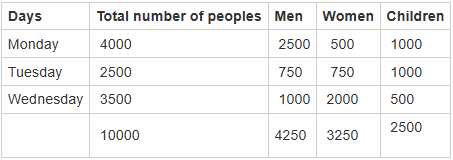
    The number of children, who visited on Wednesday are 500 

    The number of men, who visited on Monday are 2500

    As the number of men, who visited on Monday is more than the number of children, who visited on Wednesday, so

    Then 2500 - 500 = 2000

    ⇒ (2000 / 2500 ) × 100

    ⇒ ( 4 / 5) × 100

    ⇒ 80% 

    Hence, 80%, Less is the correct answer.

  • Question 2/10
    1 / -0.25

    Kashyap got 70% in an examination and got 150 marks more than the passing marks and her friend Sunaina got 60% and she got 100 marks more than the passing marks. Find the passing percentage of the examination?

    Solutions

    Let the total marks and passing marks of the examination be x and y respectively

    ∴ Marks obtained by Kashyap 

    ⇒ (70/100) × x = y + 150 ----(i)

    Marks obtained by Sunaina 

    ⇒ (60/100) × x = y + 100 ----(ii)

    Subtracting (ii) from (i)

    ⇒ {(70/100) × x} – {(60/100) × x} = y + 150 – y – 100

    ⇒ (10/100) × x = 50

    ⇒ x = 500

    Putting value of x in (ii)

    (60/100) × 500 = y + 100

    ⇒ 300 = y + 100

    ⇒ y = 200

    ∴ Passing percentage of the examination = (200/500) × 100 = 40%

  • Question 3/10
    1 / -0.25

    A’s present age is one fourth of his mother’s age two years ago.  After 10 years, A’s mother’s age will be twice of B’s age. If B’s 12th birthday was celebrated 4 years ago, then what is A’s present age?

    Solutions

    Given:

    A’s age = 1/4 (Mother’s age two years ago)

    Mother’s age = 2 × (B’s age after 10 years)

    B’s 12th birthday was 4 years ago

    Concept:

    4 years ago B’s age was 12. So present age of B is 16

    Explanation:

    Let’s denote A’s mother’s age by M

    ⇒ A = 1/4 × (M – 2)

    And, M + 10 = 2 × (B + 10)

    B = 16 (∵ 4 years ago B’s age was 12)

    Calculation:

    According to the Question,

     M + 10 = 2 × (16 + 10)

    ⇒ M = 42

    We have, A = 1/4 (M – 2)

    ⇒ A = 1/4 × (42 – 2) = 10

    ∴ Present age of A is 10 years

  • Question 4/10
    1 / -0.25

    A container contains 6 white, 8 blue and 4 red marbles. Three marbles are drawn at random from the container. Find the probability that each of them is blue?

    Solutions

    Given:

    A container contains 6 white, 8 blue and 4 red marbles. Three marbles are drawn at random from the container

    Concept used:

    The classical definition of probability

    Formula used:

    Probability = Favorable Outcome / Total Outcome

    P(E) = n(E)/n(S)

    nC= n! / r!(n - r)!

    nCr = nC(n - r)

    Calculation:

    Total number of marbles is 6 + 8 + 4 = 18

    Let S be the sample space

    n(S) = Total number of ways of drawing 3 marbles out of 18 = 18C3

    Let E = Event of drawing 3 marbles, all of them are blue

    n(E) = Number of ways of drawing 3 marbles, all of them are blue

    Number of ways of drawing 3 marbles from the total 8 = 8C3

    P(E) = n(E) / n(S)

     8C3/18C3

    ⇒ {(8 × 7 × 6)/(1 × 2 × 3)}/{(18 × 17 × 16)/(1 × 2 × 3)}

    ⇒ 56/816

    ⇒ 7/102

    ∴ The probability that all of them are blue is 7/102.

  • Question 5/10
    1 / -0.25

    At 30% rate of compound interest, 'X' pays Rs. 4600 to 'Y' in two equal annual installments. If 'X' will pay the same amount at the same rate of simple interest, then find the difference between amounts paid by 'X' in both the cases.

    Solutions

    Given:

    Rate of interest = 30% per annum

    Principal = 4600 Rs.

    Calculation:

    Let the installment paid in compound interest by 'X' is 'A' Rs.

    ⇒ 4600 = A/[1 + (3/10)] + A/[1 + (3/10)2]

    ⇒ 4600 = A × [(10/13) + (10/13)2]

    ⇒ 4600 = A × (230/169)

    ⇒ A = 3380 Rs.

    Amount paid = 3380 + 3380 = 6760 Rs.

    Let the installment paid in simple interest by 'X' is 'B' Rs.

    Simple interest installment = 100 × (Amount)/[100 × n + n × (n - 1) × (r/2)] 

    ⇒  100 × (Amount) = Simple interest installment × [100 × n + n × (n - 1) × (r/2)]

    ⇒ 100 × [Principal + Interest] = B × [100 × n + n × (n - 1) × (r/2)]

    ⇒ 100 × [Principal + (Principal × Rate × time)/100] = B × [100 × n + n × (n - 1) × (r/2)]

    ⇒ 100 × [Principal(100 + Rate × time)/100] = B × [100 × n + n × (n - 1) × (r/2)]

    ⇒ 100 × 4600 × [(100 + 2 × 30)/100] = B × [100 × 2 + 2 × 1 × (30/2)]

    ⇒ 4600 × 160 = B × 230

    ⇒ B = 3200

    Amount paid = 3200 + 3200 = 6400 Rs.

    Required difference = 6760 - 6400 = 360 Rs.

    Hence, the correct answer is Rs. 360

  • Question 6/10
    1 / -0.25

    A vessel containing 180 litres of mixture containing milk and water are in the ratio 5: 4. If x litres of mixture is taken out and (x/3) litres of water is added then the ratio between the milk and water in the vessel becomes 1: 1.Now y litres of milk is added then the milk and water in the final mixture becomes 7: 5. Find the value of (x + y).

    Solutions

    Total quantity of mixture( Milk + Water)  in vessel = 180

    Quantity of milk in the vessel = 180/9 ×  5 = 100

    Quantity of water in the vessel = (180 - 100) = 80

    Now the quantity of mixture removed = x

    Quantity of milk removed from the mixture = (x × 5/9) = 5x/9

    Quantity of water from the mixture = (x × 4/9) = 4x/9

    [(100 - 5x/9)/(80 - 4x/9 + x/3)] = 1/1

    Multiply equation by 9

     9 ×  (100 - 5x/9) = 9 ×  (80 - 4x/9 + x/3)

    900 - 5x = 720 - 4x + 3x

    900 - 5x = 720 - x

    900 = 720 = 4x

    4x = 180

    x = 45

    Now the quantity of milk in vessel = (100 - 45 ×  5/9) = 75 litres

    Quantity of water in the vessel = (80 - 45 ×  4/9) = 60 + 45/3 = 75 litres

    Now y litres of milk is added then the milk to water in the final mixture is 7: 5.

    (75 + y)/(75) = 7/5

    (375 + 5y) = 525

    5y = 150

    y = 30

    Find  (x + y) = (45 + 30) = 75

  • Question 7/10
    1 / -0.25

    A bike travels 'x' km in 1 hour and 15 minutes and if the same bike travels 48 km more, then it will take 0.75 hours more. Then find the distance traveled by bike in 4 hours 42 minutes.

    Solutions

    Let, the speed of bike = 's' km/hr

    A bike travels 'x' km in 1 hour and 15 minutes

    x/s = 1 hour and 15 minutes

    x/s = 1.25

    x = 1.25s ....(1)

    The same bike travels 48 km more, then it will take 0.75 hours more

    (x + 48)/s = (1.25 +0.75)

    x + 48 = 2s....(2)

    Substitute equation (1) in (2)

    1.25s + 48 = 2s

    0.75s = 48

    s = 64 km/hr

    Distance traveled in 4 hours 42 min = 64 × 4.7 = 300.8 km

  • Question 8/10
    1 / -0.25

    A train can cross an electric pole in 40 seconds and bridge of length 170m in 50 seconds.  Find the time taken by (in sec) train to cross a man running at 46.8 kmph in same direction as that of train?

    Solutions

    A train can cross an electric pole in 40 seconds and bridge of length 170m in 50 seconds. 

    let the length of train be x and speed of train be y.

    hence x / y = 40

    x = 40y.

    (170 + x) / y = 50

    (170 + 40y) / y = 50

    170 + 40y = 50y

    y = 17.

    hence x / 17 = 40

    x = 680m.

    hence the speed of train is 17 m/s and length of train is 680m.

    time taken by (in sec) train to cross a man running at 46.8 kmph in same direction as that of train

    speed of a man in m/s = 46.8 ×  5 / 18 = 13 m/s.

    hence speed in same direction = 17 – 13 =4 m/s.

    hence distance / speed = time

    680 / 4 = 170 seconds.

  • Question 9/10
    1 / -0.25

    The ratio of the radius of a circle and the side of a square is 2: 3. The breadth of the rectangle is equal to the side of square. The length of the rectangle is 3/7th times more than the breadth of the rectangle. If the perimeter of the rectangle is 102 cm, then, the area of the circle is –

    Solutions

    Given:

    Ratio of radius of a circle and side of a square = 2:3

    Breadth of the rectangle = Side of square

    Length of the rectangle= 10/7th× Breadth of the rectangle

    Perimeter of the rectangle= 102 cm

    Formula Used:

    Perimeter of square = 4 × Side

    Perimeter of rectangle = 2(length + breadth)

    Area of square = side2

    Area of rectangle = length × breadth

    Calculation:

    Suppose the length of the rectangle and breadth of the rectangle is 10x and 7x, respectively.

    ⇒ 2(10x + 7x) = 102

    ⇒ 17x = 51

    ⇒ x = 3

    Length of the rectangle = 30 cm

    Breadth of the rectangle = 21 cm

    ∴ Side of the square = 21 cm

    The ratio of the radius of a circle and the side of a square is 2: 3

    ⇒ 3 units = 21

    ⇒ 1 unit = 7

    ⇒ 2 unit = 14 cm

    The radius of the circle is 14 cm

    So, the area of the circle = π(14)2

    ⇒ 22/7 × 14 × 14

    ⇒ 616 sq. cm

  • Question 10/10
    1 / -0.25

    Emma purchased a laptop at a (p + 5)% discount, and her credit card provided her with an additional 10% cashback. If the laptop costs her Rs. 7560, she receives an overall 3p% discount. What was the marked price of the laptop?

    Solutions

    Calculation:

    Let the MP of a laptop be Rs. 100a

    At a discount of (p + 5)%, SP = 100a × (100 - p - 5)%

    100a × (95 - p)/100 = (95 - p)a

    At an additional discount of 10%, SP = (95 - p)a × (100 - 10)/100

    (95 - p)a × 90/100 = 7560

    (95 - p)a × 9/10 = 7560  

    (95 - p)a = 8400      ......(1)

    When overall discount is 3p%, SP = 100a × (100 - 3p)/100

    (100 - 3p)a   ......(2)

    Since SP are equal

    (95 - p)a × 9/10 = (100 - 3p)a 

    855 - 9p = 1000 - 30p

    21p = 145

    p = 145/21

    Put the value of p in eq(1), we get

    (95 - 145/21)a = 8400  

    a = 95.35

    Marked Price of the laptop = 100 × 95.35 = Rs. 9535

Close button icon
User Profile
-

Correct (-)

Wrong (-)

Skipped (-)


  • 1
  • 2
  • 3
  • 4
  • 5
  • 6
  • 7
  • 8
  • 9
  • 10
Mockers logo Get latest Exam Updates
& Study Material Alerts!
No, Thanks
Arrow pointer icon
Click on Allow to receive notifications
Notification bell icon ×
Open Now
