Please wait...

IBPS RRB OS-1 2025 Aptitude Test - 2
Menu grid icon
Result Result point icon
IBPS RRB OS-1 2025 Aptitude Test - 2
  • Goals icon

    /

    Score
  • Trophy icon

    -

    Rank
White alarm icon Time Taken: -
Result frame illustration
  • Question 1/10
    1 / -0.25

    The difference between the simple and compound interest on a certain sum of money at 20% per annum for 3 years is Rs.1408. If the same sum is invested in simple interest at 15% per annum for 5 years, find the simple interest.

    Solutions

    Answer: C

    Let the principal amount be Rs.P.

    Difference for 3 years = P(R/100)2 * (300 + R)/100

    According to the question,

    1408 = P * (20/100)2 * (300 + 20)/100

    1408 = P * (1/5)2 * 320/100

    P = 1408 * 25 * 100/320

    P = 11000

    SI = PNR/100

    = (11000 * 5 * 15)/100

    = Rs.8250

  • Question 2/10
    1 / -0.25

    Directions For Questions

    Read the following information carefully and answer the questions.

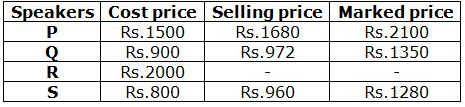
    There are four speakers in a market with different cost prices,namely P, Q, R and S. The cost price of speaker S is Rs.800, which is Rs.100 less than that of speaker Q. The cost price of speaker P is 25% less than that of speaker R and the ratio of the cost price of speakers P to Q is 5:3.The markup percentage of speaker P is 40% and itis sold at a 20% discount. The markup percentage of speaker S is 60% and it is sold at a 20% profit. The markup percentage of speaker Q is twice the discount percentage offered on speaker S and speaker Q is sold at a 28% discount.

    ...view full instructions


    If the profit percentage of speakers P and R are Y% and (Y + 0.5)% respectively, find the profit amount earned on speaker R.

    Solutions

    The cost price of speaker S = Rs.800

    The cost price of speaker Q = 800 + 100 = Rs.900

    The cost price of speaker P = 900 * (5/3) = Rs.1500

    The cost price of speaker R = 1500 * (100/75) = Rs.2000

    The marked price of speaker P = 1500 * (140/100) = Rs.2100

    The selling price of speaker P = 2100 * (80/100) = Rs.1680

    The marked price of speaker S = 800 * (160/100) = Rs.1280

    The selling price of speaker S = 800 * (120/100) = Rs.960

    The discount percentage of speaker S = {(1280 – 960)/1280} * 100 = (320/1280) * 100 = 25%

    The markup percentage of speaker Q = 25 * 2 = 50%

    The marked price of speaker Q = 900 * (150/100) = Rs.1350

    The selling price of speaker Q = 1350 * (100 – 28)/100 = 1350 * (72/100) = Rs.972
    Answer: C

    The profit percentage of speaker P = Y% = {(1680 – 1500)/1500} * 100 = (180/1500) * 100 = 12%

    The profit percentage of speaker R = Y + 0.5 = 12 + 0.5 = 12.5%

    The profit amount earned on speaker R = 2000 * (12.5/100) = Rs.250

  • Question 3/10
    1 / -0.25

    Directions For Questions

    Read the following information carefully and answer the questions.

    There are four speakers in a market with different cost prices,namely P, Q, R and S. The cost price of speaker S is Rs.800, which is Rs.100 less than that of speaker Q. The cost price of speaker P is 25% less than that of speaker R and the ratio of the cost price of speakers P to Q is 5:3.The markup percentage of speaker P is 40% and itis sold at a 20% discount. The markup percentage of speaker S is 60% and it is sold at a 20% profit. The markup percentage of speaker Q is twice the discount percentage offered on speaker S and speaker Q is sold at a 28% discount.

    ...view full instructions


    Find the difference between the marked price of speaker Q and the selling price of speaker S.

    Solutions

    The cost price of speaker S = Rs.800

    The cost price of speaker Q = 800 + 100 = Rs.900

    The cost price of speaker P = 900 * (5/3) = Rs.1500

    The cost price of speaker R = 1500 * (100/75) = Rs.2000

    The marked price of speaker P = 1500 * (140/100) = Rs.2100

    The selling price of speaker P = 2100 * (80/100) = Rs.1680

    The marked price of speaker S = 800 * (160/100) = Rs.1280

    The selling price of speaker S = 800 * (120/100) = Rs.960

    The discount percentage of speaker S = {(1280 – 960)/1280} * 100 = (320/1280) * 100 = 25%

    The markup percentage of speaker Q = 25 * 2 = 50%

    The marked price of speaker Q = 900 * (150/100) = Rs.1350

    The selling price of speaker Q = 1350 * (100 – 28)/100 = 1350 * (72/100) = Rs.972

    Answer: A

    The required difference = 1350 – 960 = Rs.390

  • Question 4/10
    1 / -0.25

    Directions For Questions

    Read the following information carefully and answer the questions.

    There are four speakers in a market with different cost prices,namely P, Q, R and S. The cost price of speaker S is Rs.800, which is Rs.100 less than that of speaker Q. The cost price of speaker P is 25% less than that of speaker R and the ratio of the cost price of speakers P to Q is 5:3.The markup percentage of speaker P is 40% and itis sold at a 20% discount. The markup percentage of speaker S is 60% and it is sold at a 20% profit. The markup percentage of speaker Q is twice the discount percentage offered on speaker S and speaker Q is sold at a 28% discount.

    ...view full instructions


    If the cost price of speaker T is Rs.250 less than that of speaker R and the marked price of speaker T is 250% more than the cost price of speaker Q. Find the difference between the marked price and cost price of speaker T.

    Solutions

    The cost price of speaker S = Rs.800

    The cost price of speaker Q = 800 + 100 = Rs.900

    The cost price of speaker P = 900 * (5/3) = Rs.1500

    The cost price of speaker R = 1500 * (100/75) = Rs.2000

    The marked price of speaker P = 1500 * (140/100) = Rs.2100

    The selling price of speaker P = 2100 * (80/100) = Rs.1680

    The marked price of speaker S = 800 * (160/100) = Rs.1280

    The selling price of speaker S = 800 * (120/100) = Rs.960

    The discount percentage of speaker S = {(1280 – 960)/1280} * 100 = (320/1280) * 100 = 25%

    The markup percentage of speaker Q = 25 * 2 = 50%

    The marked price of speaker Q = 900 * (150/100) = Rs.1350

    The selling price of speaker Q = 1350 * (100 – 28)/100 = 1350 * (72/100) = Rs.972

    Answer: E

    The cost price of speaker T = 2000 – 250 = Rs.1750

    The marked price of speaker T = 900 * (100 + 250)/100 = 9 * 350 = Rs.3150

    The required difference = 3150 – 1750 = Rs. 1400

  • Question 5/10
    1 / -0.25

    Directions For Questions

    Read the following information carefully and answer the questions.

    There are four speakers in a market with different cost prices,namely P, Q, R and S. The cost price of speaker S is Rs.800, which is Rs.100 less than that of speaker Q. The cost price of speaker P is 25% less than that of speaker R and the ratio of the cost price of speakers P to Q is 5:3.The markup percentage of speaker P is 40% and itis sold at a 20% discount. The markup percentage of speaker S is 60% and it is sold at a 20% profit. The markup percentage of speaker Q is twice the discount percentage offered on speaker S and speaker Q is sold at a 28% discount.

    ...view full instructions


    If the cost price of speaker Sincreases 12.5%, then find the ratio of the marked price of speaker P to the cost price of speaker S.

    Solutions

    The cost price of speaker S = Rs.800

    The cost price of speaker Q = 800 + 100 = Rs.900

    The cost price of speaker P = 900 * (5/3) = Rs.1500

    The cost price of speaker R = 1500 * (100/75) = Rs.2000

    The marked price of speaker P = 1500 * (140/100) = Rs.2100

    The selling price of speaker P = 2100 * (80/100) = Rs.1680

    The marked price of speaker S = 800 * (160/100) = Rs.1280

    The selling price of speaker S = 800 * (120/100) = Rs.960

    The discount percentage of speaker S = {(1280 – 960)/1280} * 100 = (320/1280) * 100 = 25%

    The markup percentage of speaker Q = 25 * 2 = 50%

    The marked price of speaker Q = 900 * (150/100) = Rs.1350

    The selling price of speaker Q = 1350 * (100 – 28)/100 = 1350 * (72/100) = Rs.972

    Answer: D

    The cost price of speaker S, now = 800 * (112.5/100) = 800 * (9/8) = Rs. 900

    The required ratio = 2100:900 = 7:3

  • Question 6/10
    1 / -0.25

    What value should come in the place of (?) in the following number series?

    129, ?, 157, 202, 311, 545

    Solutions

  • Question 7/10
    1 / -0.25

    What value should come in the place of (?) in the following number series?

    863, 842, 779, 674, ?, 338

    Solutions

    Answer: E

    The given series follows the following pattern:

    863 –(21 * 1) = 842

    842 – (21 * 3) = 779

    779 – (21 * 5) = 674

    674 – (21 * 7) = 527

    527 – (21 * 9) = 338

    Hence, option E

  • Question 8/10
    1 / -0.25

    What value should come in the place of (?) in the following number series?

    ?, 132, 198, 396, 990, 2970

    Solutions

    Answer: E

    The given series follows the following pattern:

    132 * 1 = 132

    132 * 1.5 = 198

    198 * 2 = 396

    396 * 2.5 = 990

    990 * 3 = 2970

    Hence, option E

  • Question 9/10
    1 / -0.25

    What value should come in the place of (?) in the following number series?

    400, 359, 327, 302, 282, ?

    Solutions

  • Question 10/10
    1 / -0.25

    What value should come in the place of (?) in the following number series?

    1090, 1053, 1012, ?, 922, 869

    Solutions

    Answer: B

    The given series follows the following pattern:

    1090 –37 = 1053

    1053 – 41 = 1012

    1012 – 43 = 969

    969 – 47 = 922

    922 – 53 = 869

    Hence, option B

Close button icon
User Profile
-

Correct (-)

Wrong (-)

Skipped (-)


  • 1
  • 2
  • 3
  • 4
  • 5
  • 6
  • 7
  • 8
  • 9
  • 10
Mockers logo Get latest Exam Updates
& Study Material Alerts!
No, Thanks
Arrow pointer icon
Click on Allow to receive notifications
Notification bell icon ×
Open Now
