Please wait...

RRB Group D 2025 Mix Test - 85
Menu grid icon
Result Result point icon
RRB Group D 2025 Mix Test - 85
  • Goals icon

    /

    Score
  • Trophy icon

    -

    Rank
White alarm icon Time Taken: -
Result frame illustration
  • Question 1/10
    1 / -0.33

    Choose the Venn diagram that represents the correct relation between Clock, Digital Watch and Minute Hand.

    Solutions

    The correct answer is option 4.
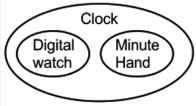
    The above given Venn Diagram is the correct representation of the relation between Clock, Digital Watch and Minute Hand.

    All the digital watches are a type of clock.

    All the minute hands are found in clock only.

    No digital watch has a minute hand.

    Hence, the correct answer is option 4.

  • Question 2/10
    1 / -0.33

    Which two signs should be interchanged in the following equation to make it correct?

    3 × 5 + 3 - 18 ÷ 3 = 12

    Solutions

    The correct answer is option 3 i.e. × and +

    Given equation: 3 × 5 + 3 - 18 ÷ 3 = 12

    On interchanging × and + we get

    3 × 5 + 3 - (18 ÷ 3) = 12

    ⇒ (3 × 5) + 3 - 6 = 12

    ⇒ (15 + 3) - 6 = 12

    ⇒ 18 - 6 = 12

    ⇒ 12 = 12

    Hence, the correct answer is × and +.

  • Question 3/10
    1 / -0.33

    Select the set in which the numbers are related in the same way as the numbers of the following set.

    (14, 31, 15)

    (12, 28, 14)

    Solutions

    The correct answer is option 3 i.e. (18, 30, 10).

    Logic: (x, y, z) → y = (x + z) + 2

    ⇒ (14, 31, 15)

    (14 + 15) + 2 = 29 + 2 = 31

    ⇒ (12, 28, 14)

    (12 + 14) + 2 = 26 + 2 = 28

    Similarly, 

    ⇒ (18, 30, 10)

    18 + 10 = 28 + 2 = 30

    Hence, the correct answer is (18, 30, 10).

  • Question 4/10
    1 / -0.33

    Six friends are sitting at a circular table from A to F (facing inside a circle). A is sitting opposite to B, C is sitting one place to the right of B. D and E cannot sit next to A. E sits to the right of B. Who is sitting to the immediate right of A?

    Solutions

    The correct answer is option 2 i.e. F

    F is sitting to the immediate right of A.

    Hence, the correct answer is F.

  • Question 5/10
    1 / -0.33

    Read the given instructions carefully and choose the correct answer.

    Six friends A, B, C, D, E and F are sitting in a row. All of them are facing north. F sits third to the right of the one who sits between D and E. A sits second to the left of C and second to the right of B who sits at one of the ends of the row.

    Who is the neighbour of B?

    Solutions

    The correct answer is Option 4 i.e. Either D or E

  • Question 6/10
    1 / -0.33

    Read the following information carefully and answer the questions given below.

    There are 7 persons seating in a straight line facing north. B sits 2nd to the left of K. M and D sit adjacent to each other. L sits to the immediate right of G who sits at one of the extreme ends of the line. V sits second to the left of M.

    How many persons are sitting between L and M?

    Solutions

    The correct answer is Option 3 i.e. Three

    Decoding the puzzle

    1) L sits to the immediate right of G who sits at one of the extreme ends of the line.

    (This implies that G sits at the extreme left end of the row)

    2) V sits second to the left of M.

    (Thus, M can sit either at 5th, 6th or 7th position from the left end)

  • Question 7/10
    1 / -0.33

    Eight friends A, B, C, D, E, F, G and H are sitting around a square table in such a way that four of them sit at four corners while four sit in the middle of each of the four sides. The ones who sit in the middle of the sides face the centre while those who sit at the four corners face outward (i.e. opposite the centre). C sits third to the right of D. D sits in the middle of one of the sides of the table. Only three people sit between C and H. Only one person sits between H and G. E is one of the immediate neighbours of G. Only three people sit between E and B. A sits second to the right of B.

    Which group of friends are sitting in the middle of each of the four sides?

    Solutions

    The correct answer is option 1 i.e. ABDE.

    According to the question, the arrangement is as follows:

    From the above arrangement, the group of friends sitting in the middle of each of the four sides are ABDE.

    Hence, the correct answer is ABDE.

  • Question 8/10
    1 / -0.33

    Eight friends A, B, C, D, E, F, G and H are sitting around a square table in such a way that four of them sit at four corners while four sit in the middle of each of the four sides. The ones who sit in the middle of the sides face the centre while those who sit at the four corners face outward (i.e. opposite the centre). C sits third to the right of D. D sits in the middle of one of the sides of the table. Only three people sit between C and H. Only one person sits between H and G. E is one of the immediate neighbours of G. Only three people sit between E and B. A sits second to the right of B.

    Three of the following four are alike in a certain way and so form a group. Which is the one that does not belong to that group?

    Solutions

    The correct answer is option 4 i.e. G.

    According to the question, the arrangement is as follows:

    From the above arrangement, G is sitting at one of the corners. Hence, G is the odd one out.

    Hence, the correct answer is G.

  • Question 9/10
    1 / -0.33

    In this question, two statements I and II have been given. These statements may be independent causes or effects of independent causes or a common cause. One of the statements may be the effect of the other statement. Read both statements and select the correct answer.

    Statement I: Providing women and girls equal access to education, healthcare, the labour market, and their own political and economic decision-making does not represent that men's opportunities are being stolen or making them inferior.

    Statement II: Understanding the impact of gender interventions can help develop effective models that can be promoted.

    Solutions

    The correct answer is option 3 i.e. Both I and II are effects of independent causes .

    Statement I focuses on the importance of providing women and girls equal opportunities without reducing men's opportunities.

    Statement II emphasizes the need to understand the impact of gender interventions to develop effective models.

    Both statements seem to address different aspects of gender equality and interventions but originate from different underlying causes, making them effects of independent causes.

    Hence, the correct answer is option 3.

  • Question 10/10
    1 / -0.33

    Select the letter that can replace the question mark (?) in the following series.

    BE, GH, KK, PN, ?

    Solutions

    The correct answer is Option 3 i.e. TQ.

    Given: BE, GH, KK, PN, ?

    Logic:

    B + 5 = G, E + 3 = H

    G + 4 = K, H + 3 = K

    K + 5 = P, K + 3 = N

    P + 4 = T, N + 3 = Q

    Hence, the next term will be 'TQ'.

    Hence, the correct answer is TQ.

Close button icon
User Profile
-

Correct (-)

Wrong (-)

Skipped (-)


  • 1
  • 2
  • 3
  • 4
  • 5
  • 6
  • 7
  • 8
  • 9
  • 10
Mockers logo Get latest Exam Updates
& Study Material Alerts!
No, Thanks
Arrow pointer icon
Click on Allow to receive notifications
Notification bell icon ×
Open Now