Please wait...

NDA I 2026 English Test - 9
Menu grid icon
Result Result point icon
NDA I 2026 English Test - 9
  • Goals icon

    /

    Score
  • Trophy icon

    -

    Rank
White alarm icon Time Taken: -
Result frame illustration
  • Question 1/10
    4 / -1.33

    Normal average thickness of stratospheric ozone layer across the globe is around

    Solutions

    Understanding the Stratospheric Ozone Layer Thickness

    The Earth's atmosphere is divided into several layers. One crucial layer is the stratosphere, which is located above the troposphere. Within the stratosphere, there is a region with a relatively high concentration of ozone gas (O3O3​). This region is known as the stratospheric ozone layer. The stratospheric ozone layer plays a vital role in protecting life on Earth by absorbing most of the Sun's harmful ultraviolet (UV) radiation.

    What are Dobson Units (DU)?

    The thickness of the ozone layer is commonly measured in Dobson Units (DU). One Dobson Unit is defined as the thickness of the ozone layer if all the ozone in a vertical column of air from the ground to the top of the atmosphere were compressed to standard temperature (0°C) and pressure (1 atmosphere). Under these conditions, 1 DU corresponds to a thickness of 0.01 millimeters (or 10 micrometers).

    So, a measurement of, say, 300 DU means that if all the ozone above a location were brought down to sea level and compressed to 0°C, it would form a layer 3 millimeters thick.

    Normal Average Thickness of the Stratospheric Ozone Layer

    The thickness of the stratospheric ozone layer varies depending on location, season, and time of day. However, a normal average thickness across the globe is often cited as approximately 300 Dobson Units (DU).

    • Thickness is typically greater over polar regions than over the tropics.
    • There are seasonal variations, with higher ozone levels generally occurring in spring.

    Let's look at the given options in relation to the normal average thickness:

    • 200 DU: While ozone levels can drop to this range, especially during severe depletion events like the "ozone hole" over Antarctica, it is significantly below the global average.
    • 300 DU: This value is widely recognized as representing the normal average thickness of the stratospheric ozone layer across the globe.
    • 400 DU: Ozone thickness can reach or exceed this value, particularly in specific locations and seasons (e.g., high latitudes in spring), but it is above the global average.
    • 500 DU: This value is quite high and would represent unusually high ozone concentrations or specific conditions, not the global average.

    Therefore, based on the typical measurements and scientific understanding, the normal average thickness of the stratospheric ozone layer across the globe is around 300 DU.
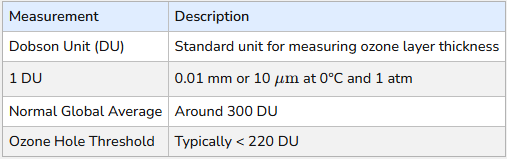
    Summary of Ozone Layer Thickness

    Revision Table: Stratospheric Ozone Facts
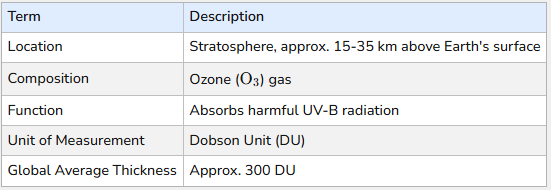
    Additional Information: Ozone Depletion

    While the normal average thickness is around 300 DU, certain chemicals, particularly chlorofluorocarbons (CFCs) and halons, have caused significant thinning of the ozone layer, a phenomenon known as ozone depletion. Severe depletion over Antarctica during spring creates the "ozone hole," where thickness can fall below 220 DU.

    Efforts like the Montreal Protocol have led to a reduction in the use of ozone-depleting substances, and the ozone layer is projected to recover gradually over several decades.

    Understanding the normal thickness helps in monitoring the health of the ozone layer and the impact of human activities.

  • Question 2/10
    4 / -1.33

    The apple, a widely consumed fruit, originated in Central Asia and is a pome, a type of fruit produced by flowering plants in the rose family. It is known for its crisp texture and varied colors, from green to red. Botanically, apples are classified as Malus domestica. The strawberry, often mistaken for a berry, is technically an aggregate accessory fruit, meaning its fleshy part is derived not from the plant's ovaries but from the receptacle that holds the ovaries. Its small, seed-like structures on the exterior are actually achenes, each containing a tiny seed. Blueberries, on the other hand, are true berries, characterized by their soft flesh and multiple seeds. They belong to the genus Vaccinium and are native to North America. These small, round fruits are rich in antioxidants and grow on shrubby plants.

    Which fruit, despite its common name, is botanically classified as an aggregate accessory fruit?

    Solutions

    Fruit Classification Analysis

    This question requires identifying which fruit, based on the provided botanical descriptions, is classified as an aggregate accessory fruit. We need to carefully examine the classification of each fruit mentioned.

    Botanical Classifications Explained

    • Apple: The text identifies the apple as a pome. Its botanical name is Malus domestica.
    • Blueberry: Blueberries are described as true berries, known for their soft flesh and multiple seeds, belonging to the genus Vaccinium.
    • Strawberry: The passage explicitly states that the strawberry is technically an aggregate accessory fruit. This means its fleshy part develops from the receptacle, not the ovary, and the 'seeds' on the outside are achenes.

    Identifying the Aggregate Accessory Fruit

    Comparing the definitions with the fruits:

    • The apple is a pome.
    • The blueberry is a true berry.
    • The strawberry is an aggregate accessory fruit.

    The term 'Pome' itself (Option 4) refers to a category of fruit like the apple, not a specific fruit commonly mistaken for something else in this context.

    Therefore, the strawberry is the fruit correctly identified as an aggregate accessory fruit.

  • Question 3/10
    4 / -1.33

    The apple, a widely consumed fruit, originated in Central Asia and is a pome, a type of fruit produced by flowering plants in the rose family. It is known for its crisp texture and varied colors, from green to red. Botanically, apples are classified as Malus domestica. The strawberry, often mistaken for a berry, is technically an aggregate accessory fruit, meaning its fleshy part is derived not from the plant's ovaries but from the receptacle that holds the ovaries. Its small, seed-like structures on the exterior are actually achenes, each containing a tiny seed. Blueberries, on the other hand, are true berries, characterized by their soft flesh and multiple seeds. They belong to the genus Vaccinium and are native to North America. These small, round fruits are rich in antioxidants and grow on shrubby plants.

    Which fruit mentioned in the passage is native to North America?

    Solutions

    Native Fruit Identification

    The task is to identify the fruit mentioned in the provided text that is native to North America.

    Passage Analysis of Fruit Origins

    The passage provides specific details about the origins and botanical classifications of the fruits mentioned:

    • Apple: The text clearly states that the apple "originated in Central Asia".
    • Strawberry: While described botanically as an "aggregate accessory fruit", the passage does not specify North America as its origin.
    • Blueberry: The passage explicitly states, "Blueberries, on the other hand, are true berries... and are native to North America." This directly answers the question.
    • Pome: This term refers to a botanical classification of fruit (like apples), not a specific fruit with a defined geographic origin in this context.

    Conclusion on North American Native Fruit

    Based on the direct information presented in the text, the Blueberry is identified as the fruit native to North America.

  • Question 4/10
    4 / -1.33

    The apple, a widely consumed fruit, originated in Central Asia and is a pome, a type of fruit produced by flowering plants in the rose family. It is known for its crisp texture and varied colors, from green to red. Botanically, apples are classified as Malus domestica. The strawberry, often mistaken for a berry, is technically an aggregate accessory fruit, meaning its fleshy part is derived not from the plant's ovaries but from the receptacle that holds the ovaries. Its small, seed-like structures on the exterior are actually achenes, each containing a tiny seed. Blueberries, on the other hand, are true berries, characterized by their soft flesh and multiple seeds. They belong to the genus Vaccinium and are native to North America. These small, round fruits are rich in antioxidants and grow on shrubby plants.

    What botanical term describes the apple, indicating its structure derived from the rose family?

    Solutions

    Determining the Apple's Botanical Classification

    The question asks for the specific botanical term that describes an apple, especially noting its relation to the rose family. The provided text offers a direct definition.

    Understanding Apple Fruit Structure

    According to the text:

    • Apples belong to the rose family (Rosaceae).
    • Apples are botanically classified as a pome.
    • A pome is defined as a type of fruit produced by flowering plants in the rose family.

    Evaluating Botanical Terms

    Let's examine the options in relation to the provided information:

    • Berry: The text clarifies that blueberries are true berries, but apples are not described as such.
    • Pome: This term is explicitly used in the text to describe the apple's structure and its origin from the rose family.
    • Drupe: This term refers to fruits like peaches or cherries, which have a hard stone surrounding the seed, and is not associated with apples in the text.
    • Achene: The text mentions achenes as the external seed-like structures on a strawberry, not the structure of an apple.

    Conclusion on Apple Classification

    Based on the botanical definition provided in the text, the apple is classified as a pome because it is a fruit structure characteristic of the rose family.

  • Question 5/10
    4 / -1.33

    Identify the INCORRECT statement about fermentation.

    Solutions

    Understanding Fermentation and Why Some Statements are Incorrect

    Fermentation is a metabolic process that produces chemical changes in organic substrates through the action of enzymes. It is a type of anaerobic respiration, meaning it occurs in the absence of oxygen. Different types of fermentation exist, carried out by various microorganisms and even some animal cells.

    Analyzing the Statements about Fermentation

    Let's examine each statement provided in the options:

    • Statement 1: "Fermentation occurs only in fungal cells."

    This statement claims that fermentation is limited exclusively to fungal cells. While fungi, particularly yeasts, are very well-known for carrying out fermentation (like alcoholic fermentation), fermentation is not restricted only to fungi. For example, bacteria perform various types of fermentation (like lactic acid fermentation, butyric acid fermentation, etc.). Muscle cells in animals can also perform lactic acid fermentation during intense exercise when oxygen supply is limited. Therefore, this statement is not accurate.

    • Statement 2: "The fermentation technique is used to make breads."

    This statement is correct. Yeast (a type of fungus) is commonly used in bread making. The yeast ferments sugars present in the dough, producing carbon dioxide gas and ethanol. The carbon dioxide gas gets trapped in the dough, causing it to rise and giving bread its airy texture. The ethanol evaporates during baking.

    • Statement 3: "It is the process of breaking down sugar into alcohol."

    This statement describes alcoholic fermentation, which is a specific type of fermentation where sugars (like glucose) are broken down into ethanol (alcohol) and carbon dioxide. This process is carried out by organisms like yeast. While not all fermentation processes produce alcohol (lactic acid fermentation produces lactic acid, for example), breaking down sugar into alcohol is indeed a valid description of a common type of fermentation used widely.

    • Statement 4: "Yeast is used in fermentation technology to prepare alcohol."

    This statement is correct. Yeast, specifically species like Saccharomyces cerevisiae, is extensively used in industries like brewing and distillation to produce alcoholic beverages (beer, wine, spirits) through the process of alcoholic fermentation.

    Identifying the Incorrect Statement

    Based on the analysis, Statement 1, "Fermentation occurs only in fungal cells," is the incorrect statement because fermentation is a process carried out by various organisms including bacteria and animal muscle cells, not just fungi.

  • Question 6/10
    4 / -1.33

    Consider the following statements and choose the appropriate option.

    Statement (A): The Muslim League announced 16 August 1946 as 'Direct Action Day' for winning the demand for Pakistan.

    Statement (B): The Cabinet Mission succeeded in providing a suitable political framework for free India that was acceptable for both the Congress and the Muslim League.

    Solutions

    Evaluating Muslim League's 'Direct Action Day' and Cabinet Mission's Success

    This solution examines two important historical statements regarding the Indian independence movement, focusing on the actions of the Muslim League and the role of the Cabinet Mission. We will analyze each statement to determine its accuracy.

    Analysis of Statement (A): The Muslim League's 'Direct Action Day'

    Statement (A) concerns the Muslim League's declaration of 16 August 1946 as 'Direct Action Day'. Let's break this down:

    • Who declared it? The All-India Muslim League, led by Muhammad Ali Jinnah.
    • What was it? A day designated for protests and demonstrations across India.
    • When was it? 16 August 1946.
    • Why was it declared? The primary goal was to forcefully assert the Muslim League's demand for the creation of Pakistan, a separate Muslim state. It was intended to show the resolve and strength of the League's supporters and to pressure the British government and the Indian National Congress.
    • Historical Context: The call for 'Direct Action Day' followed the failure of negotiations and aimed to bring matters to a head. Unfortunately, the day itself led to severe communal violence, particularly in Calcutta, highlighting the intense political and communal tensions of the time.

    Based on historical records, the Muslim League did indeed announce 16 August 1946 as 'Direct Action Day' to push for the demand for Pakistan. Therefore, Statement (A) is true.

    Analysis of Statement (B): The Cabinet Mission's Role

    Statement (B) evaluates the success of the Cabinet Mission in creating a political framework for India.

    • What was the Cabinet Mission? A high-level mission sent by the British government to India in 1946 to resolve the political deadlock concerning India's independence and the issue of partition. It consisted of Lord Pethick-Lawrence, Sir Stafford Cripps, and A.V. Alexander.
    • What was its goal? To help India achieve independence by negotiating a constitution and a viable political structure acceptable to both the Indian National Congress and the All-India Muslim League.
    • What did it propose? The mission proposed a plan that included an all-powerful Union government dealing with defence, foreign affairs, and communications, and residual powers resting with the provinces. Crucially, it suggested grouping provinces, which the Muslim League saw as a potential 'Pakistan' in disguise, while the Congress viewed it as potentially entrenches divisions.
    • Was it acceptable? While both the Congress and the Muslim League initially accepted the proposals in principle, deep disagreements soon surfaced over the interpretation of the plan, especially the clauses related to provincial grouping and the constituent assembly's structure. The Muslim League later withdrew its support, and the Congress also expressed reservations.
    • Outcome: The fundamental differences in interpretation and objectives meant the Cabinet Mission's proposals ultimately failed to provide a mutually agreeable political framework. It did not succeed in bridging the gap between the Congress and the Muslim League.

    Therefore, Statement (B) is false.

    Conclusion: Final Assessment of the Statements

    Comparing our analysis with the given options:

    • Statement (A) is confirmed as true: The Muslim League announced 'Direct Action Day' on 16 August 1946 to advance its demand for Pakistan.
    • Statement (B) is confirmed as false: The Cabinet Mission did not succeed in creating a political framework acceptable to both the Congress and the Muslim League.

    This leads us to the conclusion that the correct option is the one stating that (A) is true and (B) is false.

  • Question 7/10
    4 / -1.33

    Each item in this section consists of a sentence with an underlined word followed by four words/group of words. Select the option that is nearest in meaning to the underlined word and mark your response on the answer sheet accordingly.

    His temerarious disregard for the established protocols led to a swift reprimand.

    Solutions

    Keyword Analysis: Understanding 'Temerarious Disregard'

    The question requires identifying a synonym for the word temerarious, which describes how someone disregarded established protocols. The context tells us this action led to a "swift reprimand," indicating the disregard was likely unwise or dangerous.

    Defining 'Temerarious'

    The term temerarious describes behavior that is very bold, rash, or reckless. It implies acting without sufficient thought for danger or the possible consequences. Essentially, it means acting carelessly or without proper consideration.

    Exploring Word Options for 'Temerarious'

    We need to examine the provided options to find the one closest in meaning to temerarious:

    • Option 1: Cautious - This word means being careful and avoiding risks. It is the opposite of acting rashly.
    • Option 2: Reckless - This means acting without thinking about the consequences or potential dangers; being careless and rash. This meaning strongly aligns with temerarious.
    • Option 3: Prudent - This describes someone who acts with wisdom, care, and foresight. Similar to 'cautious', this is an antonym for temerarious.
    • Option 4: Compliant - This means obeying rules or instructions. It is the opposite of showing 'disregard' for established protocols.

    Selecting the Closest Synonym

    After evaluating the options, the word reckless is the best fit. A temerarious disregard for protocols signifies acting in a bold and careless manner, without minding the potential negative outcomes, which is precisely what reckless implies.

  • Question 8/10
    4 / -1.33

    In this section each of the following sentences has a blank space and each sentence is followed by four options. Select the most appropriate option to fill the blank space.

    Despite facing a series of daunting challenges and numerous financial setbacks, the startup's resilient team managed to uphold its collective ______ by celebrating small victories and maintaining a positive outlook.

    Solutions

    Startup Team Resilience: Filling the Blank

    This question challenges us to find the best word to complete a sentence describing a startup team's perseverance. The sentence emphasizes how the team, despite facing serious "daunting challenges" and "financial setbacks," managed to preserve their group's spirit. This was achieved through celebrating small successes and maintaining a positive outlook. We need a word that captures this collective state of mind and enthusiasm.

    Context: Maintaining Spirit Amidst Challenges

    Understanding the situation is key. A startup is navigating difficulties, but its "resilient team" actively works to keep up their spirits. The actions mentioned – celebrating small wins and having a positive outlook – are typical ways people boost or maintain their collective enthusiasm and confidence when times are tough.

    Vocabulary Analysis: Choosing the Right Word

    Let's examine each option carefully:

    • mood Analysis

      The term "mood" refers to a person's or group's temporary emotional state. While related to feelings, it often implies something more fleeting and less consciously maintained than what the sentence describes. A team might have a good or bad mood, but "upholding" a mood through specific actions points to something more substantial.

    • Morale Significance

      "Morale" specifically relates to the confidence, enthusiasm, and discipline of a group. This word fits perfectly because it describes the collective spirit that can be actively maintained or boosted. Celebrating small victories and maintaining a positive outlook are direct methods for upholding team morale, especially during challenging periods.

    • Morality Distinction

      "Morality" concerns principles of right and wrong, or ethical values. This concept is unrelated to a team's enthusiasm or psychological state in a work environment. It does not fit the context of overcoming business challenges.

    • Moral Usage

      "Moral" typically functions as an adjective (e.g., a moral obligation) or a noun referring to the lesson from a fable. It does not fit the context here as a noun representing the collective spirit or confidence of a team.

    Final Selection: The Correct Term

    Considering the definitions and the context of the sentence, "morale" is the most accurate and fitting word. It precisely describes the collective confidence and enthusiasm that the resilient startup team sustained by focusing on positivity and acknowledging small achievements, even amidst significant adversity.

  • Question 9/10
    4 / -1.33

    Western Disturbances are extratropical storm systems that originate over the Mediterranean Sea and bring crucial winter precipitation to the northern Indian subcontinent. Their eastward propagation across Central Asia, Iran, Afghanistan, and Pakistan towards India is primarily influenced by which of the following atmospheric circulation patterns?

    Solutions

    The correct answer is: Westerly Jet Stream

    Explanation:

    Western Disturbances are extratropical storm systems that originate over the Mediterranean Sea and bring winter precipitation to the northern Indian subcontinent. The movement of these disturbances towards India is primarily influenced by the Westerly Jet Stream, which is a high-altitude, fast-moving air current that flows from the west to the east.

    • The Westerly Jet Stream is positioned in the upper atmosphere (around 30 km altitude) and plays a significant role in steering weather systems, including Western Disturbances, from the Mediterranean region towards Central Asia, Pakistan, and northern India.
    • The Subtropical Easterly Jet Stream and the Intertropical Convergence Zone (ITCZ) do not play a significant role in the eastward propagation of Western Disturbances across the Indian subcontinent. The North-East Monsoon Winds are primarily responsible for bringing moisture to southern and eastern India but are not related to Western Disturbances.

    Therefore, the Westerly Jet Stream is the primary atmospheric circulation pattern that influences the propagation of Western Disturbances.

  • Question 10/10
    4 / -1.33

    In this section each of the following sentences has a blank space and each sentence is followed by four options. Select the most appropriate option to fill the blank space.

    Indians ________ plants like Peepal and Tulsi sacred and worship them.

    Solutions

    Understanding the Sentence: Indians and Sacred Plants

    The question requires filling in a blank in the sentence: "Indians ________ plants like Peepal and Tulsi sacred and worship them." This sentence describes how Indians perceive certain plants, such as the Peepal and Tulsi, and the resulting action of worshipping them. We need to choose the verb that best describes this perception of sacredness.

    Analyzing Verb Options for Regard

    The sentence suggests that Indians hold Peepal and Tulsi plants in a special, sacred regard, leading to worship. Let's examine how each option fits this context:

    • think: While Indians might think these plants are sacred, the verb 'think' is very general. It doesn't specifically capture the nuance of holding something in a particular, revered status that leads to worship.
    • consider: This verb means to regard or think of something or someone in a specific way. "Indians consider plants like Peepal and Tulsi sacred" accurately means they view these plants as holy or divine, which directly explains why they would worship them. This option strongly fits the context.
    • judge: The verb 'judge' typically implies forming an opinion based on evidence or criteria, often involving evaluation or criticism. It doesn't align well with the concept of treating plants as sacred and worshipping them.
    • reflect: 'Reflect' means to think deeply or to mirror something. In this sentence, Indians are not 'reflecting' the plants as sacred; they are actively regarding them as such. This verb doesn't fit the intended meaning.

    Step-by-Step Solution

    1. Contextual Fit: The sentence links regarding plants as 'sacred' with the act of 'worship'. The chosen verb must bridge these two ideas effectively.
    2. Option 1 Analysis (think): 'Think' is too broad and doesn't convey the specific sense of reverence implied.
    3. Option 2 Analysis (consider): 'Consider' means to regard or deem. "Indians consider these plants sacred" perfectly sets up the reason for worship. This is the most suitable option.
    4. Option 3 Analysis (judge): 'Judge' implies evaluation, which is not the primary meaning here. Sacredness is a matter of belief and reverence, not judgment in the typical sense.
    5. Option 4 Analysis (reflect): 'Reflect' implies contemplation or mirroring, which does not fit the active act of deeming something sacred.
    6. Final Verification: The sentence "Indians consider plants like Peepal and Tulsi sacred and worship them" makes logical and grammatical sense, clearly stating the belief that leads to the action.

    Conclusion

    The verb consider is the most appropriate choice because it accurately describes the act of regarding or holding Peepal and Tulsi plants as sacred, which is the reason Indians worship them. It fits the context better than 'think', 'judge', or 'reflect'.

Close button icon
User Profile
-

Correct (-)

Wrong (-)

Skipped (-)


  • 1
  • 2
  • 3
  • 4
  • 5
  • 6
  • 7
  • 8
  • 9
  • 10
Mockers logo Get latest Exam Updates
& Study Material Alerts!
No, Thanks
Arrow pointer icon
Click on Allow to receive notifications
Notification bell icon ×
Open Now
