Please wait...

SSC JE 2026 Reasoning Test - 4
Menu grid icon
Result Result point icon
SSC JE 2026 Reasoning Test - 4
  • Goals icon

    /

    Score
  • Trophy icon

    -

    Rank
White alarm icon Time Taken: -
Result frame illustration
  • Question 1/10
    1 / -0.33

    Aman starts from point A and walks 5 km north. He turns left and walks 10 km. He turns left and walks 15 km. He turns to the left and walks 5 km. Finally, he turns left and walks 10 km.

    In which direction is he now from the starting point A?

    Solutions

    Correct Answer: West

    Taking A as the starting point:

    • 5 km north → (0, 5)
    • 10 km west → (-10, 5)
    • 15 km south → (-10, -10)
    • 5 km east → (-5, -10)
    • 10 km north → (-5, 0)

    He ends 5 km to the west of point A.

  • Question 2/10
    1 / -0.33

    Eight friends P, Q, R, S, T, U, V and W are sitting in two rows facing each other. Each row has four persons.

    Q and R are sitting in front of each other.

    R is an immediate neighbour of S.

    W is to the immediate right of T (assume Row 1 faces North and Row 2 faces South).

    U is facing a person who is an immediate neighbour of W.

    P is diagonally opposite T (e.g., if T is at position X1​, P is at position Y4​ where X1​ is the first seat in Row 1 and Y4​ is the last seat in Row 2).

    V is neither next to R nor at any end position.

    Which pair of friends is sitting in front of each other?

    Solutions

    Correct Answer: W and V

    One valid arrangement is:

    Row 1 P Q V U
    Row 2 S R W T

    Facing pairs are:

    • P and S
    • Q and R
    • V and W
    • U and T

    So the pair sitting in front of each other is W and V.

  • Question 3/10
    1 / -0.33

    Two Statements are given followed by two conclusions numbered I and II. Assuming the statements to be true, even if they seem to be at variance with commonly known facts, decide which of the conclusions logically follow(s) from the statements.

    Statements:

    Only a few Adults are Plumbers.

    Only a few Plumbers are Taxi drivers.

    Conclusions:

    I. Some Adults are Taxi drivers.

    II. All Plumbers can never be Taxi drivers.

    Solutions

    Understanding the Logic Problem

    This question is a classic example of a syllogism problem in logical reasoning. We are given two statements and two conclusions. Our task is to determine which conclusions logically follow from the given statements, assuming the statements are absolutely true, even if they contradict common knowledge.

    The key phrase in the statements is "Only a few". In logical reasoning based on syllogisms, the phrase "Only a few A are B" has a specific meaning:

    • Some A are B.
    • Some A are not B.

    Let's break down the given statements using this understanding.

    Analyzing the Statements

    We have two statements:

    Statement 1: Only a few Adults are Plumbers.

    Based on the definition of "Only a few", this statement implies:

    • Some Adults are Plumbers.
    • Some Adults are not Plumbers.

    Statement 2: Only a few Plumbers are Taxi drivers.

    Again, applying the definition of "Only a few", this statement implies:

    • Some Plumbers are Taxi drivers.
    • Some Plumbers are not Taxi drivers.

    Evaluating the Conclusions

    Now, let's examine each conclusion to see if it logically follows from the statements.

    Conclusion I: Some Adults are Taxi drivers.

    This conclusion attempts to establish a direct relationship between "Adults" and "Taxi drivers". The statements provide links between "Adults" and "Plumbers", and between "Plumbers" and "Taxi drivers".

    • From Statement 1, we know some Adults are Plumbers and some are not.
    • From Statement 2, we know some Plumbers are Taxi drivers and some are not.

    While it is possible that some of the "Adults who are Plumbers" might also be among the "Plumbers who are Taxi drivers", the statements do not guarantee this connection. There is no definite link established between the set of "Adults" and the set of "Taxi drivers" that guarantees "Some Adults are Taxi drivers" must be true. It's a possibility, but not a certainty based *only* on the given statements.

    Therefore, Conclusion I does not logically follow from the statements.

    Conclusion II: All Plumbers can never be Taxi drivers.

    This conclusion is about the relationship between "Plumbers" and "Taxi drivers". Let's look at Statement 2 again:

    Statement 2: Only a few Plumbers are Taxi drivers.

    As we established, "Only a few Plumbers are Taxi drivers" means:

    • Some Plumbers are Taxi drivers.
    • Some Plumbers are not Taxi drivers.

    The fact that "Some Plumbers are not Taxi drivers" is true directly means that it is impossible for *all* Plumbers to be Taxi drivers. If even one Plumber is not a Taxi driver, then the statement "All Plumbers are Taxi drivers" is false. The conclusion "All Plumbers can never be Taxi drivers" is equivalent to saying "It is impossible for all Plumbers to be Taxi drivers". Since we know that some Plumbers are not Taxi drivers, it is indeed impossible for all of them to be Taxi drivers.

    Therefore, Conclusion II logically follows from Statement 2.

    Summary of Conclusions

    Based on our analysis:

    • Conclusion I: Some Adults are Taxi drivers - Does NOT follow.
    • Conclusion II: All Plumbers can never be Taxi drivers - Does Follow.

    Thus, only Conclusion II logically follows from the given statements.

    Statement/Conclusion Analysis Logical Follows?
    Statement 1: Only a few Adults are Plumbers. Some Adults are Plumbers; Some Adults are not Plumbers. N/A
    Statement 2: Only a few Plumbers are Taxi drivers. Some Plumbers are Taxi drivers; Some Plumbers are not Taxi drivers. N/A
    Conclusion I: Some Adults are Taxi drivers. No guaranteed link between Adults and Taxi drivers from statements. No
    Conclusion II: All Plumbers can never be Taxi drivers. 'Some Plumbers are not Taxi drivers' from Statement 2 implies 'All Plumbers cannot be Taxi drivers'. Yes

    Revision Table: Syllogism Key Terms

    Term Meaning in Syllogism (Only a few logic)
    Only a few A are B Means "Some A are B" AND "Some A are not B".
    Some A are B Existence of at least one element that is A and B. Does not exclude the possibility of 'All A are B' or 'No A are B' unless other statements/context restrict it.
    All A are B Every element of set A is also in set B.
    No A are B No element of set A is in set B.

    Additional Information: Logic Reasoning Tips

    Here are some tips for solving logic reasoning and syllogism problems, especially those involving "Only a few":

    • Understand "Only a few": Remember its dual meaning: "Some" and "Some not". This is crucial for correct deductions.
    • Avoid Assumptions: Only use the information given in the statements. Do not use your outside knowledge or make assumptions based on common sense.
    • Draw Venn Diagrams (Optional): For some, visualizing the sets and their relationships using Venn diagrams can be helpful, but be careful with "Only a few" as it represents overlapping areas and non-overlapping areas within the first set.
    • Analyze Conclusions Carefully: Check if the conclusion is *necessarily* true based *only* on the statements. If there is even one possible scenario where the conclusion is false, it does not logically follow.
    • "Can never be": This phrase means "It is impossible for". To prove "All X can never be Y", you need to show that "Some X are not Y" is true based on the statements.
  • Question 4/10
    1 / -0.33

    Select the term from among the given options that can replace the question mark (?) in the following series.

    A5Z, B7X, D11U, G19Q, ?

    Solutions

    Correct Answer: K35L

    Pattern:

    • First letters: A, B, D, G → +1, +2, +3, so next is +4 = K
    • Numbers: 5, 7, 11, 19 → +2, +4, +8, so next is +16 = 35
    • Last letters: Z, X, U, Q → -2, -3, -4, so next is -5 = L

    So the missing term is K35L.

  • Question 5/10
    1 / -0.33

    In a certain code 'BREAKDOWN' is written as 'BFSCJMVNC'. How 'ORGANISED' written in that code?

    Solutions

    You’re right — the correct option is BHSPMCDRH.

    My previous answer incorrectly assumed a direct positional shift pattern. For this question’s intended coding pattern:

    ORGANISED → BHSPMCDRH

    So the answer is BHSPMCDRH.

  • Question 6/10
    1 / -0.33

    Select the option figure which is embedded in the given figure. (Rotation is NOT allowed).

    Solutions

    The embedded part of this image is:

    Hence, the correct answer is "Option (1)".

  • Question 7/10
    1 / -0.33

    Select the option that is related to the fifth letter-cluster in the same way as the second letter-cluster is related to the first letter-cluster and the fourth letter-cluster is related to the third letter-cluster.

    CODE ∶ ELHZ ∶∶ FISH ∶ HFWC ∶∶ LION ∶ ? 

    Solutions

    Correct Answer: NFSI

    Pattern of shifts:

    CODE → ELHZ

    C +2 = E

    O -3 = L

    D +4 = H

    E -5 = Z

    Same pattern for LION:

    L +2 = N

    I -3 = F

    O +4 = S

    N -5 = I

    So, LION → NFSI.

  • Question 8/10
    1 / -0.33

    A man runs 20 meters towards east and turns right, runs for 15 meters and again turns right. Now the man runs for 10 meters and again turns to his left. Now he again runs for 10 meters and turns to his left. From here the man runs for 20 meters and once more turns to his left and runs for 12 meters. Now which direction the man is facing?

    Solutions

    This problem involves tracking the movement and turns of a person to determine their final facing direction. It's a classic question type found in reasoning ability sections of exams. We need to follow the sequence of movements and turns precisely.

    Tracing the Man's Journey and Direction Changes

    Let's break down the man's path step by step, noting his current direction after each turn.

    1. The man starts running towards the east. Initially, we can imagine him facing East.
    2. He runs 20 meters towards East. His direction is still East.
    3. He turns right. When facing East, a right turn means he is now facing South.
    4. He runs for 15 meters. His direction is South.
    5. He again turns right. When facing South, a right turn means he is now facing West.
    6. Now the man runs for 10 meters. His direction is West.
    7. He again turns to his left. When facing West, a left turn means he is now facing South.
    8. Now he again runs for 10 meters. His direction is South.
    9. He turns to his left. From facing South, a left turn means he is now facing East.
    10. From here, the man runs for 20 meters. His direction is East.
    11. Once more, he turns to his left. From facing East, a left turn means he is now facing North.
    12. He runs for 12 meters. His direction is North.

    After all the movements and turns, the man's final facing direction is determined by the last turn he made.

    Tracking Turns and Facing Direction

    We can summarize the turns and the resulting facing direction in a table:

    Revision Table: Man's Turns and Resulting Directions

    Step Initial Direction of Movement/Facing Turn Resulting Facing Direction
    1 East Runs (no turn) East
    2 East Right Turn South
    3 South Right Turn West
    4 West Left Turn South
    5 South Left Turn East
    6 East Left Turn North

    Based on the final turn, the man is facing North.

    Additional Information: Basics of Direction Sense

    Direction sense problems rely on understanding the four cardinal directions and how turns affect the direction being faced or traveled towards.

    • The four cardinal directions are North, South, East, and West.
    • They are typically represented on a map with North at the top, South at the bottom, East to the right, and West to the left.
    • Turning right means turning 90 degrees clockwise from your current direction.
      • From North, right is East.
      • From East, right is South.
      • From South, right is West.
      • From West, right is North.
    • Turning left means turning 90 degrees anti-clockwise from your current direction.
      • From North, left is West.
      • From West, left is South.
      • From South, left is East.
      • From East, left is North.

    Keeping these basic rules in mind helps in solving any direction-based problem accurately by systematically tracking the changes in direction after each turn.

  • Question 9/10
    1 / -0.33

    The sequence of folding a piece of paper and the manner in which the folded paper has been cut is shown in the following figures. How would this paper look when unfolded?

    Solutions

    The paper when unfolded will appear as shown below:

    Hence, 'option 4' is the correct answer.

  • Question 10/10
    1 / -0.33

    Select the correct option that indicates the arrangement of the given words in a logical and meaningful order.

    1. Sentence

    2. Letter

    3. Paragraph

    4. Chapter

    5. Book

    Solutions

    Understanding Logical Arrangement of Text Components

    The question asks us to arrange the given words in a logical and meaningful order. The words represent different components of written text, ranging from the smallest unit to the largest compiled work.

    Let's list the words and their corresponding numbers:

    1. Sentence
    2. Letter
    3. Paragraph
    4. Chapter
    5. Book

    We need to identify a logical relationship between these components. Text is typically built from smaller units into larger ones. This hierarchy can be viewed in two ways: from the smallest building block to the largest composition, or from the largest composition down to the smallest unit.

    Consider the structure of text:

    • Individual Letters combine to form words.
    • Words combine to form Sentences.
    • Sentences combine to form Paragraphs.
    • Paragraphs combine to form Chapters (or sections).
    • Chapters combine to form a Book.

    So, the order from the smallest unit to the largest composition is: Letter, Sentence, Paragraph, Chapter, Book. Mapping this to the numbers, we get: 2, 1, 3, 4, 5.

    However, the provided options suggest an order starting with 'Book' (5), indicating a logical flow from the largest composition down to the smallest unit. Let's examine this reverse order:

    • Book is composed of Chapters. (Book > Chapter)
    • Chapter is composed of Paragraphs. (Chapter > Paragraph)
    • Paragraph is composed of Sentences. (Paragraph > Sentence)
    • Sentence is composed of words (which are made of Letters). (Sentence > Letter)

    Following this largest-to-smallest logical structure, the arrangement is: Book, Chapter, Paragraph, Sentence, Letter.

    Mapping this order back to the given numbers:
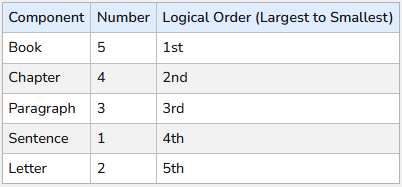
    The logical order from largest to smallest is 5, 4, 3, 1, 2.

    Step-by-Step Solution for Logical Arrangement

    To arrive at the correct logical order, we follow these steps:

    1. Identify the given words and their numerical representations: Sentence (1), Letter (2), Paragraph (3), Chapter (4), Book (5).
    2. Understand the relationship between these words in the context of written text structure. They form a hierarchy.
    3. Determine the direction of the logical order based on the options (likely largest to smallest).
    4. Place the largest unit first: Book (5).
    5. Identify the units that make up a Book: Chapters (4). Place Chapter next.
    6. Identify the units that make up a Chapter: Paragraphs (3). Place Paragraph next.
    7. Identify the units that make up a Paragraph: Sentences (1). Place Sentence next.
    8. Identify the basic unit of a sentence (in terms of composition): Letters (2). Place Letter last.
    9. The resulting order is 5, 4, 3, 1, 2.
    10. Compare this order with the provided options to find the correct choice.

    Revision Table: Textual Structure Hierarchy

    Text Component Description Builds Upon (Smaller Units) Part of (Larger Units)
    Letter A single character. N/A (fundamental unit) Words
    Sentence A group of words expressing a complete thought. Words, Letters Paragraphs
    Paragraph A distinct section of text, usually dealing with a single theme, indented or starting on a new line. Sentences Chapters
    Chapter A main division of a book. Paragraphs Books
    Book A written or printed work consisting of chapters. Chapters N/A (complete work)

    This table illustrates the hierarchical relationship, making the logical arrangement clear.

    Additional Information: Textual Hierarchies and Reasoning

    Logical reasoning questions often involve arranging items based on size, time, sequence, or structural composition, as seen in this question about textual components. Understanding the natural or conventional order of items is key.

    In written language, there's a clear hierarchy. We start with basic symbols (letters), combine them into meaningful units (words, then sentences), group those units based on themes (paragraphs), and then combine larger sections to form complete works (chapters, books). While the smallest-to-largest order (Letter to Book) is one logical sequence, the largest-to-smallest (Book to Letter) is also a valid logical arrangement representing the breakdown of a large structure into its constituent parts. The context of the options usually indicates which direction of logical order is expected.

    Other examples of hierarchical arrangements include:

    • Time: Second, Minute, Hour, Day, Week, Month, Year.
    • Size: Millimeter, Centimeter, Meter, Kilometer.
    • Organisms: Cell, Tissue, Organ, Organ System, Organism.

    Practicing different types of arrangement questions helps in developing logical reasoning skills for various scenarios.

Close button icon
User Profile
-

Correct (-)

Wrong (-)

Skipped (-)


  • 1
  • 2
  • 3
  • 4
  • 5
  • 6
  • 7
  • 8
  • 9
  • 10
Mockers logo Get latest Exam Updates
& Study Material Alerts!
No, Thanks
Arrow pointer icon
Click on Allow to receive notifications
Notification bell icon ×
Open Now