Verify mobile number to view the solution
Solutions
Solving Syllogism Statements and Conclusions
This problem requires us to analyse the given statements and determine which of the provided conclusions logically follow. We will examine each statement and then evaluate each conclusion based on the information provided in the statements.
Given Statements
- Some pens are books.
- All books are compasses.
- Some compasses are pins.
Given Conclusions
- I. Some compasses are pens.
- II. All compasses are pens.
- III. Some pins are books.
- IV. Some compasses are books.
Analysing the Statements
Let's represent the categories:
- Pens (P)
- Books (B)
- Compasses (C)
- Pins (Pi)
The statements can be interpreted as relationships between these categories:
- Statement 1: Some pens are books (Some P are B). This means there is an overlap between the set of pens and the set of books. There is at least one item that belongs to both categories.
- Statement 2: All books are compasses (All B are C). This means the entire set of books is contained within the set of compasses. Every book is also a compass.
- Statement 3: Some compasses are pins (Some C are Pi). This means there is an overlap between the set of compasses and the set of pins. There is at least one item that belongs to both categories.
Evaluating Each Conclusion
Now, let's evaluate each conclusion based on the information from the statements:
Conclusion I: Some compasses are pens (Some C are P).
Let's consider Statements 1 and 2:
- Some pens are books (Some P are B).
- All books are compasses (All B are C).
Since some pens are books, there's a group of items that are both pens and books. According to the second statement, all books are compasses. Therefore, the group of items that are both pens and books must also be compasses. This means there are some pens that are compasses. If some pens are compasses, it logically follows that some compasses are pens.
Conclusion I logically follows from the statements.
Conclusion II: All compasses are pens (All C are P).
From Conclusion I, we know that some compasses are pens. However, this does not mean that all compasses are pens. Statement 2 says "All books are compasses", but it doesn't say that *only* books are compasses. Compasses could include items that are not books (and therefore not necessarily pens). There is no information given that restricts the set of compasses solely to pens or to things that are also pens.
Conclusion II does not logically follow from the statements.
Conclusion III: Some pins are books (Some Pi are B).
Let's consider Statements 2 and 3:
- All books are compasses (All B are C).
- Some compasses are pins (Some C are Pi).
We know that all books are compasses, and some compasses are pins. However, the compasses that are pins might be precisely the ones that are *not* books. The statements do not guarantee any overlap between the set of pins and the set of books. There is no direct link established between books and pins.
Conclusion III does not logically follow from the statements.
Conclusion IV: Some compasses are books (Some C are B).
Consider Statement 2:
- All books are compasses (All B are C).
If all books are compasses, it means that the set of books is entirely contained within the set of compasses. Assuming there is at least one book (which is a standard assumption in these types of problems unless stated otherwise), then that book must also be a compass. If there is at least one item that is a book and also a compass, then it must be true that some compasses are books (specifically, the compasses that are also books).
Conclusion IV logically follows from the statements.
Summary of Conclusions
Based on our analysis:
- Conclusion I (Some compasses are pens) follows.
- Conclusion II (All compasses are pens) does not follow.
- Conclusion III (Some pins are books) does not follow.
- Conclusion IV (Some compasses are books) follows.
Therefore, only conclusions I and IV logically follow from the given statements.
| Conclusion |
Logically Follows? |
Reasoning Based on Statements |
| I. Some compasses are pens. |
Yes |
From "Some pens are books" and "All books are compasses", we deduce Some pens are compasses, implying Some compasses are pens. |
| II. All compasses are pens. |
No |
Knowing Some compasses are pens doesn't mean ALL compasses are pens. There could be compasses that are not pens. |
| III. Some pins are books. |
No |
From "All books are compasses" and "Some compasses are pins", there's no guaranteed overlap between books and pins. |
| IV. Some compasses are books. |
Yes |
If "All books are compasses", then the set of books is part of the compasses. Thus, Some compasses must be books. |
Revision Table: Basic Syllogism Inferences
Here are a couple of basic inference rules used in syllogism problems:
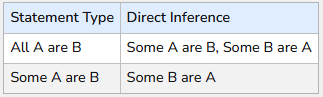
Also, combining statements often follows rules, such as:

Note: Many combinations of statements yield no valid direct conclusion between the extreme terms (A and C).
Additional Information on Syllogism Logic
Syllogism problems are a key part of logical reasoning tests. They assess your ability to draw valid conclusions strictly from given premises, regardless of whether those premises align with real-world facts. The structure typically involves two or three statements (premises) and a set of conclusions.
To solve these problems effectively, you must:
- Understand the meaning of quantifiers like "All", "Some", and "No".
- Trace the relationship between different categories across the statements.
- Avoid bringing outside knowledge into the problem. Only the information in the statements is true for the purpose of the exercise.
Using techniques like Venn diagrams or understanding the distribution of terms can help visualise the relationships and verify the validity of conclusions, especially in more complex cases.
 ReNEET UG 2026
 JEE Advanced 2026
 CUET UG 2026
 UP Police Constable 2026
 SSC Selection Post (Phase 14) 2026
 SSC GD 2025-26
 RRB NTPC 2026
 SSC CGL Tier-I 2026
 SSC JE 2026
 UPSC (CSE) 2026
 SBI PO Prelims 2026
 SSC Steno Grade C & D 2026
 SBI Clerk Prelims 2026
 IBPS PO Prelims 2026
 IBPS Clerk Prelims 2026
 SSC CPO Tier I 2026
 Bank
Bank


 SSC
SSC


 Railway


 State
State


 Other
Other


 Teaching


 Insurance


 Medical


 Engineering


 Defence


 GATE
GATE


 NTA CUET

 UPSC
UPSC

 MBA Entrance


 LAW
LAW


