Please wait...

Probability Test 2
Menu grid icon
Result Result point icon
Probability Test 2
  • Goals icon

    /

    Score
  • Trophy icon

    -

    Rank
White alarm icon Time Taken: -
Result frame illustration
  • Question 1/10
    1 / -0

    In each of a set of games it is 2 to 1 in favour of the winner of the previous game. The chance that the player who wins the first game shall win three at least of the next four is

    Solutions

    Let W stand for the winning of a game and L for losing it. Then there are 4 mutually exclusive possibilities

    (i) W, W, W
    (ii) W, W, L, W
    (iii) W, L, W, W
    (iv) L, W, W, W.

    [Note that case (i) includes both the cases whether he losses or wins the fourth game.]

    By the given conditions of the question, the probabilities for (i), (ii), (iii) and (iv) respectively are

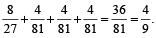
    Hence the required probability

    [Since the probability of winning the game if previous game was also won is 2/(1+2) = 2/3 and the probability of winning the game if previous game was a loss is 1/(1+2) = 1/3].

  • Question 2/10
    1 / -0

    A man and his wife appear for an interview for two posts. The probability of the husband’s selection is ¹⁄₇ and that of the wife’s selection is ⅕. The probability that only one of them will be selected is

    Solutions

    Probability that only husband is selected

  • Question 3/10
    1 / -0

    In a single throw with four dice, the probability of throwing seven is:

    Solutions

    Total of seven can be obtained in the following ways

    1, 1, 1, 4 in = 4 ways [there are four objects, three repeated]

    Similarly,

    1, 1,2, 3 in = 12 ways

    1, 2,2, 2 in  = 4 ways

    Hence, required probability

    [Since exhaustive no. of cases = 6 × 6 × 6 × 6 = 6⁴]

  • Question 4/10
    1 / -0

    Six dice are thrown. The probability that different number will turn up is :

    Solutions

    The number of ways of getting the different number 1, 2, ….., 6 in six dice = 6!.

    Total number of ways = 6⁶

    Hence, required probability

  • Question 5/10
    1 / -0

    There are four machines and it is known that exactly two of them are faulty. They are tested, one by one, in a random order till both the faulty machines are identified. Then the probability that only two tests are needed is

    Solutions

    The faulty machines can be identified in two tests only if both the tested machines are either all defective or all non-defective. See the following tree diagram.

    (Here D is for Defective & ND is for Non Defective)

    Required Probability

    Since the probability that first machine is defective (or non-defective) is ²⁄₄ and the probability that second machine is also defective (or non – defective) is ⅓ as 1 defective machine remains in total three machines.

  • Question 6/10
    1 / -0

    The probability that a person will hit a target in shooting practice is 0.3. If he shoots 10 times, the probability that he hits the target is

    Solutions

    The probability that the person hits the target = 0.3

    ∴ The probability that he does not hit the target in a trial

    = 1 – 0.3 = 0.7

    ∴ The probability that he does not hit the target in any of the ten trials = (0.7)¹⁰

    ∴ Probability that he hits the target

    = Probability that at least one of the trials succeeds

    = 1 – (0.7)¹⁰.

  • Question 7/10
    1 / -0

    The probability that A can solve a problem is ⅔ and B can solve it is ¾. If both attempt the problem, what is the probability that the problem gets solved?

    Solutions

    The probability that A cannot solve the problem

  • Question 8/10
    1 / -0

    Seven people seat themselves indiscriminately at round table. The probability that two distinguished persons will be next to each other is

    Solutions

    Seven people can seat themselves at a round table in 6! ways. The number of ways in which two distinguished persons will be next to each other = 2 (5) !, Hence, the required probability

  • Question 9/10
    1 / -0

    The probability that two integers chosen at random and their product will have the same last digit is :

    Solutions

    The condition implies that the last digit in both the integers should be 0, 1, 5 or 6 and the probability

    [ Since the squares of numbers ending in 0 or 1 or 5 or 6 also 0 or 1 or 5 or 6 respectively]

  • Question 10/10
    1 / -0

    The probability that the birth days of six different persons will fall in exactly two calendar months is

    Solutions

    Exhaustive number of cases = 12

    Favourable cases = ¹²C₂ (2⁶ – 2)

    ∴ Probability 

Close button icon
User Profile
-

Correct (-)

Wrong (-)

Skipped (-)


  • 1
  • 2
  • 3
  • 4
  • 5
  • 6
  • 7
  • 8
  • 9
  • 10
Mockers logo Get latest Exam Updates
& Study Material Alerts!
No, Thanks
Arrow pointer icon
Click on Allow to receive notifications
Notification bell icon ×
Open Now