Please wait...
/
-
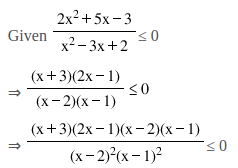
The solution set for the inequality fraction numerator 2 straight x squared plus 5 straight x minus 3 over denominator straight x squared minus 3 straight x plus 2 end fraction ≤ 0 is
Verify mobile number to view the solution
⇒ (x + 3) (2x – 1) (x – 1) (x – 2) ≤ 0
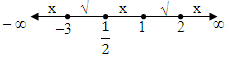
⇒ The critical points are –3, 1/2, 1 and 2
When x = 0, the inequality is true
The solution set is [–3, 1/2] ∪ (1, 2)
The equation (1 + m2) x2 + 2mcx + c2 – a2 = 0 has equal roots, if
Equal roots, if D = 0 ⇒ B2 – 4AC = 0
(2mc)2 – 4(1 + m2)(c2 – a2) = 0
4m2c2 – 4[c2 + m2c2 – m2a2 – a2] = 0
As 4 ≠ 0
c2 – m2a2 – a2 = 0 ⇒ c2 = a2(1 + m2)
The minimum value of 10 + |x| is
When x < - 2, |x – 1| > 3
So, |x + 2| + |x – 1| > 3
When x > 1, |x + 2| > 3 and so |x + 2| + |x – 1| > 3.
When -2 < × < 1, |x + 2| + |x – 1| = 3
Hence there is no real number x such that |x + 2| + |x – 1| < 2.
The minimum value of the expression |2x – 3| + 17 is
We know that
∴ |2x – 3| > 0 for every real value of x.
∴ |2x – 3| + 17 > 17
∴ the minimum value of |2x + 3| + 17 is 17.
If |3x + 7| > 12, then the range of the real values of x is
Given |3x + 7| > 12
3x + 7 < – 12 or 3x + 7 > 12
3x < – 19 or 3x > 5
x < – 19 / 3 or x > 5 / 3
∴ the solution set is
Match list I with list II
List I
List II
A.
Roots of 2x2 – 13x + 21 = 0
7/2 and 1
B.
Roots of 2x2 – 9x + 7 = 0
3 and 7/2
C.
Roots of x2 – 6x + 9 = 0
3 and 3
D.
Roots of 2x2 – 21x + 49 = 0
7 and 7/2
A 2x2 – 13x + 21 = 0 ⇒ 2x2 – 7x – 6x + 21 = 0
⇒ x(2x – 7) – 3(2x – 7) = 0 ⇒ (2x – 7)(x – 3) = 0
⇒ x = 7/2 or x = 3
B 2x2 – 9x + 7 = 0 ⇒ (2x – 7)(x – 1) = 0
⇒ x = 7 / 2 or x = 1
C x2 – 6x + 9 = 0
⇒ (x – 3)(x – 3) = 0
⇒ x = 3 or x = 3
D 2x2 – 21x + 49 = 0
⇒ (2x – 7)(x – 7) = 0
⇒ x = 7 / 2 or x = 7
The number of integer values of x satisfying the in equation |x + 3| < 5 is
Given |x + 3| < 5
⇒ – 5 < x + 3 < 5
⇒ – 5 – 3 < x < 5 – 3
⇒ – 8 < x < 2
∴ The integers which satisfy the given in equation are –8, –7, –6, –5, –4, –3, –2, –1, 0, 1 and 2.
Hence the required number of integers is 11.
If |b| > 2 and x = |a| b, then which of the following is always true?
Given x = |a| b and |b| > 2
a + xb = a + |a| b2
and a – xb = a - |a|b2
As|–6| > 1, the magnitude of |a| b2 is greater than that of a.
The sign of either expression is determined by the sign of this term.
i.e. a + |a| b2 > 0 and a – |a| b2 < 0
The equality holds when a = 0.
Find the range of the real values of x if |9 – x| < 2 – 3x.
Given, |9 – x| < 2 – 3x
Let x < 9
Then, 9 – x < 2 – 3x ⇒ 2x < – 7
⇒ x < – 7 / 2 which agrees with x < 9
Let x > 9
Then –(9 – x) < 2 – 3x
– 9 + x < 2 – 3x
4x < 11
which does not agree with x > 9.
∴ the solution set is .
If one of the roots of the equation ax2 + x – 3 = 0 is -1.5 then what is the value of a?
Since, – 1.5 is a root of ax2 + x – 3 = 0
∴ a(–1.5)2 + (–1.5) – 3 = 0
⇒ 2.25 a – 4.5 = 0 ⇒ a =
Correct (-)
Wrong (-)
Skipped (-)


 Time Taken: -
 Bank
Bank


 SSC
SSC


 Railway


 State
State


 Other
Other


 Teaching


 Insurance


 Medical


 Engineering


 Defence


 GATE
GATE


 NTA CUET

 UPSC
UPSC

 MBA Entrance


 LAW
LAW

 JEE Advanced 2026
 CUET UG 2026
 NEET UG 2026
 UP Police Constable 2026
 SSC Selection Post (Phase 14) 2026
 SSC GD 2025-26
 RRB NTPC 2026
 SSC CGL Tier-I 2026
 SSC JE 2026
 UPSC (CSE) 2026
 SBI PO Prelims 2026
 SSC Steno Grade C & D 2026