Please wait...

IBPS Clerk 2019 Reasoning Test - 3
Menu grid icon
Result Result point icon
IBPS Clerk 2019 Reasoning Test - 3
  • Goals icon

    /

    Score
  • Trophy icon

    -

    Rank
White alarm icon Time Taken: -
Result frame illustration
  • Question 1/10
    1 / -0

    Directions For Questions

    Study the following information carefully and answer the given questions.

    Eight friends A, B, C, D, E, F, G and H are sitting around a circle facing towards the centre. Additionally it is known that:
    1) B is sitting opposite F
    2) Neither A nor E is opposite to G
    3) C and H are not neighbours
    4) E is to the immediate right of B
    5) A and C are not neighbours
    6) D is two places to the right of G

    ...view full instructions


    Who is sitting two places to the right of D?

    Solutions

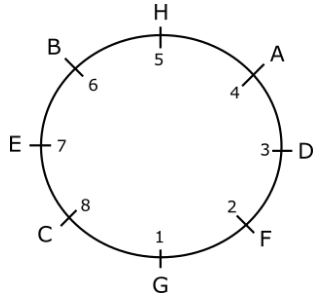
    Let us number the positions from 1 to 8 around the circle as shown in the figure.
    As we have the most amount of definite information on G, let us begin by placing G in position 1.
    From statement 6 we know that D is two places to the right of G
    So D will be in position 3.
    From statement 1 we know that B is sitting opposite F.
    From statement 4 we know that E is to the immediate right of B.
    Combining statements 1 and 4 we know that B can be in either position 6 or position 4.
    If B is in position 4then E will be opposite G which is against statement 2.
    So B must be sitting in position 6.
    This means that F is in position 2.
    As E is to the immediate right of B, E will be in position 7.
    Now from statements 3 and 5 we know that C and H are not neighbours and A and C are not neighbours.
    This means that C must be in position 8.
    Now from statement 2 we know that A is not opposite G.
    So H must be in position 5 and A must be in position 4.
    Hence the final seating arrangement is as shown in the figure below.
     

  • Question 2/10
    1 / -0

    Directions For Questions

    Study the following information carefully and answer the given questions.

    Eight friends A, B, C, D, E, F, G and H are sitting around a circle facing towards the centre. Additionally it is known that:

    1) B is sitting opposite F
    2) Neither A nor E is opposite to G
    3) C and H are not neighbours
    4) E is to the immediate right of B
    5) A and C are not neighbours
    6) D is two places to the right of G

    ...view full instructions


    How many people are sitting in between G and F?

    Solutions

    Let us number the positions from 1 to 8 around the circle as shown in the figure.
    As we have the most amount of definite information on G, let us begin by placing G in position 1.
    From statement 6 we know that D is two places to the right of G
    So D will be in position 3.
    From statement 1 we know that B is sitting opposite F.
    From statement 4 we know that E is to the immediate right of B.
    Combining statements 1 and 4 we know that B can be in either position 6 or position 4.
    If B is in position 4then E will be opposite G which is against statement 2.
    So B must be sitting in position 6.
    This means that F is in position 2.
    As E is to the immediate right of B, E will be in position 7.
    Now from statements 3 and 5 we know that C and H are not neighbours and A and C are not neighbours.
    This means that C must be in position 8.
    Now from statement 2 we know that A is not opposite G.
    So H must be in position 5 and A must be in position 4.
    Hence the final seating arrangement is as shown in the figure below.


  • Question 3/10
    1 / -0

    Directions For Questions

    Study the following information carefully and answer the given questions.

    Eight friends A, B, C, D, E, F, G and H are sitting around a circle facing towards the centre. Additionally it is known that:

    1) B is sitting opposite F
    2) Neither A nor E is opposite to G
    3) C and H are not neighbours
    4) E is to the immediate right of B
    5) A and C are not neighbours
    6) D is two places to the right of G

    ...view full instructions


    What is the position of H with respect to C?

    Solutions

    Let us number the positions from 1 to 8 around the circle as shown in the figure.
    As we have the most amount of definite information on G, let us begin by placing G in position 1.
    From statement 6 we know that D is two places to the right of G
    So D will be in position 3.
    From statement 1 we know that B is sitting opposite F.
    From statement 4 we know that E is to the immediate right of B.
    Combining statements 1 and 4 we know that B can be in either position 6 or position 4.
    If B is in position 4then E will be opposite G which is against statement 2.
    So B must be sitting in position 6.
    This means that F is in position 2.
    As E is to the immediate right of B, E will be in position 7.
    Now from statements 3 and 5 we know that C and H are not neighbours and A and C are not neighbours.
    This means that C must be in position 8.
    Now from statement 2 we know that A is not opposite G.
    So H must be in position 5 and A must be in position 4.
    Hence the final seating arrangement is as shown in the figure below.


  • Question 4/10
    1 / -0

    Directions For Questions

    Study the following information carefully and answer the given questions.

    Eight friends A, B, C, D, E, F, G and H are sitting around a circle facing towards the centre. Additionally it is known that:

    1) B is sitting opposite F
    2) Neither A nor E is opposite to G
    3) C and H are not neighbours
    4) E is to the immediate right of B
    5) A and C are not neighbours
    6) D is two places to the right of G

    ...view full instructions


    Pick the odd pair out.

    Solutions

    Let us number the positions from 1 to 8 around the circle as shown in the figure.
    As we have the most amount of definite information on G, let us begin by placing G in position 1.
    From statement 6 we know that D is two places to the right of G
    So D will be in position 3.
    From statement 1 we know that B is sitting opposite F.
    From statement 4 we know that E is to the immediate right of B.
    Combining statements 1 and 4 we know that B can be in either position 6 or position 4.
    If B is in position 4then E will be opposite G which is against statement 2.
    So B must be sitting in position 6.
    This means that F is in position 2.
    As E is to the immediate right of B, E will be in position 7.
    Now from statements 3 and 5 we know that C and H are not neighbours and A and C are not neighbours.
    This means that C must be in position 8.
    Now from statement 2 we know that A is not opposite G.
    So H must be in position 5 and A must be in position 4.
    Hence the final seating arrangement is as shown in the figure below.

    All the pairs except the pair in Option B have exactly one person sitting in between them.


  • Question 5/10
    1 / -0

    Directions For Questions

    Study the following information carefully and answer the given questions.

    Eight friends A, B, C, D, E, F, G and H are sitting around a circle facing towards the centre. Additionally it is known that:

    1) B is sitting opposite F
    2) Neither A nor E is opposite to G
    3) C and H are not neighbours
    4) E is to the immediate right of B
    5) A and C are not neighbours
    6) D is two places to the right of G

    ...view full instructions


    Who is sitting opposite D?

    Solutions

    Let us number the positions from 1 to 8 around the circle as shown in the figure.
    As we have the most amount of definite information on G, let us begin by placing G in position 1.
    From statement 6 we know that D is two places to the right of G
    So D will be in position 3.
    From statement 1 we know that B is sitting opposite F.
    From statement 4 we know that E is to the immediate right of B.
    Combining statements 1 and 4 we know that B can be in either position 6 or position 4.
    If B is in position 4then E will be opposite G which is against statement 2.
    So B must be sitting in position 6.
    This means that F is in position 2.
    As E is to the immediate right of B, E will be in position 7.
    Now from statements 3 and 5 we know that C and H are not neighbours and A and C are not neighbours.
    This means that C must be in position 8.
    Now from statement 2 we know that A is not opposite G.
    So H must be in position 5 and A must be in position 4.
    Hence the final seating arrangement is as shown in the figure below.


  • Question 6/10
    1 / -0

    Directions For Questions

    The following questions are based on the following set of 5 numbers.

    6548, 6436, 6987, 6876, 6153

    ...view full instructions


    If the second and third digits of each of the given numbers are interchanged, then which of the following would be the third largest number?

    Solutions

    Given numbers: 6548, 6436, 6987, 6876, 6153
    Numbers after changing the second and the third digits = 6458, 6346, 6897, 6786, 6513
    Hence the third largest number is 6513.


  • Question 7/10
    1 / -0

    Directions For Questions

    The following questions are based on the following set of 5 numbers.

    6548, 6436, 6987, 6876, 6153

    ...view full instructions


    How many of the given numbers are divisible by 3?

    Solutions

    For a number to be divisible by 3, the sum of the digits should be divisible by 3.
    The sum of the digits for each of the given numbers is given below.
    6548 = 23
    6436 = 19
    6987 = 30
    6876 = 27
    6153 = 15
    Hence we can see that 3 numbers are divisible by 3.


  • Question 8/10
    1 / -0

    Directions For Questions

    The following questions are based on the following set of 5 numbers.

    6548, 6436, 6987, 6876, 6153

    ...view full instructions


    If the first and the last digits of each of the given numbers are interchanged then which of the following would be the second largest number?

    Solutions

    Given numbers: 6548, 6436, 6987, 6876, 6153
    Numbers after interchanging the first and the last digits = 8546, 6436, 7986, 6876, 3156.
    Hence the second largest number would be 7986.


  • Question 9/10
    1 / -0

    Directions For Questions

    The following questions are based on the following set of 5 numbers.

    6548, 6436, 6987, 6876, 6153

    ...view full instructions


    If the product of the digits is calculated for each of the given numbers then which number will have the largest product?

    Solutions

    The product of the digits are calculated for each of the given numbers then we have
    6548 = 6*5*4*8 = 960
    6436 = 6*4*3*6 = 432
    6987 = 6*9*8*7 = 3024
    6876 = 6*8*7*6 = 2016
    6153 = 6*1*5*3 = 90
    Hence the product is largest for 6987


  • Question 10/10
    1 / -0

    Directions For Questions

    The following questions are based on the following set of 5 numbers.

    6548, 6436, 6987, 6876, 6153

    ...view full instructions


    If the product of the digits is calculated for each of the given numbers then what will be the difference between the largest and the smallest product?

    Solutions

    The product of the digits are calculated for each of the given numbers then we have
    6548 = 6*5*4*8 = 960
    6436 = 6*4*3*6 = 432
    6987 = 6*9*8*7 = 3024
    6876 = 6*8*7*6 = 2016
    6153 = 6*1*5*3 = 90
    Hence the required difference = 3024 - 90 = 2934


Close button icon
User Profile
-

Correct (-)

Wrong (-)

Skipped (-)


  • 1
  • 2
  • 3
  • 4
  • 5
  • 6
  • 7
  • 8
  • 9
  • 10
Mockers logo Get latest Exam Updates
& Study Material Alerts!
No, Thanks
Arrow pointer icon
Click on Allow to receive notifications
Notification bell icon ×
Open Now
