Please wait...

IBPS Clerk 2019 Reasoning Test - 7
Menu grid icon
Result Result point icon
IBPS Clerk 2019 Reasoning Test - 7
  • Goals icon

    /

    Score
  • Trophy icon

    -

    Rank
White alarm icon Time Taken: -
Result frame illustration
  • Question 1/10
    1 / -0

    Directions For Questions

    Read the following information carefully and answer the questions which follow.

    8 people P, Q, R, S, T, U, V and W live at different floors among 1 to 8 in a building. There are 2 people living between P and V and P lives on a floor higher than V. S and T live on adjacent floors and T does not live on the top floor. 3 people live between U and W and 3 people live between S and Q. Only V lives between Q and R. The number of people living below W is 1 more than the number of people living above him.

    ...view full instructions


    Who lives on the 7th floor?

    Solutions

    We can make a table in the following manner and then fill it according to the given information.
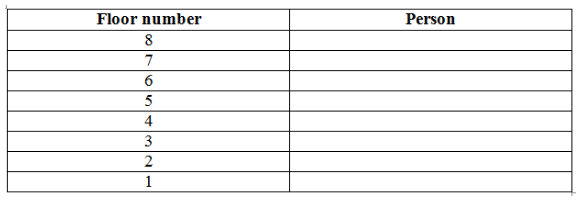
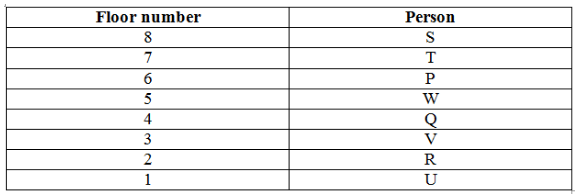
    We know that the number of people living below W is one more than the number of people living below him. Hence W must be on the 5th floor. It is also given that 3 people live between U and W. Hence U can only be at the first floor. There are 2 people between P and V and V is the only person between Q and R. So V can be 2nd or 7th. However if V is 7th then P will not have any place since it has been given that P lives on a floor higher that V. Hence V must be 2nd and P must be 6th.This implies that S must be 8th and T must be 7th. Since there are 3 people between S and Q, so Q must be 4th and R must be 2nd. Thus, we will have the following arrangement
     

  • Question 2/10
    1 / -0

    Directions For Questions

    Read the following information carefully and answer the questions which follow.

    8 people P, Q, R, S, T, U, V and W live at different floors among 1 to 8 in a building. There are 2 people living between P and V and P lives on a floor higher than V. S and T live on adjacent floors and T does not live on the top floor. 3 people live between U and W and 3 people live between S and Q. Only V lives between Q and R. The number of people living below W is 1 more than the number of people living above him.

    ...view full instructions


    How many people live between T and R?

    Solutions

    We can make a table in the following manner and then fill it according to the given information.

    We know that the number of people living below W is one more than the number of people living below him. Hence W must be on the 5th floor. It is also given that 3 people live between U and W. Hence U can only be at the first floor. There are 2 people between P and V and V is the only person between Q and R. So V can be 2nd or 7th. However if V is 7th then P will not have any place since it has been given that P lives on a floor higher that V. Hence V must be 2nd and P must be 6th.This implies that S must be 8th and T must be 7th. Since there are 3 people between S and Q, so Q must be 4th and R must be 2nd. Thus, we will have the following arrangement


  • Question 3/10
    1 / -0

    Directions For Questions

    Read the following information carefully and answer the questions which follow.

    8 people P, Q, R, S, T, U, V and W live at different floors among 1 to 8 in a building. There are 2 people living between P and V and P lives on a floor higher than V. S and T live on adjacent floors and T does not live on the top floor. 3 people live between U and W and 3 people live between S and Q. Only V lives between Q and R. The number of people living below W is 1 more than the number of people living above him.

    ...view full instructions


    Who lives at the first floor?

    Solutions

    We can make a table in the following manner and then fill it according to the given information.

    We know that the number of people living below W is one more than the number of people living below him. Hence W must be on the 5th floor. It is also given that 3 people live between U and W. Hence U can only be at the first floor. There are 2 people between P and V and V is the only person between Q and R. So V can be 2nd or 7th. However if V is 7th then P will not have any place since it has been given that P lives on a floor higher that V. Hence V must be 2nd and P must be 6th.This implies that S must be 8th and T must be 7th. Since there are 3 people between S and Q, so Q must be 4th and R must be 2nd. Thus, we will have the following arrangement


  • Question 4/10
    1 / -0

    Directions For Questions

    Read the following information carefully and answer the questions which follow.

    8 people P, Q, R, S, T, U, V and W live at different floors among 1 to 8 in a building. There are 2 people living between P and V and P lives on a floor higher than V. S and T live on adjacent floors and T does not live on the top floor. 3 people live between U and W and 3 people live between S and Q. Only V lives between Q and R. The number of people living below W is 1 more than the number of people living above him.

    ...view full instructions


    How many people live between S abd U

    Solutions

    We can make a table in the following manner and then fill it according to the given information.

    We know that the number of people living below W is one more than the number of people living below him. Hence W must be on the 5th floor. It is also given that 3 people live between U and W. Hence U can only be at the first floor. There are 2 people between P and V and V is the only person between Q and R. So V can be 2nd or 7th. However if V is 7th then P will not have any place since it has been given that P lives on a floor higher that V. Hence V must be 2nd and P must be 6th.This implies that S must be 8th and T must be 7th. Since there are 3 people between S and Q, so Q must be 4th and R must be 2nd. Thus, we will have the following arrangement


  • Question 5/10
    1 / -0

    Directions For Questions

    Read the following information carefully and answer the questions which follow.

    8 people P, Q, R, S, T, U, V and W live at different floors among 1 to 8 in a building. There are 2 people living between P and V and P lives on a floor higher than V. S and T live on adjacent floors and T does not live on the top floor. 3 people live between U and W and 3 people live between S and Q. Only V lives between Q and R. The number of people living below W is 1 more than the number of people living above him.

    ...view full instructions


    Who lives on the 6th floor?

    Solutions

    We can make a table in the following manner and then fill it according to the given information.

    We know that the number of people living below W is one more than the number of people living below him. Hence W must be on the 5th floor. It is also given that 3 people live between U and W. Hence U can only be at the first floor. There are 2 people between P and V and V is the only person between Q and R. So V can be 2nd or 7th. However if V is 7th then P will not have any place since it has been given that P lives on a floor higher that V. Hence V must be 2nd and P must be 6th.This implies that S must be 8th and T must be 7th. Since there are 3 people between S and Q, so Q must be 4th and R must be 2nd. Thus, we will have the following arrangement


  • Question 6/10
    1 / -0

    Directions For Questions

    In the question three statements are given, followed by three conclusions. You have to consider the statements to be true even if they seem to be at variance from commonly known facts. You have to decide which of the given conclusions, if any, follows from the given statements and select the appropriate option.

    ...view full instructions


    Statements:

    Statement 1: Some P are D.

    Statement 2: All C are A.

    Statement 3: No P is A.

    Conclusion :

    Conclusion 1: No C is P.

    Conclusion 2: No C is D.

    Conclusion 3: Some A are definitely D.

    Solutions

    From all the diagrams we can see that all C are A and No P is A hence no C is P.
    From all the diagrams we can see that Some C may be D.
    From all the diagrams we can see that Some A may/ may not D.
    Hence we can say that only I conclusion follow.


  • Question 7/10
    1 / -0

    Directions For Questions

    In the question three statements are given, followed by three conclusions. You have to consider the statements to be true even if they seem to be at variance from commonly known facts. You have to decide which of the given conclusions, if any, follows from the given statements and select the appropriate option.

    ...view full instructions


    Statements:

    Statement 1: All C are X.

    Statement 2: All X are P.

    Statement 3: No Q is C.

    Conclusion :

    Conclusion 1: Some X are not Q.

    Conclusion 2: Some Q may be both X and P.

    Conclusion 3: Some P are not Q.

    Solutions

    From all the diagrams we can see that all C those are part of X and P can’t be Q hence conclusion I, III follows.
    From all the diagrams we can see that Some Q may be both X and P.
    Hence we can say that only all I, II, III conclusion follows.


  • Question 8/10
    1 / -0

    Directions For Questions

    In the question three statements are given, followed by three conclusions. You have to consider the statements to be true even if they seem to be at variance from commonly known facts. You have to decide which of the given conclusions, if any, follows from the given statements and select the appropriate option.

    ...view full instructions


    Statements:

    Statement 1: No F is E.

    Statement 2: No E is C.

    Statement 3: No Y is E.

    Conclusion :

    Conclusion 1: Some F are C.

    Conclusion 2: Some Y are F.

    Conclusion 3: Some C are Y.

    Solutions

    From both the diagrams, we can see that Some F may/may not be C.
    From both the diagrams, we can see that Some Y may/may not be F.
    From both the diagrams, we can see that Some C may/may not be Y.
    Hence we can say that no conclusion follows.


  • Question 9/10
    1 / -0

    Directions For Questions

    In the question three statements are given, followed by three conclusions. You have to consider the statements to be true even if they seem to be at variance from commonly known facts. You have to decide which of the given conclusions, if any, follows from the given statements and select the appropriate option.

    ...view full instructions


    Statements:

    Statement 1: All P are T.

    Statement 2: Some T are J.

    Statement 3: Some X are J.

    Conclusion :

    Conclusion 1: Some X may be P.

    Conclusion 2: No J is p.

    Conclusion 3: Some X may be both J and T.

    Solutions

    From all the diagrams we can see that Some X may be P.
    From all the diagrams we can see that Some J may be P.
    From all the diagrams we can see that Some X may be both J and T.
    Hence we can say that only I, III conclusion follows.
    Hence A is the correct answer.


  • Question 10/10
    1 / -0

    Directions For Questions

    In the question three statements are given, followed by three conclusions. You have to consider the statements to be true even if they seem to be at variance from commonly known facts. You have to decide which of the given conclusions, if any, follows from the given statements and select the appropriate option.

    ...view full instructions


    Statements:

    Statement 1: All H are E.

    Statement 2: All E are D.

    Statement 3: All D are M.

    Conclusion :

    Conclusion 1: Some M are not H.

    Conclusion 2: Some D are not H.

    Conclusion 3: Some E are not M.

    Solutions

    We can see from the diagram that when all H, E, D, M congruent then no conclusion follows. Hence option E is the correct answer.


Close button icon
User Profile
-

Correct (-)

Wrong (-)

Skipped (-)


  • 1
  • 2
  • 3
  • 4
  • 5
  • 6
  • 7
  • 8
  • 9
  • 10
Mockers logo Get latest Exam Updates
& Study Material Alerts!
No, Thanks
Arrow pointer icon
Click on Allow to receive notifications
Notification bell icon ×
Open Now
