Please wait...

SBI Clerk 2020 Reasoning Test - 17
Menu grid icon
Result Result point icon
SBI Clerk 2020 Reasoning Test - 17
  • Goals icon

    /

    Score
  • Trophy icon

    -

    Rank
White alarm icon Time Taken: -
Result frame illustration
  • Question 1/10
    1 / -0

    Directions For Questions

    Study the following information carefully and answer the questions given below it.

    There are seven persons namely G, K, L, N, P, S and U are living in a nine story building but not necessarily in same order. There are two vacant floors in the building. Ground floor is numbered as floor number one above it floor number two and so on. Similarly top floor is numbered as floor number nine.

    There are three floors gap between P’s floor and G’s floor. P’s floor is above of G’s floor. P lives on even number floor. There is only one floor gap between G’s floor and a vacant floor. U lives on floor number five. K’s floor is just above of N’s floor. N’s floor is above of both the vacant floor. Top floor is not the vacant floor. The number of floors are below of K is same as the number of floors are above of L. S lives below of vacant floor.

    ...view full instructions


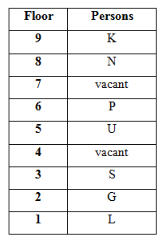
    There are how many floors gap between P’s floor and K’s floor?

    Solutions

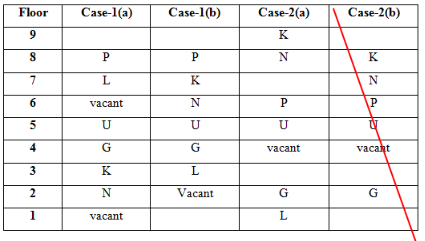
    There are three floors gap between P’s floor and G’s floor. P’s floor is above of G’s floor. P lives on even number floor. Here, we have two cases.
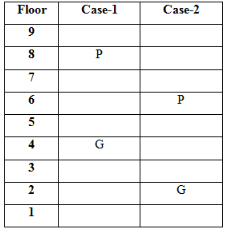
    There is only one floor gap between G’s floor and a vacant floor. Here, we have one more case from Case-1. U lives on floor number five.
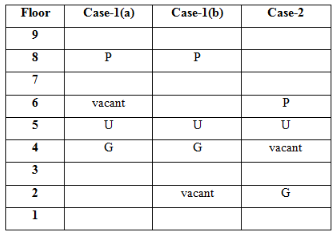
    K’s floor is just above of N’s floor. Here, we have one more case from Case-2.
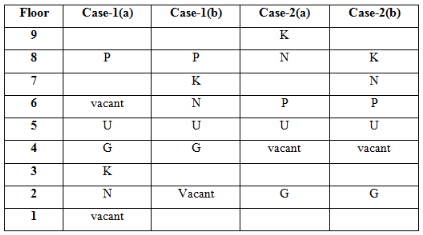
    The number of floors are below of K is same as the number of floors are above of L. Here, Case-2(b) is eliminated.
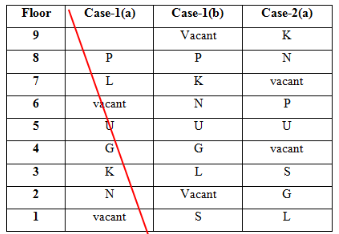
    S lives below of vacant floor. Here, Case-1(a) is eliminated.
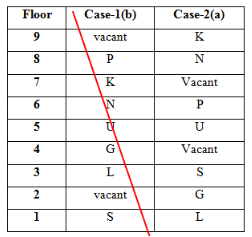
    Top floor is not the vacant floor. Here, Case-1(b) is eliminated.
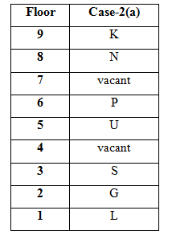
    Hence, Final solution is Case-2(a).
     

  • Question 2/10
    1 / -0

    Study the following information carefully and answer the questions given below it.

    A certain number of persons are sitting around a circular table and all of them are facing towards the center. Two persons sit between N and M (either left or right). P is an immediate neighbor of both R and S. P sits second to the right of M. U sits immediate right of S. T sits third to the left of R. Three persons are sitting between N and P when counting from the left N.

    How many seats are around the table?

    Solutions

    Two persons sit between N and M (either left or right). Here, we have two cases.

    P sits second to the right of M.

    P is an immediate neighbor of both R and S. Here, Case-2 is eliminated.

    T sits third to the left of R. Three persons are sitting between N and P when counting from the left N.

    U sits immediate right of S. Hence, final solution is Case-1.


  • Question 3/10
    1 / -0

    Study the following information carefully and answer the questions given below it.

    A certain number of persons are sitting around a circular table and all of them are facing towards the center. Two persons sit between N and M (either left or right). P is an immediate neighbor of both R and S. P sits second to the right of M. U sits immediate right of S. T sits third to the left of R. Three persons are sitting between N and P when counting from the left N.

    Who sits immediate left of T?

    Solutions

    Two persons sit between N and M (either left or right). Here, we have two cases.

    P sits second to the right of M.

    P is an immediate neighbor of both R and S. Here, Case-2 is eliminated.

    T sits third to the left of R. Three persons are sitting between N and P when counting from the left N.

    U sits immediate right of S. Hence, final solution is Case-1.


  • Question 4/10
    1 / -0

    Study the following information carefully and answer the questions given below it.

    A certain number of persons are sitting around a circular table and all of them are facing towards the center. Two persons sit between N and M (either left or right). P is an immediate neighbor of both R and S. P sits second to the right of M. U sits immediate right of S. T sits third to the left of R. Three persons are sitting between N and P when counting from the left N.

    How many known persons are sitting between N and M when counted from left of N?

    Solutions

    Two persons sit between N and M (either left or right). Here, we have two cases.

    P sits second to the right of M.

    P is an immediate neighbor of both R and S. Here, Case-2 is eliminated.

    T sits third to the left of R. Three persons are sitting between N and P when counting from the left N.

    U sits immediate right of S. Hence, final solution is Case-1.


  • Question 5/10
    1 / -0

    Study the following information carefully and answer the questions given below it.

    A certain number of persons are sitting around a circular table and all of them are facing towards the center. Two persons sit between N and M (either left or right). P is an immediate neighbor of both R and S. P sits second to the right of M. U sits immediate right of S. T sits third to the left of R. Three persons are sitting between N and P when counting from the left N.

    Who among the following sits fourth to the left of U?

    Solutions


    Two persons sit between N and M (either left or right). Here, we have two cases.

    P sits second to the right of M.

    P is an immediate neighbor of both R and S. Here, Case-2 is eliminated.

    T sits third to the left of R. Three persons are sitting between N and P when counting from the left N.

    U sits immediate right of S. Hence, final solution is Case-1.


  • Question 6/10
    1 / -0

    Study the following information carefully and answer the questions given below it.

    A certain number of persons are sitting around a circular table and all of them are facing towards the center. Two persons sit between N and M (either left or right). P is an immediate neighbor of both R and S. P sits second to the right of M. U sits immediate right of S. T sits third to the left of R. Three persons are sitting between N and P when counting from the left N.

    What is the position of S with respect to M?

    Solutions


    Two persons sit between N and M (either left or right). Here, we have two cases.

    P sits second to the right of M.

    P is an immediate neighbor of both R and S. Here, Case-2 is eliminated.

    T sits third to the left of R. Three persons are sitting between N and P when counting from the left N.

    U sits immediate right of S. Hence, final solution is Case-1.


  • Question 7/10
    1 / -0

    Directions For Questions

    In each of the following questions, relationship between different elements is shown in the statements followed by two conclusions. Find the conclusion which is definitely true.

    Give answer:

    a) If only conclusion I follows.

    b) If only conclusion II follows.

    c) If either conclusion I or II follows.

    d) If neither conclusion I nor II follows.

    e) If both conclusions I and II follow.

    ...view full instructions


    Statements:

    M < L > V ≤ C; K ≥ N = T ≤ P; G ≥ L < N ≥ H

    Conclusion:

    I) P > V

    II) G ≥ M

    Solutions

    I) P > V (True) (P ≥ T = N > L > V)

    II) G ≥ M (False) (G ≥ L > M)


  • Question 8/10
    1 / -0

    Directions For Questions

    In each of the following questions, relationship between different elements is shown in the statements followed by two conclusions. Find the conclusion which is definitely true.

    Give answer:

    a) If only conclusion I follows.

    b) If only conclusion II follows.

    c) If either conclusion I or II follows.

    d) If neither conclusion I nor II follows.

    e) If both conclusions I and II follow.

    ...view full instructions


    Statements:

    P ≤ Z < E < T; R ≤ S = A < U; P ≥ U ≤ D

    Conclusion:

    I) T > A

    II) R < D

    Solutions

    I) T > A (True) (T > E > Z ≥ P ≥U > A

    II) R < D (True) (D ≥ U > A = S ≥ R)


  • Question 9/10
    1 / -0

    Directions For Questions

    In each of the following questions, relationship between different elements is shown in the statements followed by two conclusions. Find the conclusion which is definitely true.

    Give answer:

    a) If only conclusion I follows.

    b) If only conclusion II follows.

    c) If either conclusion I or II follows.

    d) If neither conclusion I nor II follows.

    e) If both conclusions I and II follow.

    ...view full instructions


    Statements:

    L < N ≥ C = K; G ≥ M ≤ T = K

    Conclusion:

    I) N > M

    II) M = N

    Solutions

    L < N ≥ C = K = T ≥ M

    Either ‘N > M’ or ‘M = N’


  • Question 10/10
    1 / -0

    Directions For Questions

    Study the following information carefully and answer the questions given below it.

    There are seven colour boxes namely Blue, Green, Grey, Magenta, Pink, Red and White placed one above another but not necessarily in same order.

    Red colour box placed at fourth position from bottom. There are two boxes are placed between Red colour box and Magenta colour box. Blue colour box is not placed at bottom. Three boxes are placed between White colour box and Blue colour box. White colour box is placed above of Blue colour box. Pink colour box is placed above of Grey colour box and below of Green colour box. Not more than two boxes are placed between White colour box and Grey colour box.

    ...view full instructions


    How many boxes are placed above of Green colour box?

    Solutions

    Red colour box placed at fourth position from bottom. There are two boxes are placed between Red colour box and Magenta colour box. Here, we have following cases.

    Blue colour box is not placed at bottom. Three boxes are placed between White colour box and Blue colour box. White colour box is placed above of Blue colour box. Here, we have one more case.

    Pink colour box is placed above of Grey colour box and below of Green colour box.

    Not more than two boxes are placed between White colour box and Grey colour box. Here, Case-1(a) and Case-2 are eliminated.

    Hence, Final solution is Case-1(b).


Close button icon
User Profile
-

Correct (-)

Wrong (-)

Skipped (-)


  • 1
  • 2
  • 3
  • 4
  • 5
  • 6
  • 7
  • 8
  • 9
  • 10
Mockers logo Get latest Exam Updates
& Study Material Alerts!
No, Thanks
Arrow pointer icon
Click on Allow to receive notifications
Notification bell icon ×
Open Now