Please wait...

Linear Arrangement Test 2
Menu grid icon
Result Result point icon
Linear Arrangement Test 2
  • Goals icon

    /

    Score
  • Trophy icon

    -

    Rank
White alarm icon Time Taken: -
Result frame illustration
  • Question 1/15
    1 / -0

    Directions For Questions

    Directions: Read the following information and answer the given questions:

    Seven persons A, B, C, D, E, F and G are seated in a row facing North. Each of them belongs to different profession: Teacher, Architect, Businessman, Engineer, Lawyer, Banker and Doctor but not necessarily in the same order. Three persons sit between D and the one who is a Banker. D is sitting at one of the extreme ends of the row. A who is a Doctor is an immediate neighbour of D. G is not an immediate neighbour of A and the one who is a Banker. The one who is a lawyer sits to the immediate right of E who is a Teacher. G is not a Lawyer. Neither B nor F is a Banker. B is not an immediate neighbour of C. The one who is an Engineer does not sit at any of the extreme ends of the row. D is not an Architect.

    ...view full instructions


    Which of the following condition is true?
    Solutions

    Persons: A, B, C, D, E, F and G. (Facing north)

    Profession: Teacher, Architect, Businessman, Engineer, Lawyer. Banker and Doctor.

    1) Three persons sit between D and the one who is a Banker. D is sitting at one of the extreme ends of the row.

    2) A who is a Doctor is an immediate neighbour of D.

    3) G is not an immediate neighbour of A and the one who is a Banker.

    4) The one who is a lawyer sits to the immediate right of E who is a Teacher.

    5) G is not a Lawyer.

    6) Neither B nor F is a Banker. So, C will be Banker.

    7) B is not an immediate neighbour of C. 
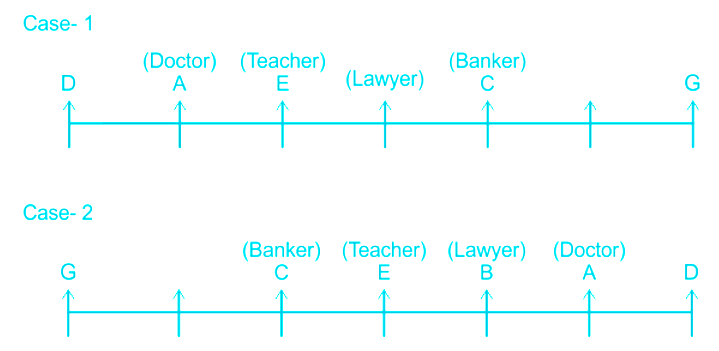
    As the 1st case does not fulfil the above condition (B is not an immediate neighbour of C), it is eliminated.

    8) The one who is an Engineer does not sit at any of the extreme ends of the row.

    9) D is not an Architect. So, G will be Architect.
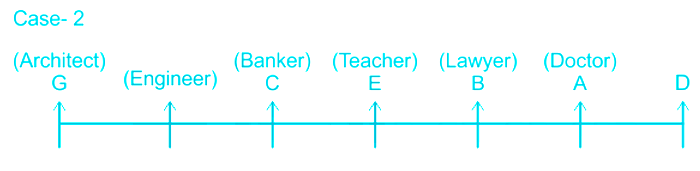
    The final arrangement will be:

    As C is a Banker.

    Hence, the condition ‘C- Banker’ is true and the other conditions are false.
  • Question 2/15
    1 / -0

    Directions For Questions

    Directions: Read the following information and answer the given questions:

    Seven persons A, B, C, D, E, F and G are seated in a row facing North. Each of them belongs to different profession: Teacher, Architect, Businessman, Engineer, Lawyer, Banker and Doctor but not necessarily in the same order. Three persons sit between D and the one who is a Banker. D is sitting at one of the extreme ends of the row. A who is a Doctor is an immediate neighbour of D. G is not an immediate neighbour of A and the one who is a Banker. The one who is a lawyer sits to the immediate right of E who is a Teacher. G is not a Lawyer. Neither B nor F is a Banker. B is not an immediate neighbour of C. The one who is an Engineer does not sit at any of the extreme ends of the row. D is not an Architect.

    ...view full instructions


    How many persons are sitting between B and C?
    Solutions

    Persons: A, B, C, D, E, F and G. (Facing north)

    Profession: Teacher, Architect, Businessman, Engineer, Lawyer. Banker and Doctor.

    1) Three persons sit between D and the one who is a Banker. D is sitting at one of the extreme ends of the row.

    2) A who is a Doctor is an immediate neighbour of D.

    3) G is not an immediate neighbour of A and the one who is a Banker.

    4) The one who is a lawyer sits to the immediate right of E who is a Teacher.

    5) G is not a Lawyer.

    6) Neither B nor F is a Banker. So, C will be Banker.

    7) B is not an immediate neighbour of C. 

    As the 1st case does not fulfil the above condition (B is not an immediate neighbour of C), it is eliminated.

    8) The one who is an Engineer does not sit at any of the extreme ends of the row.

    9) D is not an Architect. So, G will be Architect.

    The final arrangement will be:

    Hence, only one person is sitting between B and C.

  • Question 3/15
    1 / -0

    Directions For Questions

    Directions: Read the following information and answer the given questions:

    Seven persons A, B, C, D, E, F and G are seated in a row facing North. Each of them belongs to different profession: Teacher, Architect, Businessman, Engineer, Lawyer, Banker and Doctor but not necessarily in the same order. Three persons sit between D and the one who is a Banker. D is sitting at one of the extreme ends of the row. A who is a Doctor is an immediate neighbour of D. G is not an immediate neighbour of A and the one who is a Banker. The one who is a lawyer sits to the immediate right of E who is a Teacher. G is not a Lawyer. Neither B nor F is a Banker. B is not an immediate neighbour of C. The one who is an Engineer does not sit at any of the extreme ends of the row. D is not an Architect.

    ...view full instructions


    What is the position of F with respect to A?
    Solutions

    Persons: A, B, C, D, E, F and G. (Facing north)

    Profession: Teacher, Architect, Businessman, Engineer, Lawyer. Banker and Doctor.

    1) Three persons sit between D and the one who is a Banker. D is sitting at one of the extreme ends of the row.

    2) A who is a Doctor is an immediate neighbour of D.

    3) G is not an immediate neighbour of A and the one who is a Banker.

    4) The one who is a lawyer sits to the immediate right of E who is a Teacher.

    5) G is not a Lawyer.

    6) Neither B nor F is a Banker. So, C will be Banker.

    7) B is not an immediate neighbour of C. 

    As the 1st case does not fulfil the above condition (B is not an immediate neighbour of C), it is eliminated.

    8) The one who is an Engineer does not sit at any of the extreme ends of the row.

    9) D is not an Architect. So, G will be Architect.

    The final arrangement will be:

    Hence, F is fourth to the left of A.

  • Question 4/15
    1 / -0

    Directions For Questions

    Directions: Read the following information and answer the given questions:

    Seven persons A, B, C, D, E, F and G are seated in a row facing North. Each of them belongs to different profession: Teacher, Architect, Businessman, Engineer, Lawyer, Banker and Doctor but not necessarily in the same order. Three persons sit between D and the one who is a Banker. D is sitting at one of the extreme ends of the row. A who is a Doctor is an immediate neighbour of D. G is not an immediate neighbour of A and the one who is a Banker. The one who is a lawyer sits to the immediate right of E who is a Teacher. G is not a Lawyer. Neither B nor F is a Banker. B is not an immediate neighbour of C. The one who is an Engineer does not sit at any of the extreme ends of the row. D is not an Architect.

    ...view full instructions


    G belongs to which profession?
    Solutions

    Persons: A, B, C, D, E, F and G. (Facing north)

    Profession: Teacher, Architect, Businessman, Engineer, Lawyer. Banker and Doctor.

    1) Three persons sit between D and the one who is a Banker. D is sitting at one of the extreme ends of the row.

    2) A who is a Doctor is an immediate neighbour of D.

    3) G is not an immediate neighbour of A and the one who is a Banker.

    4) The one who is a lawyer sits to the immediate right of E who is a Teacher.

    5) G is not a Lawyer.

    6) Neither B nor F is a Banker. So, C will be Banker.

    7) B is not an immediate neighbour of C. 

    As the 1st case does not fulfil the above condition (B is not an immediate neighbour of C), it is eliminated.

    8) The one who is an Engineer does not sit at any of the extreme ends of the row.

    9) D is not an Architect. So, G will be Architect.

    The final arrangement will be:

    Hence, G is an Architect.

  • Question 5/15
    1 / -0

    Directions For Questions

    Directions: Read the following information and answer the given questions:

    Seven persons A, B, C, D, E, F and G are seated in a row facing North. Each of them belongs to different profession: Teacher, Architect, Businessman, Engineer, Lawyer, Banker and Doctor but not necessarily in the same order. Three persons sit between D and the one who is a Banker. D is sitting at one of the extreme ends of the row. A who is a Doctor is an immediate neighbour of D. G is not an immediate neighbour of A and the one who is a Banker. The one who is a lawyer sits to the immediate right of E who is a Teacher. G is not a Lawyer. Neither B nor F is a Banker. B is not an immediate neighbour of C. The one who is an Engineer does not sit at any of the extreme ends of the row. D is not an Architect.

    ...view full instructions


    Who is a Businessman?
    Solutions

    Persons: A, B, C, D, E, F and G. (Facing north)

    Profession: Teacher, Architect, Businessman, Engineer, Lawyer. Banker and Doctor.

    1) Three persons sit between D and the one who is a Banker. D is sitting at one of the extreme ends of the row.

    2) A who is a Doctor is an immediate neighbour of D.

    3) G is not an immediate neighbour of A and the one who is a Banker.

    4) The one who is a lawyer sits to the immediate right of E who is a Teacher.

    5) G is not a Lawyer.

    6) Neither B nor F is a Banker. So, C will be Banker.

    7) B is not an immediate neighbour of C. 

    As the 1st case does not fulfil the above condition (B is not an immediate neighbour of C), it is eliminated.

    8) The one who is an Engineer does not sit at any of the extreme ends of the row.

    9) D is not an Architect. So, G will be Architect.

    The final arrangement will be:

    Hence, D is a Businessman.

  • Question 6/15
    1 / -0

    Directions For Questions

    Directions (6-10):- Study the following information carefully and answer the Questions given below:

    A, S, D, F, G, H, J and K are sitting in a straight line but not necessarily in the same order. Some of them are facing south while some are facing north. (Note: - Same direction means the person is facing north then the other also faces north and vice-versa. Opposite directions means that if one person is facing north then other person is facing south and vice-versa).

    G faces North, only three people sits to the left of G. Only two people sit between G and S. H sits third to the right of K. K is neither an immediate neighbor of G nor S. K does not sits at any of the extreme end of the line. The only neighbor of F faces north. F is not an immediate neighbor of K. A is sitting second to the left of F. A faces the same direction as K. The persons sitting at extreme ends facing opposite directions. D faces the same direction as F. H faces south.

    ...view full instructions


    how many people facing north direction?
    Solutions

    1) G faces North, only three people sits to the left of G.

    2) Only two people sit between G and S.

    3) H sits third to the right of K. K is neither an immediate neighbor of G nor S.

    4) K does not sit at any of the extreme end of the line.

    Hence we have two cases:- 

    5) The only neighbor of F faces north. F is not an immediate neighbor of K. A is sitting second to the left of F. A faces the same direction as K.

    Here case – 1 gets cancelled because there is no place left for A because A is sitting second to the left of F and F will face north direction and K is already sitting second to the left of F.

    6) The person sitting at extreme ends facing opposite directions.

    7) D faces the same direction as F. H faces south.

    The final arrangement is given below-

    We can clearly see that in the diagram there 6 people facing north direction.

    Hence, the correct answer is 6

  • Question 7/15
    1 / -0

    Directions For Questions

    Directions (6-10):- Study the following information carefully and answer the Questions given below:

    A, S, D, F, G, H, J and K are sitting in a straight line but not necessarily in the same order. Some of them are facing south while some are facing north. (Note: - Same direction means the person is facing north then the other also faces north and vice-versa. Opposite directions means that if one person is facing north then other person is facing south and vice-versa).

    G faces North, only three people sits to the left of G. Only two people sit between G and S. H sits third to the right of K. K is neither an immediate neighbor of G nor S. K does not sits at any of the extreme end of the line. The only neighbor of F faces north. F is not an immediate neighbor of K. A is sitting second to the left of F. A faces the same direction as K. The persons sitting at extreme ends facing opposite directions. D faces the same direction as F. H faces south.

    ...view full instructions


    Four of them are alike in a certain way hence form a group, which amonth following does not belong to that group?
    Solutions

    1) G faces North, only three people sits to the left of G.

    2) Only two people sit between G and S.

    3) H sits third to the right of K. K is neither an immediate neighbor of G nor S.

    4) K does not sit at any of the extreme end of the line.

    Hence we have two cases:- 

    5) The only neighbor of F faces north. F is not an immediate neighbor of K. A is sitting second to the left of F. A faces the same direction as K.

    Here case – 1 gets cancelled because there is no place left for A because A is sitting second to the left of F and F will face north direction and K is already sitting second to the left of F.

    6) The person sitting at extreme ends facing opposite directions.

    7) D faces the same direction as F. H faces south.

    The final arrangement is given below-

    Common Solution:

    We can see that in all four combinations i.e. (J, D) (G, K) (S, H) (A, F) there are gap of one person, but in (D, A) there are gap of two person. So our answer is (D, A).

    Hence, the correct answer is (D, A).
  • Question 8/15
    1 / -0

    Directions For Questions

    Directions (6-10):- Study the following information carefully and answer the Questions given below:

    A, S, D, F, G, H, J and K are sitting in a straight line but not necessarily in the same order. Some of them are facing south while some are facing north. (Note: - Same direction means the person is facing north then the other also faces north and vice-versa. Opposite directions means that if one person is facing north then other person is facing south and vice-versa).

    G faces North, only three people sits to the left of G. Only two people sit between G and S. H sits third to the right of K. K is neither an immediate neighbor of G nor S. K does not sits at any of the extreme end of the line. The only neighbor of F faces north. F is not an immediate neighbor of K. A is sitting second to the left of F. A faces the same direction as K. The persons sitting at extreme ends facing opposite directions. D faces the same direction as F. H faces south.

    ...view full instructions


    How many people face south?
    Solutions

    1) G faces North, only three people sits to the left of G.

    2) Only two people sit between G and S.

    3) H sits third to the right of K. K is neither an immediate neighbor of G nor S.

    4) K does not sit at any of the extreme end of the line.

    Hence we have two cases:- 

    5) The only neighbor of F faces north. F is not an immediate neighbor of K. A is sitting second to the left of F. A faces the same direction as K.

    Here case – 1 gets cancelled because there is no place left for A because A is sitting second to the left of F and F will face north direction and K is already sitting second to the left of F.

    6) The person sitting at extreme ends facing opposite directions.

    7) D faces the same direction as F. H faces south.

    The final arrangement is given below-

    We can clearly see that there are only two people facing south.

    Hence, the correct answer is two.

  • Question 9/15
    1 / -0

    Directions For Questions

    Directions (6-10):- Study the following information carefully and answer the Questions given below:

    A, S, D, F, G, H, J and K are sitting in a straight line but not necessarily in the same order. Some of them are facing south while some are facing north. (Note: - Same direction means the person is facing north then the other also faces north and vice-versa. Opposite directions means that if one person is facing north then other person is facing south and vice-versa).

    G faces North, only three people sits to the left of G. Only two people sit between G and S. H sits third to the right of K. K is neither an immediate neighbor of G nor S. K does not sits at any of the extreme end of the line. The only neighbor of F faces north. F is not an immediate neighbor of K. A is sitting second to the left of F. A faces the same direction as K. The persons sitting at extreme ends facing opposite directions. D faces the same direction as F. H faces south.

    ...view full instructions


    How many persons sit between K and S?
    Solutions

    1) G faces North, only three people sits to the left of G.

    2) Only two people sit between G and S.

    3) H sits third to the right of K. K is neither an immediate neighbor of G nor S.

    4) K does not sit at any of the extreme end of the line.

    Hence we have two cases:- 

    5) The only neighbor of F faces north. F is not an immediate neighbor of K. A is sitting second to the left of F. A faces the same direction as K.

    Here case – 1 gets cancelled because there is no place left for A because A is sitting second to the left of F and F will face north direction and K is already sitting second to the left of F.

    6) The person sitting at extreme ends facing opposite directions.

    7) D faces the same direction as F. H faces south.

    The final arrangement is given below-

    We can clearly see that there are four persons sitting between K and S.

    Hence, the correct answer is four.

  • Question 10/15
    1 / -0

    Directions For Questions

    Directions (6-10):- Study the following information carefully and answer the Questions given below:

    A, S, D, F, G, H, J and K are sitting in a straight line but not necessarily in the same order. Some of them are facing south while some are facing north. (Note: - Same direction means the person is facing north then the other also faces north and vice-versa. Opposite directions means that if one person is facing north then other person is facing south and vice-versa).

    G faces North, only three people sits to the left of G. Only two people sit between G and S. H sits third to the right of K. K is neither an immediate neighbor of G nor S. K does not sits at any of the extreme end of the line. The only neighbor of F faces north. F is not an immediate neighbor of K. A is sitting second to the left of F. A faces the same direction as K. The persons sitting at extreme ends facing opposite directions. D faces the same direction as F. H faces south.

    ...view full instructions


    Who among the following sits at extreme end?
    Solutions

    1) G faces North, only three people sits to the left of G.

    2) Only two people sit between G and S.

    3) H sits third to the right of K. K is neither an immediate neighbor of G nor S.

    4) K does not sit at any of the extreme end of the line.

    Hence we have two cases:- 

    5) The only neighbor of F faces north. F is not an immediate neighbor of K. A is sitting second to the left of F. A faces the same direction as K.

    Here case – 1 gets cancelled because there is no place left for A because A is sitting second to the left of F and F will face north direction and K is already sitting second to the left of F.

    6) The person sitting at extreme ends facing opposite directions.

    7) D faces the same direction as F. H faces south.

    The final arrangement is given below-

    Hence, the correct answer is J.

  • Question 11/15
    1 / -0

    Directions For Questions

    Directions: Read the following information and answer the given questions:

    12 people are seated in two parallel rows with six people in each row such that there is equal distance between the adjacent persons and each person in one row faces the person in another row. In row 1, A, B, C, D, E and F are seated facing South and in Row 2, G, H, I, J, K and L are seated facing North not necessarily in the same order. L sits third to the left of G. G does not sits at the extreme end of the row. The one who faces L is an immediate neighbour of C. Two person sits between C and F. I face D. D sits to the immediate right of A. D is not an immediate neighbour of C. E does not face G. Neither H nor K faces E. K does not sits in front of C.

    ...view full instructions


    How many persons are sitting between K and L?
    Solutions

    Persons: Row:1: A, B, C, D, E and F are seated facing South

    Row:2: Row 2: G, H, I, J, K and L are seated facing North

    1) L sits third to the left of G. G does not sits at the extreme end of the row.

    2) The one who faces L is an immediate neighbour of C.

    3) Two person sits between C and F.

    4) D sits to the immediate right of A.

    5) D is not an immediate neighbour of C.


    As the 1st and 2nd case does not fulfil the above condition, it is eliminated.

    6) I face D.

    7) E does not face G.

    8) Neither H nor K faces E.

    9) K does not sit in front of C.

    The final arrangement will be:

    Hence, three persons are sitting between K and L.

  • Question 12/15
    1 / -0

    Directions For Questions

    Directions: Read the following information and answer the given questions:

    12 people are seated in two parallel rows with six people in each row such that there is equal distance between the adjacent persons and each person in one row faces the person in another row. In row 1, A, B, C, D, E and F are seated facing South and in Row 2, G, H, I, J, K and L are seated facing North not necessarily in the same order. L sits third to the left of G. G does not sits at the extreme end of the row. The one who faces L is an immediate neighbour of C. Two person sits between C and F. I face D. D sits to the immediate right of A. D is not an immediate neighbour of C. E does not face G. Neither H nor K faces E. K does not sits in front of C.

    ...view full instructions


    What is the position of A with respect to B?
    Solutions

    Persons: Row:1: A, B, C, D, E and F are seated facing South

    Row:2: Row 2: G, H, I, J, K and L are seated facing North

    1) L sits third to the left of G. G does not sits at the extreme end of the row.

    2) The one who faces L is an immediate neighbour of C.

    3) Two person sits between C and F.

    4) D sits to the immediate right of A.

    5) D is not an immediate neighbour of C.


    As the 1st and 2nd case does not fulfil the above condition, it is eliminated.

    6) I face D.

    7) E does not face G.

    8) Neither H nor K faces E.

    9) K does not sit in front of C.

    The final arrangement will be:

    Hence, A sits third to the right of B.

  • Question 13/15
    1 / -0

    Directions For Questions

    Directions: Read the following information and answer the given questions:

    12 people are seated in two parallel rows with six people in each row such that there is equal distance between the adjacent persons and each person in one row faces the person in another row. In row 1, A, B, C, D, E and F are seated facing South and in Row 2, G, H, I, J, K and L are seated facing North not necessarily in the same order. L sits third to the left of G. G does not sits at the extreme end of the row. The one who faces L is an immediate neighbour of C. Two person sits between C and F. I face D. D sits to the immediate right of A. D is not an immediate neighbour of C. E does not face G. Neither H nor K faces E. K does not sits in front of C.

    ...view full instructions


    Who sits second to the left of H?
    Solutions

    Persons: Row:1: A, B, C, D, E and F are seated facing South

    Row:2: Row 2: G, H, I, J, K and L are seated facing North

    1) L sits third to the left of G. G does not sits at the extreme end of the row.

    2) The one who faces L is an immediate neighbour of C.

    3) Two person sits between C and F.

    4) D sits to the immediate right of A.

    5) D is not an immediate neighbour of C.


    As the 1st and 2nd case does not fulfil the above condition, it is eliminated.

    6) I face D.

    7) E does not face G.

    8) Neither H nor K faces E.

    9) K does not sit in front of C.

    The final arrangement will be:

    Hence, I sit second to the left of H.

  • Question 14/15
    1 / -0

    Directions For Questions

    Directions: Read the following information and answer the given questions:

    12 people are seated in two parallel rows with six people in each row such that there is equal distance between the adjacent persons and each person in one row faces the person in another row. In row 1, A, B, C, D, E and F are seated facing South and in Row 2, G, H, I, J, K and L are seated facing North not necessarily in the same order. L sits third to the left of G. G does not sits at the extreme end of the row. The one who faces L is an immediate neighbour of C. Two person sits between C and F. I face D. D sits to the immediate right of A. D is not an immediate neighbour of C. E does not face G. Neither H nor K faces E. K does not sits in front of C.

    ...view full instructions


    Who sits in front of E?
    Solutions

    Persons: Row:1: A, B, C, D, E and F are seated facing South

    Row:2: Row 2: G, H, I, J, K and L are seated facing North

    1) L sits third to the left of G. G does not sits at the extreme end of the row.

    2) The one who faces L is an immediate neighbour of C.

    3) Two person sits between C and F.

    4) D sits to the immediate right of A.

    5) D is not an immediate neighbour of C.


    As the 1st and 2nd case does not fulfil the above condition, it is eliminated.

    6) I face D.

    7) E does not face G.

    8) Neither H nor K faces E.

    9) K does not sit in front of C.

    The final arrangement will be:

    Hence, J sits in front of E.

  • Question 15/15
    1 / -0

    Directions For Questions

    Directions: Read the following information and answer the given questions:

    12 people are seated in two parallel rows with six people in each row such that there is equal distance between the adjacent persons and each person in one row faces the person in another row. In row 1, A, B, C, D, E and F are seated facing South and in Row 2, G, H, I, J, K and L are seated facing North not necessarily in the same order. L sits third to the left of G. G does not sits at the extreme end of the row. The one who faces L is an immediate neighbour of C. Two person sits between C and F. I face D. D sits to the immediate right of A. D is not an immediate neighbour of C. E does not face G. Neither H nor K faces E. K does not sits in front of C.

    ...view full instructions


    Which of the following condition is true regarding G?
    Solutions

    Persons: Row:1: A, B, C, D, E and F are seated facing South

    Row:2: Row 2: G, H, I, J, K and L are seated facing North

    1) L sits third to the left of G. G does not sits at the extreme end of the row.

    2) The one who faces L is an immediate neighbour of C.

    3) Two person sits between C and F.

    4) D sits to the immediate right of A.

    5) D is not an immediate neighbour of C.


    As the 1st and 2nd case does not fulfil the above condition, it is eliminated.

    6) I face D.

    7) E does not face G.

    8) Neither H nor K faces E.

    9) K does not sit in front of C.

    The final arrangement will be:

    As G is sitting in front of B.

    Hence, the condition ‘G faces B’ is true and the other conditions are false.

Close button icon
User Profile
-

Correct (-)

Wrong (-)

Skipped (-)


  • 1
  • 2
  • 3
  • 4
  • 5
  • 6
  • 7
  • 8
  • 9
  • 10
  • 11
  • 12
  • 13
  • 14
  • 15
Mockers logo Get latest Exam Updates
& Study Material Alerts!
No, Thanks
Arrow pointer icon
Click on Allow to receive notifications
Notification bell icon ×
Open Now