Please wait...

IBPS PO SUPER 15 Test 51
Menu grid icon
Result Result point icon
IBPS PO SUPER 15 Test 51
  • Goals icon

    /

    Score
  • Trophy icon

    -

    Rank
White alarm icon Time Taken: -
Result frame illustration
  • Question 1/15
    1 / -0

    Directions For Questions

    Direction: In the following question, a part of the sentence is printed in bold. Below the sentence, alternatives to the bold part are given as (A), (B), (C) and (D) which may help improve the sentence. Choose the correct alternative. In case the given sentence is correct, your answer is (E), i.e., "No correction required".

    ...view full instructions


    With none rain or any access to clean water many farmers will lose their crops.
    Solutions
    The boldened statement part seems inappropriate and needs to be replaced with option D, which is able to improve the sentence and so is the appropriate response.
  • Question 2/15
    1 / -0

    Directions For Questions

    Direction: In the given question, a part of the sentence is printed in bold. Which of the following among (A), (B), (C) and (D) given below the sentence can replace the word(s) printed in bold to make the sentence grammatically correct? If the sentence is correct as it is, mark E i.e. 'No correction required' as the answer.

    ...view full instructions


    The disparity between the earnings of the poor and the rich has widen in the last few decades.
    Solutions
    The structure of the sentence in Present Perfect is :
    Subject + has / have + V3
    Hence, 'widened' should be used. 'has' should be used since the subject is 'disparity' which is singular.
    Hence, option D is the correct answer.
  • Question 3/15
    1 / -0

    Directions For Questions

    Direction: In the given question, a part of the sentence is printed in bold. Which of the following among (A), (B), (C) and (D) given below the sentence can replace the word(s) printed in bold to make the sentence grammatically correct? If the sentence is correct as it is, mark E i.e. 'No correction required' as the answer.

    ...view full instructions


    When he fell down the ditch, he shouted with all his might so that to catch someone’s attention.
    Solutions
    "To catch" is a correct 'to-infinitive structure' and needs no change. Now, to denote the purpose of something, we use two structures, either 'so that' + clause (containing a modal) or 'in order + infinitive clause'.
    When the next word is a verb, we “in order to” or “so as to” and when the next word is a verb, we use “so that” or “in order that”.
    Since the next word is a verb 'catch', the appropriate structure is 'so as to'.
    So, the correct answer is option B.
  • Question 4/15
    1 / -0

    Directions For Questions

    Direction: In the given question, a part of the sentence is printed in bold. Below the sentence alternatives to the bold part are given at (A), (B), (C) and (D) which may help improve the sentence. Choose the correct alternative. In case the given sentence is correct, your answer is (E) i.e. No correction required.

    ...view full instructions


    Recently, my expenses have gone run up considerably.
    Solutions
    RUN UP means “to rise; to swell; to grow or to increase”
    GONE RUN UP should be replaced by RUN UP.
    Hence Option A is correct
  • Question 5/15
    1 / -0

    Directions For Questions

    Direction: In the given question, a part of the sentence is printed in bold. Below the sentence alternatives to the bold part are given at (A), (B), (C) and (D) which may help improve the sentence. Choose the correct alternative. In case the given sentence is correct, your answer is (E) i.e. No correction required.

    ...view full instructions


    Most of the people were dumb-founded and obviously uncomfortable by the performance that was expected of them.
    Solutions
    Option A: The given sentence is in past tense, hence 'they are expecting' is incorrect.
    Option B: 'by' and 'with' make the sentence grammatically incorrect. 
    Option C: It makes the given sentence grammatically as well as structurally correct. 
    Option D: The given fragment doesn't logically fit in the given sentence. 
    Option E: 'by' is incorrect. 
  • Question 6/15
    1 / -0

    Directions For Questions

    Direction: What should come in place of question mark (?) in the following question? (You do not have to calculate the exact value.)

    ...view full instructions


    12.02% of 900.02 + 1499.98% of 26.02 = ?
    Solutions
    As per the BODMAS rule, the priority in which the operations should be done is:


    Note:
     Addition and subtraction can be treated on same priority (from left to right) when they are in consecutive order.

    12.02% of 900.02 + 1499.98% of 26.02 = ?
    Approximating the values to the nearest integer:
    12% ×900+1500%×26 = ?

    ×900+×26 = ?
    108+390 = ?
    ? = 498
  • Question 7/15
    1 / -0

    Directions For Questions

    Direction: What will come in place of “x" in the following question (You do not have to calculate the exact value)?

    ...view full instructions


    (59.98% of 1649.98-32.01% of 1124.97)÷62.98=x
    Solutions
    x=(60%×1650-32%×1125)÷63
    =(×1650-×1125)÷63
    =(990-360)÷63
    =630÷63
    =10
  • Question 8/15
    1 / -0

    Directions For Questions

    Direction: What will come in the place of question mark (?) in the following question (You do not have to calculate the exact value)?

    ...view full instructions


    √3365 + √145- =?+ √1155
    Solutions

    After approximation (so that the square roots can be found out)

    √3364 + √144- =?+ √1156
    58+12-4=?+34
    66=?+34
    ?=66-34
    ?=32

  • Question 9/15
    1 / -0

    Directions For Questions

    Direction: What approximate value will come in place of the question mark (?) in the following question? (You do not have to calculate the exact value).

    ...view full instructions


    17651/2 + 1056 ÷ 16-54% of 150 = ?
    Solutions
    +66-
    42+66-81
    27
  • Question 10/15
    1 / -0

    Directions For Questions

    Direction: What approximate value should come in place of the question mark (?) in the following equation (Note: You are not expected to calculate the exact value)?

    ...view full instructions


    67.99% of 1401-13.99%of 1299=?
    Solutions
  • Question 11/15
    1 / -0

    Directions For Questions

    Direction: Study the information given below and answer the questions based on it.

    Eight persons M, N, O, P, Q, R, S and T are sitting around a circular table. Some of them are facing the centre and some of them are facing outside from the centre.

    Note: Two consecutives alphabetical name’s persons are not facing the same direction i.e. if A is facing inside then B is facing outside and C is facing inside like this.

    P is 2nd to the right of T. Two persons are sitting between P and O. Q is 2nd to the right of O. N is not neighbor of T. M is 2nd to the right of N. R is 2nd to the left of S but not neighbor of N. R’s both neighbours are facing outside from the centre.

    ...view full instructions


    Who among the following doesn’t belong to the group?
    Solutions
    All the persons are facing inside except N.
    Hence, option A.
    P is 2nd to the right of T so either T is facing inside or outside.
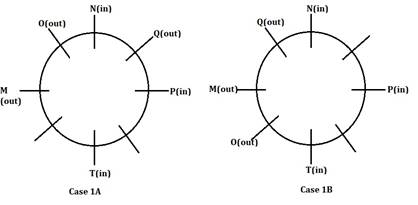
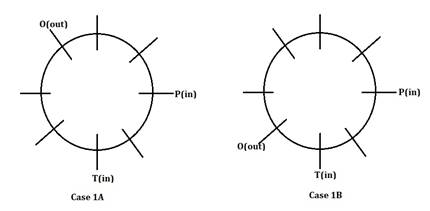
    Case 1: If T is facing inside:
    If T is facing inside then S is facing outside and then R is facing inside so we get this-
    N, P, R and T are facing inside and M, O, Q and S are facing outside.
    Two persons are sitting between P and O.
    1.jpg
    Q is 2nd to the right of O. N is not neighbor of T. M is 2nd to the right of N.
    1.jpg
    R is 2nd to the left of S but not neighbor of N. R’s both neighbours are facing outside from the centre. In both cases, R’s both neighbors cannot be facing outside so this case gets rejected.
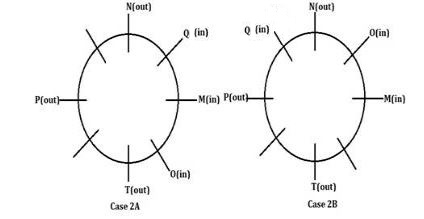
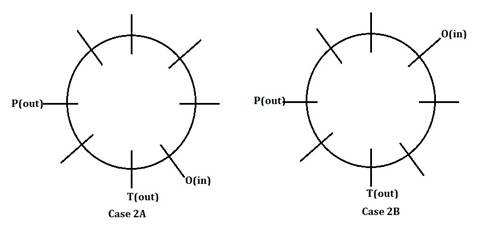
    Case 2: If T is facing outside:
    If T is facing outside then S is facing inside and then R is facing outside so we get this-
    N, P, R and T are facing outside and M, O, Q and S are facing inside.
    Two persons are sitting between P and O.
    2.jpg
    Q is 2nd to the right of O. N is not neighbor of T. M is 2nd to the right of N.
    2.jpg
    R is 2nd to the left of S but not neighbor of N. As S is facing inside so in case 2A, R must be neighbor of N so case 2A gets rejected. In case 2B, R is neighbor of P and T and S is immediate neighbor of M.
    Here is the final arrangement:
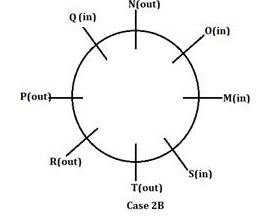
    2.jpg
  • Question 12/15
    1 / -0

    Directions For Questions

    Direction: Study the information given below and answer the questions based on it.

    Eight persons M, N, O, P, Q, R, S and T are sitting around a circular table. Some of them are facing the centre and some of them are facing outside from the centre.

    Note: Two consecutives alphabetical name’s persons are not facing the same direction i.e. if A is facing inside then B is facing outside and C is facing inside like this.

    P is 2nd to the right of T. Two persons are sitting between P and O. Q is 2nd to the right of O. N is not neighbor of T. M is 2nd to the right of N. R is 2nd to the left of S but not neighbor of N. R’s both neighbours are facing outside from the centre.

    ...view full instructions


    Who among the following is 3rd to the left of M?
    Solutions
    All the persons are facing inside except N.
    Hence, option A.
    P is 2nd to the right of T so either T is facing inside or outside.
    Case 1: If T is facing inside:
    If T is facing inside then S is facing outside and then R is facing inside so we get this-
    N, P, R and T are facing inside and M, O, Q and S are facing outside.
    Two persons are sitting between P and O.
    1.jpg
    Q is 2nd to the right of O. N is not neighbor of T. M is 2nd to the right of N.
    1.jpg
    R is 2nd to the left of S but not neighbor of N. R’s both neighbours are facing outside from the centre. In both cases, R’s both neighbors cannot be facing outside so this case gets rejected.
    Case 2: If T is facing outside:
    If T is facing outside then S is facing inside and then R is facing outside so we get this-
    N, P, R and T are facing outside and M, O, Q and S are facing inside.
    Two persons are sitting between P and O.
    2.jpg
    Q is 2nd to the right of O. N is not neighbor of T. M is 2nd to the right of N.
    2.jpg
    R is 2nd to the left of S but not neighbor of N. As S is facing inside so in case 2A, R must be neighbor of N so case 2A gets rejected. In case 2B, R is neighbor of P and T and S is immediate neighbor of M.
    Here is the final arrangement:
    2.jpg
  • Question 13/15
    1 / -0

    Directions For Questions

    Direction: Study the information given below and answer the questions based on it.

    Eight persons M, N, O, P, Q, R, S and T are sitting around a circular table. Some of them are facing the centre and some of them are facing outside from the centre.

    Note: Two consecutives alphabetical name’s persons are not facing the same direction i.e. if A is facing inside then B is facing outside and C is facing inside like this.

    P is 2nd to the right of T. Two persons are sitting between P and O. Q is 2nd to the right of O. N is not neighbor of T. M is 2nd to the right of N. R is 2nd to the left of S but not neighbor of N. R’s both neighbours are facing outside from the centre.

    ...view full instructions


    How many persons are sitting between Q and M if starts counting to the left of Q?
    Solutions
    All the persons are facing inside except N.
    Hence, option A.
    P is 2nd to the right of T so either T is facing inside or outside.
    Case 1: If T is facing inside:
    If T is facing inside then S is facing outside and then R is facing inside so we get this-
    N, P, R and T are facing inside and M, O, Q and S are facing outside.
    Two persons are sitting between P and O.
    1.jpg
    Q is 2nd to the right of O. N is not neighbor of T. M is 2nd to the right of N.
    1.jpg
    R is 2nd to the left of S but not neighbor of N. R’s both neighbours are facing outside from the centre. In both cases, R’s both neighbors cannot be facing outside so this case gets rejected.
    Case 2: If T is facing outside:
    If T is facing outside then S is facing inside and then R is facing outside so we get this-
    N, P, R and T are facing outside and M, O, Q and S are facing inside.
    Two persons are sitting between P and O.
    2.jpg
    Q is 2nd to the right of O. N is not neighbor of T. M is 2nd to the right of N.
    2.jpg
    R is 2nd to the left of S but not neighbor of N. As S is facing inside so in case 2A, R must be neighbor of N so case 2A gets rejected. In case 2B, R is neighbor of P and T and S is immediate neighbor of M.
    Here is the final arrangement:
    2.jpg
  • Question 14/15
    1 / -0

    Directions For Questions

    Direction: Study the information given below and answer the questions based on it.

    Eight persons M, N, O, P, Q, R, S and T are sitting around a circular table. Some of them are facing the centre and some of them are facing outside from the centre.

    Note: Two consecutives alphabetical name’s persons are not facing the same direction i.e. if A is facing inside then B is facing outside and C is facing inside like this.

    P is 2nd to the right of T. Two persons are sitting between P and O. Q is 2nd to the right of O. N is not neighbor of T. M is 2nd to the right of N. R is 2nd to the left of S but not neighbor of N. R’s both neighbours are facing outside from the centre.

    ...view full instructions


    Which of the following is TRUE?
    Solutions
    All the persons are facing inside except N.
    Hence, option A.
    P is 2nd to the right of T so either T is facing inside or outside.
    Case 1: If T is facing inside:
    If T is facing inside then S is facing outside and then R is facing inside so we get this-
    N, P, R and T are facing inside and M, O, Q and S are facing outside.
    Two persons are sitting between P and O.
    1.jpg
    Q is 2nd to the right of O. N is not neighbor of T. M is 2nd to the right of N.
    1.jpg
    R is 2nd to the left of S but not neighbor of N. R’s both neighbours are facing outside from the centre. In both cases, R’s both neighbors cannot be facing outside so this case gets rejected.
    Case 2: If T is facing outside:
    If T is facing outside then S is facing inside and then R is facing outside so we get this-
    N, P, R and T are facing outside and M, O, Q and S are facing inside.
    Two persons are sitting between P and O.
    2.jpg
    Q is 2nd to the right of O. N is not neighbor of T. M is 2nd to the right of N.
    2.jpg
    R is 2nd to the left of S but not neighbor of N. As S is facing inside so in case 2A, R must be neighbor of N so case 2A gets rejected. In case 2B, R is neighbor of P and T and S is immediate neighbor of M.
    Here is the final arrangement:
    2.jpg
  • Question 15/15
    1 / -0

    Directions For Questions

    Direction: Study the information given below and answer the questions based on it.

    Eight persons M, N, O, P, Q, R, S and T are sitting around a circular table. Some of them are facing the centre and some of them are facing outside from the centre.

    Note: Two consecutives alphabetical name’s persons are not facing the same direction i.e. if A is facing inside then B is facing outside and C is facing inside like this.

    P is 2nd to the right of T. Two persons are sitting between P and O. Q is 2nd to the right of O. N is not neighbor of T. M is 2nd to the right of N. R is 2nd to the left of S but not neighbor of N. R’s both neighbours are facing outside from the centre.

    ...view full instructions


    Which of the following pair is facing the same direction?
    Solutions
    All the persons are facing inside except N.
    Hence, option A.
    P is 2nd to the right of T so either T is facing inside or outside.
    Case 1: If T is facing inside:
    If T is facing inside then S is facing outside and then R is facing inside so we get this-
    N, P, R and T are facing inside and M, O, Q and S are facing outside.
    Two persons are sitting between P and O.
    1.jpg
    Q is 2nd to the right of O. N is not neighbor of T. M is 2nd to the right of N.
    1.jpg
    R is 2nd to the left of S but not neighbor of N. R’s both neighbours are facing outside from the centre. In both cases, R’s both neighbors cannot be facing outside so this case gets rejected.
    Case 2: If T is facing outside:
    If T is facing outside then S is facing inside and then R is facing outside so we get this-
    N, P, R and T are facing outside and M, O, Q and S are facing inside.
    Two persons are sitting between P and O.
    2.jpg
    Q is 2nd to the right of O. N is not neighbor of T. M is 2nd to the right of N.
    2.jpg
    R is 2nd to the left of S but not neighbor of N. As S is facing inside so in case 2A, R must be neighbor of N so case 2A gets rejected. In case 2B, R is neighbor of P and T and S is immediate neighbor of M.
    Here is the final arrangement:
    2.jpg
Close button icon
User Profile
-

Correct (-)

Wrong (-)

Skipped (-)


  • 1
  • 2
  • 3
  • 4
  • 5
  • 6
  • 7
  • 8
  • 9
  • 10
  • 11
  • 12
  • 13
  • 14
  • 15
Mockers logo Get latest Exam Updates
& Study Material Alerts!
No, Thanks
Arrow pointer icon
Click on Allow to receive notifications
Notification bell icon ×
Open Now