Please wait...

Thermodynamics Test 1
Menu grid icon
Result Result point icon
Thermodynamics Test 1
  • Goals icon

    /

    Score
  • Trophy icon

    -

    Rank
White alarm icon Time Taken: -
Result frame illustration
  • Question 1/10
    1 / -0.25

    The isentropic process on the Mollier diagram is represented by 
    Solutions

    Explanation:

    • Mollier Diagram: Mollier diagram is enthalpy (h) versus entropy (s) plot.
    • It consists of a family of constant pressure lines, constant temperature lines and constant volume lines plotted on enthalpy versus entropy coordinates.
    • From the T-ds equation:

     Tds = dh – vdp

     In the two-phase region, the constant pressure and constant temperature lines coincide.

    \({\left( {\frac{{\partial h}}{{\partial s}}} \right)_p} = T\)

    • The slope of an isobar on the h-s coordinates is equal to the absolute temperature. If the temperature remains constant the slope will remain constant.
    • If the temperature increases the slope of the isobar will increase.
    • For the saturated liquid and saturated vapour i.e. within the dome the temperature and pressure remains constant.


                                   Figure: Mollier diagram

    • A vertical line in the Mollier diagram represents the isentropic process (s = C).
    • A horizontal line in the Mollier diagram represents the isenthalpic process (h = C).
  • Question 2/10
    1 / -0.25

    The critical point of water is
    Solutions

    Explanation:

    Critical point:

    At a critical point, the liquid is directly converted into vapor without having a two-phase transition.

    For water at the critical point: 

    Pcr = 220.6 bar = 22.06 MPa

    Tcr = 373.95oC

    vcr = 0.005155 m3/kg

    Enthalpy of vaporization at a critical point is zero. 

    The figure below represents the P-V diagram for a pure substance (water).

  • Question 3/10
    1 / -0.25

    Heating wet steam at constant temperature is the same as heating at constant:
    Solutions

    Explanation:

    Wet steam is the mixture of liquid and steam in which both are at saturation temperature. If heat is added to the wet steam at a constant temperature, the pressure remains constant until all liquid is evaporated (saturated steam). In the wet region, the constant pressure and temperature lines coincide. So if the temperature is constant than the pressure is also constant. 

  • Question 4/10
    1 / -0.25

    Consider P – V diagram for an ideal gas as shown in figure.

    Out of the following diagrams, which figure represents the T – P diagram?

    Solutions

    Explanation:

    Given: P = Const./V ⇒ PV = const.

    We know that PV = mRT

    Hence, we can say that gas is going through an isothermal process.

    Here V2 > V1 ⇒ P2 < P1

    So T1 = T2 and P2 < P

  • Question 5/10
    1 / -0.25

    The slope of constant pressure curve on enthalpy-entropy diagram gives: 
    Solutions

    Explanation:

    • Mollier Diagram: Mollier diagram is enthalpy (h) versus entropy (s) plot.
    • It consists of a family of constant pressure lines, constant temperature lines and constant volume lines plotted on enthalpy versus entropy coordinates.
    • From the T-ds equation:

    Tds = dh – vdp

     In the two-phase region, the constant pressure and constant temperature lines coincide.

    \({\left( {\frac{{\partial h}}{{\partial s}}} \right)_p} = T\)

    • The slope of an isobar on the h-s coordinates is equal to the absolute temperature. If the temperature remains constant the slope will remain constant.
    • If the temperature increases the slope of the isobar will increase.
    • For the saturated liquid and saturated vapor i.e. within the dome the temperature and pressure remain constant. 

  • Question 6/10
    1 / -0.25

    Which of the following is true statement for phase diagram of pure substance?
    Solutions

    Explanation:

    "Extreme points of fusion curve are triple point and critical point" is an incorrect statement

    Validation:

    From the phase diagram, it is seen that the triple point and critical point are the extreme points of the vaporization curve. 
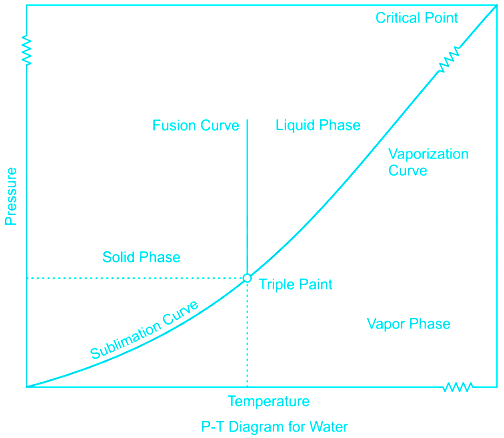
    "Extreme points of vaporization curve are triple point and critical point" is a correct statement 

    Validation:

    From the phase diagram, it is seen that vaporization starts from the triple point and goes till critical point beyond which liquid is directly flashed into vapour and there is no vaporization. 

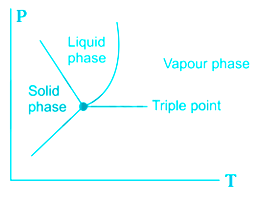
    "Sublimation curve, fusion curve, and vaporization curve meets at critical point" is an incorrect statement

    Validation:

    The sublimation curve fusion curve and the vaporization curve meets at the triple point. 
     

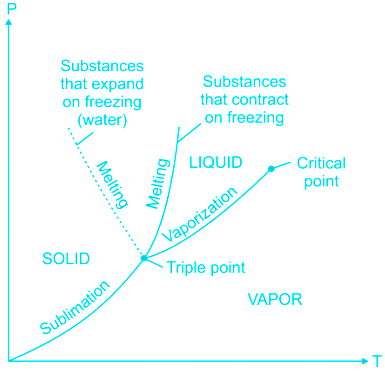
    "Fusion curve for water has positive slope" is an incorrect statement

    Validation: 

    The fusion curve of water has a negative slope it can be seen on the phase diagram also, the reason for this negative slope is that water expands after freezing, unlike other substances which contract after freezing. 
  • Question 7/10
    1 / -0.25

    In an experiment to determine dryness fraction of steam, the mass of water separated was 1.2 kg in 15 minutes and the mass of steam passed out in same time was 4.8 kg. Dryness fraction is:
    Solutions

    Concept:

    Dryness fraction is defined as the ratio of the mass of dry steam and the combined mass of dry steam & mass of water vapour in the mixture. It is denoted by x.

    \(Dryness\;fraction\;\left( x \right) = \frac{{mass\;of\;vapour\;\left( {{m_v}} \right)}}{{mass\;of\;vapour\;\left( {{m_v}} \right) ~+~ mass\;of\;liquid\;\left( {{m_l}} \right)}}\)

    For saturated liquid x = 0

    For saturated vapour = 1

    The value of dryness fraction lies between 0 and 1.

    Calculation:

    Given:

    mv = 4.8 kg, ml = 1.2 kg

    \(x=\frac{4.8}{4.8~+~1.2}=0.8\)

  • Question 8/10
    1 / -0.25

    What is the dryness fraction of dry and saturated steam? (where x is dryness fraction)

    Solutions

    Explanation:

    Dryness fraction is defined as the ratio of mass of dry steam (vapour) to combined mass of dry steam (vapour) & mass of liquid in mixture. It is denoted by x.

    \(Dryness\;fraction\;\left( x \right) = \frac{{mass\;of\;vapour\;\left( {{m_v}} \right)}}{{mass\;of\;vapour\;\left( {{m_v}} \right) + mass\;of\;liquid\;\left( {{m_l}} \right)}}\)

    For saturated liquid x = 0

    For saturated vapour = 1

    The value of dryness fraction lies between 0 and 1.

  • Question 9/10
    1 / -0.25

    Steam has a specific saturation temperature at
    Solutions

    Concept:

    Saturation temperature:

    • The saturation temperature is the temperature for a corresponding saturation pressure at which a liquid boils into its vapour phase.
    • According to Mayer’s equation, PV = mRT, pressure is directly proportional to temperature.
    • In microscopic point of view if pressure increases, the intermolecular forces increases and so the temperature. Therefore for each pressure steam has a specific saturation temperature.
  • Question 10/10
    1 / -0.25

    The only state at which the solid, liquid and vapour phases coexist in equilibrium is-
    Solutions

    Concept:

    Triple point

    • The Triple point is a line on the P-V diagram where all the three phases solid, liquid and gases exist in equilibrium.
    • At a pressure below the triple point line, the substance cannot exist in the liquid phase and the substance when heated, transforms from solid to vapour by absorbing the latent heat of sublimation from the surroundings.
    • The triple point is merely the point of intersection of the sublimation and vaporization curves.
    • It has been found that on a ‘p-T’ diagram the triple point is represented by a point and on a ‘p-v’ diagram it is a line, and on a ‘u-v’ diagram it is a triangle.
    • In the case of ordinary water, the triple point is at a pressure of 4.58 mm Hg and a temperature of 0.01°C.


    Critical Point

    • It is the point at which the slope changes from positive to negative and at this point the slope is zero.


    • It represents the highest pressure and temperature at which the liquid and vapour phases coexist in equilibrium.
    • All the thermodynamic properties of liquid and vapour phases are identical at the critical point.
    • The temperature pressure and volume at the critical point are called critical temperature Tc, critical pressure Pc and critical volume Vc
    • It is a fixed point that’s why the degree of freedom will be zero.
    • Dryness fraction (x) is not defined at a critical point.

    Note:

    The critical point properties of water are

    Pc = 221.2 bar

    Tc = 374.15° C

    Vc = 0.00317 m3/kg

Close button icon
User Profile
-

Correct (-)

Wrong (-)

Skipped (-)


  • 1
  • 2
  • 3
  • 4
  • 5
  • 6
  • 7
  • 8
  • 9
  • 10
Mockers logo Get latest Exam Updates
& Study Material Alerts!
No, Thanks
Arrow pointer icon
Click on Allow to receive notifications
Notification bell icon ×
Open Now
