Please wait...

Thermodynamics Test 2
Menu grid icon
Result Result point icon
Thermodynamics Test 2
  • Goals icon

    /

    Score
  • Trophy icon

    -

    Rank
White alarm icon Time Taken: -
Result frame illustration
  • Question 1/10
    1 / -0.25

    Ice kept in a well-insulated thermo flask is an example of which system?
    Solutions

    Explanation:

    Closed System: There is no mass transfer across the system boundary but energy transfer takes place into or out of the system.

    Open System: In this type of system both mass and energy transfer takes place across the boundary of the system.

    Isolated System: In this type of system neither mass nor energy crosses the boundary of the system.

    In the case of well-insulated Thermo flask, there is no exchange of mass and energy with the surroundings. So this becomes an isolated system.
  • Question 2/10
    1 / -0.25

    Control volume refers to
    Solutions

    Explanation:

    A control volume is a fixed, identifiable region in space through which fluid flows. The boundary of the control volume is called a control surface.

    Types of System

    Control Mass System (Closed System)

    • It is a system of fixed mass with a fixed identity
    • This type of system is usually referred to as "closed system"
    • There is no mass transfer across the system boundary
    • Energy transfer may take place into or out of the system

    Control Volume System (Open System)

    • It is a system of fixed volume
    • This type of system is usually referred to as "open system” or a "control volume"
    • Mass transfer can take place across a control volume
    • Energy transfer may also occur into or out of the system
    • A control volume can be seen as a fixed region across which mass and energy transfers are studied
    • Control Surface- It is the boundary of a control volume across which the transfer of both mass and energy takes place
    • The mass of a control volume (open system) may or may not be fixed
    Most of the engineering devices, in general, represent an open system or control volume.
  • Question 3/10
    1 / -0.25

    The temperature at which the volume of a gas becomes zero is called:

    Solutions

    Explanation:

    Charles’ Law states that for an ideal gas under constant pressure, the volume of the gas is directly proportional to its temperature.

    PV = mRT

    Now for constant Pressure, if we plot a graph between V v/s T then it is a straight line

    Charles plotted the graph experimentally for different pressures and found out the following graph

    PV = mRT

    When T = 0 K, Volume is zero.

    From the above graph we can see that at T= –273.15 ˚C, Volume become zero.

    We know that 0 K is –273.15 ˚C which is nothing but the Absolute zero temperature.

    Absolute temperature is temperature measured using the Kelvin scale where zero is absolute zero The zero point is the temperature at which particles of matter have their minimum motion and can become no colder (minimum energy).

  • Question 4/10
    1 / -0.25

    An ideal gas goes from state A to state B via three different processes as indicated in the P-V diagrams:

    If Q1, Q2, Q3 indicates the heat absorbed by the gas along the three processes and ΔU1, ΔU2, ΔU3 indicates the changes in internal energy along the three processes respectively, then

    Solutions

    Concept:

    There are two thermodynamics functions:

    Path function:

    • Heat and work are path functions.
    • Their magnitude depends on the path followed during a process as well as end states.

    Point function:

    • Pressure, temperature, volume and internal energy etc. are point function.
    • They depend on the end states only, not on the path followed.

    Calculation:

    Given:

    Here in all the three processes, end states are fixed i.e. A and B only.

    So, during all the three processes i.e. A-1-B, A-2-B, and A-3-B, change in internal energy will be the same.

    ΔU1 = ΔU2 = ΔU3

    According to first law of thermodynamics:

    δQ = δW + ΔU

    Work done = Area under P-V curve

    Area1 > Area2 > Area3

    W1 > W2 > W3

    ∴ Q1 > Q2 > Q3
  • Question 5/10
    1 / -0.25

    A new scale N of temperature is divided in such a way that the freezing point of ice is 100°N and the boiling point is 400°N. At what temperature, both the Celsius and the new temperature scale reading would be the same?
    Solutions

    Concept:

    In this type of scaling problems,

    Equate gradient of both the scales between Boiling point and freezing point

    \({\left( {\frac{{Boiling\;point - x}}{{Boiling\;point - freezing\;point}}} \right)_{scale1}} = {\left( {\frac{{Boiling\;point - x}}{{Boiling\;point - freezing\;point}}} \right)_{scale2}}\)

    Calculation:

    Let's consider a new scale as scale 1 and the Celcius scale as scale 2.

    Given:

    The boiling point on new scale = 400°C

    The freezing point on new scale = 100°C

    To find the temperature, at which both the Celsius and the new temperature scale reading would be the same

    Now,

    Equating the gradient of both the scales between Boiling point and freezing point

    \(\begin{array}{l} \left( {\frac{{400 - x}}{{400 - \left( { 100} \right)}}} \right) = \left( {\frac{{100 - x}}{{100 - 0}}} \right)\\ x = \;-50^\circ \;C \end{array}\)

    ∴ The reading at which both the Celsius and the new temperature scale reading would be the same will be -50°C

  • Question 6/10
    1 / -0.25

    In an adiabatic process, the work done for a given pair of end states depends on:
    Solutions

    Explanation:

    Work transfer and heat transfer are a path function.

    Example:

    It is possible to take a system from state 1 to state 2 along many quasi-static paths such as A, B or C. Since the area under each curve represents the work for each process, the amount of work involved in each case is not a function of the end states of the process and it depends on the path which the system follows in going from state 1 to state 2. For this reason, work is called a path function, and δW is an inexact or imperfect differential.
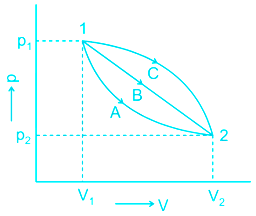
    According to the question:

    For the given problem statement i.e. “work done in an adiabatic process”, the path is fixed i.e. adiabatic process.

    And for a given path work done will be dependent on the end states only.

    So, the work done in an adiabatic process between two given end states depends on end states only.
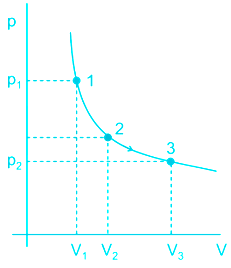
    or, from first law of thermodynamics,

    δQ = ΔU + δW, 

    for an adiabatic process δQ = 0.

    i.e. 0 = ΔU + δW

    ⇒ δW = - ΔU = U1 - U2

    Since, work done is equal to change in internal energy and internal energy is a point function or state function.

    So, the work done in an adiabatic process between two given end states depends on end states only.

  • Question 7/10
    1 / -0.25

    Thermodynamic non-flow work is the product of an intensive property with 
    Solutions

    Explanation:

    Intensive Property: 

    • These are the properties of the system which are independent of mass under consideration.
    • For e.g. Pressure, Temperature, density

    Extensive Properties:

    • The properties that depend on the mass of the system under consideration.
    • For e.g Internal Energy, Enthalpy, Volume, Entropy

    Thermodynamic work:

    The non-flow work done by the system (only on the quasi-static process) is given by:

    \({W} = \mathop \smallint \limits_1^2 pdV\)

    Here Pressure P is the intensive property and ΔV is changed in volume i.e. change in the extensive property.

    So, thermodynamic work is the product of an intensive property and change in an extensive property.

  • Question 8/10
    1 / -0.25

    An ideal gas is compressed to half its initial volume by means of several processes. Which of the process results in the maximum work done on the gas?
    Solutions

    Explanation:

    Polytropic Process is represented by PVn = C

    • n = 0 ⇒ P = C ⇒ Constant Pressure Process (Isobaric Process)
    • n = 1 ⇒ PV = C ⇒ Constant Temperature Process (Isothermal process)
    • n = γ ⇒ PVγ = C ⇒ Adiabatic Process
    • n = ∞ ⇒ V = C ⇒ Constant Volume Process (Isochoric process)

    Area under P-V diagrams represents the work done.

    For compression between two volumes, we can see that area is maximum for the adiabatic process.

    So work done on the gas will be maximum for the adiabatic process.

  • Question 9/10
    1 / -0.25

    Heat transfer in a cyclic process are +20 kJ, -5 kJ, -10 kJ and +15kJ. Net work done for this cycle will be given by:
    Solutions

    Concept:

    The first law of thermodynamics is a version of the law of conservation of energy, adapted for thermodynamic systems. The law of conservation of energy states that the total energy of an isolated system is constant. Energy can be transformed from one form to another but cannot be created or destroyed.

    The first law is often formulated by stating that the change in the internal energy of a closed system is equal to the amount of heat supplied to the system, minus the amount of work done by the system on its surroundings

    δQ = ΔU + δW

    ΔU = δQ - δW

    According to first Law of thermodynamics, “For a closed system undergoing a cycle, net heat transfer is equal to network transfer.”

    ΣQ = ΣW

    Net work done = Net heat in the cycle

    Calculation:

    Given, heat transfer in the cyclic process is +20 kJ, -5 kJ, -10 kJ and +15 kJ

    Net work done in the cycle = Net heat in the cycle

    Wnet = +20 kJ - 5 kJ - 10 kJ + 15 kJ = +20 kJ

  • Question 10/10
    1 / -0.25

    Polytropic index n is given by
    Solutions

    Concept:

    According to the Ideal gas equation for a polytropic process:

    \({P_1}V_1^n = {P_2}V_2^n\)

    \( \Rightarrow {\left( {\frac{{{V_1}}}{{{V_2}}}} \right)^n } = \frac{{{P_2}}}{{{P_1}}}\)

    Taking log on both sides

    \(n \ln \left( {\frac{{{V_1}}}{{{V_2}}}} \right) = \ln \left( {\frac{{{P_2}}}{{{P_1}}}} \right)\)

    \( \Rightarrow n = \frac{{\ln \left( {\frac{{{P_2}}}{{{P_1}}}} \right)}}{{\ln \left( {\frac{{{V_1}}}{{{V_2}}}} \right)}}\)

    Work done for Polytropic process is, \({{W}_{1-2}}=\frac{{{P}_{1}}{{V}_{1}}\;-\;{{P}_{2}}{{V}_{2}}}{n\;-\;1}\)

    Heat transfer for Polytropic process is, \(Q = W\left( {\frac{{\gamma\;- \;n}}{{\gamma\;-\;1}}} \right)\)

Close button icon
User Profile
-

Correct (-)

Wrong (-)

Skipped (-)


  • 1
  • 2
  • 3
  • 4
  • 5
  • 6
  • 7
  • 8
  • 9
  • 10
Mockers logo Get latest Exam Updates
& Study Material Alerts!
No, Thanks
Arrow pointer icon
Click on Allow to receive notifications
Notification bell icon ×
Open Now