Please wait...

Thermodynamics Test 3
Menu grid icon
Result Result point icon
Thermodynamics Test 3
  • Goals icon

    /

    Score
  • Trophy icon

    -

    Rank
White alarm icon Time Taken: -
Result frame illustration
  • Question 1/10
    1 / -0.25

    If δQ, ΔE and δW denote the heat added, change in internal energy and work done respectively, in a closed cyclic process then
    Solutions

    Explanation:

    According to the first law of thermodynamics:

    δQ = δW + ΔU

    Since internal energy is a point function, so for a cyclic process change in internal energy i.e. ΔU will be zero (because the initial and final state will be the same).

    For the cyclic process:

    δQ = δW

    \(\oint \delta Q = \oint \delta W\)

    The first law of thermodynamics states that for a cyclic process, the cyclic integral of heat is equal to the cyclic integral of work.

  • Question 2/10
    1 / -0.25

    Which of the following is incorrect regarding first law of thermodynamics?
    Solutions

    Explanation:

    The first law of thermodynamics is a restatement of the law of conservation of energy. It states that energy cannot be created nor destroyed in an isolated system; energy can only be transferred or changed from one form to another.

    When heat energy is supplied to a gas, two things may occur:

    • The internal energy of the gas may change
    • The gas may do some external work by expanding


    According to the first law of Thermodynamics:

    δQ = δW + ΔU

    When a process is executed by a system, the change in stored energy of the system is numerically equal to the net heat interaction minus the net work interaction during the process:

    ΔU = δQ – δW where U is the internal energy which is introduced by this law.

    For the cyclic process: ΔU = 0

    \(\oint \delta Q = \oint \delta W\)

    The first law of thermodynamics states that for a cyclic process, the cyclic integral of heat is equal to the cyclic integral of work.

    The second law of thermodynamics introduces the concept of entropy.
  • Question 3/10
    1 / -0.25

    If the value of n is zero in a polytropic process PVn = C, then the process is known as constant
    Solutions

    Explanation:

    In many real processes, it is found that the states during an expansion or compression can be described approximately by a relation of the form Pvn = constant,

    where n is a constant called index of compression or expansion, P and v are the average value of pressure and specific volume for the system.

    Compressions and expansions of the form Pvn = constant are called polytropic process.

    For the reversible polytropic process, single values of P and v can truly define the state of a system, dW = -Pdv.
    The equation for the polytropic process: 
    \(P{v^n} = C \Rightarrow \frac{P}{{{\rho ^n}}} = C \Rightarrow \frac{{{P_1}}}{{{P_2}}} = {\left( {\frac{{{\rho _1}}}{{{\rho _2}}}} \right)^n}\)

    The general polytropic process is shown in the figure:


    Value of n

    Equation

    Process

    0

    P = C

    Isobaric

    1

    Pv = C

    Isothermal

    n

    Pvn = C

    Polytropic

    γ (1.4)

    Pvγ = C

    Adiabatic

    v = C

    Isochoric

  • Question 4/10
    1 / -0.25

    The four process of the Carnot cycles are
    Solutions

    Explanation:

    Carnot cycle consists of two reversible isothermal and two isentropic process.

    Carnot cycle is one of the best-known reversible cycles. The Carnot cycle is composed of four reversible processes.

    • Reversible Isothermal expansion (process 1-2)
    • Reversible adiabatic expansion (process 2-3)
    • Reversible isothermal compression (process 3-4)
    • Reversible adiabatic compression (process 4-1)

    Fig. P-V and T-S diagrams of Carnot Cycle

  • Question 5/10
    1 / -0.25

    During a non-flow thermodynamic process (1-2) executed by a perfect gas, the heat interaction is equal to the work interaction (Q1-2 = W1-2) when the process is
    Solutions

    Concept:

    The first law of thermodynamics

    For a closed system/non-flow system undergoing a process, (1 - 2)

    Q1-2 = ΔE + W1-2 …1)

    E = Stored energy of a system

    This stored energy can be viewed as the sum of microscopic and macroscopic energies.
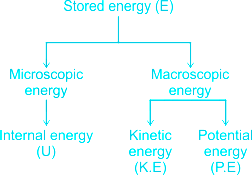
    ⇒ Q1-2 = Δ (U + KE + PE) + W1-2

    ⇒ Q1-2 = ΔU + ΔKE + ΔPE + W1-2 …2)

    For a non-flow or closed system at equilibrium, ΔKE and ΔPE are negligible,

    So, these 2 terms can be neglected.

    ⇒ Q1-2 = ΔU + W1-2 …3)

    Also, for a perfect gas, the internal energy is a function of temperature only.

    i.e. dU = mCνdT …4)

    Calculation:

    Given equation is

    Q1-2 = W1-2 …5)

    But first law states that; Q1-2 = ΔU + W1-2 …6)

    Comparing 5) and 6)

    ⇒ ΔU = 0 …7)

    But for perfect gas; dU = mCνdT, integrating both sides

    \(\mathop \smallint \nolimits_1^2 dU = \mathop \smallint \nolimits_1^2 m{C_\nu }dT\)

    ⇒ U2 – U1 = mCν(T2 – T1) {Assuming constant m, Cν}

    ΔU = mCν(ΔT) …8)

    Comparing 7) and 8)

    ⇒ ΔT = 0 {∵ m ≠ 0, Cν ≠ 0}

    T2 = T1 = Constant = Isothermal process


    Remember the properties of perfect gases and apply these directly instead of writing first law.

    Study all the basic processes in detail like the adiabatic process, Isobaric, isochoric etc.

  • Question 6/10
    1 / -0.25

    Change in enthalpy in a closed system is equal to the heat transferred if the reversible process takes place at constant 
    Solutions

    Explanation:

    dQ = du + pdv

    At constant pressure

    pdV = d(pV)

    (dQ)p = d(u + pV) = dh

    Hence, heat transferred at constant pressure increase the enthalpy of a system.

    Application of first law to a closed system process:

    (i) For a closed system:

    δQ = δW + dU

    a) For an isolated system:

    δQ = 0, δW = 0 ⇒ dU = 0

    b) For reversible constant volume process:

    dV = 0 ⇒ δW = 0

    δQ = dU = CvdT

    c) For reversible constant pressure:

    δW = P(v2 – v1)

    δQ = δW + dU = P(v2 – v1) + (u– u1)

    δQ = (Pv2 + u2) – (Pv1 + u1) = h2 – h1 = CpdT = dh

    d) For reversible constant temperature process:

    dT = 0 ⇒ dU = 0

    \(\delta Q = \delta W = {p_1}{v_1}\ln \frac{{{v_2}}}{{{v_1}}}\)

    e) For reversible adiabatic process:

    δQ = 0

    δW = dU

  • Question 7/10
    1 / -0.25

    An open system
    Solutions

    Explanation:

    A thermodynamic system is defined as a quantity of matter or a region in a space upon which attention is concentrated in the analysis of a problem.

    There are three classes of systems:

    1. Closed system
    2. Open system
    3. Isolated system


    Closed system:

    • The system of fixed mass is called the closed system. There is no mass transfer across the system boundary. The energy transfer into or out of the system may happen.
    • The arrangement of piston-cylinder with a certain quantity of fluid is an example of a closed system.

    Open system:

    • The open system is one in which matter crosses the boundary of the system. The energy transfer into or out of the system may happen.
    • Most of the engineering devices are an open system, Air compressor, turbine, pump, etc. are an example of an open system.

    Isolated system: 

    • The isolated system is one in which there is no interaction between the system and surroundings. It is of fixed mass and energy, and there is no mass or energy transfer across the system boundary.
    • A thermo flask and universe is the example of an isolated system.
  • Question 8/10
    1 / -0.25

    Calculate the enthalpy of 3 kg of fluid that occupies a volume of 1.5 m3, if the internal energy is 3.5 MJ/kg and the pressure is 0.3 MN/m2
    Solutions

    Concept:

    Enthalpy is defined as:

    H = U + PV

    Calculation:
    Given:
    Mass (m) = 3 kg, Volume (V) = 1.5 m3, Internal Energy (u) = 3.5 MJ/kg, Pressure (P) = 0.3 MN/m2

    Total Internal Energy, U = mu = 3 × 3.5 = 10.5 MJ

    Enthalpy, H = U + pV = 10.5 + 0.3 × 1.5 = 10.95 MJ


    • When Pressure is in Pa and Volume is in m3 then the unit of work done (W = PV) is Joule (J).
    • When Pressure is in Pa and Volume is in m3/kg then the unit of work done (W = PV) is Joule per kg (J/kg).
    • Given internal energy is specific internal energy (MJ/kg) but PV work is in joule (J) so it is necessary to do the unit conversion (make all the property in J or J/kg).

    That's why specific internal energy is converted to total internal energy before the final calculation.

    U = mu = 3 × 3.5 = 10.5 MJ

  • Question 9/10
    1 / -0.25

    A balloon containing an ideal gas is initially kept in an evacuated and insulated room. The balloon ruptures and the gas fills up the entire room. Which one of the following statements is TRUE at the end of above process ?
    Solutions

    Concept:

    If the balloon containing the ideal gas is initially kept in an evacuated and insulated room. Then if the balloon ruptures and the gas fills up the entire room, the process is known as free or unrestrained expansion.

    Now if apply the first law of thermodynamics between the initial and final states.

    \(Q=(u_2-u_1)+W\)

    In this process, no work is done on or by the fluid, since the boundary of the system does not move. No heat flows to or from the fluid since the system is well insulated.

    \(u_2-u_1=0\Rightarrow u_2=u_1\)

    Enthalpy is given as 

    h = u + Pv

    For ideal gases, as we know, internal energy and enthalpy are a function of temperature only, so if internal energy U remains constant, temperature T also remains constant which means enthalpy also remains constant.

    So, during the free expansion of an ideal gas, both internal energy and enthalpy remain constant.

  • Question 10/10
    1 / -0.25

    The cyclic integral of (δQ - δW) for a process is
    Solutions

    Explanation:

    The first law of thermodynamics is a restatement of the law of conservation of energy. It states that energy cannot be created or destroyed in an isolated system; energy can only be transferred or changed from one form to another.

    When heat energy is supplied to a gas, two things may occur:

    • The internal energy of the gas may change
    • The gas may do some external work by expanding


    According to the first law of Thermodynamics:

    δQ = δW + ΔU

    When a process is executed by a system, the change in stored energy of the system is numerically equal to the net heat interaction minus the net work interaction during the process:

    ΔU = δQ – δW where U is the internal energy which is introduced by this law.

    For the cyclic process: ΔU = 0

    \(\oint \delta Q = \oint \delta W\)

    \(\oint \left( {dQ - dW} \right) = 0\)

    The first law of thermodynamics states that for a cyclic process, the cyclic integral of heat is equal to the cyclic integral of work.

Close button icon
User Profile
-

Correct (-)

Wrong (-)

Skipped (-)


  • 1
  • 2
  • 3
  • 4
  • 5
  • 6
  • 7
  • 8
  • 9
  • 10
Mockers logo Get latest Exam Updates
& Study Material Alerts!
No, Thanks
Arrow pointer icon
Click on Allow to receive notifications
Notification bell icon ×
Open Now