Please wait...

Measuring Instruments Test 3
Menu grid icon
Result Result point icon
Measuring Instruments Test 3
  • Goals icon

    /

    Score
  • Trophy icon

    -

    Rank
White alarm icon Time Taken: -
Result frame illustration
  • Question 1/10
    1 / -0.25

    The wattmeter measures the angle between the current phasor detected by the _________ and the voltage phasor detected by the ____________.
    Solutions

    In wattmeter, the arrangement of the current coil is in series with the load and the arrangement of the potential coil is across the load.

    Hence the wattmeter measures the angle between the current phasor detected by the current coil and the voltage phasor detected by the voltage coil.

    The wattmeter measures the average power and it is given by

    \(P = {V_{ph}}{I_{ph}}\cos \left( \phi \right)\)

    ϕ is the angle between Vph and Iph

  • Question 2/10
    1 / -0.25

    When measuring power with an electrodynamometer wattmeter in a circuit having a low power factor:
    Solutions
    • In the circuit shown in figure (a), the pressure coil is connected on the supply side of the current coil; The same current passes through the load and current coil of the wattmeter
    • But the voltage across the pressure coil is more than that across the load by an amount equal to the voltage drop in the current coil
    • This connection is used under light loads (or) where the load impedance is high
    • This connection is used for high power factor circuits
    • In the circuit shown in figure (b), the pressure coil is connected on the load side of the current coil
    • The voltage across the pressure coil is the same as that across the load, but the current in the current coil is more than in the load by an amount equal to the current in the pressure coil
    • This connection is used under heavy loads (or) where the load impedance is low
    • This connection is used for low power factor circuits

  • Question 3/10
    1 / -0.25

    Which method is generally adopted to measure the power in a three-phase and 3 wire unbalanced load system?
    Solutions
    • Electrical power is measured with a wattmeter. A wattmeter consists of a current coil connected in series with load, while the other potential coil is connected parallel with load
    • Two wattmeter method is generally adopted to measure the power in a three-phase and 3 wire unbalanced load system.
    • If the three phase systems are 3-phase 4 wire (neutral) then one may use three watt-meters connected and add all to get the sum.
  • Question 4/10
    1 / -0.25

    Measurement of power factor for balanced load by two wattmeters for lagging power factor is:
    Solutions

    Two wattmeter method:

    The connection diagram using wattmeters is shown below.
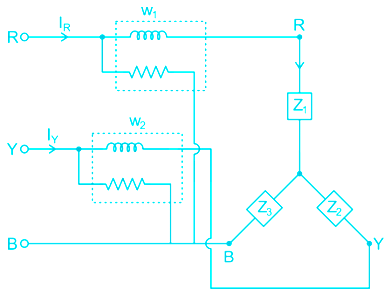
    \({W_1} = {I_R}{V_{RB}}\cos \left( {{I_R} \ ^\wedge{V_{RB}}} \right)\)

    \({W_2} = {I_Y}{V_{YB}}\cos \left( {{I_Y}^\wedge{V_{YB}}} \right)\)
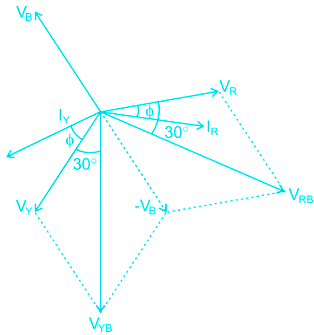
    From the phasor diagram

    \({I_R}^\wedge{V_{RB}} = 30 - ϕ \)

    \({I_Y}^\wedge{V_{YB}} = 30 + ϕ \)

    \({W_1} = {I_R}{V_{RB}}\cos \left( {30 - ϕ } \right)\)

    \(\Rightarrow {W_1} = {V_L}{I_L}\cos \left( {30 - ϕ } \right)\)

    \({W_2} = {I_Y}{V_{YB}}\cos \left( {30 + ϕ } \right)\)

    \(\Rightarrow {W_2} = {V_L}{I_L}\cos \left( {30 + ϕ } \right)\)

    \({W_1} + {W_2} = {V_L}{I_L}\left[ {\cos \left( {30 - ϕ } \right) + \cos \left( {30 + ϕ } \right)} \right]\)

    \(= \sqrt 3 {V_L}{I_L}\cos ϕ\)

    ⇒ Total three-phase power \( = {\rm{\;}}{{\rm{W}}_1} + {{\rm{W}}_2} = \sqrt 3 {V_L}{I_L}\cos ϕ \)

    Total three-phase power is the sum of two wattmeters.

    \({W_1} = {V_L}{I_L}\cos \left( {30 - ϕ } \right)\)

    \({W_2} = {V_L}{I_L}\cos \left( {30 + ϕ } \right)\)

    \({W_1} - {W_2} = \sqrt 3 {V_{ph}}{I_{ph}}\sin ϕ\)

    \(\sqrt 3 \left( {{W_1} - {W_2}} \right) = 3{V_{ph}}{I_{ph}}\sin ϕ \)

    Reactive power \(= \surd 3\;\left( {{W_1}-{W_2}} \right)\)

    Reactive power is equal to √3 times the difference between the readings of the two wattmeters.

    \({W_1} + {W_2} = 3{V_{ph}}{I_{ph}}\cos ϕ\)

    \(\sqrt 3 \left( {{W_1} - {W_2}} \right) = 3{V_{ph}}{I_{ph}}\cos ϕ \)

    \(\Rightarrow ϕ = {\tan ^{ - 1}}\left( {\frac{{\sqrt 3 \left( {{W_1} - {W_2}} \right)}}{{{W_1} + {W_2}}}} \right)\)

    Power factor \(= cos\;ϕ\)

    \(cosϕ = \cos \left[ {{{\tan }^{ - 1}}\left( {\frac{{\sqrt 3 \left( {{W_1} - {W_2}} \right)}}{{{W_1} + {W_2}}}} \right)} \right]\)

    Points to remember:

    • If the power factor is between zero and 0.5 or the power factor angle is between 60° and 90° then one of the wattmeters shows a negative value.
    • If ϕ = 60° or power factor is 0.5 then one of the wattmeter shows zero reading
  • Question 5/10
    1 / -0.25

    A wattmeter is connected as shown in the figure. The wattmeter reads

    Solutions

    Concept:

    Wattmeter reads the power and it is given by

    P = VPC ICC cos ϕ

    VPC is the voltage across pressure coil

    ICC is current flows through the current coil

    ϕ is the phase angle between VPC and ICC

    Application:

    The circuit representation of the given question is as shown below.

    • The potential coil is connected across Z2.
    • It reads the voltage across Z2 only.
    • So, Wattmeter reads only power consumed by Z2.
  • Question 6/10
    1 / -0.25

    In the two-wattmeter method of 3ϕ power measurement, if the phase sequence of the supply is reversed:
    Solutions

    Two wattmeter method:

    The connection diagram using wattmeters as shown below.

    \({W_1} = {I_R}{V_{RB}}\cos \left( {{I_R}^\wedge{V_{RB}}} \right)\)

    \({W_2} = {I_Y}{V_{YB}}\cos \left( {{I_Y}^\wedge{V_{YB}}} \right)\)

    From the phasor diagram

    \({I_R}^\wedge{V_{RB}} = 30 - \phi \)

    \({I_Y}^\wedge{V_{YB}} = 30 + \phi\)

    \({W_1} = {I_R}{V_{RB}}\cos \left( {30 - \phi } \right)\)

    \(\Rightarrow {W_1} = {V_L}{I_L}\cos \left( {30 - \phi } \right)\)

    \({W_2} = {I_Y}{V_{YB}}\cos \left( {30 + \phi } \right)\)

    \(\Rightarrow {W_2} = {V_L}{I_L}\cos \left( {30 + \phi } \right)\)

    If the phase sequence of the supply is reversed, the reading of wattmeters will be interchanged.

  • Question 7/10
    1 / -0.25

    In a three-phase measurement by two-wattmeter method, the readings of the wattmeters are equal in magnitude but opposite in the sign then the nature of the load will be
    Solutions

    Two wattmeter method:

    Two wattmeter method is used to measure the power in three-phase circuits for both balanced and unbalanced load.

    The wattmeter readings are

    \({W_1} = {V_L}{I_L}\cos \left( {30 - ϕ } \right)\)

    \( {W_2} = {V_L}{I_L}\cos \left( {30 + ϕ } \right)\)

    \({W_1} + {W_2} = {V_L}{I_L}\left[ {\cos \left( {30 - ϕ } \right) + \cos \left( {30 + ϕ } \right)} \right]\)

    \(= \sqrt 3 {V_L}{I_L}\cos ϕ\)

    ∴Total three-phase power is

     \( W= {\rm{\;}}{{\rm{W}}_1} + {{\rm{W}}_2} = \sqrt 3 {V_L}{I_L}\cos ϕ \)

    Total three-phase power is the sum of two wattmeters.

    \({W_1} = {V_L}{I_L}\cos \left( {30 - ϕ } \right)\)

    \({W_2} = {V_L}{I_L}\cos \left( {30 + ϕ } \right)\)

    \({W_1} - {W_2} = \sqrt 3 {V_{ph}}{I_{ph}}\sin ϕ\)

    \(\sqrt 3 \left( {{W_1} - {W_2}} \right) = 3{V_{ph}}{I_{ph}}\sin ϕ \)

    Reactive power \(= \surd 3\;\left( {{W_1}-{W_2}} \right)\)

    Reactive power is equal to √3 times the difference between the readings of the two wattmeters.

    \({W_1} + {W_2} = 3{V_{ph}}{I_{ph}}\cos ϕ\)

    \(\sqrt 3 \left( {{W_1} - {W_2}} \right) = 3{V_{ph}}{I_{ph}}\cos ϕ \)

    \(\Rightarrow ϕ = {\tan ^{ - 1}}\left( {\frac{{\sqrt 3 \left( {{W_1} - {W_2}} \right)}}{{{W_1} + {W_2}}}} \right)\)

    Power factor \(= cos\;ϕ\)

    \(cosϕ = \cos \left[ {{{\tan }^{ - 1}}\left( {\frac{{\sqrt 3 \left( {{W_1} - {W_2}} \right)}}{{{W_1} + {W_2}}}} \right)} \right]\)

    Nature of the load based on wattmeter readings:

    The nature of the load w.r.t the readings shown in the below table.

    Wattmeter readings

    Power factor value

    Nature of the load

    W1

    W2

    W1 = P

    W2 = -P

    Cos ϕ = 0

    (ZPF)

    Pure inductive load

    W1 = P

    W2 = P

    Cos ϕ = 1

    (UPF)

    Pure resistive load

    W1 = P

    W2 = 0

    cos ϕ = 0.5 lag

    R-L load

    P = Active power value in Watts


    Points to remember:

    The value 0 < cos ϕ < 0.5 or 60° < ϕ < 90° means that one of the wattmeters reads negative value.

  • Question 8/10
    1 / -0.25

    In an Induction type meter, maximum torque is produced when the phase angle between two fluxes is
    Solutions

    An induction type meter consists of two electromagnets, called shunt magnet and series magnet of laminated construction.

    A coil having a large number of turns of fine wire is wound on the middle limb of shunt magnet. This coil is known as voltage coil or pressure coil and it is connected across the supply mains. It has many turns and is arranged to be as highly inductive as possible. This causes the current and therefore the flux, to lag the supply voltage by nearly 90°.

    An adjustable copper shading rings are provided on the central limb of the shunt magnet to make the phase angle displacement between the magnetic field set up by shunt magnet and the supply voltage is approximately 90°.

    The series electromagnet is energized by a coil which is known as current coil and it is connected in series with the load so that it carries the load current. The flux produced by this magnet proportional to and in phase with the load current.

    The moving system essentially consists of a light rotating aluminium disk mounted on a vertical spindle or shaft. The fluxes produced by shunt and series magnet induce eddy currents in the aluminium disc. The interaction between these two magnetic fields and eddy currents set up a driving torque in the disc.

    As in energy meter instrument, we have two fluxes and two eddy currents and therefore two torques are produced by

    (i) First flux interacting with eddy current produced by second flux and

    (ii) Second flux interacting with eddy currents generated by the first flux

    Maximum torque is produced when the phase angle between these two fluxes is 90°
  • Question 9/10
    1 / -0.25

    A single-phase energy meter is operating on 200 V, 50 Hz supply with a load of 10 A for two hours at 0.8 p.f. The meter takes 1800 revolutions in that period. The meter constant is:
    Solutions

    Energy meter:

    An energy meter or watt-hour meter is used to measure the energy consumed in kWh.

    It is an integrating type instrument.

    Recording mechanism:

    It is required for the energy meter to record the no. of revolutions made by the aluminum disc which is proportional to the energy consumed in kWh.

    The meter constant can be calculated as

    k = (No. of revolutions / Energy consumption in kWh)

    Units of meter constant are revolutions per kWh

    1 unit means 1 kWh.

    Calculation:

    Given:

    Voltage V= 200 V

    Current I = 10 A

    Time = 2 hour

    cosϕ = 0.8

    Energy consumed = V × I × cosϕ × time = 200 × 10 × 0.8 × 2 = 3.2 kWh

    Meter constant = No. of revolution by meter/Energy consumed = 1800/3.2 = 562.5 rev/kWh.

    Points to remember:

    Braking torque obtained by a permanent magnet inside the meter used to control the speed of the disc.

  • Question 10/10
    1 / -0.25

    The braking torque of induction type single-phase energy meter is:

    Solutions

    Energy meter:

    Energy meter or Watt-hour meter is used to measure the energy in kWh.

    It is an integrating type instrument.

    Its working principle is similar to the transformer.

    There are three essential mechanisms required in the energy meter named Driving torque, Braking torque, and registered mechanism.

    Driving torque:

    This torque is required to revolve the disc or rotate the disc.

    It is obtained by the electromagnetic induction effect.

    Braking torque:

    It is required to rotate the disc at a constant speed.

    It is obtained by using a permanent magnet placed inside the energy meter near the Aluminum disc.

    Eddy currents have induced in the magnet due to the movement of the rotating disc through the magnetic field. This eddy current reacts with the flux and exerts a braking torque which opposes the motion of the disk. The speed of the disk can be controlled by changing flux.

    Breaking torque of induction type single-phase energy meter is:

    \({T_b} = k\frac{{{\phi ^2}}}{{{R_e}}}N \times R\)

    K = constant

    ϕ = flux

    N = speed in rpm

    R = radius of the disc

    Re = resistance in path of current (i.e. disc)

    The braking torque of induction type single-phase energy meter is directly proportional to the square of the flux.

    Registered mechanism:

    It registers the no. of rotations or revolutions of the disc which is proportional to the energy consumed in kWh.

    Meter constant = (No. of revolutions / kWh)

    Points to remember:

    Creeping:

    Sometimes the disc of the energy meter makes the slow but continuous rotation at no load i.e. when the potential coil is excited but with no current flowing in the load called creeping error

    This error may be caused due to overcompensation for friction, excessive supply voltage, vibrations, stray magnetic fields, etc

    It can be reduced by making two opposite holes on the disc.

Close button icon
User Profile
-

Correct (-)

Wrong (-)

Skipped (-)


  • 1
  • 2
  • 3
  • 4
  • 5
  • 6
  • 7
  • 8
  • 9
  • 10
Mockers logo Get latest Exam Updates
& Study Material Alerts!
No, Thanks
Arrow pointer icon
Click on Allow to receive notifications
Notification bell icon ×
Open Now