Please wait...

Thermodynamics Test 6
Menu grid icon
Result Result point icon
Thermodynamics Test 6
  • Goals icon

    /

    Score
  • Trophy icon

    -

    Rank
White alarm icon Time Taken: -
Result frame illustration
  • Question 1/10
    1 / -0.25

    If \(\oint \frac{{{\rm{dQ}}}}{{\rm{T}}} < 0\) it implies that

    Solutions

    Explanation:

    Entropy:

    • Entropy is the index of unavailability or degradation of energy. Heat always flows from hot bodies to cold bodies and this becomes degrades or less available.
    • For a reversible transfer of heat change in entropy

    \({\rm{\Delta }}s = {s_2} - {s_1} = \mathop \smallint \nolimits \frac{{dQ}}{T}\) where, s = entropy, Q = heat, T = temperature

    • No process between two equilibrium states is possible if it would result in a decrease in the total entropy of the system and surroundings.

    Clausius Inequality:

    Clausius inequality states that \(\oint \frac{{{\rm{dQ}}}}{{\rm{T}}} \le 0\)

    It provides the criteria for the reversibility of a cycle.

    If \(\oint \frac{{{\rm{dQ}}}}{{\rm{T}}} = 0\), the cycle is reversible,

    If, \(\oint \frac{{{\rm{dQ}}}}{{\rm{T}}} < 0\), the cycle is irreversible and possible

    If \(\oint \frac{{\partial Q}}{T} > 0\), cycle is impossible

    Clausius theorem:  

    Clausius theorem states that: Any reversible path may be substituted by a reversible isotherm and a reversible adiabatic between the same end states such that the heat transferred during the isothermal process is the same as that transferred during the original process.
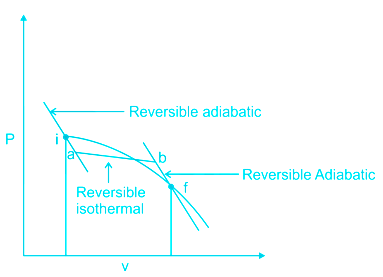
    Substitution of a reversible process (i-f) by reversible adiabatic processes (i-a and b-f) and reversible isothermal process (a-b).

  • Question 2/10
    1 / -0.25

    A heat engine is supplied with 1200 kW of heat at a constant temperature of 600 K and it rejects 700 kW of heat at 300 K. Which of the following is true for this heat engine?

    Solutions

    Concept:

    Clausius Inequality:

    \(\oint \frac{{dQ}}{T} \le \;0\)

    This equation is known as the inequality of Clausius.  It provides the criterion of the reversibility of a cycle.

    1. \(\oint \frac{{dQ}}{T} = 0\) for reversible engines.
    2. \(\oint \frac{{dQ}}{T} < 0\) for irreversible engines.
    3. \(\oint \frac{{dQ}}{T} > 0\) impossible.

    Calculation:

    Given:

    Q1 = 1200 kW, T1 = 600 K

    Q2 = 700 kW, T2 = 300 K

    \(\frac{{{{\rm{Q}}_1}}}{{{{\rm{T}}_1}}} = \frac{{1200}}{{600}} = 2{\rm{\;kJ}}/{\rm{K}}\)

    \(\frac{{{{\rm{Q}}_2}}}{{{{\rm{T}}_2}}} = \frac{{700}}{{300}} = - 2.33{\rm{\;kJ}}/{\rm{K}}\)

    \(\oint \frac{{dQ}}{T} = \;\frac{{{{\rm{Q}}_1}}}{{{{\rm{T}}_1}}} + \frac{{{{\rm{Q}}_2}}}{{{{\rm{T}}_2}}}\)

    \(\oint \frac{{dQ}}{T} = 2 -2.33=-0.33\)

    \(\oint \frac{{dQ}}{T} < 0,\) ∴ it is an irreversible engine.

  • Question 3/10
    1 / -0.25

    Efficiency of Perpetual motion machine of second kind (PMM-2) is:
    Solutions

    Explanation:

    Kelvin Planck statement of 2nd law of thermodynamics

    It is impossible to construct a device operating in a cycle which produces work while exchanging heat with a single reservoir.

    If such a device is constructed then it is known as PMM-2, Hence PMM-2 is impossible.

    Efficiency of PMM-2

    From 1st law of thermodynamics

    ∑Q = ∑W

    Q1 = Wnet

    \(\eta = \frac{{output}}{{input}} \times 100 = \frac{W_{net}}{{{Q_1}}} \times 100 = 100\% \)

    Thus, it violates the second law of thermodynamics and It is a hypothetical machine.

  • Question 4/10
    1 / -0.25

    Which of the below stated are properties of a PMM-2?

    1. When the net work is equal to the heat absorbed and work efficiency is 100%.

    2. Heat is exchanged from one heat reservoir only.

    3. It violates Kelvin-Planck statement.

    4. It is a hypothetical machine.

    Solutions

    Explanation:

    Kelvin-Planck statement states “It is impossible for any device that operates on a cycle to receive heat from a single reservoir and produce a net amount of work."

    Perpetual motion machine of the first kind (PMM1):

    The first law of thermodynamics states that energy can neither be created nor be destroyed. It can only get transformed from one form to another form. An imaginary device which would produce work continuously without absorbing any energy from its surroundings is called a Perpetual Motion Machine of the First kind, (PMMFK). A PMMFK is a device which violates the first law of thermodynamics. It is impossible to devise a PMMFK

    The converse of the above statement is also true, i.e., there can be no machine which would continuously consume work without some other form of energy appearing simultaneously. PMM-I violates the first law of thermodynamics.

    Perpetual motion machine of the second kind (PMM2): A fictitious machine which produces net work in a complete cycle by exchanging heat with only one reservoir is called the PMM2.

    It violates the Kelvin plank statement.

    Thus, it violates the second law of thermodynamics and It is a hypothetical machine.

  • Question 5/10
    1 / -0.25

    The area of a p-v diagram for a Carnot cycle represents
    Solutions

    Carnot cycle consists of two reversible isothermal and two isentropic process.

    Carnot cycle is one of the best-known reversible cycles. The Carnot cycle is composed of four reversible processes.

    • Reversible Isothermal Expansion (process 1-2)
    • Reversible adiabatic expansion (process 2-3)
    • Reversible isothermal compression (process 3-4)
    • Reversible adiabatic compression (process 4-1)

    Fig. P-V and T-S diagrams of Carnot Cycle

    ∵ We know that 

    Work done (W) = PΔV

    ∴ The area under the PV diagram represents the work done.

  • Question 6/10
    1 / -0.25

    Entropy is a measure of __________. 
    Solutions

    Explanation:

    Entropy change in a process is given by

    \(dS \ge \frac{{\delta Q}}{T} \)

    For a reversible process, 

    So the entropy change depends on the change of heat energy. Entropy change is the measure of the irreversibility of a process.

    The entropy generation is one of the most important attributes in thermodynamics. Entropy generation is a measure of the entropy created during the irreversible processes.

    The entropy of any closed system can be changed in two ways:

    • By heat exchange between system and surroundings
    • Due to internal irreversibility arising from dissipative effects

    (dS)total = (dS)ext + (dS)int

    \({\left( {dS} \right)_{total}} = \frac{{\delta Q}}{T} + {\left( {dS} \right)_{int}}\)


    • Entropy can be transferred to or from a system in two forms: heat transfer and mass flow.
    • In contrast, energy is transferred by work also. Entropy transfer is recognized at the system boundary as entropy crosses the boundary, and it represents the entropy gained or lost by a system during a process.
    • The only form of entropy interaction associated with a fixed mass or closed system is heat transfer, and the entropy transfer for an adiabatic closed system is zero
  • Question 7/10
    1 / -0.25

    Which of the following laws of thermodynamics deals with entropy?
    Solutions

    Concept:

    From first law, we get energy term and from second law entropy.

    There are 4 laws to thermodynamics:

    Zeroth law of thermodynamics  

    • If two thermodynamic systems are each in thermal equilibrium with a third, then they are in thermal equilibrium with each other.

    The first law of thermodynamics  

    • Energy can neither be created nor destroyed. It can only change forms. In any process, the total energy of the universe remains the same.
    • For a thermodynamic cycle, the net heat supplied to the system equals the net work done by the system.
    • δQ = ΔU + δW

    The second law of thermodynamics – 

    • The entropy of an isolated system not in equilibrium will tend to increase over time, approaching a maximum value at equilibrium.
    • ΔS = ΔQ/T
    • ΔSTotal = ΔSSystem + ΔSsurrounding
    • The second law of thermodynamics introduces the concept of entropy.

    Third law of thermodynamics – 

    • As the temperature approaches absolute zero, the entropy of a system approaches a constant minimum.
    • ΔS= 0K = 0
  • Question 8/10
    1 / -0.25

    Which of the following is a false statement?
    Solutions

    Explanation:

    Reversible cycle:

    • Reversible cycles are the one that can be reversed or whose process if reversed will not cause any loss of energy. 
    • For example the Carnot cycle

    ​Irreversible cycle:

    • Irreversible cycles are the one that undergo loss of energy in due course of operation.
    • As the losses in case of irreversible engines are present so naturally, its efficiency will be less as compared to reversible cycle.

    ​Let us understand this with an example of Carnot cycle:

    Carnot cycle:

    • It is an reversible ideal cycle.
    • Carnot cycle is also known as an impractical cycle. It is used only to compare other actual cycles.

    The Carnot cycle consists of 4 processes
    1-2 isothermal heat addition
    2-3 reversible adiabatic expansion
    3-4 isothermal heat rejection
    4-1 reversible adiabatic compression

    • Carnot cycle consists of 2 isothermal and 2 adiabatic processes.
    • Carnot a completely reversible cycle.
    • An isothermal process is a very slow process and the adiabatic process is a very fast process and the combination of a slow process and fast process are very difficult.

    The efficiency of the Carnot cycle is given by,

    \(\eta_{Carnot}= 1-\frac{T_2}{T_1}\)

    where T1 =  Absolute temperature of the source, T2 = Absolute temperature of sink

    Some Important points can be observed with the help of the Carnot cycle;

    • The efficiency of the reversible cycle is independent of the working fluid.
    • The efficiency of a reversible cycle depends only on the temperature limit.
    • All reversible cycles operating between the same temperature limit will have the same efficiency.
    • The efficiency of an irreversible cycle is always less than a reversible cycle.
    • The absolute temperature of the source can never be zero hence the efficiency of the Carnot cycle can never be 100 %. Hence no thermodynamic cycle can achieve the 100 % efficiency.
  • Question 9/10
    1 / -0.25

    The entropy may be expressed as a function of

    Solutions

    Explanation:

    The entropy may be expressed as a function of pressure and temperature.

    Entropy (S)

    • It is a measure of the disorder of the molecular motion of a system.
    • Greater is the disorder, the greater is the entropy.

    The change in entropy is,

    \({\rm{\Delta }}S = \frac{{{\rm{\Delta }}Q}}{T}\)

    where ΔQ = Heat absorbed by the system and T = Absolute temperature


    • The change in entropy is related to heat.
    • Entropy increases with temperature.
    • However, at higher temperatures, a certain amount of heat added to the system causes a smaller change in entropy than the same amount of heat at a lower temperature.
  • Question 10/10
    1 / -0.25

    Carnot cycle consists of
    Solutions

    EXPLANATION:

    Carnot cycle: The ideal reversible cycle that has the highest possible efficiency among all heat engines is called the Carnot cycle.

    Carnot cycle is one of the best-known reversible cycles. The Carnot cycle is composed of four reversible processes.

    • Reversible Isothermal Expansion (process 1-2)
    • Reversible adiabatic expansion (process 2-3)
    • Reversible isothermal compression (process 3-4)
    • Reversible adiabatic compression (process 4-1)

    Fig. P-V and T-S diagrams of Carnot Cycle

    The Carnot cycle consists of two isothermal and two isentropic processes. So option 3 is correct.

Close button icon
User Profile
-

Correct (-)

Wrong (-)

Skipped (-)


  • 1
  • 2
  • 3
  • 4
  • 5
  • 6
  • 7
  • 8
  • 9
  • 10
Mockers logo Get latest Exam Updates
& Study Material Alerts!
No, Thanks
Arrow pointer icon
Click on Allow to receive notifications
Notification bell icon ×
Open Now